
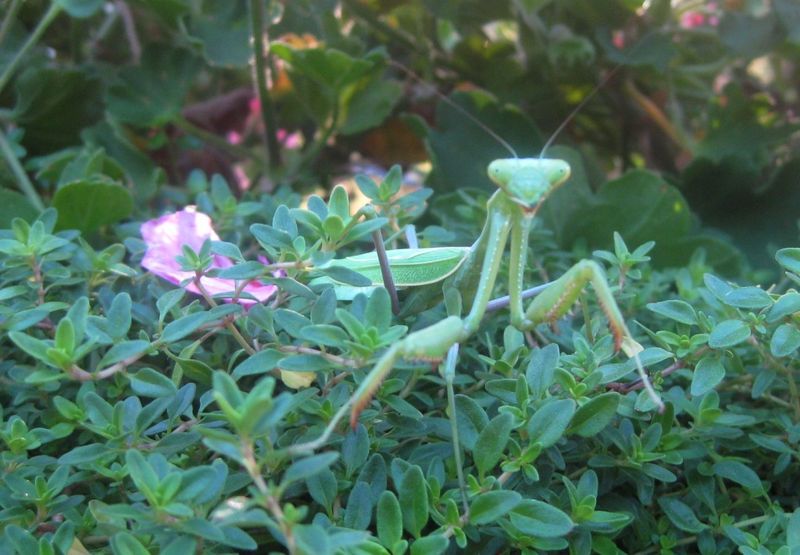
Spotting a praying mantis perched on your tomato cage or squash vine in late summer can stop you in your tracks. These angular, slow-moving hunters look like they belong in a science fiction film, yet they show up in California backyard gardens every year right around the same time.
Before you decide what to do about one, it helps to understand what the sighting actually tells you about your garden and what it does not.
Late summer makes a mantis easier to notice
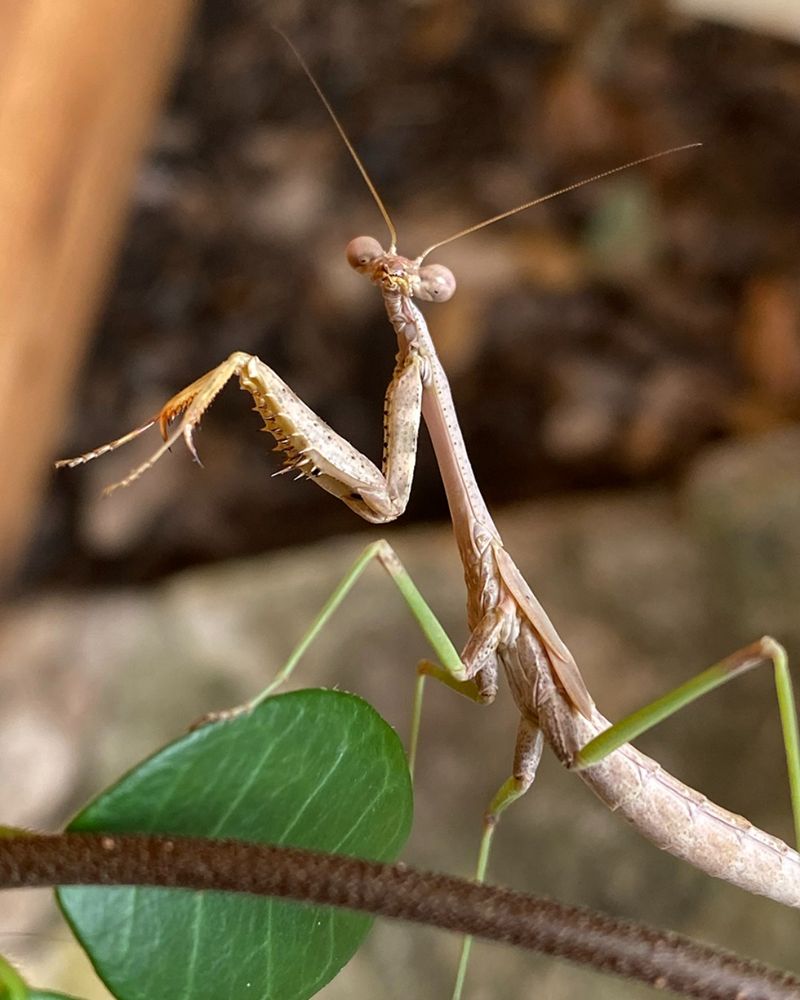
Most California mantises spend the warm months quietly growing, hidden among stems and leaves as small nymphs that are easy to miss. By late summer, they have reached adult size, and adults are simply harder to overlook.
A full-grown mantis can stretch three to four inches long, moves deliberately between plants while hunting or seeking a mate, and no longer blends in as effortlessly as it did at a fraction of that size.
According to UC IPM’s profile of California mantids, these insects typically overwinter as eggs inside a hardened case, hatch in late winter or spring, and spend the warmer months maturing. Observations commonly peak in late summer and early fall when individuals are full-sized and actively searching for mates.
A peer-reviewed study of Stagmomantis limbata populations in California found that adults first appeared in August, remained active through late September, and generally died off in October as temperatures dropped.
That seasonal pattern is real, but it is not a fixed statewide calendar. California stretches across coastal valleys, hot inland basins, mountain elevations, and desert-edge communities, and the exact timing of adult emergence can shift by weeks depending on local temperature, food availability, and species.
A mantis showing up on your Central Valley pepper plants in early August and one appearing on a coastal San Diego bed in late September may both be following the same biological rhythm on different schedules.
The sighting also does not tell you the mantis’s sex without a closer look. Only females deposit egg cases, and an adult you spot on a cucumber trellis may be male or a female that will not produce an egg case nearby.
The mantis is there because your garden offers vegetation for camouflage, passing prey, and opportunity, not because a pest outbreak drew it in from somewhere else.
The visitor may be native—or introduced
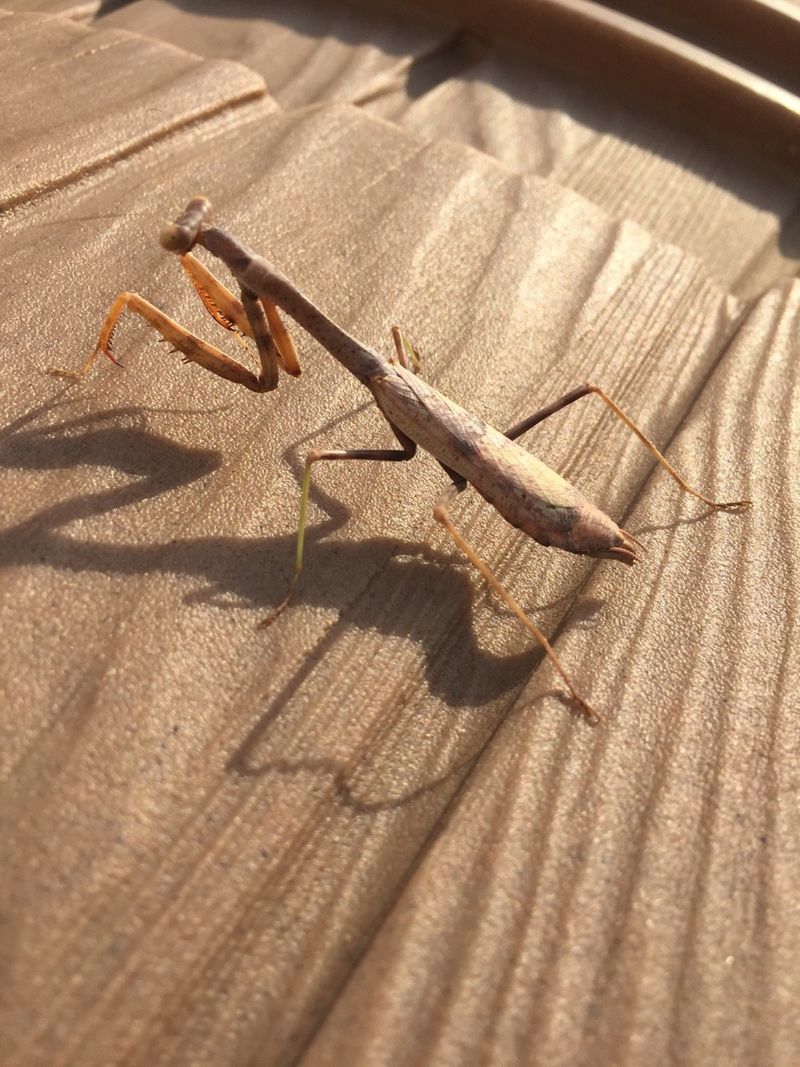
Seeing a mantis in a California garden and assuming it is a native species is a common and understandable mistake. The state hosts several mantid species, and they do not come with obvious labels.
UC IPM lists California’s mantid species as including the native California mantid (Stagmomantis californicaStagmomantis limbataTenodera sinensisMantis religiosaIris oratoria) and the bordered or Arizona mantid (), alongside introduced species: the Chinese mantis (), European mantis (), and Mediterranean mantis ().
Color alone will not sort these out. A brown mantis could be a native or an introduced species depending on its age, the surface it has been resting on, and the time of year.
Green coloring is similarly shared across multiple species. Without examining wing structure, body proportions, and other physical details, a backyard identification from color is not reliable.
For most California gardeners, the species question matters less than the behavioral one. Every mantis on this list, native or introduced, is a generalist ambush predator.
None of them specialize in the aphids crowding your pepper stems or the caterpillars chewing your kale. They sit and wait, then strike at whatever moving prey comes within range and fits their size preference.
That behavior does not change based on species origin, which means the practical question, what will this mantis actually do in my vegetable bed, has roughly the same answer regardless of which species you are looking at.
What the mantis can—and cannot—do for a vegetable bed
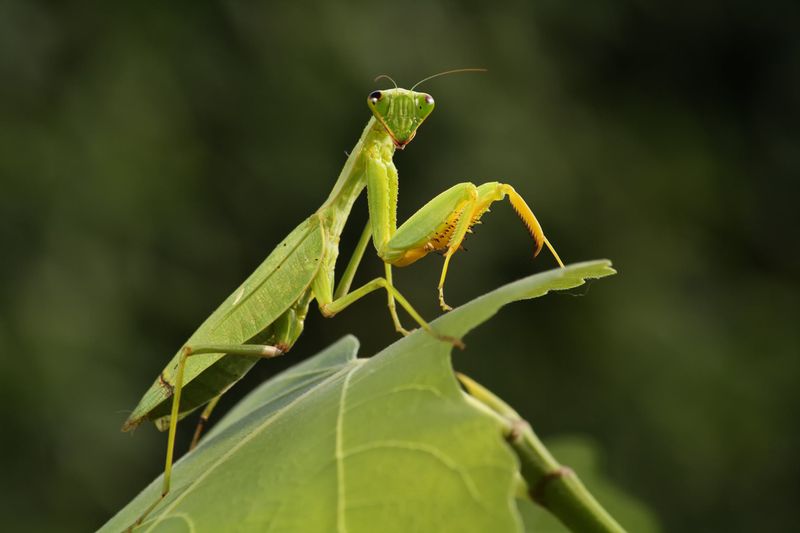
A mantis stationed near your beans or squash can absolutely catch insects that damage vegetables. Aphids, caterpillars, flies, and grasshoppers all fall within the prey range of an adult mantis, and if one of those insects wanders within striking distance, the mantis will take it.
That occasional predation is real, and there is nothing wrong with acknowledging it.
The gap between occasional predation and dependable pest control is wide, though. UC IPM’s assessment of mantids in California gardens is notably direct: mantises provide little or no reliable biological-control value because they feed indiscriminately, are relatively inactive, and consume comparatively few insects relative to the pest populations a garden can generate.
A single mantis sitting on one plant for several days will not make a measurable dent in an aphid colony that is reproducing by the hundreds.
The indiscriminate part of that description carries real weight. Mantises do not read the label on your vegetable bed and limit themselves to the harmful insects.
They will eat a honeybee visiting your squash blossoms. They will catch a syrphid fly whose larvae were already consuming aphids on a nearby leaf.
They will eat other mantises if food is scarce. The prey choice is driven by movement, size, and proximity, not by whether the insect was helping or hurting your crop.
So the honest framing is this: a mantis may eat some pests, but you cannot predict which insects it will target, and you cannot count on it to protect a vegetable bed from an active infestation. Treating its presence as a bonus observation is reasonable.
Treating it as a pest-management plan is not.
An egg case can explain why the mantis is there
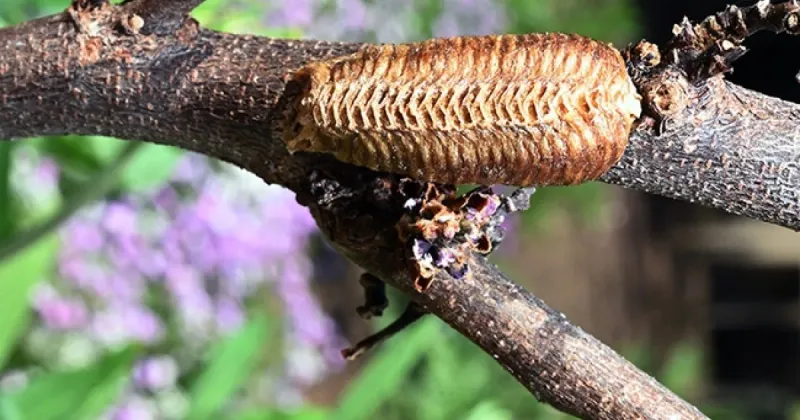
After spotting an adult mantis in late summer, the next thing worth looking for is an egg case. A female mantis that has mated may deposit an ootheca on a nearby surface before the season ends.
The ootheca starts as a frothy, secreted mass that quickly hardens into a firm, brown, paperlike capsule. It can look a little like a small piece of dried foam insulation or a roughened cocoon, and it tends to get attached firmly to whatever surface the female chose.
Common attachment spots include twigs, plant stems, wooden stakes, wire fencing, trellises, and the undersides of horizontal surfaces. UC ANR’s guide to mantis egg cases describes oothecae as the overwintering stage for California mantids, meaning the eggs inside survive winter while the adult that laid them does not.
Adults and nymphs generally do not make it through California winters; the egg case is the species’ bridge to the following spring.
Knowing that means one practical thing for fall garden cleanup: check your stakes, fencing, and woody plant stems before you pull, prune, or clear them. An egg case that gets tossed in the yard waste bin or accidentally crushed ends a future generation of mantises before it starts.
If you find one, you can leave it in place or move it carefully to a sheltered spot nearby, such as the back of a fence or a woody shrub.
Keep in mind that not every adult you spot will produce an egg case. A male will not, and a female that has not mated may not either.
Finding an adult does not guarantee a future egg case, and finding an egg case does not guarantee a large emerging population, since many nymphs disperse quickly, face predation, or do not survive to adulthood.
Leaving the mantis alone is usually the right response
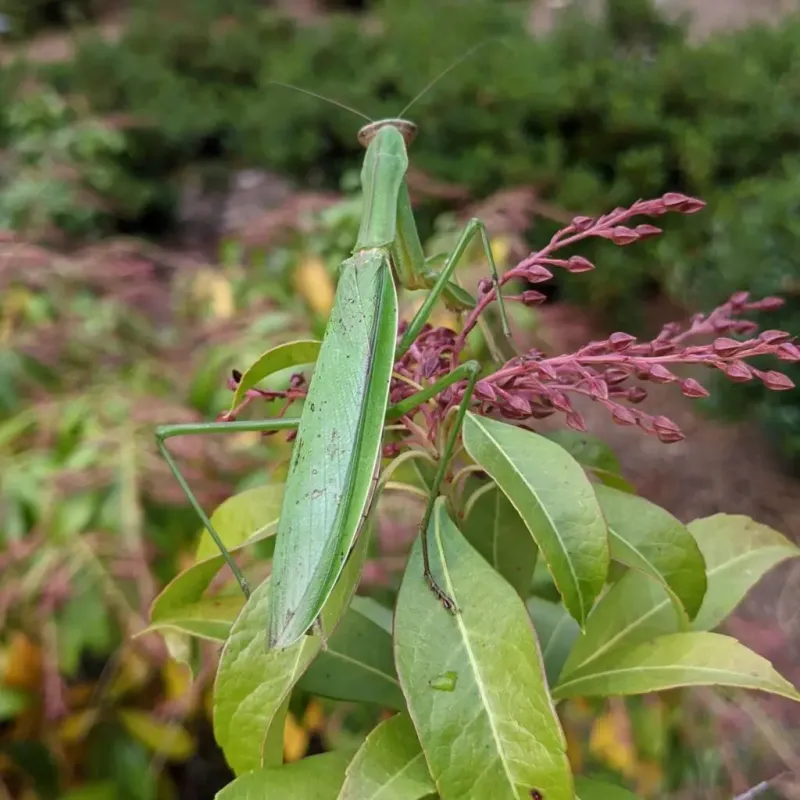
Finding a mantis on your vegetable bed does not require any corrective action. The most appropriate response for most gardeners is to observe it, maybe take a photo, and move on with whatever else needed doing in the garden.
There is no reason to spray it, step on it, or relocate it simply because it landed near your vegetables.
Mantises are not venomous and pose no medical risk during normal observation. University of Florida Entomology’s overview of praying mantises confirms they generally avoid human contact and are not dangerous to people.
That said, picking one up and handling it roughly is not advisable. A mantis that feels threatened may deliver a quick nip with its forelegs, which is startling and potentially uncomfortable but not medically serious.
Watching from a short distance is the better approach.
Leaving a naturally occurring mantis in place also means allowing a predator to remain part of your yard’s food web without any effort on your part. That is worth something even if the mantis is not a precision pest-control tool.
California yards that support a range of predatory insects, including mantises, tend to have more ecological complexity than those stripped of insect life by repeated pesticide use.
Just do not mistake conservation for pest management. Letting the mantis stay is a reasonable choice because it is a living part of your local ecosystem, not because it will solve whatever is eating your kale.
Those are two separate things, and keeping them separate helps you make better decisions about your garden.
A real infestation still requires integrated pest management
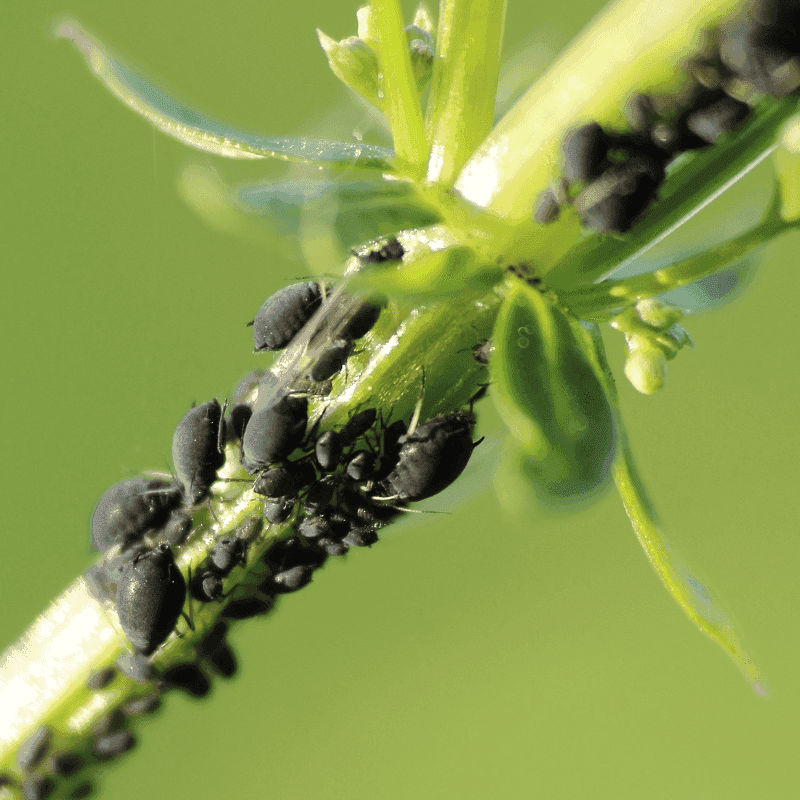
A mantis on your tomato plant is not a diagnosis. If your vegetables are showing damage, the mantis did not tell you what is causing it, and it cannot reliably fix it.
The first step is figuring out what pest is actually present. Turn over leaves, check stems, look for frass, webbing, or sticky residue, and match what you find to the specific insect responsible.
Squash vine borers, tomato hornworms, and cabbage loopers all leave different evidence, and treating one as another wastes time and resources.
Once you know what you are dealing with, UC IPM’s integrated pest management framework recommends starting with nonchemical methods. For many vegetable pests, hand-picking caterpillars or egg masses is effective when populations are still small.
Pruning out badly infested tissue and disposing of it in the trash rather than compost can reduce pressure quickly. A firm spray of water knocks aphids off suitable plants and disrupts their colonies without any chemical input.
Row covers and physical barriers can protect vulnerable seedlings from flying pests before damage starts.
When those steps are not enough, choose a product that is selective for the pest you identified, labeled for the crop you are treating, and as low-impact as possible. Bacillus thuringiensis, known as Bt, is a microbial option that targets caterpillars without broad toxicity to other insects.
Insecticidal soap works on soft-bodied pests like aphids and mites on contact. Both have much narrower effects than broad-spectrum synthetic insecticides.
Throughout this process, the mantis remains a bystander. UC IPM notes that mantises are generalist predators with little reliable biological-control value, so pest management decisions should be based on what you observe in the bed, not on whether a mantis is present nearby.
Protect the whole community of natural enemies
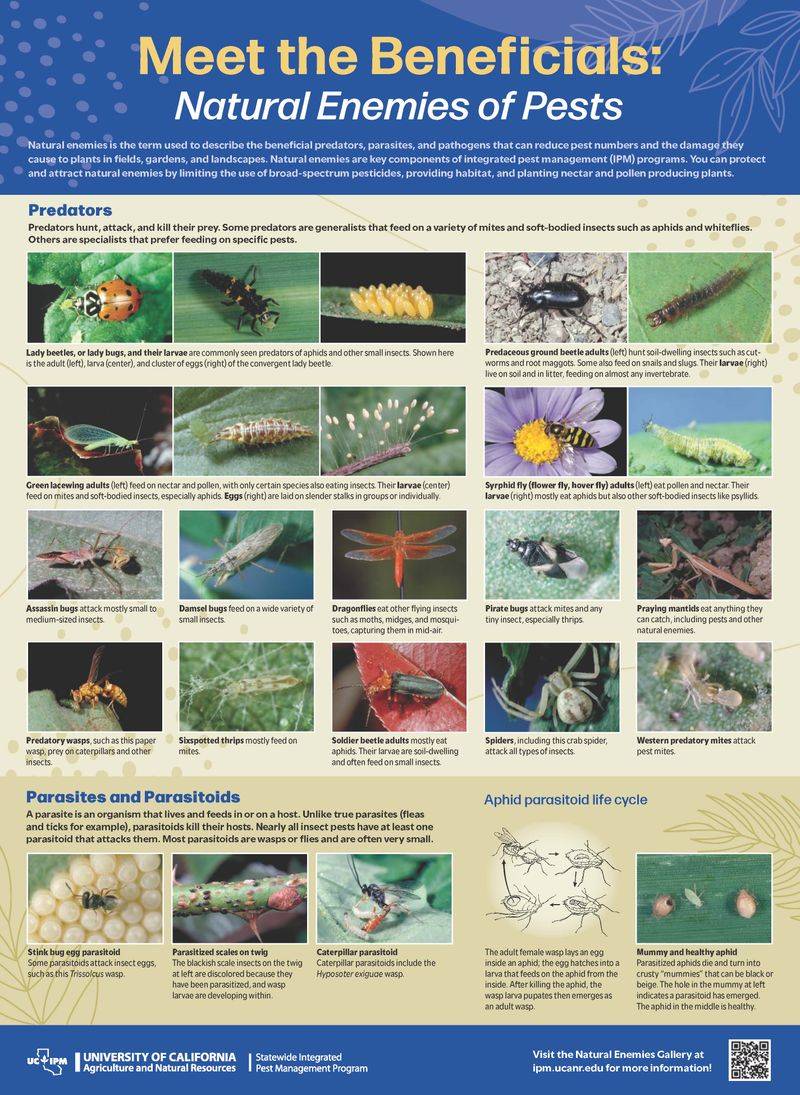
A mantis is one predator in a much larger cast of insects working through your garden. When broad-spectrum insecticides get applied unnecessarily, the mantis is not the only casualty.
UC IPM’s guidance on protecting natural enemies and pollinators specifically flags carbamates such as carbaryl, organophosphates such as malathion, pyrethroids, and some systemic neonicotinoids as products that can kill or disrupt natural enemies and pollinators. These chemicals do not distinguish between the caterpillar on your tomato and the parasitoid wasp that was about to lay eggs inside it.
UC IPM’s biological control resource identifies lacewings, lady beetles, syrphid flies, parasitoid wasps, and spiders as groups that can contribute meaningfully to natural pest suppression in California gardens. Some of these, particularly parasitoid wasps, may be more pest-specific than mantises, targeting particular host species rather than grabbing whatever moves nearby.
That specificity does not make every member of those groups uniformly more effective, but it does mean the overall community of natural enemies is more valuable than any single predator.
When treatment is necessary, spot-treating the affected plants rather than spraying the entire bed limits collateral damage. Avoiding application during flowering hours reduces risk to pollinators.
Following the product label is not optional: it specifies rates, timing, and safety intervals that exist for good reasons.
Buying mantis egg cases from a garden store and releasing them is not a reliable substitute for any of this. University extension guidance cautions that purchased egg cases are often from introduced Chinese mantises, and released individuals disperse quickly rather than concentrating where the target pest is located.
The better investment is in a diverse, flowering California garden that provides habitat and food sources for the beneficial insects already present in your area.
The late-summer mantis is a clue, not a cure
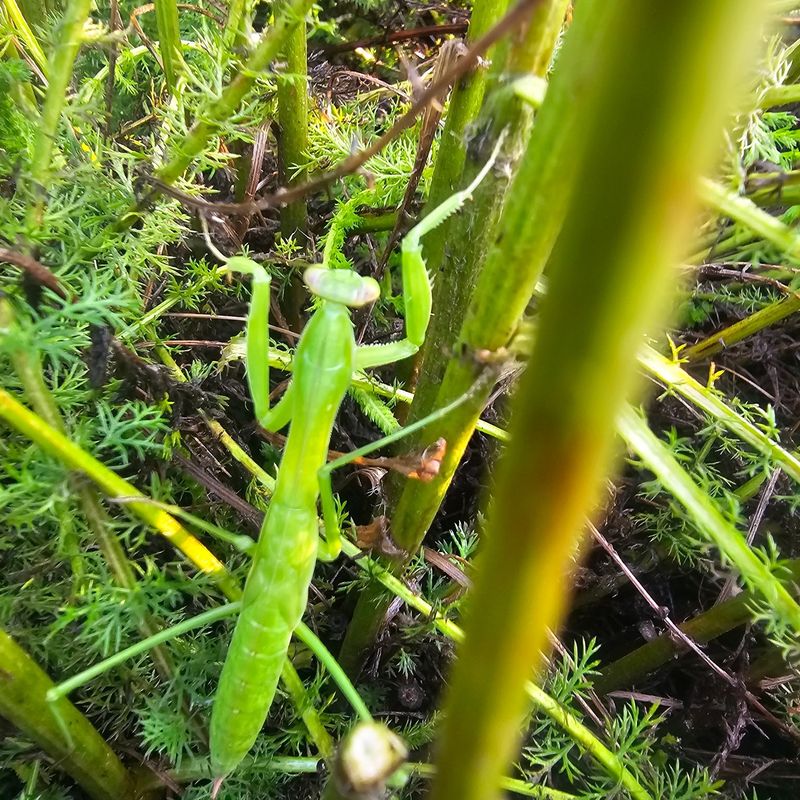
A mantis in your vegetable bed in late summer is worth a moment of attention and nothing more dramatic than that. The practical response is straightforward: observe it, scan nearby stakes and stems for an egg case before you do any clearing or pruning, and then turn your attention to the vegetables themselves to check for the pest actually causing any visible damage.
The sighting reflects a mature predator entering its most active season, moving through your garden while hunting and seeking a mate. A female may later deposit an ootheca nearby, though not every adult will.
The mantis’s presence does not confirm that your garden is in good health, that a pest outbreak is underway, or that your crops are protected. UC IPM’s mantid guidance is clear that these insects are generalist predators with limited and unpredictable value as biological-control agents.
Real protection for a California vegetable bed comes from identifying what is actually damaging it and responding with targeted integrated pest management, while keeping the broader community of beneficial insects intact. The mantis is a welcome part of that community, a predator doing what predators do, and the most useful thing you can do is leave it alone and keep your eyes on the plants.