
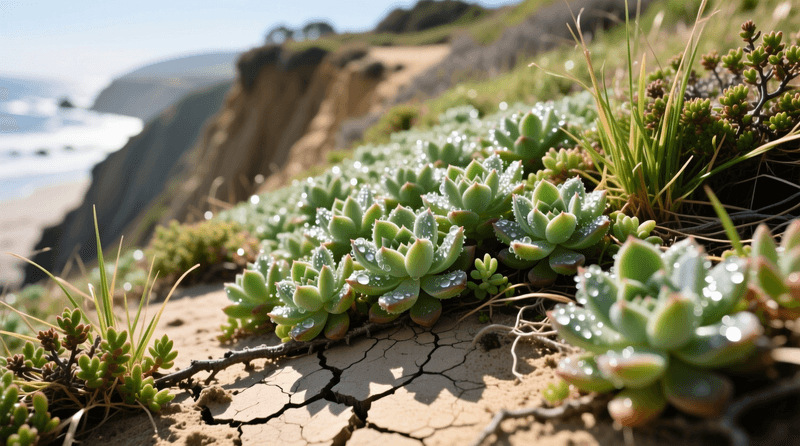
A thick, spreading groundcover that blankets coastal slopes in bright magenta flowers sounds like a landscaping win, but that same plant is showing up on prohibited and problematic-plant lists in parts of California. The plant most strongly connected to these local restrictions is highway ice plant, known scientifically as Carpobrotus edulis.
Before you pull anything out of your yard or ignore a neighbor’s warning, you need to know exactly which plant you have and what your local rules actually say.
The Strongest Match Is Highway Ice Plant
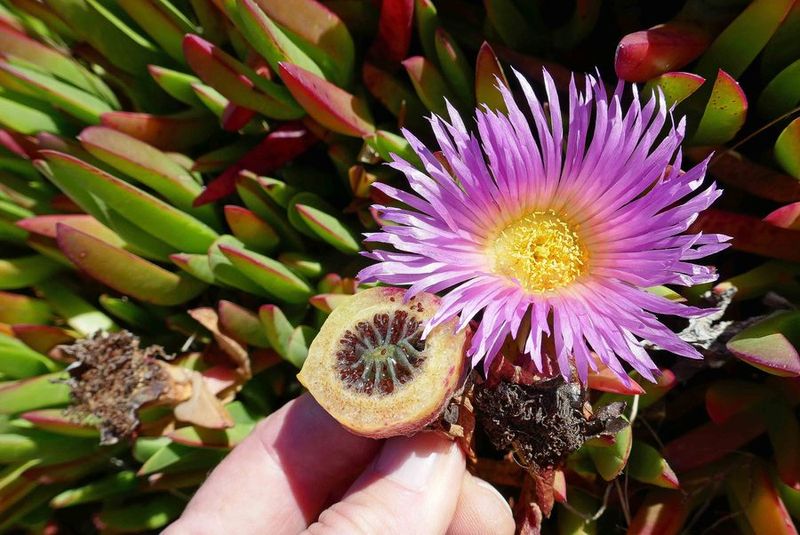
Carpobrotus edulis goes by several names depending on where you encounter it: highway ice plant, Hottentot fig, and sometimes just ice plant. That last label is where the confusion starts, because ice plant is a broad common name applied to dozens of succulent groundcovers from multiple genera.
A restriction that targets Carpobrotus edulis does not automatically apply to every succulent sold at a nursery under the ice plant label.
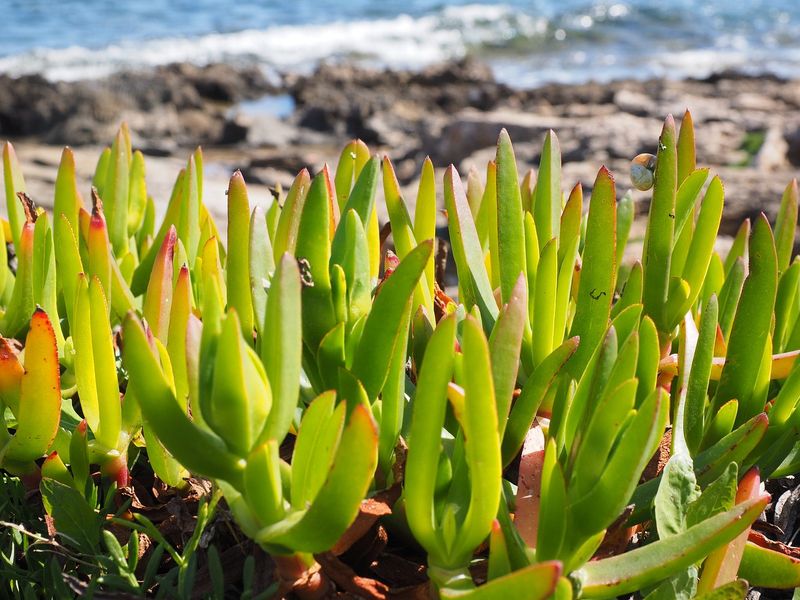
The plant itself is easy to recognize once you know what to look for. Carpobrotus edulis produces thick, triangular, finger-length leaves with a slight curve along one edge.
The stems sprawl along the ground in dense, overlapping mats that can stretch several feet in every direction.
Flowers are large and showy, typically bright magenta or yellow, and the fruit resembles a small fig.
California Department of Fish and Wildlife guidance on ice plant identifies Carpobrotus edulis as an invasive coastal groundcover and advises against planting it, noting that it spreads along much of the California coast. That official identification is the starting point for any homeowner trying to understand what the warnings are actually about.
Accurate identification comes before legal or ecological conclusions. If your groundcover has flat, grass-like leaves, round leaves, or any other shape that differs from the triangular succulent stem described above, you may be growing something else entirely.
Photograph your plant from multiple angles, including a close-up of a leaf cross-section, and compare it against botanical references or your local UC Cooperative Extension office before applying any restriction to your yard.
Why This Familiar Ornamental Can Harm Coastal Habitat
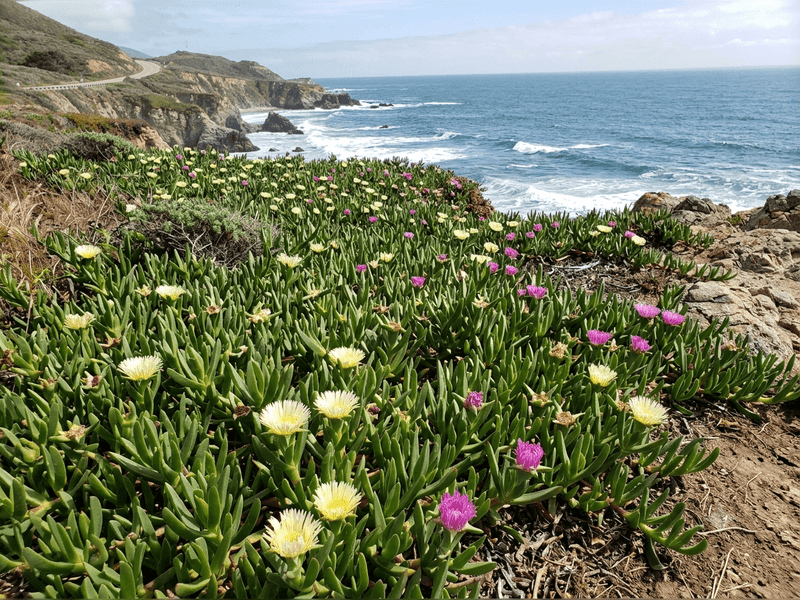
Carpobrotus edulis did not arrive in California as a garden escapee. State and local agencies introduced it deliberately during the mid-twentieth century for erosion control along roadsides and railroad embankments, and it became a familiar sight on coastal slopes from San Diego to the Oregon border.
Homeowners adopted it as a low-maintenance ornamental because it asked for almost nothing: no supplemental irrigation once established, no fertilizer, and minimal pruning.
The ecological problem is that the plant does not stay where it is planted. Stems root wherever they touch soil, fragments carried by water or foot traffic can start new colonies, and fruit eaten by animals deposits seeds in natural areas far from the original planting.
CDFW’s invasive plant documentation reports that Carpobrotus edulis has spread along much of the California coast, forming dense mats that crowd out native coastal sage scrub, dune plants, and rare or threatened species that evolved in open, well-drained coastal habitat.
The mats themselves change the environment in ways that outlast the plant. They trap moisture, alter soil chemistry, and shade out seedlings of native species that need direct sun and lean, sandy soil to germinate.
Cal-IPC’s landscaping guidance classifies Carpobrotus edulis as an invasive groundcover and advises against planting it near natural areas for exactly these reasons.
One point worth clarifying: the plant does attract native bees and butterflies. CDFW acknowledges this while still recommending against planting it, because the habitat it destroys supports far more native species than the flowers it feeds.
The ecological concern is about displacement and spread, not a simple claim that the plant harms every insect that visits it. UC IPM’s invasive-plant guidance recommends that homeowners consider removal when a garden planting borders natural areas, flood channels, or waterways that can carry plant material into open space.
Local Lists Do Not Prove a Sudden Countywide Ban
The headline framing of a sudden, universal countywide ban on ice plant does not match what the available evidence shows. What exists instead is a patchwork of local and site-specific rules that vary by jurisdiction, property type, and the kind of activity triggering review.
Understanding that distinction matters before a homeowner starts pulling plants or ignoring a concern entirely.
A county planning document, for example, may list Carpobrotus edulis among plants prohibited or discouraged in new landscape plans submitted with a development application. That restriction applies to what a contractor proposes to install on a project site, not necessarily to a groundcover that has been growing in a residential yard for twenty years.
A 2015 Monterey County planning document includes highway ice plant among plants prohibited or discouraged from planting, but that document is nearly a decade old and applies within a specific planning context. Readers should verify whether a current, operative rule exists in their jurisdiction before drawing conclusions from it.
San Luis Obispo County maintains a potentially problematic plants resource that homeowners sometimes encounter online. The San Luis Obispo County plants information page reflects county guidance rather than a criminal prohibition on existing residential plantings, and its posted materials should be checked for their current effective date and geographic scope.
Vinca major, also called periwinkle, is a separate invasive groundcover that appears on similar local lists and is worth mentioning here because homeowners sometimes confuse the two plants or encounter warnings about both in the same document. Cal-IPC’s Vinca major profile describes it as an aggressive perennial whose trailing stems root at contact points and whose fragments can resprout.
It is not another name for highway ice plant, and restrictions on one do not automatically extend to the other. Knowing which plant you actually have is the only way to apply the correct local guidance.
How to Check Whether a Rule Applies to Your Property
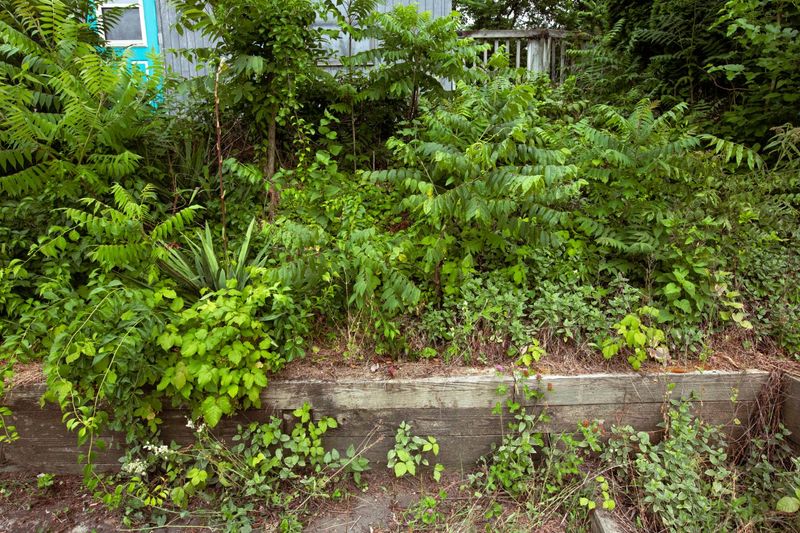
Start with a photograph. Take several shots from different angles: a wide view showing how the plant spreads, a close-up of a leaf cross-section, and a photo of a flower or fruit if one is present.
Those images will help you confirm the plant’s identity through a UC Cooperative Extension office, a master gardener hotline, or a botanical identification app before you contact any agency.
Once you are confident in the identification, look for the current version of your county’s invasive-plant list, prohibited-plant list, or fire-management plant list. County planning, agricultural commissioner, and fire department websites are the most reliable starting points.
If you live near the coast, check with your local coastal commission or resource conservation district as well, because coastal-habitat rules sometimes differ from inland county standards.
When you find a relevant document, check four things before drawing any conclusion: the effective date, the geographic scope, the enforcement mechanism, and whether the rule applies to existing plantings or only to new construction and permitted landscaping work. A planting restriction tied to a development approval, for instance, binds the project applicant, not every neighboring homeowner who happens to grow the same species.
California Government Code section 53087.7 limits a city or county’s ability to prohibit living drought-tolerant landscaping on residential property, and the current statutory text is worth reading carefully. That protection does not automatically override restrictions based on invasive-species management, wildfire safety, habitat conservation, setbacks, or other applicable laws.
If you live in a fire-hazard severity zone, also check CAL FIRE’s defensible-space guidance, because fuel-modification rules can restrict or require removal of specific plant types regardless of drought tolerance. When in doubt, a brief call to your county planning department or agricultural commissioner’s office is faster than trying to interpret an old document on your own.
Assess Habitat Connections, Drainage, and Slopes Before Removing It
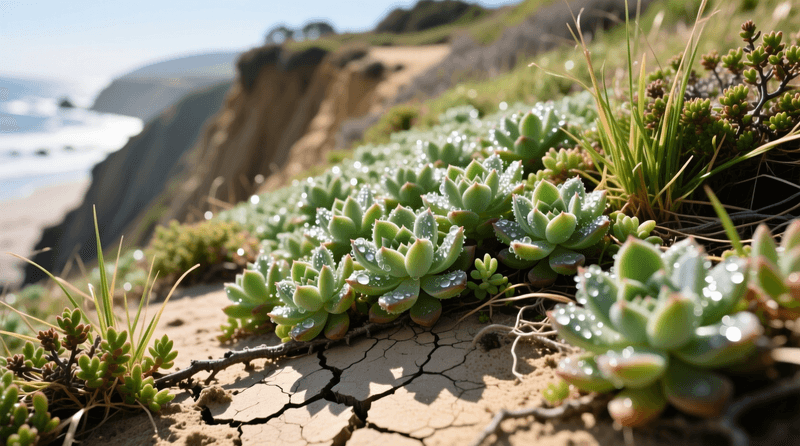
Not every patch of Carpobrotus edulis in a California yard poses the same risk. A planting surrounded by concrete, fencing, and established lawn on a flat suburban lot behaves differently from one that borders an undeveloped hillside, a storm drain, a creek, or a coastal bluff.
The first question to answer is whether your planting has a pathway to a natural area.
UC IPM’s invasive-plant guidance recommends that homeowners prioritize removal when a garden planting is near natural areas, roads, flood channels, or waterways that can carry plant material into open space. Ice plant stems and fragments float, and a single runoff event can move cuttings from a yard into a drainage channel and then into coastal scrub or dune habitat downstream.
If your planting sits uphill from any of those connections, the ecological argument for removal is stronger.
Slopes require extra caution from both directions. CDFW notes that ice plant is shallow-rooted, which is part of why manual removal is feasible, but shallow roots also mean the plant’s grip on a steep, saturated slope is limited.
UC Cooperative Extension fire-safety planting guidance specifically notes that ice plant may perform adequately on flat surfaces but can be problematic on steep slopes where saturated roots may contribute to erosion or slippage.
Removing established cover from a slope without a replacement plan can expose bare soil to rain and wind, creating new erosion problems that are sometimes worse than the original planting. Before disturbing any slope or large patch, sketch out a plan that includes temporary erosion control such as jute netting or straw wattles, an irrigation strategy for establishing replacement plants, and a realistic timeline for getting new root systems in place.
Wildlife considerations also matter: check for nesting birds before starting any large removal project, particularly between February and August when most California songbirds are actively nesting.
Remove Small Infestations Carefully and Dispose of Cuttings Properly
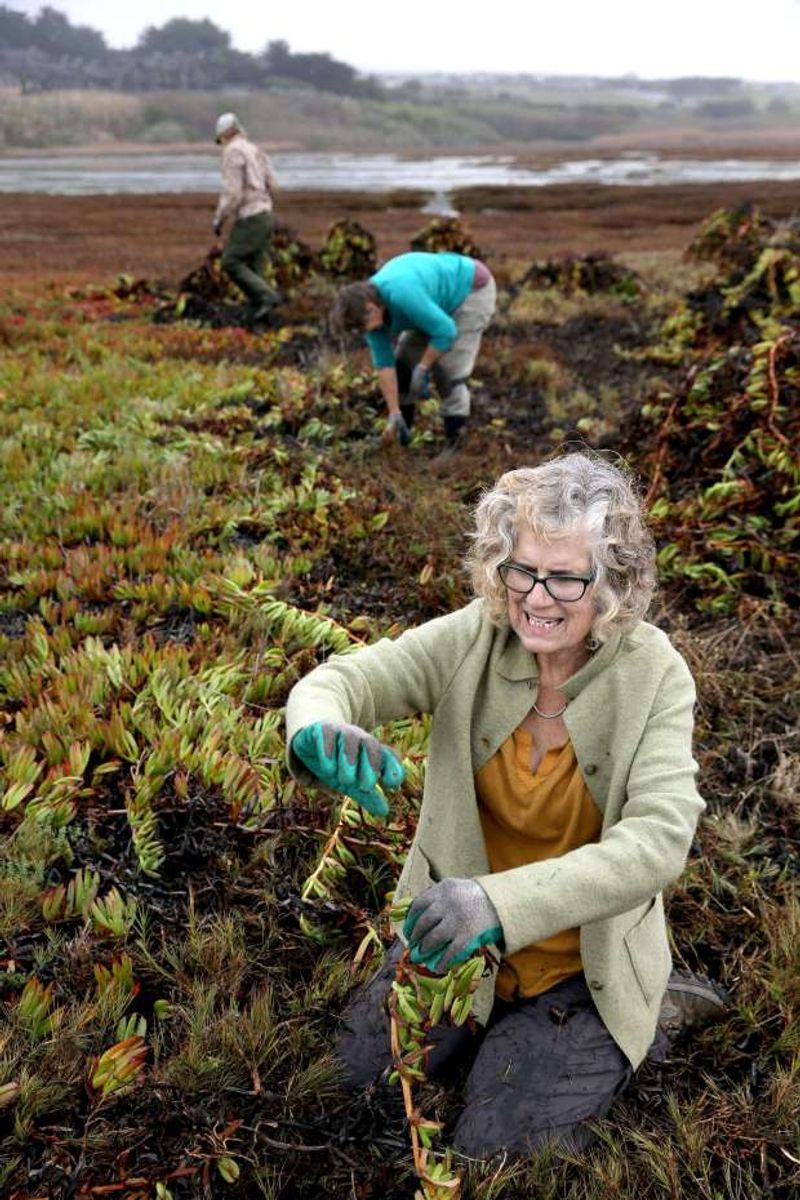
Manual removal is the most practical approach for small patches of Carpobrotus edulis in a residential setting. The plant’s shallow root system means most stems come free with steady hand pressure or a flat garden spade slid just under the mat.
Working after a rain, when soil is loose, makes the job easier and reduces the chance of leaving behind stem fragments that can reroot.
Timing matters more than most homeowners expect. Pull the plant before it sets fruit, because ripe fruit dropped during removal can deposit viable seeds in the soil.
If flowering is already underway, bag the stems and any fruit immediately rather than letting them sit in a pile on-site.
CDFW confirms that ice plant is amenable to manual control, especially in small infestations, and emphasizes that removal should be followed by rehabilitation or replanting to prevent bare soil from being recolonized by the same or another invasive species. Bare ground left after removal is an open invitation.
Disposal is where many homeowners make a costly mistake. Cal-IPC warns explicitly against disposing of invasive plant material in natural areas, and notes that stem fragments from some invasive groundcovers can resprout even after being cut.
Keep all cuttings away from storm drains, creek banks, open-space edges, and compost piles that are not hot enough to kill plant tissue. Sealed yard-waste bags set out for municipal green-waste collection are the safest option in most California counties; check your local waste-hauler guidelines to confirm that the service accepts succulent material.
UC IPM’s landscape weed-management guidance cautions that herbicides can injure desirable plants if misapplied, and burning vegetation near homes or on dry California slopes presents obvious wildfire risk. Neither approach should be used casually or without specific local guidance authorizing it for your site and plant type.
For larger infestations or steep slopes, consult a licensed landscape contractor or your local resource conservation district before starting work.
Choose Replacements for the Site, Not the Marketing Label
Replacement planting is where many homeowners get tripped up a second time. A plant labeled drought-tolerant, fire-resistant, or native at a nursery is not automatically the right choice for your slope, soil, sun exposure, and irrigation setup.
Each of those qualities depends on species, establishment conditions, climate zone, and how the plant is arranged relative to structures and other vegetation.
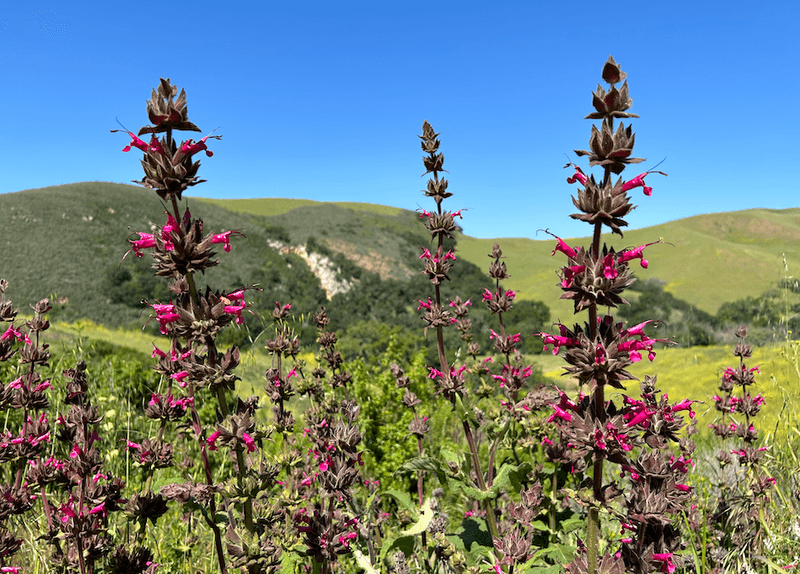
Purple sage, Salvia leucophylla, is one example of a California native that CDFW suggests as a coastal-native alternative to invasive ice plant. It handles dry summers well once established, supports native bees and hummingbirds, and fits naturally into coastal sage scrub communities.
That does not mean it works on every California slope: it needs good drainage and full sun, and it may struggle in heavy clay or in areas with regular foot traffic.
UC Cooperative Extension planting guidance lists additional alternatives suited to particular California conditions, including California wild grape for shaded or riparian edges, yerba mansa for moist low spots, and California honeysuckle for trellised or scrambling situations. Each of those works in a specific niche rather than everywhere.
A practical approach is to visit a California native plant nursery, describe your site conditions precisely, and ask which groundcovers are already performing well in your neighborhood or watershed. Local knowledge from a master gardener or a native plant society chapter is often more reliable than a general species list, because it reflects what actually survives your county’s specific combination of soil, frost, heat, and summer drought.
Plan for an establishment period of one to two seasons during which new plantings will need supplemental water even if they are ultimately drought-tolerant once mature.
Fire Safety Depends on Maintenance and Local Standards
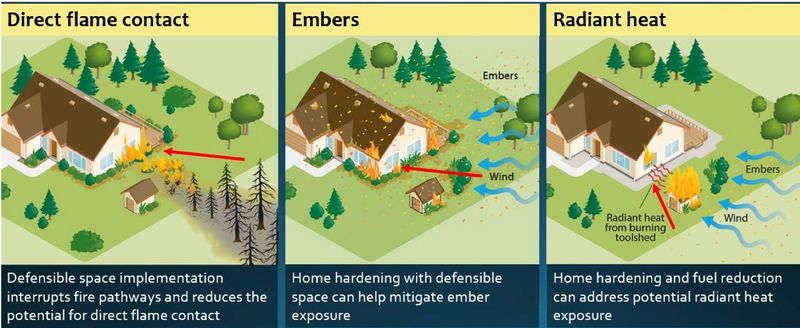
Removing Carpobrotus edulis from your yard because of invasive-plant concerns is a separate decision from managing your property for wildfire safety, and the two should not be treated as the same project. A plant that is ecologically problematic is not automatically a fire hazard, and a plant that is low-growing or marketed as fire-resistant is not automatically safe in every fire-hazard severity zone.
CAL FIRE’s defensible-space guidance focuses on dead vegetation removal, fuel continuity, plant spacing, and zone-by-zone management rather than on approved or prohibited species lists. A dense mat of any plant, including one marketed as fire-resistant, can carry fire if it accumulates dead material, dries out severely, or connects unbroken to other vegetation close to a structure.
Counties and local fire districts can impose stricter standards than the state minimum, and those local requirements sometimes include specific plant restrictions in fuel-modification zones around new development or in high-risk areas. CAL FIRE’s fire-hazard severity zone maps show where state-level defensible-space requirements apply, but your local fire department or fire-safe council may have additional guidance specific to your neighborhood.
Replacing ice plant with a native groundcover does not automatically resolve a defensible-space obligation. The new planting still needs to be spaced appropriately, kept free of dead material, watered enough during establishment to avoid becoming a dry fuel source, and arranged so it does not create a continuous fuel path to your home.
Wildfire management is an ongoing maintenance practice, not a one-time plant swap.
Identify First, Verify Locally, Then Change the Yard
The invasive-plant concern attached to Carpobrotus edulis is real and backed by state wildlife officials and independent botanists. What is not established is a sudden, universal ban affecting every California homeowner who grows it.
Your legal obligation depends on a current, operative local rule and on how your specific property relates to natural habitat, fire zones, and drainage.
A straightforward action sequence covers the essentials. Photograph and confirm the plant’s identity using CDFW’s identification guidance, then check your county’s current plant lists and contact the relevant local offices.
Assess whether the planting connects to habitat, waterways, or fire-management areas using UC IPM’s proximity criteria. If removal makes sense, plan for erosion control and replacement before disturbing the soil, follow local disposal rules for cuttings, and consult CAL FIRE’s defensible-space standards separately as part of ongoing yard maintenance.
The homeowner who takes those steps is far better positioned than one who either panics and strips a slope bare or dismisses the concern because no inspector has knocked on the door yet. Knowing your plant and your local rule is the only shortcut that actually works.