
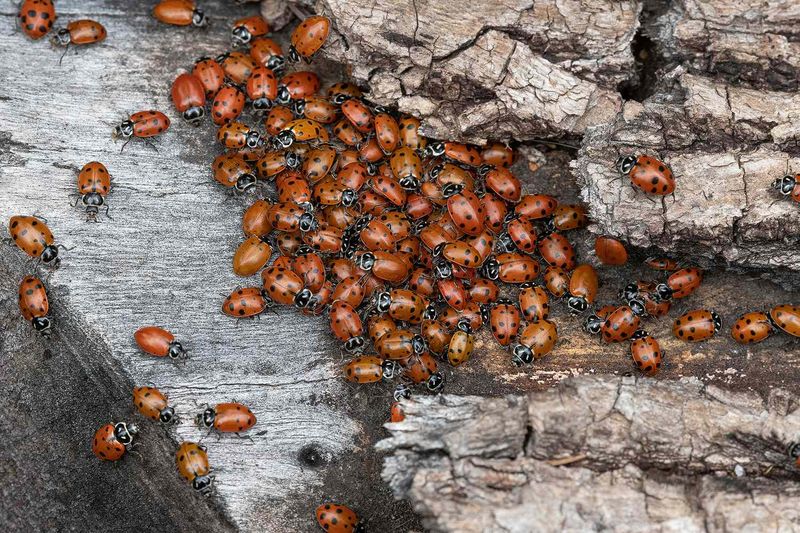
Step outside on a warm August afternoon in California and you might find your rose bush or vegetable bed covered in small red-and-black beetles that weren’t there yesterday. Before you grab the spray bottle, it’s worth knowing what that gathering might actually be telling you about your yard.
A sudden concentration of lady beetles can point toward nearby prey, seasonal movement, or both, and understanding the difference changes how you respond.
A gathering offers a clue, not a diagnosis
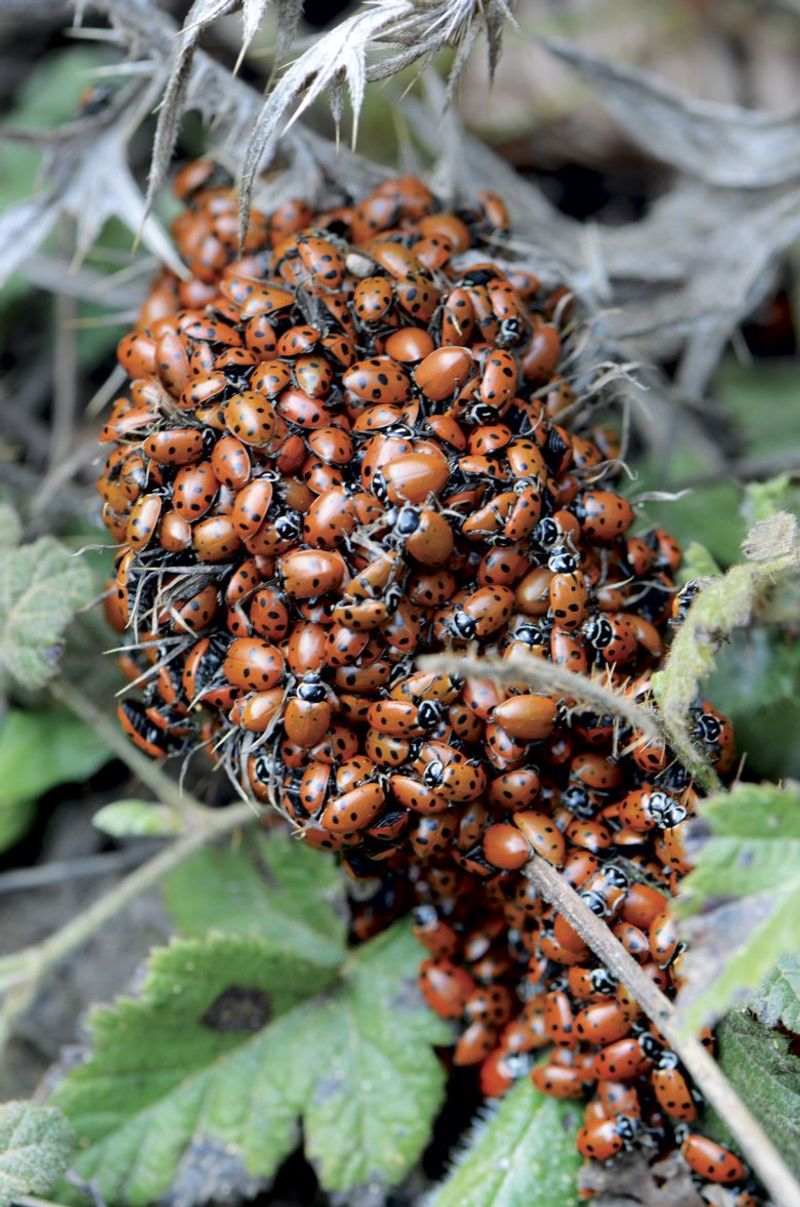
Spotting a cluster of lady beetles on a garden plant is a signal worth taking seriously, but it isn’t proof of anything specific. Many of California’s lady beetle species are active predators, feeding on aphids, scales, mealybugs, and other soft-bodied insects, so a group of beetles concentrated near a particular plant does make nearby prey worth investigating.
According to UC IPM’s lady beetle resource, most California species are predators of pest insects, and both adults and larvae feed on pest populations when prey is available.
What a gathering does not do is confirm an infestation, identify the species, or promise that the beetles will stay long enough to clear the problem. The observation is a starting point, not a conclusion.
A yard with active lady beetles may have a thriving aphid colony nearby, or it may simply be a resting stop for beetles moving through on their way to seasonal habitat elsewhere.
The practical response is to inspect the plants where the beetles are concentrated before reaching for any treatment. Check tender new growth, flower buds, and the undersides of leaves for live aphid colonies.
UC IPM’s aphid guidance notes that lady beetle numbers often rise when aphid populations are high, but also that natural control varies and depends on conditions the beetles cannot always overcome on their own. If you spray before confirming a real problem, you risk eliminating the very insects that were already working in your favor.
Treat the sighting as useful yard information, and let inspection guide the next step.
California lady beetles have different diets and life stages
Not every red or orange beetle in a California garden is the same creature doing the same job. The state is home to roughly 150 to 200 lady beetle species, and while most are predators, they don’t all eat the same prey.
UC IPM’s lady beetle overview explains that different species specialize in aphids, scales, mealybugs, psyllids, spider mites, insect eggs, and other targets. Assuming every spotted beetle is hunting aphids can lead to the wrong conclusion about what’s actually happening in your yard.
Color and spot count alone won’t reliably tell you which species you’re looking at. Several California species share similar red or orange coloring with black spots, and some, like the convergent lady beetle, have close relatives with nearly identical markings.
Species-level identification may require expert review, which means homeowners are better off treating any lady beetle as a potential ally and focusing on what the population is doing rather than precisely what it is.
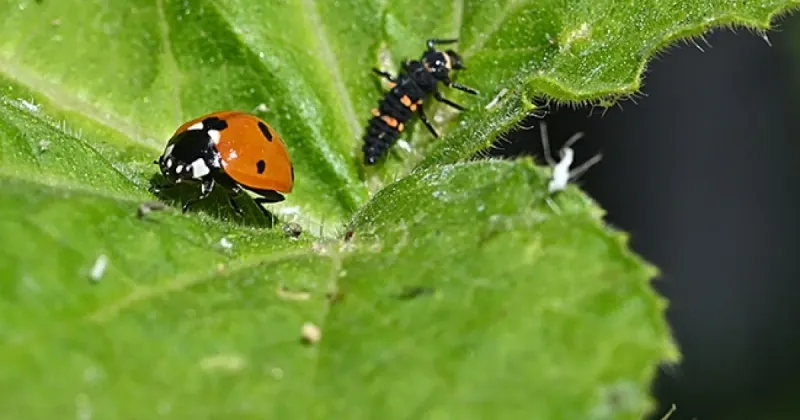
The life stage question matters just as much as species. Lady beetle larvae, described in UC IPM’s beneficial predators guide as elongated, active, six-legged insects that resemble tiny alligators, are important predators in their own right and often consume more pests than adults.
Gardeners who don’t recognize larvae sometimes mistake them for harmful insects and kill them. If you find dark, spiky, fast-moving insects near a colony of aphids, look closely before acting.
Those larvae may be doing more pest-control work per day than the shiny adult beetles a few inches away.
Inspect the plants where the beetles gather
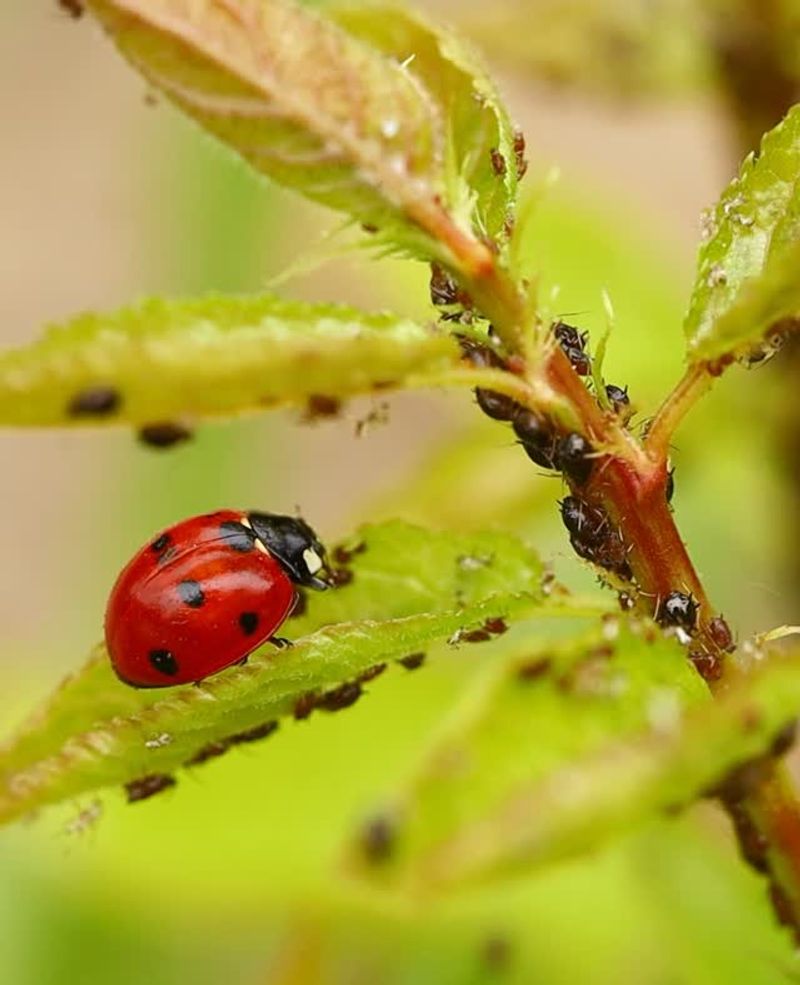
When lady beetles concentrate on a particular plant, that plant deserves a close look. Start at the tips of new growth, where aphids tend to cluster first, and work your way down to flower buds, stems, and the undersides of leaves.
Aphids are small and soft-bodied, often green, yellow, black, or pinkish, and they gather in dense groups rather than spreading out individually across a leaf surface.
Beyond the insects themselves, UC IPM’s aphid page lists several secondary clues that signal an active colony. Sticky residue on foliage or on surfaces below the plant often comes from honeydew, the sugary waste aphids produce as they feed.
That honeydew can develop a coating of sooty mold, a dark fungal growth that makes leaves look dusty or blackened. Curled or puckered new growth, where aphids have been feeding long enough to distort tissue, is another useful sign.
Ants moving steadily up and down a stem are worth noting too. Ants tend aphid colonies for their honeydew and will actively drive off predators to protect that food source.
Managing ants around infested plants, using a sticky barrier on the trunk or stem base, can reduce interference and give natural enemies a better chance to work. UC IPM’s biological control resource notes that ant management is one practical step that supports resident predators without applying any pesticide.
While inspecting, look for more than just aphids and adult beetles. Yellow oblong eggs standing upright on leaves may be lady beetle eggs.
Small, papery, mummified aphids indicate that parasitoid wasps have already been at work. UC IPM’s convergent lady beetle page recommends watching for these signs of multiple natural enemies before deciding whether any intervention is needed at all.
Late summer can bring feeding or seasonal movement
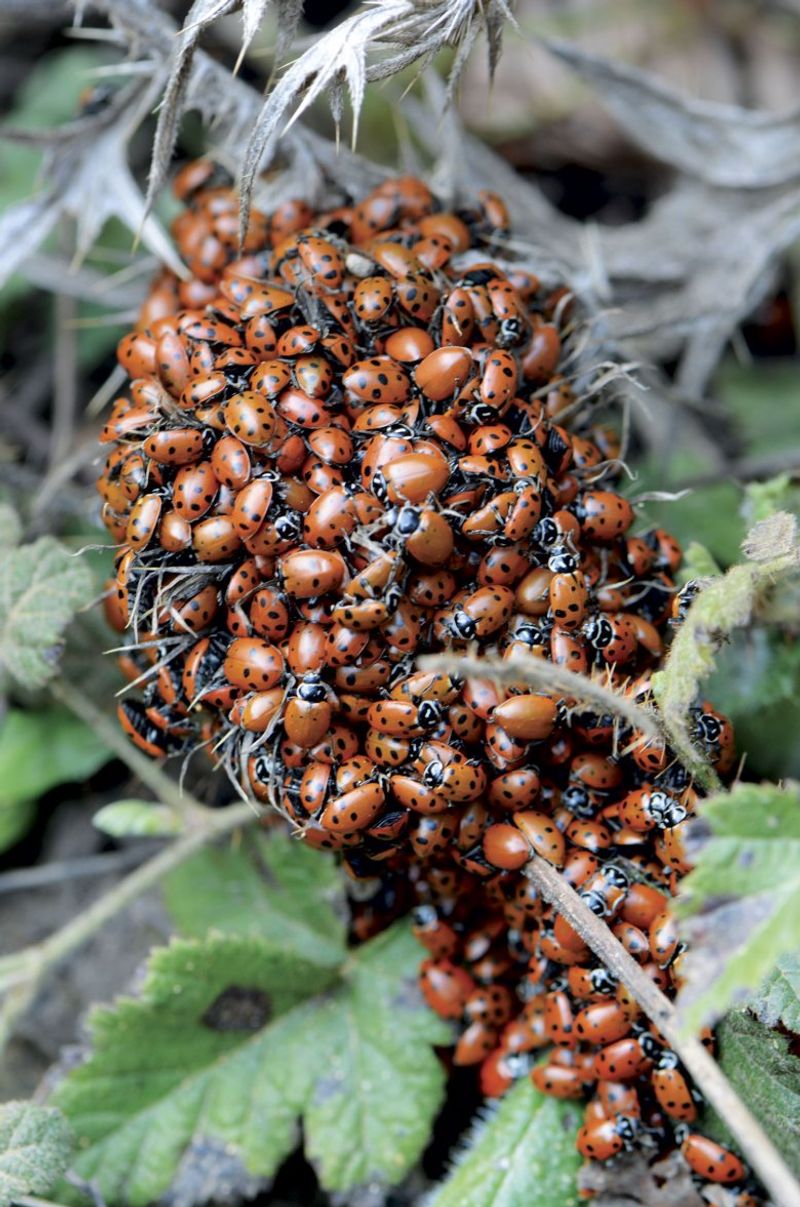
A late-summer lady beetle gathering in a California yard can mean two very different things, and telling them apart matters. Beetles found directly on plants that carry live aphid colonies are likely feeding, using the infestation as a food source while conditions support it.
That’s the scenario most homeowners picture, but it isn’t the only one.
Convergent lady beetles, one of California’s most recognizable species, also undergo seasonal movement that has nothing to do with the pest population in your yard. UC IPM’s convergent lady beetle profile explains that these beetles migrate from coastal and valley areas toward the Coastal Range or the Sierra Nevada foothills as lowland food becomes scarce.
They are strong fliers and readily move among locations, which means a large group that appears overnight may be resting, seeking moisture, or passing through rather than settling in to clear aphids.
Aggregating convergent lady beetles are often associated with moist, low-growing vegetation and shaded spots near structures or dense plantings. If the beetles are gathered on a wall, a fence post, or low ground cover rather than on aphid-covered plants, seasonal movement is a more likely explanation than active pest control.
The beetles may linger for a day or two before continuing toward higher-elevation overwintering habitat.
Regional timing also shapes what you’re seeing. UC IPM notes that aphid activity varies considerably across California’s climate zones.
Inland valley and desert areas may see aphid populations crash during the hottest weeks of summer, while coastal zones with milder temperatures can support active colonies well into fall. A late-summer beetle gathering in San Jose carries different implications than the same sighting in Bakersfield or along the Marin coast, so local conditions should always factor into how you read the evidence.
Use the yard’s natural enemies before reaching for chemicals
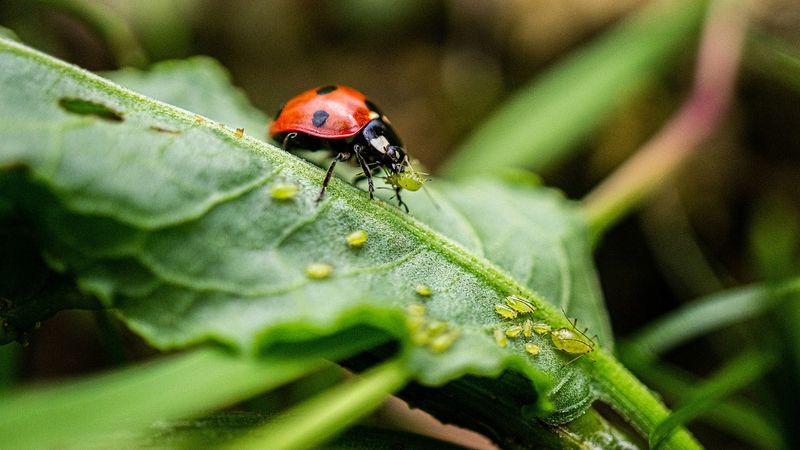
After inspecting and confirming an aphid population, the first question is whether treatment is actually necessary right now. Many established plants tolerate light to moderate aphid feeding without lasting harm, and natural forces often reduce populations before the damage becomes serious.
Predators, parasitoid wasps, fungal diseases, and summer heat can all bring aphid numbers down without any intervention from the homeowner.
Coastal California gardeners may wait longer for natural control to kick in, since milder temperatures support aphid activity through more of the season. In hotter inland areas, a population that looks alarming in early August may collapse on its own within a week or two as temperatures rise and the colony runs out of tender new growth.
UC IPM’s aphid guidance recommends watching the population for several days before deciding to treat, since natural enemy activity can be rapid once it builds momentum.
For colonies that are large enough to concern you, a strong stream of water directed at infested shoots is often the most effective immediate response. Aphids knocked off plants rarely find their way back, and repeated water treatments over several days can reduce a colony significantly without harming any of the beneficial insects working nearby.
Pruning heavily infested shoot tips is another targeted option that removes a large portion of the population quickly.
Lady beetles are not the only allies at work. UC IPM’s biological control overview describes lacewing larvae, syrphid fly larvae, soldier beetles, parasitic wasps, and aphid-specific fungal diseases as part of a yard’s broader natural-enemy community.
Focusing only on adult lady beetles understates how many different organisms may already be reducing the population. Managing ants that protect aphid colonies is another low-impact step that gives all of these natural enemies a better operating environment.
Spraying can destroy the control you want to preserve
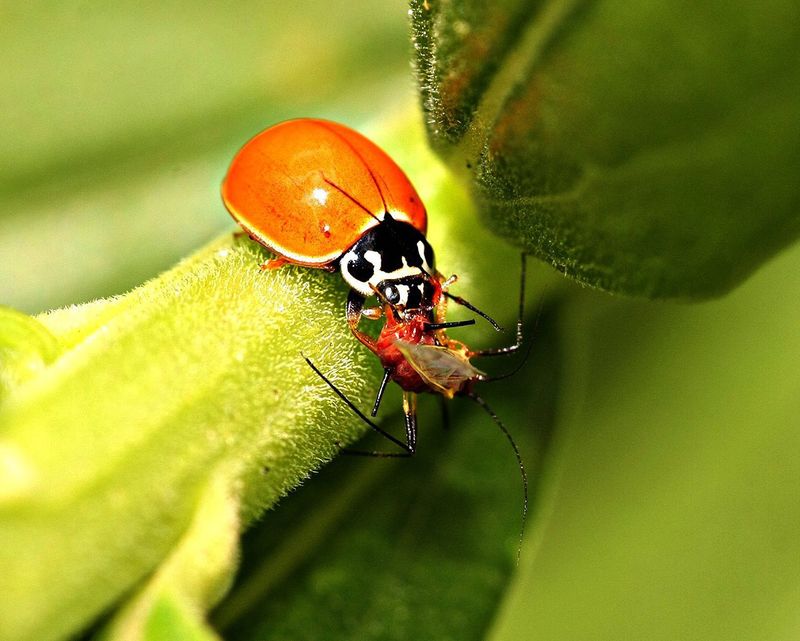
Reaching for a pesticide the moment you see aphids can eliminate the natural enemies that were already reducing the population, and it can deter or kill beneficial insects that arrive after the application. Broad-spectrum and persistent insecticides, including many carbamates, organophosphates, and pyrethroids, are particularly damaging because they remain active long after the spray dries.
UC IPM’s guidance on protecting natural enemies recommends using pesticides sparingly, targeting only the areas with confirmed problems, and avoiding applications to flowering plants when pollinators and other beneficial insects are foraging.
If inspection confirms that aphid pressure is beyond what water, pruning, and natural enemies can handle, lower-impact options exist. Insecticidal soaps and horticultural oils are identified by UC IPM’s aphid quick tips as appropriate choices for many aphid situations, but they work only by direct contact with the insect.
That means thorough coverage of all infested surfaces, including leaf undersides, is required for the treatment to work. Any aphids the spray misses survive unaffected.
Both products carry important limitations. Insecticidal soaps and horticultural oils can damage plants that are already drought-stressed, and applications during very hot weather increase the risk of leaf burn.
Some ornamentals are sensitive to these products even under good conditions, so checking the label and testing a small area first is standard practice. UC IPM also notes that even these lower-impact products can injure exposed beneficial insects on contact, so timing applications for early morning or evening when predators are less active reduces unintended harm.
Buying and releasing commercial lady beetles is not a reliable substitute for preserving resident natural enemies. UC IPM’s biological control resource for ornamentals reports that commercially collected convergent lady beetles often disperse within days of release, and effective suppression may require very large or repeated releases.
Supporting the natural enemies already living in your yard is a more dependable long-term approach than purchasing beetles that are unlikely to stay.
Treat the sighting as information about your yard
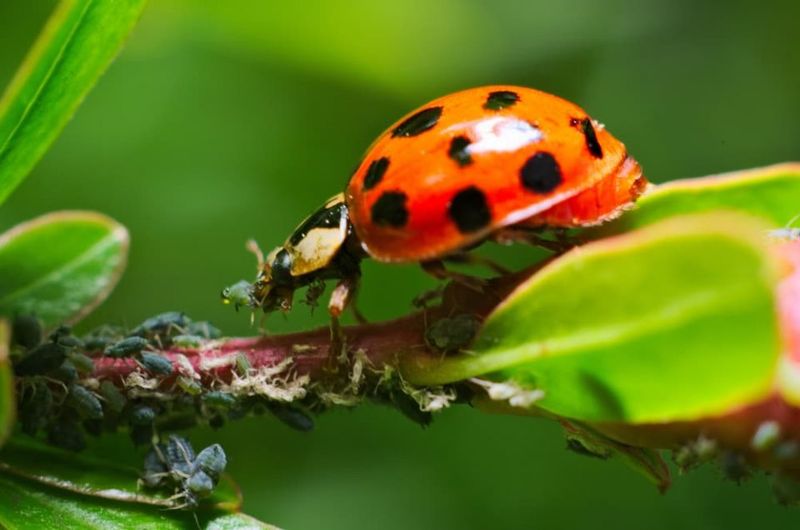
A sudden gathering of lady beetles in late summer is most useful when you treat it as a question rather than an answer. Inspect the plants where the beetles are concentrated, confirm whether live prey and active larvae are present, and factor in local California conditions before deciding anything.
A cluster on aphid-covered rose tips in a coastal garden calls for a different response than beetles resting on a fence post in an inland valley neighborhood where aphid populations have already peaked.
Resident natural enemies, including the beetles, larvae, wasps, and other predators already in your yard, offer a more dependable foundation than purchased insects. UC IPM’s aphid page consistently points toward conservation of existing natural enemies as the more sustainable strategy.
Flowering plants that provide nectar and pollen may support adult beneficial insects, but as UC IPM’s insectary plant guidance makes clear, their benefit depends on plant selection, proximity to problem areas, and whether pesticide use is undermining the insects you’re trying to support.
Avoiding broad-spectrum treatments until inspection confirms they’re necessary is the single most protective thing a California homeowner can do for the yard’s existing food web. A yard that supports multiple natural enemies is more resilient than one that relies on any single species, purchased or wild, to clear every pest.
The beetles that showed up this August are telling you something worth knowing; the job is figuring out exactly what.