
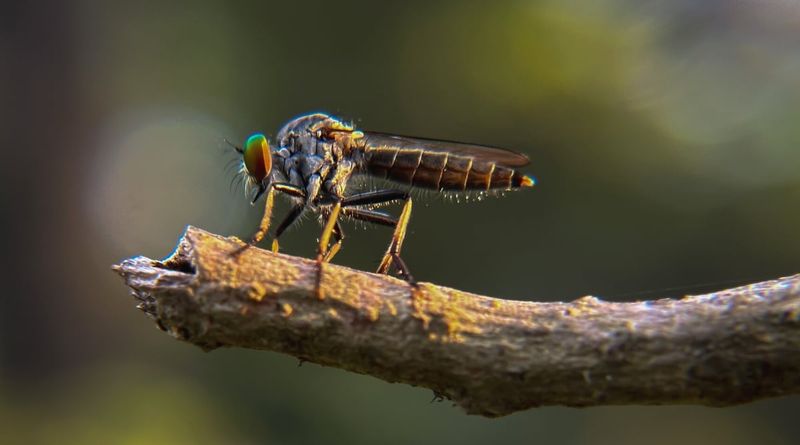
Spotting a large, bristly fly hovering around your tomatoes or pepper plants can catch any gardener off guard. That fly is almost certainly a robber fly, one of nature’s more aggressive hunters, and it is far more interested in catching other insects than nibbling your crops.
North Carolina vegetable gardens attract a surprising variety of predatory insects during summer, and knowing which ones are working in your favor can change how you respond. Understanding what a robber fly is actually doing among your beds may be the most useful thing you learn this season.
The fly is probably hunting, not feeding on your vegetables
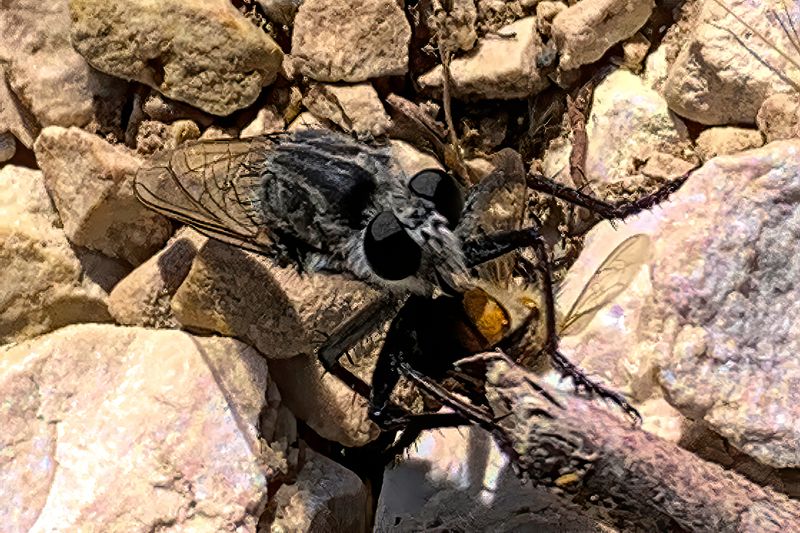
Seeing a large, unfamiliar fly buzzing near your squash or bean rows is enough to send most gardeners reaching for a spray bottle. Before you do anything, consider what that fly is actually after.
Adult robber flies belong to the family Asilidae, and NC State Extension describes them as generally regarded as beneficial because they prey on other insects rather than on garden plants.
A robber fly does not chew leaves, bore into fruit, or suck plant sap. Its mouthparts are built for seizing and paralyzing insect prey, not for plant feeding.
So when one shows up near your vegetable beds on a warm July morning, the most accurate read is that it is hunting whatever flying insects happen to be moving through the area.
That said, its presence is not a guarantee that your pest problems are being handled. Robber flies are generalist predators, meaning they take a wide range of prey without targeting any one species.
NC State’s general entomology resource on family Asilidae confirms the family is native and widespread across North America, but abundance can vary by location, season, and habitat.
North Carolina gardens from the Coastal Plain to the Piedmont and into the mountains can host robber flies during summer, though which species appear and how many depends on local conditions. What stays consistent is the behavior: adults perch in sunny spots and launch short, precise strikes at flying prey.
Your vegetables are not the target. The insects moving around your vegetables are.
What does a robber fly look like?
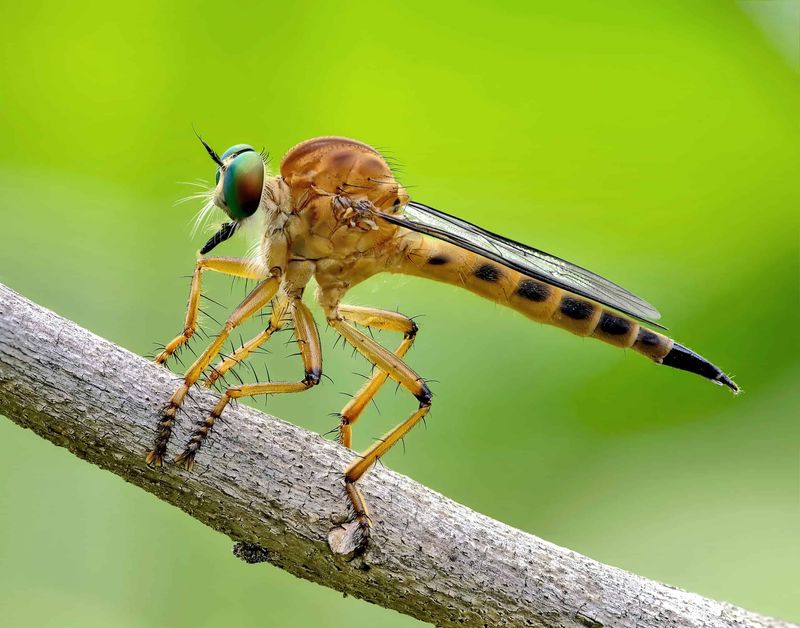
Robber flies have a distinctive look once you know what to check for, but they are easy to misidentify at a glance. According to NC State Extension’s robber fly profile, the key features are a bearded or bristly face around the piercing mouthparts, a noticeable concave or hollowed area between the large compound eyes when viewed from the front, long spiny legs built for grabbing prey in flight, and a long or tapering abdomen.
Like all true flies, robber flies have only one pair of wings. That single-wing detail separates them from bees, wasps, and most other large insects that share the garden.
Body size varies widely across the roughly 1,000 North American species, ranging from small and slender to impressively large and robust.
Some species mimic bees or wasps closely enough to fool a quick glance. Thick body hair, banded abdomens, and buzzing flight can make a robber fly look convincingly like a bumblebee.
Resist the urge to identify any large or bee-like fly by appearance alone. A clear, close photograph taken from multiple angles, or a submission to a local extension office or iNaturalist, will give you a much more reliable answer than a field guess.
Hoverflies, also called syrphid flies, are a separate group entirely and are commonly mistaken for robber flies or vice versa. NC State’s syrphid fly resource and University of Minnesota Extension’s syrphid fly guide both describe hoverflies as smaller, rounder, and far more likely to hover steadily over flowers.
Treating every bee-mimicking fly as a robber fly leads to misidentification and, potentially, to mismanaging your garden’s insect community.
A perch-and-pounce hunter works the sunny edges
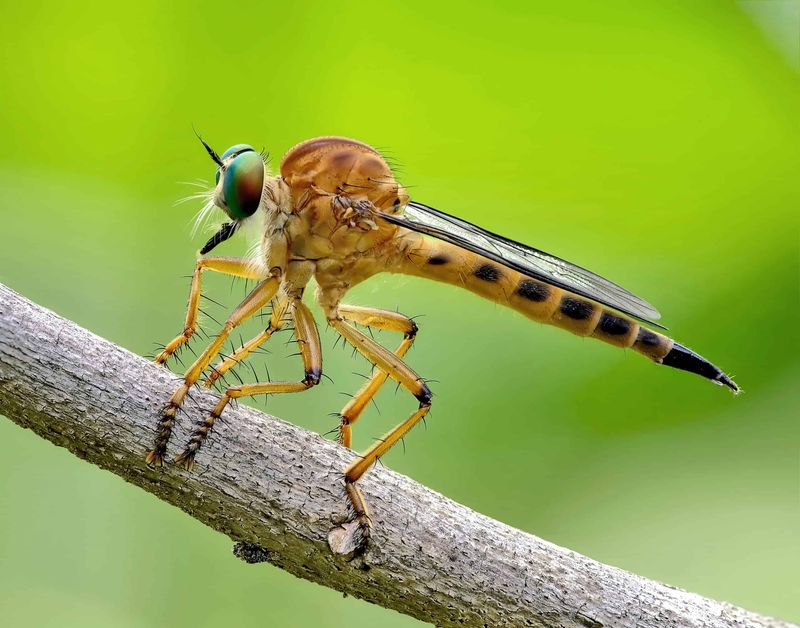
Watching a robber fly for a few minutes reveals a pattern that is more methodical than random. Adults typically choose an exposed perch, a fence rail, a bare stem, a tomato cage wire, or a sun-warmed rock, and wait.
When a suitable insect crosses their field of view, they launch a short, fast flight to intercept and capture it in midair. Texas A&M AgriLife’s robber fly entry describes this perch-and-strike behavior as the defining feature of adult hunting.
The fly injects a paralyzing saliva into its prey and then feeds on the liquefied contents. Reported prey includes other flies, beetles, grasshoppers, leafhoppers, wasps, bees, dragonflies, and a range of other flying insects.
NC State Extension notes that adults favor open, sunny locations for hunting, which is why garden edges, fence lines, and raised beds with good sun exposure tend to attract them more than shaded interior rows.
The term “patrolling” captures how it looks from a gardener’s perspective, but the fly is not continuously scanning every bed. It works from fixed points, making targeted strikes rather than cruising the whole garden.
Seeing one perched near your peppers does not mean every insect in the vicinity is under threat.
Larvae tell a completely different story. They live underground or inside decaying wood and are almost never seen by gardeners.
Missouri Department of Conservation’s robber fly field guide explains that larvae prey on insect larvae, eggs, and other soft-bodied stages in the soil. Eggs may be deposited in soil, plant material, bark, or other protected sites depending on the species.
The larval stage is a hidden but real part of the predatory life cycle, quietly reducing insect populations below the soil surface while the adult hunts above it.
Its presence helps, but it cannot manage a crop by itself
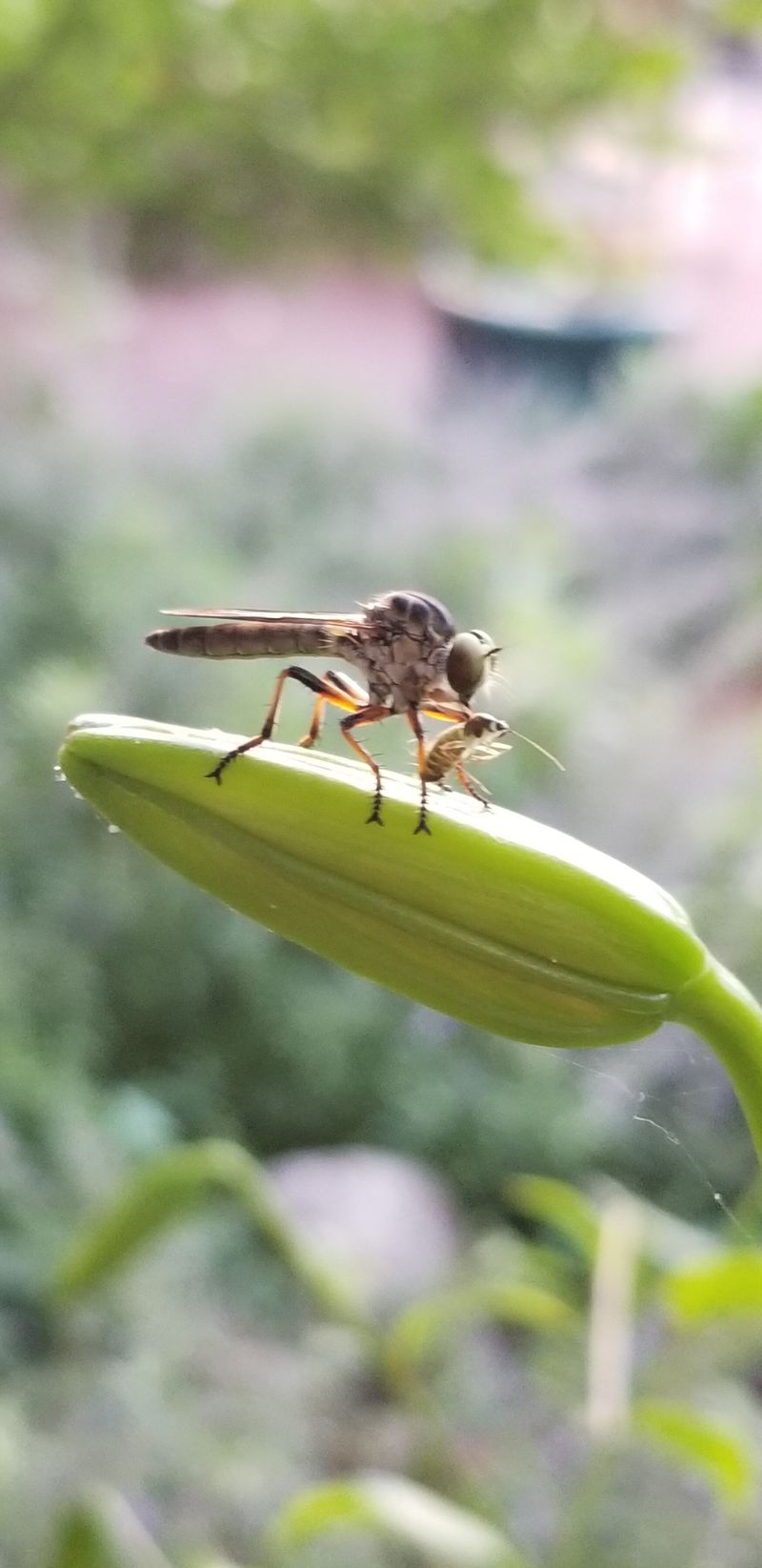
A robber fly eating insects near your vegetable beds does add something real to the garden’s food web. Adults consume a broad range of prey, including flies, beetles, grasshoppers, leafhoppers, wasps, bees, dragonflies, and other insects.
Some of those prey items are genuine crop pests, which means a robber fly can contribute to natural insect mortality in the garden.
The catch is the word “contribute.” University of Wisconsin Extension’s robber fly article specifically cautions that robber flies are not reliable for managing a particular pest species. Because they are generalists, they take whatever prey is available and catchable, not whatever pest is currently damaging your tomatoes.
A robber fly hunting near your squash is just as likely to catch a beneficial wasp or a passing dragonfly as it is to catch a squash vine borer moth.
Utah State University’s beneficial insect identification guide reinforces this point, noting that generalist predators play a supporting role in a healthy insect community without providing the kind of targeted suppression that a specialized natural enemy might offer. Their value is real but diffuse.
Counting on a robber fly to handle caterpillars chewing your cabbage, beetles attacking your beans, or aphids colonizing your peppers is not a sound strategy. The fly may catch some of those insects incidentally, but it has no preference for the insects causing your specific problem.
Think of it as one thread in a larger web of natural checks and balances, useful and worth protecting, but not a substitute for monitoring and managing actual pest pressure when it builds.
Not every intimidating fly is a robber fly—and flower visits do not make it a pollinator
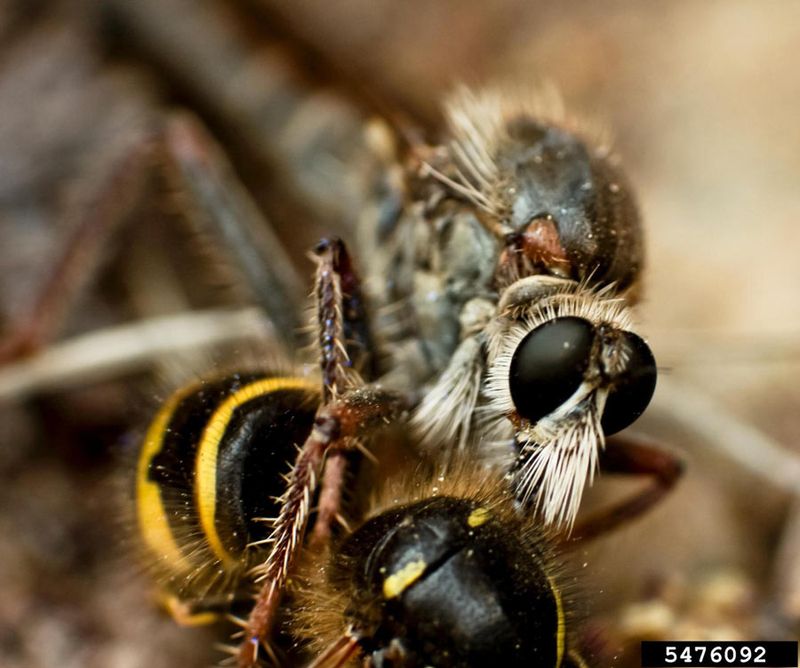
Two identification mistakes trip up gardeners regularly. The first is calling any large, hairy, or bee-mimicking fly a robber fly.
The second is assuming that a fly sitting on a flower must be pollinating it. Both errors lead to wrong conclusions about what is actually happening in the garden.
Hoverflies, or syrphid flies, are a separate family with a very different role. NC State Extension’s syrphid fly page describes their larvae as important aphid predators, while adults feed on pollen and nectar and do contribute to pollination.
Robber flies and hoverflies can both mimic bees, but hoverflies tend to be smaller, rounder, and hover steadily over flowers in a way that robber flies generally do not. Misidentifying a hoverfly as a robber fly, or vice versa, can lead you to underestimate a genuine aphid-control ally or overestimate a predator’s crop-protection value.
Robber flies are predators, not usually considered pollinators. Utah State University’s beneficial insect guide and University of Georgia Extension’s beneficial flies resource both describe robber flies primarily in the context of predation.
Adults may land on flowers or use flowering vegetation as hunting perches, and incidental pollen transfer is not impossible, but their flower visits do not make them meaningful pollinators in the way that bees or hoverflies are.
When you see a large fly near your garden blooms, take a moment to observe before labeling it. Check for the bearded face, concave eye area, and tapering abdomen of a robber fly, or the rounder, hovering profile of a syrphid.
Getting the identification right helps you respond appropriately to whichever insect is actually present.
How should you respond when one appears?
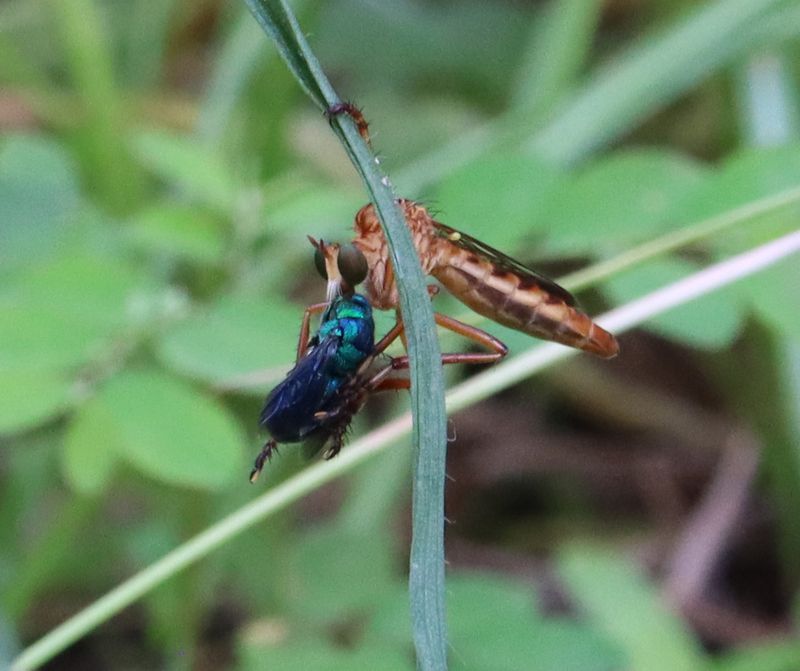
Finding a robber fly among your vegetables calls for a simple response: watch it, and leave it alone. An outdoor robber fly has no interest in landing on you.
It is focused entirely on catching other insects, and it will move on when prey becomes scarce or conditions change. NC State Extension advises against trying to catch, swat, or handle robber flies, because while they are not aggressive toward people and are not blood-feeding insects, they can deliver a painful bite if they are grabbed or cornered.
Observe from a comfortable distance. A close look will confirm the key features, and if you want a reliable identification, photograph it from several angles and compare against extension resources or submit it to iNaturalist.
Texas A&M AgriLife’s robber fly page notes that adults are not considered a human pest and that unprovoked biting is not typical behavior.
The fly’s presence does not automatically mean your garden is pest-free, and it does not require you to stop any treatment you have already planned for a documented infestation. What it does mean is that reaching for a broad-spectrum spray the moment you spot it is not the right first move.
NC State’s integrated pest management guidance consistently recommends identifying the actual pest and assessing real damage before deciding whether any treatment is warranted.
Use the sighting as a prompt to look more carefully at the plants nearby. Check leaves, stems, and fruit for signs of actual pest feeding.
If you find a genuine problem, you will have the information needed to address it correctly. If you find no problem, the robber fly gets to keep hunting undisturbed.
A lighter-touch pest plan protects both crops and predators
A robber fly sighting is a good moment to think through how you handle pest problems more broadly. The most effective approach for a home vegetable garden is integrated pest management, which starts with identification.
Before treating anything, confirm what pest is actually present, how much damage it is causing, and whether the population is at a level that genuinely threatens the crop.
NC State Extension’s IPM handbook chapter explains that tolerating a small amount of pest activity is often reasonable, especially when natural enemies are present. Broad-spectrum insecticides applied without a confirmed pest problem can kill robber flies, hoverflies, parasitic wasps, and other beneficial insects along with the target pest, making future pest outbreaks harder to manage naturally.
When treatment is genuinely necessary, NC State’s insect and related pests of vegetables resource and the 2026 North Carolina Agricultural Chemicals Manual provide crop-specific and pest-specific product guidance. Always choose a product labeled for the exact vegetable and the exact pest you have identified.
Follow the label rates, application timing, and preharvest intervals precisely, since the label is a legal document and its directions exist for good reasons.
Prefer the least disruptive effective option. NC State’s biological control guide for home gardeners recommends targeted, narrow-spectrum treatments when they will work, reserving broader applications for situations where nothing else is adequate.
Timed applications, physical removal, row covers, and targeted sprays all reduce collateral harm to the insects that are quietly doing useful work in your garden.
Make the garden friendlier without trying to summon robber flies
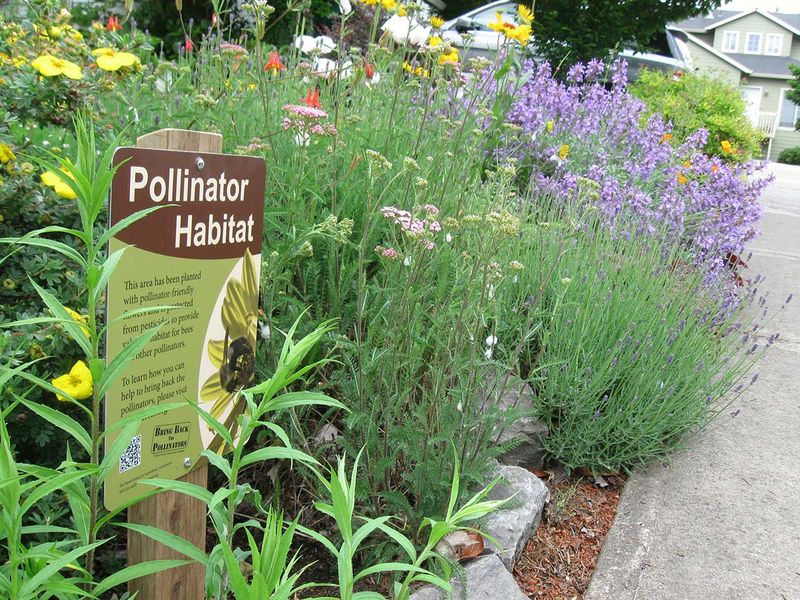
General habitat stewardship creates conditions where naturally occurring predators, including robber flies, can move through and use your garden. None of these steps come with a guarantee that robber flies will appear in any particular number, but they reduce unnecessary obstacles for the beneficial insects already present in your area.
Limiting pesticide applications to confirmed pest problems is the single most impactful thing most gardeners can do. NC State’s IPM guidance consistently points to unnecessary broad-spectrum spraying as one of the primary ways home gardeners disrupt beneficial insect communities.
Fewer chemical inputs means more insects survive long enough to hunt, parasitize, or otherwise suppress the pests you care about.
Retaining some undisturbed areas near the garden, a patch of unmulched soil, a brushy edge, or a small section of decaying wood, gives ground-dwelling insects, including robber fly larvae, a place to complete their life cycle. Missouri Department of Conservation’s field guide notes that robber flies are associated with a range of habitats including grassland edges, forest margins, and areas with exposed soil and decaying wood.
Plant diversity and sunny open areas support a broader insect community overall. Utah State University’s beneficial insect identification guide recommends varied plantings and reduced chemical inputs as broad habitat support for predatory insects.
No specific flower has been shown to reliably attract a predictable robber fly population to a vegetable garden, so skip the targeted planting prescriptions and focus instead on creating a less hostile environment overall. A garden with structural diversity, minimal unnecessary disturbance, and thoughtful pest management is genuinely more welcoming to the full range of beneficial insects, robber flies included.
Let the hunter work, and keep watching the real pests
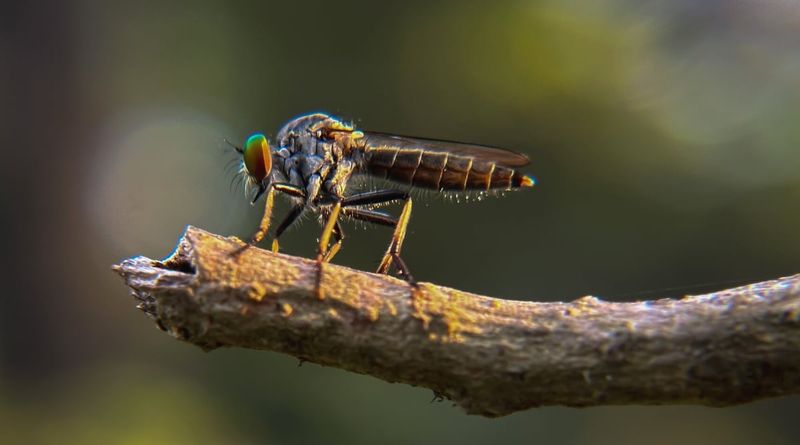
Leaving a robber fly alone outdoors is the right call. An adult perched near your tomatoes or beans is one generalist predator contributing to the natural food web of your garden, taking prey opportunistically and asking nothing of you in return.
NC State Extension’s robber fly profile frames the family as beneficial, and that assessment holds as long as expectations stay realistic.
Appreciation for the fly should run alongside, not instead of, regular scouting. Keep checking your plants for actual pest pressure: frass on leaves, chewed fruit, wilting stems, or sticky residue from aphids.
A robber fly hunting nearby does not mean those problems are absent or handled. NC State’s IPM framework places regular monitoring at the center of good vegetable garden management, and no single predator changes that need.
A garden that supports predatory insects while also staying on top of real pest problems is not a contradiction. The robber fly earns its place in the food web one captured insect at a time.