
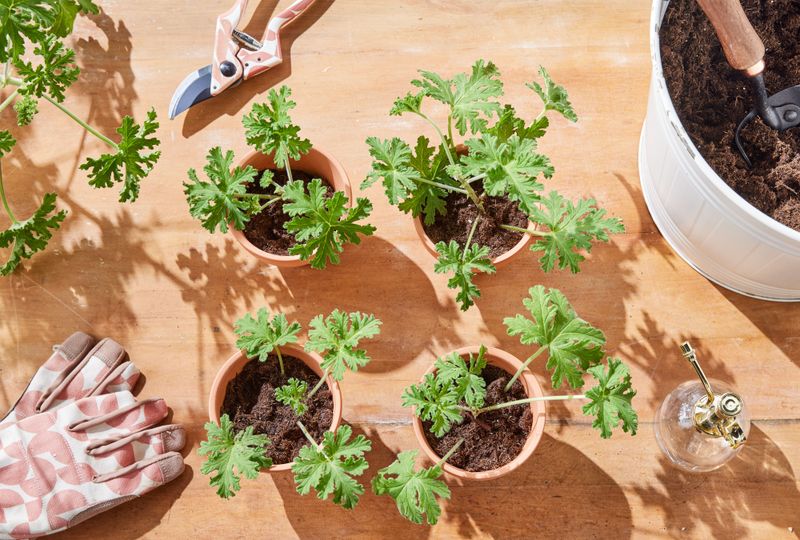
If you have a bedding geranium with flower color or leaf markings you love, you can use one healthy plant to grow several new ones before the season ends. Most plants sold as “geraniums” at garden centers are actually Pelargonium, a tender perennial that roots reliably from short stem cuttings.
Taking those cuttings while the parent is still strong gives you rooted plants to grow indoors and move back outside when your local weather allows. The payoff is real, but how many cuttings survive and how well they bloom depends on several factors worth knowing before you reach for the pruners.
Identify the bedding geranium you can propagate
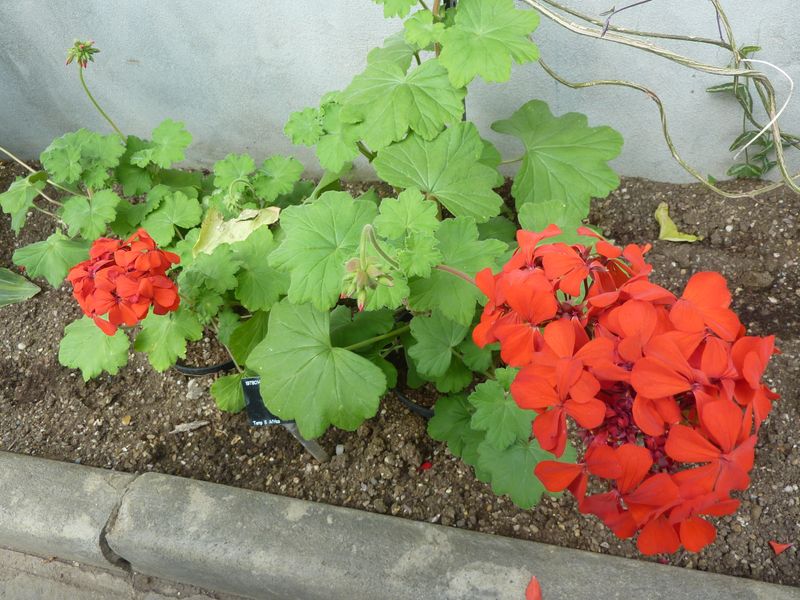
Walk through any garden center in Florida or Texas and you will find tables loaded with plants labeled simply “geranium.” Almost all of them are Pelargonium, a genus of tender perennials from South Africa that thrive in warm weather but cannot survive a hard freeze in the ground. The name confusion runs deep, and sorting it out matters before you start taking cuttings.
Common bedding types, zonal geraniums, ivy-leaf geraniums, scented geraniums, and Regal or Martha Washington geraniums are all Pelargonium. As University of Illinois Extension notes, true hardy Geraniums belong to a completely separate genus and overwinter differently in the ground.
The propagation and care advice in this guide applies to tender Pelargoniums, not to the perennial cranesbills you might grow as a border plant.
One practical reason to take cuttings rather than collect seed is that stem cuttings produce genetic copies of the parent. The University of Georgia Cooperative Extension confirms that vegetative propagation preserves traits such as flower color, leaf pattern, scent, and growth habit.
Seed-grown plants, especially from cultivars and hybrids, may not reproduce those traits reliably.
That said, a genetic copy is not a performance guarantee. A cutting that roots successfully still needs adequate light, proper moisture, and good conditions to grow into a strong, free-flowering plant.
The RHS growing guide for pelargoniums makes clear that these plants reward attentive care at every stage, from cutting to flowering pot.
Choose timing by plant condition and local weather
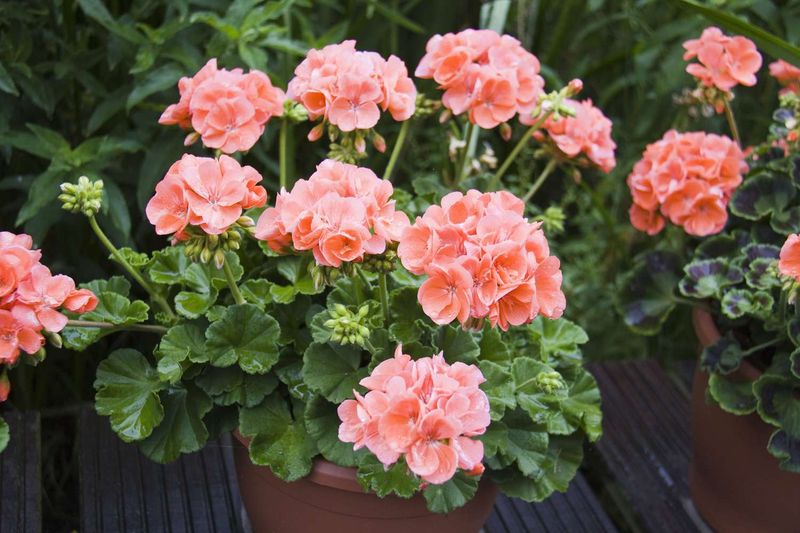
Late summer or early fall is often the practical window for taking cuttings from bedding Pelargoniums, but “now” means something different depending on where you garden in the South. The trigger that matters most is not the date on the calendar but the condition of the parent plant and the weather heading your way.
Florida gardeners face a split situation. UF/IFAS guidance on Pelargonium notes that geraniums can be planted outdoors in south and central Florida from roughly October through March, making them a cool-season crop in those regions.
North Florida gardeners may cut plants back in early fall and allow new growth to develop before cooler weather arrives. The takeaway is that Florida is not one climate, and your county’s typical low temperatures and frost dates should guide your timing more than any statewide rule.
Texas gardeners need to watch their local freeze risk and exposure rather than follow a single statewide date. Texas A&M AgriLife Extension emphasizes that active growth and approaching cold are the real cues.
A plant in San Antonio faces different timing than one in the Rio Grande Valley or the Panhandle.
Wherever you garden, Purdue Extension’s overwintering guidance reinforces the principle of acting while the plant is still vigorous. Do not wait until frost nips the foliage, severe heat has exhausted the plant, or stems show signs of decline.
A stressed or damaged parent produces weaker cuttings, and weaker cuttings are less likely to root well.
Select a healthy parent and take terminal cuttings
Before cutting anything, spend a few minutes looking the parent plant over carefully. Healthy Pelargonium stems are firm and green or reddish-green, with no soft spots, darkening at the base, or signs of rot.
Leaves should be uniformly colored and free of spots, rings, yellowing, or distorted edges.
Any plant showing leaf spots, wilting that does not recover overnight, darkened or mushy stems, stunted new growth, or other unexplained symptoms should not be used for propagation. The Texas Plant Disease Handbook lists bacterial blight, blackleg, and root rot among the diseases that affect Pelargoniums, and the UC IPM geranium disease guide notes that pathogens can be carried in cuttings, spread through tools, and transmitted through contaminated water or media.
Propagating from a sick plant multiplies the problem, not the plant.
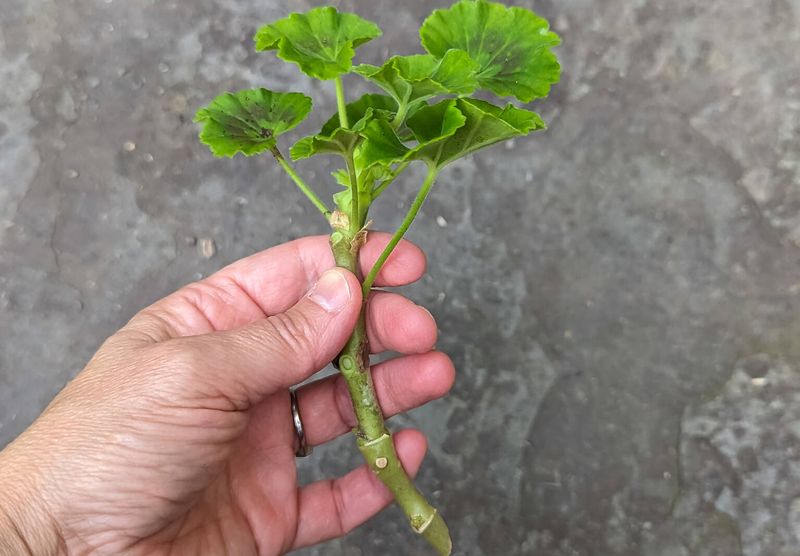
Once you have confirmed the parent is healthy, look for vigorous shoot tips near the top of the stems. UF/IFAS specifies terminal shoots with at least three nodes, and Iowa State University Extension gives a working length of 3 to 4 inches.
Use clean, sharp scissors or pruners and cut just below a node. Strip the lower leaves cleanly, leaving a small cluster of leaves at the top to support the cutting while roots develop.
One healthy parent can give you several cuttings, which creates the possibility of several new plants. How many of those cuttings actually root and grow into strong, blooming plants depends on cutting quality, care, and conditions, not on any fixed multiplication rate.
Build a clean, airy rooting setup
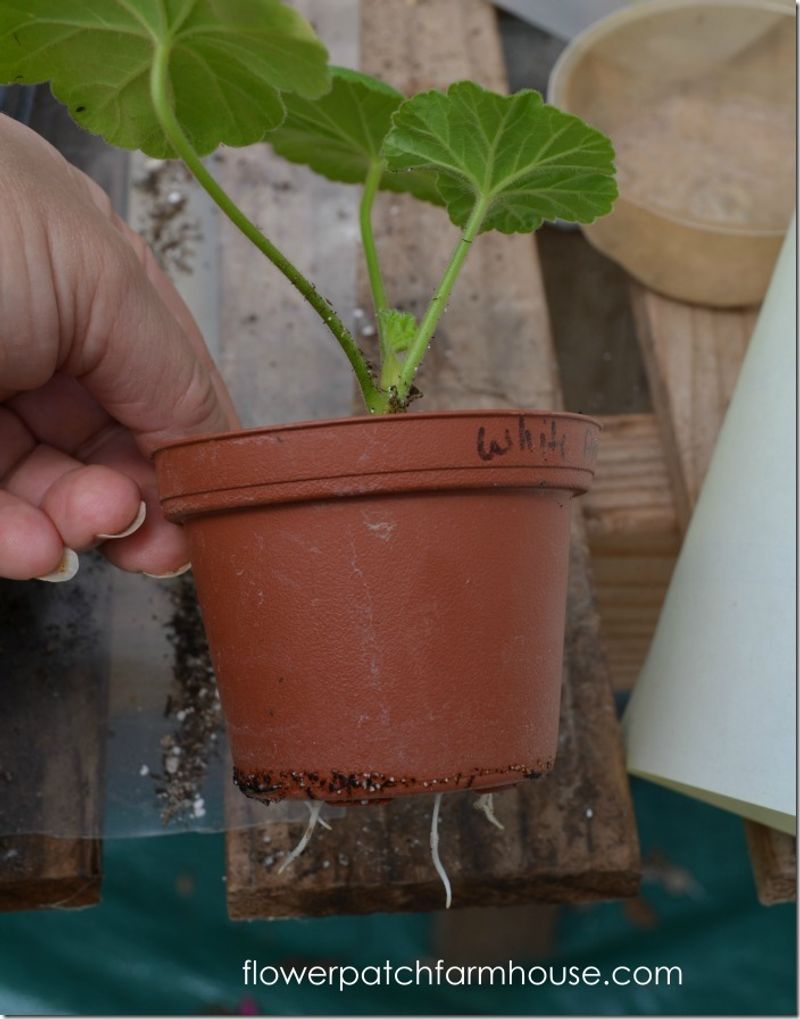
The medium you root cuttings in matters more than most gardeners expect. Ordinary garden soil is a poor choice indoors because it compacts easily, holds too much moisture, and may carry pathogens that thrive in warm, humid conditions.
What Pelargonium cuttings need instead is a medium that stays moist without staying wet and allows air to reach the developing roots.
Iowa State University Extension recommends perlite, vermiculite, coarse sand, or a sand-and-peat mixture for geranium cuttings. Purdue Extension also favors clean, aerated media over heavy or organic-rich soils for this purpose.
Use a container that has drainage holes so excess water can escape freely, and clean it with soap and water or a dilute bleach rinse if it has held plants before.
Rooting hormone is a topic worth understanding accurately. UF/IFAS propagation guidance states that herbaceous cuttings, including Pelargoniums, generally root without added auxin, though hormone may speed the process or improve root numbers.
Some Extension sources recommend it as a useful aid; others treat it as optional. If you choose to use rooting hormone powder, follow the product label carefully and avoid dipping cuttings directly into the shared container.
Instead, tap a small amount onto a separate surface, apply it to the cut end, and discard the remainder. That keeps the main supply free of moisture and potential contamination.
University of Illinois Extension’s propagation guidance reinforces the value of clean tools, clean containers, and fresh media for every new batch of cuttings.
Manage moisture, light, and ventilation while roots form
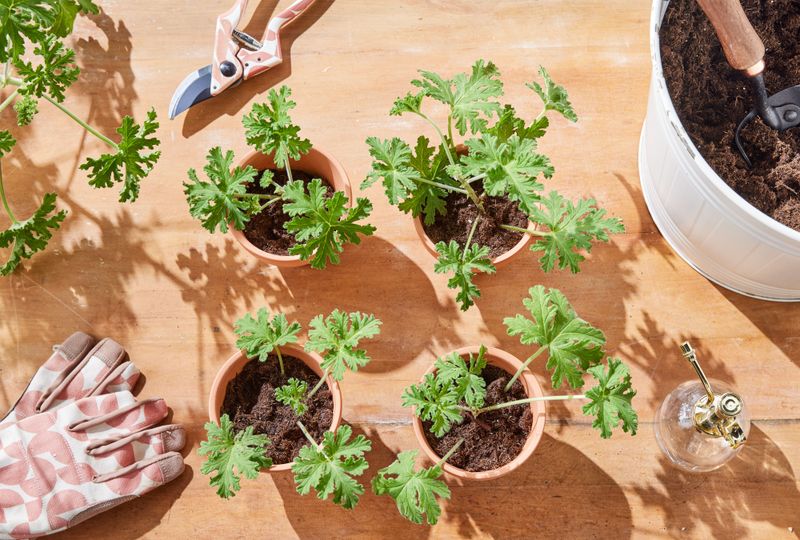
After inserting the cuttings into the prepared medium, water it gently until moisture reaches the bottom of the container. From that point, the goal is to keep the medium consistently moist but never soggy.
Saturated media cuts off oxygen to the base of the cutting and encourages rot before roots have a chance to form.
Iowa State University Extension recommends bright, indirect light for cuttings rather than hot direct sun. A south- or east-facing windowsill that receives strong but diffused light works well.
Avoid placing cuttings under plastic in a sunny window where temperatures can build quickly; that combination promotes fungal problems rather than root development.
A clear plastic bag or humidity dome placed loosely over the cuttings can reduce wilting while roots are absent. University of Illinois Extension advises monitoring any cover and ventilating it when condensation becomes heavy or mold appears.
Lift the bag for an hour or two each day, or prop it open slightly to allow air exchange. Remove it entirely once you see signs of new growth, which usually signals that roots are present.
How long rooting takes varies by cultivar, cutting quality, temperature, and light. University of Georgia Cooperative Extension and Texas A&M AgriLife Extension both describe a range of roughly 3 to 8 weeks across published guidance.
Treat that as an estimate rather than a deadline; some cuttings root faster, some slower, and a few will not root at all regardless of care.
Grow rooted cuttings into sturdy indoor plants
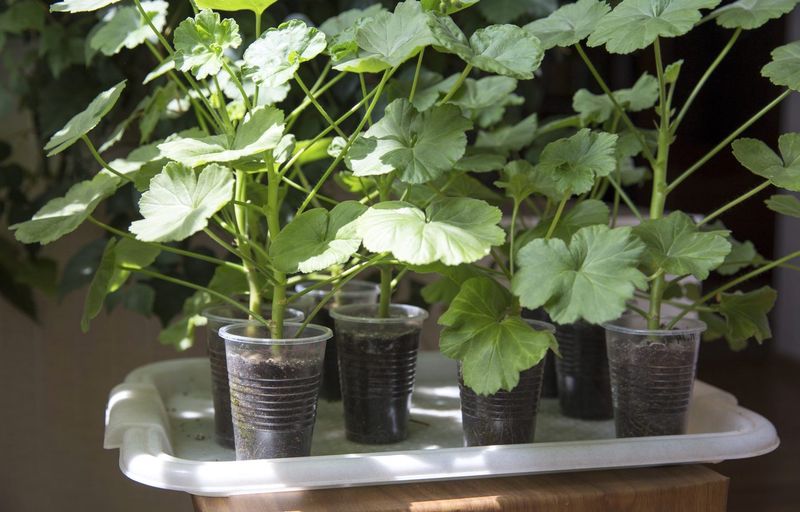
Rooting is a milestone, not a finish line. A cutting that has developed roots still needs several more weeks of attentive care before it becomes a plant strong enough to handle outdoor conditions or produce a reliable flush of flowers.
The clearest sign that a cutting has rooted is gentle resistance when you give it a very light tug, or new leaf growth emerging from the tip. At that point, Iowa State University Extension recommends moving each cutting into its own pot filled with a well-drained potting mix.
Crowding several rooted cuttings into one container slows development and makes moisture management harder.
Light becomes the most critical factor from this stage forward. University of Georgia Cooperative Extension notes that Pelargoniums grown indoors need as much bright light as possible to stay compact and develop flower buds.
A south-facing window is the best natural option; if that is not available, a simple LED grow light positioned a few inches above the foliage can make a meaningful difference. Plants that stretch toward a dim window grow leggy and produce fewer blooms, a problem that carries into the next season if it is not corrected early.
Colorado State University Extension’s overwintering guide suggests pinching the growing tips once plants are a few inches tall to encourage branching and a fuller shape. Pinching sets the plant back briefly but usually results in more stems and, eventually, more flower heads.
Keep watering moderate, letting the top inch of potting mix dry slightly between waterings, and avoid letting pots sit in standing water.
Protect plants through the Southern winter
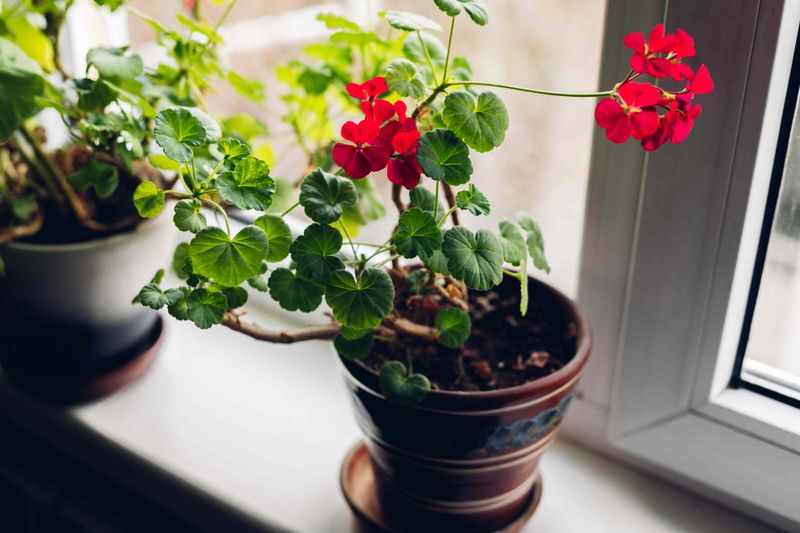
Overwintering Pelargoniums in the South is not a one-size-fits-all situation. What a gardener in Gainesville needs to do differs significantly from what works in Tampa or San Antonio, and the type of Pelargonium you are growing adds another layer of variation.
Florida gardeners in the central and southern parts of the state have a real advantage. UF/IFAS describes common bedding geraniums as useful cool-season plants in much of Florida, where they can be grown outdoors from roughly October through March.
North Florida gardeners face occasional freezes and should be ready to move container plants under cover when temperatures threaten to drop below 30 degrees Fahrenheit.
In Texas, the situation varies sharply by location. Texas A&M AgriLife Extension recommends protecting plants from freezing temperatures, which in central Texas can arrive suddenly and without much warning.
Keeping rooted cuttings in containers makes it easy to move them indoors on cold nights and back to a bright porch or patio on mild days.
Cultivar type matters here too. Clemson Cooperative Extension notes that ivy-leaf Pelargoniums prefer moderate temperatures and benefit from afternoon shade when heat exceeds 85 degrees Fahrenheit, while Regal types are not heat tolerant and perform better as houseplants during warm spells.
Colorado State University Extension advises keeping overwintering Pelargoniums in the brightest available indoor spot and watering sparingly during low-light periods to prevent root rot.
Return established plants outdoors when conditions suit them
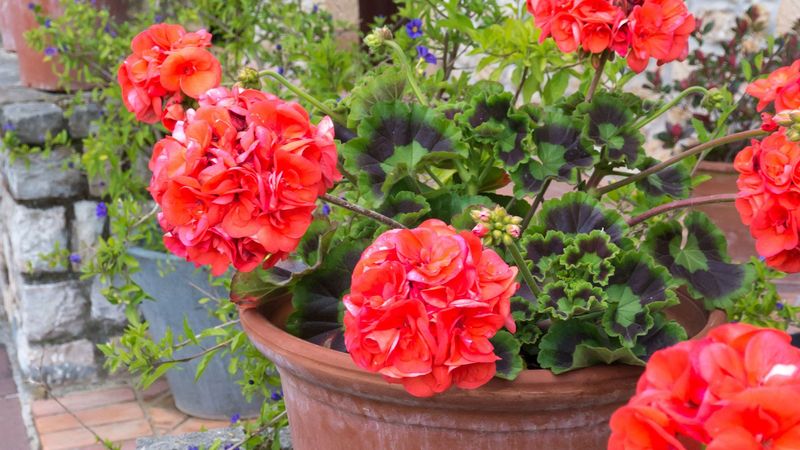
Moving indoor-grown Pelargoniums back outside too early is one of the most common ways to lose progress made over the winter. Plants that have spent months in a sheltered interior need time to adjust before they face full sun, wind, and fluctuating temperatures.
Hardening off is the standard approach: set plants outside in a shaded, protected spot for a few hours each day over one to two weeks, gradually increasing their exposure to direct sun and outdoor air. UF/IFAS ties outdoor planting in Florida to the local seasonal window rather than a specific date, which is the right framework for any Southern gardener.
In central and south Florida, that window may open in October; in north Florida and most of Texas, it is safer to wait until the risk of frost has passed reliably.
Clemson Cooperative Extension reminds gardeners to account for cultivar preferences when choosing a planting spot. Ivy-leaf types need protection from intense afternoon heat, and Regal types struggle once temperatures consistently climb above the mid-70s.
Zonal types are the most forgiving in warm Southern conditions, but even they benefit from afternoon shade in the hottest parts of summer.
University of Illinois Extension frames the whole propagation process honestly: cuttings from one healthy Pelargonium can preserve a favorite plant and may produce several new ones, but survival and flowering depend on light, moisture, disease prevention, plant strength, cultivar, and regional timing. Texas A&M AgriLife Extension supports this approach as a practical way to carry a valued plant forward.
Start by inspecting the parent: when it is healthy and actively growing, that is your cue to take cuttings, not the month, not a headline, and not a neighbor’s schedule. A plant worth saving tells you when it is ready.