
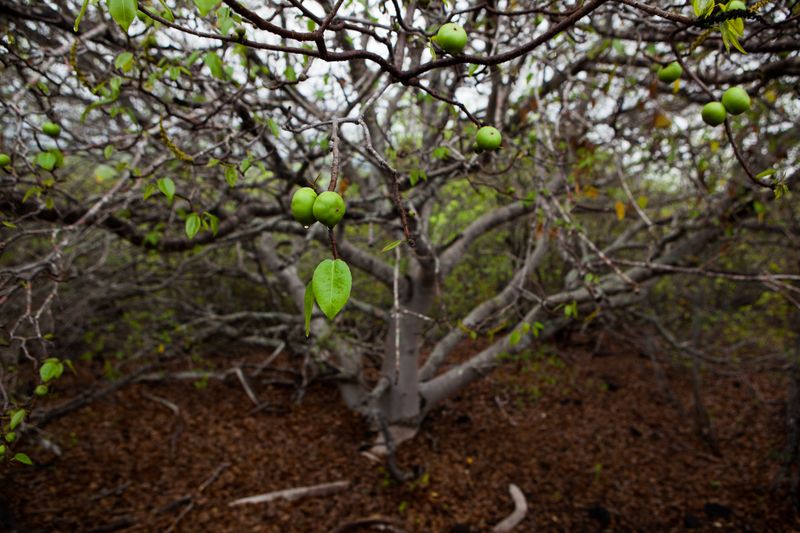
A small, ordinary-looking tree growing along South Florida’s coastlines has a reputation that far outpaces its modest size. Known as manchineel, it produces a milky sap capable of causing serious burns, and every part of the plant carries some level of hazard. Before you worry about the tree in your backyard, though, the full story is more nuanced than the alarming headlines suggest. Understanding what manchineel actually is, where it genuinely grows, and how to respond if you encounter it could one day protect you or someone you love.
The possible culprit is manchineel, not an ordinary yard tree
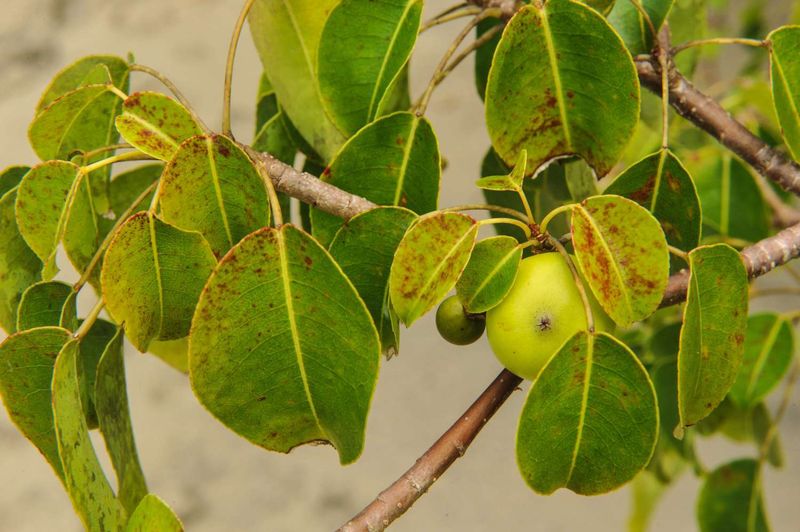
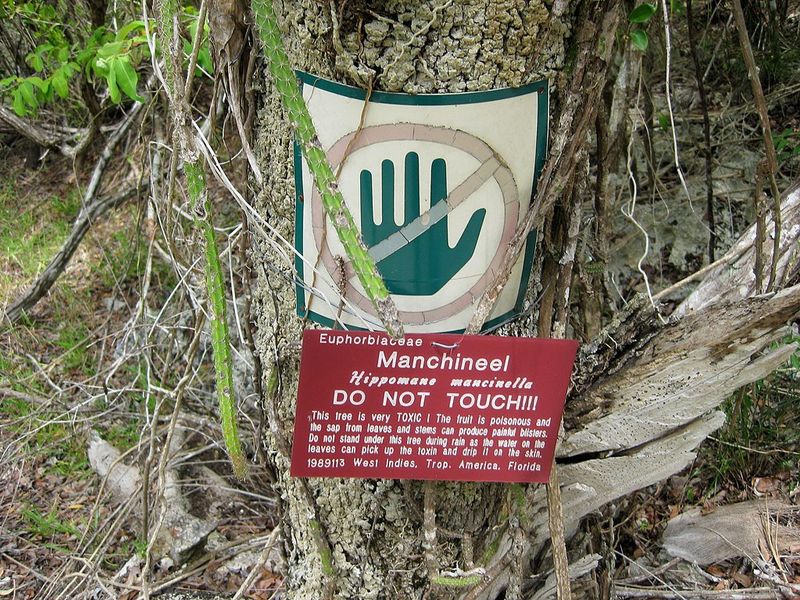
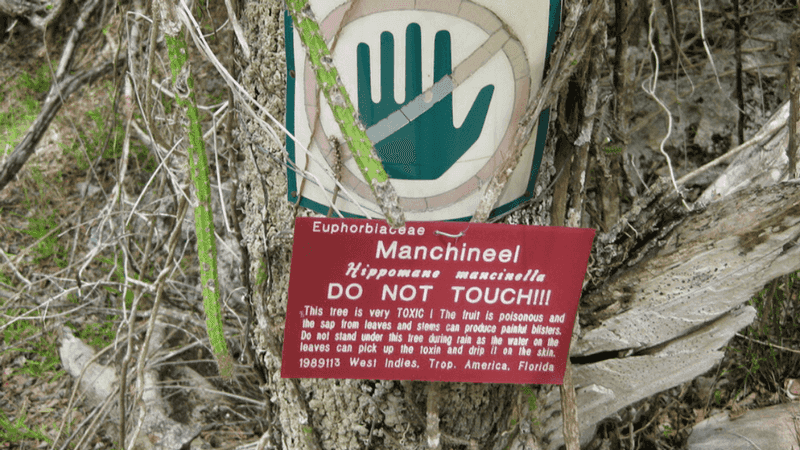
Manchineel, known scientifically as Hippomane mancinella, is the species most likely behind the alarming descriptions circulating about a dangerous South Florida tree. Common names include “manchineel” and “beach apple,” and the plant belongs to the spurge family, Euphorbiaceae, a group with a long history of latex-producing, toxic members. UF/IFAS documentation on manchineel confirms that all parts of the plant are considered poisonous, that its milky sap can produce burn-like blisters on skin, and that ingestion may be lethal.
That said, framing manchineel as a tree “hiding in South Florida yards” overstates where the plant actually grows. Conservation data tell a more precise story: Institute for Regional Conservation records document native manchineel occurrences in only three Florida county units, specifically Miami-Dade County, Monroe County Keys, and Monroe County mainland. Its documented habitats are coastal berms and rockland hammocks, not residential landscapes or typical suburban lots.
The species is listed as endangered in Florida, making it a genuinely rare plant within the state. Cultivated specimens can occasionally appear outside its native range, but that does not make manchineel a common fixture in home gardens or neighborhood yards. Identifying a specific tree as manchineel without expert confirmation is also a mistake worth avoiding: the plant’s features overlap with other species, and a photograph alone is not enough to establish what you are actually looking at.
Manchineel’s toxicity is real and well-documented, and the caution it deserves is equally real. What the evidence does not support is the idea that a deadly tree is probably already growing in the average South Florida yard. For most homeowners, the relevant question is not whether manchineel is in their garden, but whether they would recognize it and respond safely if they ever came across it in a coastal natural area or park.
Use several clues to recognize the plant without touching it
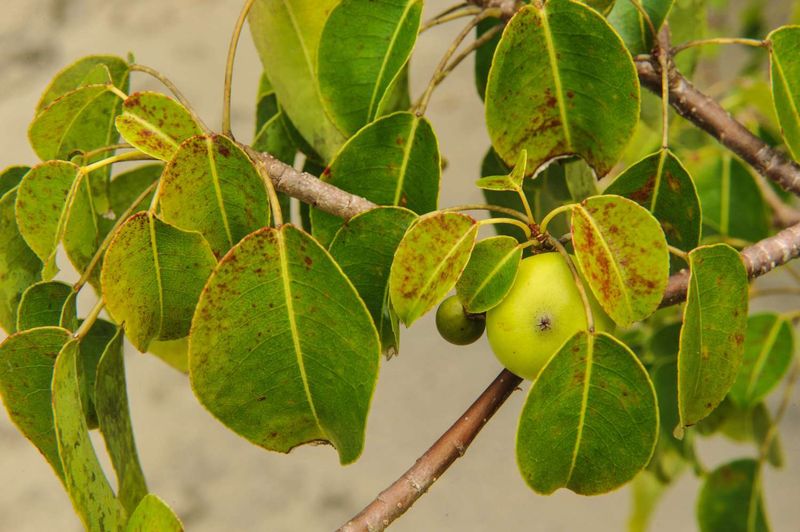
Recognizing manchineel from a safe distance requires looking at several features together, not just one. The plant can grow as a shrub or a tree reaching roughly 50 feet in height, though many specimens encountered in Florida are considerably smaller. Its bark is reddish to gray and noticeably deeply cracked or furrowed, which sets it apart from smoother-barked coastal trees nearby.
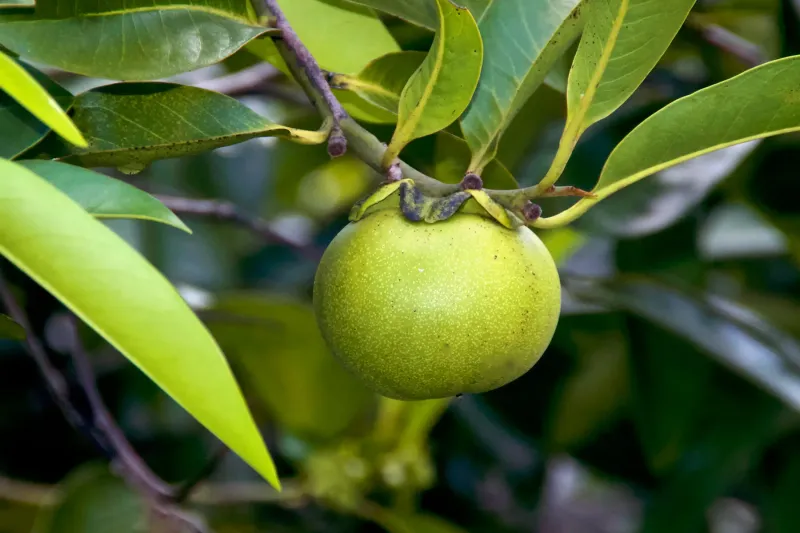
Leaf shape offers another useful clue. Manchineel has alternate, simple leaves that are finely toothed along the edges and typically measure about 2 to 4 inches in length. One of the more diagnostic features is a small gland located at the base of each leaf where the blade meets the stem. That gland is easy to miss at a glance, but it is a meaningful botanical marker when you are trying to distinguish manchineel from visually similar species.
The fruits are small, round, and green, sometimes turning greenish-yellow as they ripen, and they measure roughly 1 to 2 inches across. Their resemblance to a tiny apple is what gives manchineel one of its common names, “beach apple,” and it is precisely that ordinary appearance that makes the plant dangerous to curious passersby. UF/IFAS extension guidance on manchineel emphasizes that the fruit’s apple-like look does not establish identification on its own.
Habitat context matters as much as any single physical feature. Manchineel in Florida grows in coastal berms and rockland hammocks, not in manicured yards or garden beds. If you are walking a coastal trail in Miami-Dade or Monroe County and spot a small tree with cracked bark, toothed leaves, a leaf-base gland, and tiny apple-like fruits, treat it with caution. For a definitive identification, the Atlas of Florida Plants, a local UF/IFAS Extension office, or a qualified arborist can provide expert confirmation without putting you at risk.
The plant can injure through sap, smoke, and possible runoff
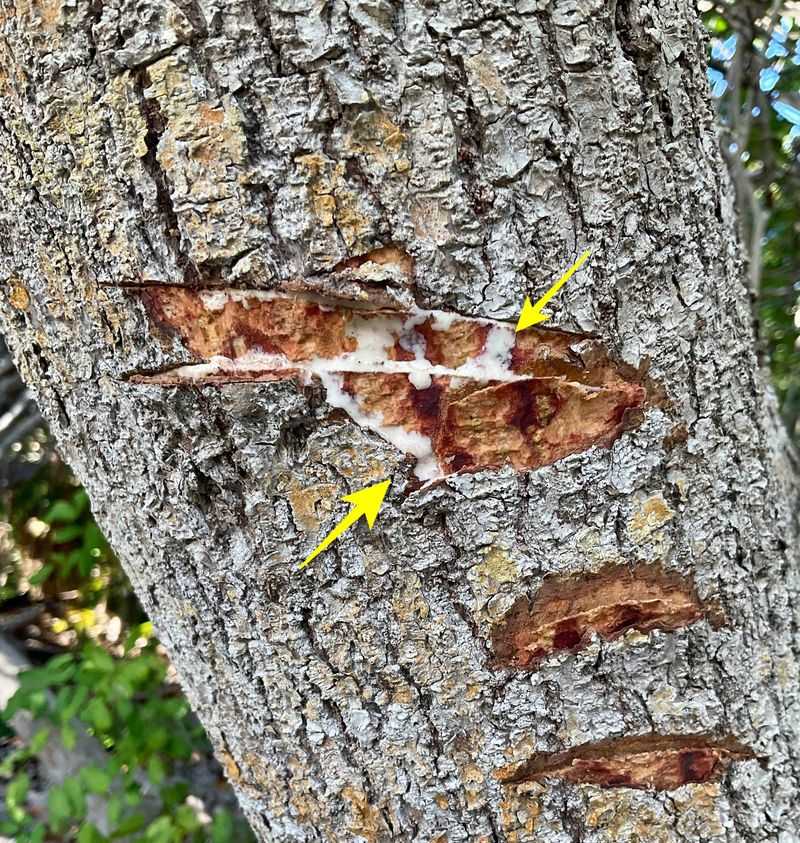
Manchineel’s hazard does not come from a single source. The milky sap present in the leaves, twigs, bark, fruit, and other parts of the plant is the primary agent of injury. Skin contact with that sap can cause burn-like blistering, and UF/IFAS documentation describes the reaction as capable of producing serious tissue damage. The severity of a skin reaction depends on the amount of sap involved, how long it stays in contact with skin, and individual differences in sensitivity.
Burning manchineel wood creates a separate and serious problem. Smoke from the wood has been associated with severe eye irritation and, in some accounts, temporary blindness. This is one reason why the plant should never be treated as ordinary yard waste to be cleared with a bonfire. Even dried wood retains enough irritant potential that burning it poses real risks, and no household method of preparation makes that process safe.
Rain adds a third route of exposure that is worth understanding carefully. UF/IFAS warns that water running off manchineel can carry sap with it, and Poison Control’s guidance on spurge sap supports general caution around sap-producing plants in this family. What the available sources do not establish is exactly how often rain-mediated exposure causes injury or how severe those outcomes typically are. The practical takeaway is straightforward: avoid sheltering under a suspected manchineel tree during rain.
That precaution is warranted without needing to claim that every raindrop carries a guaranteed dose of harmful sap.
Eye exposure deserves particular attention because the eyes are far more sensitive to irritants than intact skin. If sap or contaminated water reaches the eyes, Poison Control’s eye-exposure guidance recommends rinsing immediately with comfortable-temperature water for 15 to 20 minutes and then seeking expert advice. Waiting to see whether symptoms develop is not the right response when the eyes are involved.
Fruit poisoning can be severe without making every case fatal
What actually happens when someone swallows manchineel fruit or its juice? Clinical records provide a more detailed answer than broad warnings alone. A retrospective series of 97 manchineel fruit poisoning cases reported to French Poison Control Centers found that the most common symptoms were mouth and throat pain, abdominal pain, and diarrhea. Most patients in that series experienced painful gastrointestinal poisoning rather than life-threatening collapse, though the pain described was significant and the experience was far from minor.
A separate case documented in the medical literature illustrates how quickly even a small amount can cause serious injury. A BMJ case report on manchineel ingestion described oral and esophageal ulceration along with severe swelling after only a small quantity of fruit juice was swallowed. The patient experienced intense burning pain in the mouth and throat almost immediately, and the damage extended into the esophagus. That case makes clear that even a cautious taste of the fruit carries meaningful risk of serious injury.
Reconciling those clinical reports with the warning that ingestion may be lethal requires some nuance. UF/IFAS states plainly that eating any part of the plant may be lethal, and that warning should be taken seriously. At the same time, the 97-case series shows that outcomes vary, and the dominant pattern in that dataset was severe but survivable poisoning rather than death in every instance. The evidence does not support saying that a single bite guarantees a fatal outcome, nor does it support dismissing the risk as trivial.
The practical message is consistent regardless of where on that spectrum a particular exposure might fall: there is no safe amount to taste, no variety that is less harmful, and no way to judge severity in advance. Anyone who swallows any part of manchineel, or suspects they might have, should contact Poison Control at 1-800-222-1222 without delay and follow the guidance they receive.
A rattlesnake bite is the wrong toxicity yardstick
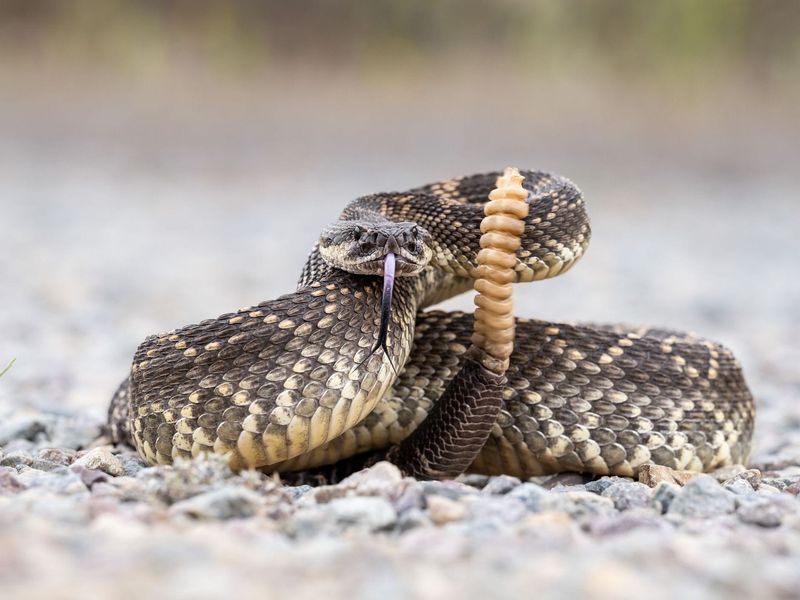
Calling manchineel “more toxic than a rattlesnake bite” makes for a striking headline, but it does not hold up as a scientific comparison. The two hazards work through entirely different mechanisms, and ranking them without specifying exposure route, dose, timing, and outcome is like comparing a sunburn to a broken bone because both cause pain.
Manchineel causes injury through toxic or caustic plant latex. That sap can reach the body through skin contact, ingestion, smoke inhalation, or possible rain-mediated runoff. Poison Control’s guidance on spurge family sap describes the mechanism as irritant and toxic plant-latex exposure, a category that involves external contact and absorption rather than injection. A rattlesnake bite, by contrast, delivers venom directly into tissue through hollow fangs.
That venom contains a complex mixture of enzymes and proteins that begin breaking down tissue, disrupting blood clotting, and affecting the nervous system almost immediately after injection.
The symptoms, timelines, and treatments for these two types of exposure are fundamentally different. Manchineel sap causes blistering and burning at the contact site, while rattlesnake venom can cause local tissue destruction, systemic bleeding problems, and in serious cases, organ failure. CDC information on venomous snakebites notes that roughly 7,000 to 8,000 venomous snakebites occur in the United States each year, causing about five deaths annually, with rattlesnake bites capable of producing permanent injury even when they do not kill.
Both hazards are serious. Neither deserves to be minimized or dismissed. What the comparison fails to do is give readers any useful information about either one, because “more toxic” only means something when you define what substance, at what dose, by what route, measured by what outcome, over what time period. Without those specifics, the ranking is more alarming than informative, and alarm without accuracy does not help anyone stay safe.
Leave suspected trees alone and use professional help
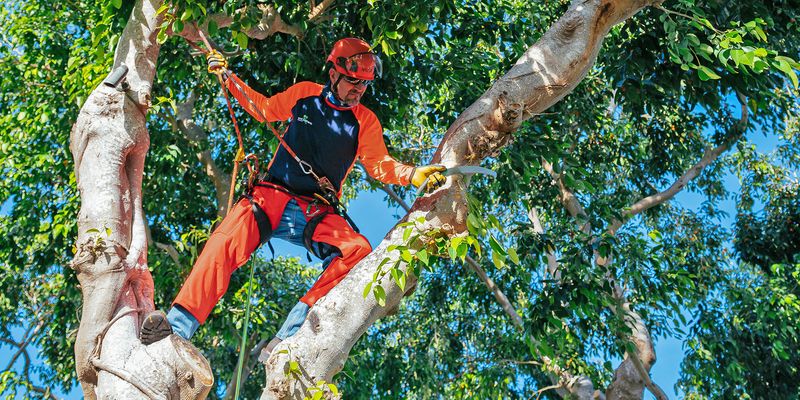
Knowing what manchineel can do should change how you respond if you ever suspect you have found one. The right reaction is not to investigate more closely, prune a branch for a better look, or try to remove it yourself. Every one of those actions puts you in direct contact with the sap, and no pair of garden gloves provides adequate protection against a plant whose latex can blister skin through incidental contact.
UF/IFAS Extension Volusia County guidance on manchineel specifically advises professional tree service for removal because of the plant’s toxicity. That recommendation extends to any interaction with a suspected specimen: do not cut it, prune it, burn the trimmings, or handle fallen fruit or leaves. Children and pets should be kept well away from the area, and the site should be treated as off-limits until a qualified professional can assess it.
Photograph identification also has real limits here. A photograph of apple-like fruits or finely toothed leaves can raise a reasonable suspicion, but it cannot confirm a species. Manchineel shares visual traits with other plants, and UF/IFAS manchineel documentation makes clear that the combination of habitat, bark, leaf features, the leaf-base gland, and fruit together establish identification far more reliably than any single characteristic alone.
For expert help, start with your local UF/IFAS Extension office, which can connect you with a county agent familiar with Florida’s native plants. A certified arborist with experience in South Florida species is another strong option. If the suspected tree is on public land, a park ranger or land manager is the appropriate contact. Getting a professional confirmation before taking any action protects you, your family, and, given manchineel’s endangered status in Florida, a genuinely rare native species that plays a role in its coastal ecosystem.
Take route-specific steps after an exposure
Speed and specificity both matter after any contact with manchineel. What you do first depends on which part of the body was exposed, and doing the right thing for the wrong exposure type can delay effective care. Here is what the evidence supports for each route.
Skin contact is the most common scenario. Remove any clothing that may have absorbed sap, then wash the affected skin gently but thoroughly with soap and water. Poison Control’s guidance for spurge family sap on skin supports this approach for irritating plant latex exposures. Avoid scrubbing hard, which can drive irritants deeper into broken skin, and avoid applying home remedies that have not been recommended by a medical professional.
Eye exposure requires immediate action. Rinse the affected eye or eyes with comfortable-temperature water continuously for 15 to 20 minutes. Poison Control’s eye-exposure protocol recommends this rinse duration for chemical or plant-sap exposures, and after rinsing you should seek expert advice rather than waiting to see how the eye responds over time.
Swallowing any part of the plant, inhaling smoke from burning wood, or experiencing severe pain, significant swelling, vision changes, or difficulty breathing all call for a phone call to Poison Control at 1-800-222-1222. Poison Control’s immediate assistance line is staffed around the clock by specialists who can guide you through next steps based on the specific exposure. The Florida Poison Control Centers’ manchineel resource reinforces that this call should happen promptly, not after symptoms have had time to worsen.
Reserve a call to 911 for emergencies that cannot wait: collapse, seizure, inability to awaken, or breathing that sounds abnormal or stops. Those situations require emergency responders on scene, not a phone consultation. When in doubt about which number to call first, start with Poison Control and follow their instructions exactly.
Recognition without contact is the useful takeaway
Manchineel is a genuinely hazardous plant. Its sap can blister skin, its smoke can injure eyes, its fruit can cause serious poisoning, and UF/IFAS documentation warns that exposure to or ingestion of plant parts may be lethal. That warning deserves to be taken seriously, not softened.
At the same time, conservation records from the Institute for Regional Conservation place manchineel as a rare, endangered species in Florida, concentrated in coastal berms and rockland hammocks in Miami-Dade and Monroe counties. A photograph of apple-like fruits cannot confirm it. A blanket comparison to rattlesnake venom does not help you assess your actual risk. And the idea that it is probably already growing in your backyard does not match what the documented range shows.
The most protective thing you can do is learn what the plant looks like from a safe distance, avoid touching any tree you cannot confidently identify, and contact Poison Control at 1-800-222-1222 promptly if any exposure occurs. Caution grounded in accurate information is far more useful than fear built on an overstated headline. The tree that warrants the most respect is the one you recognize before you ever reach out to touch it.