
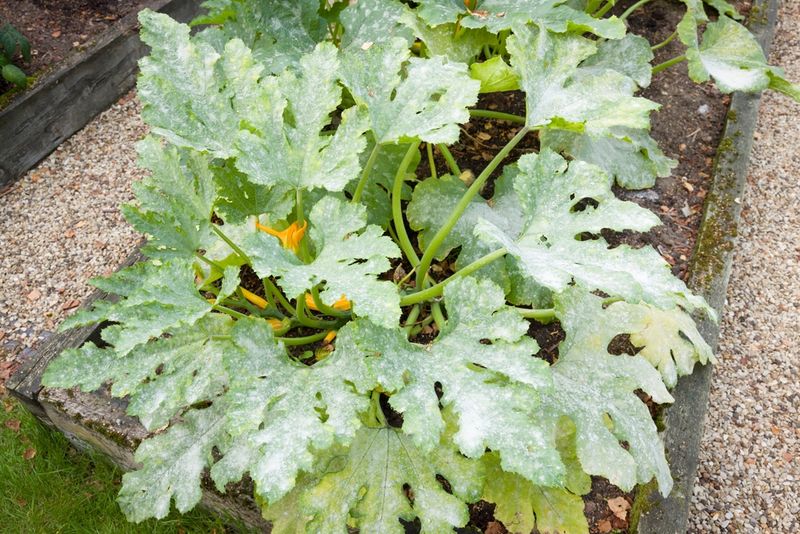
Spotting white or silvery patches on your zucchini leaves can send a gardener into a panic, especially when the plants seemed perfectly healthy just days before. Before you reach for a spray bottle, though, it pays to take a closer look, because not every pale marking on a zucchini leaf signals a disease.
Some patches are harmless features of the variety itself, while others do point to cucurbit powdery mildew, a fungal problem that can spread across the plant if left unchecked. Knowing which one you are dealing with makes all the difference in how you respond.
First, separate mildew from natural silver markings
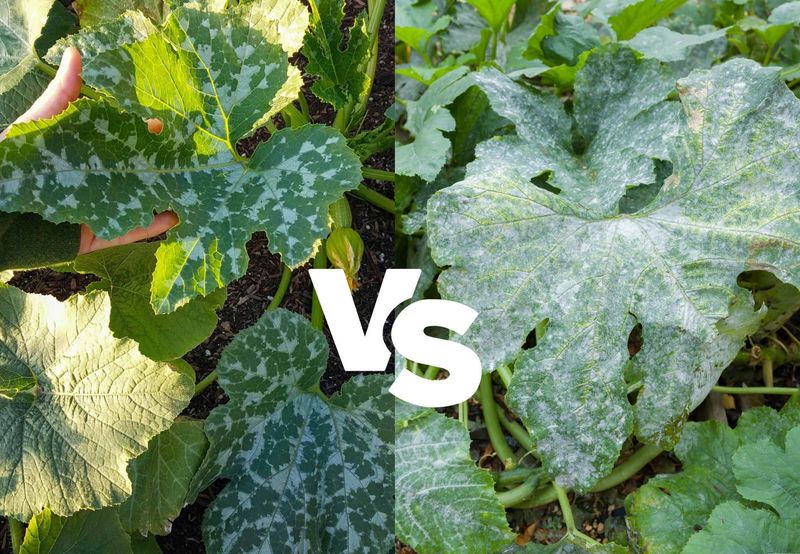
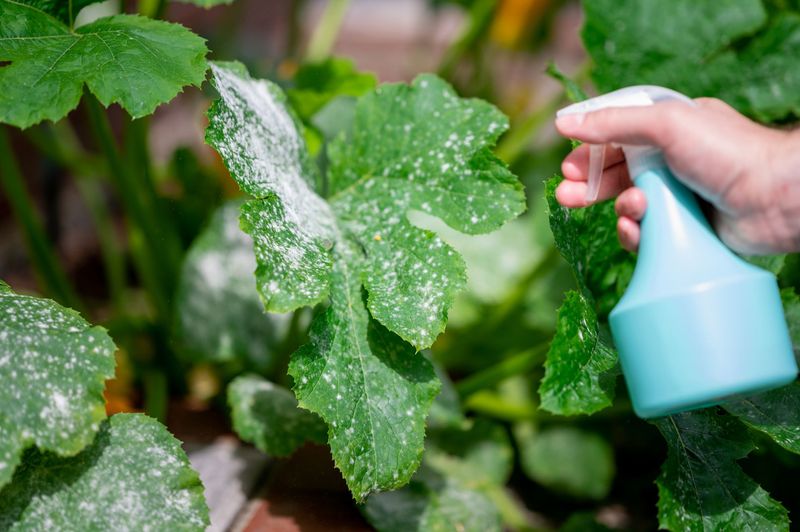
Before assuming the worst, hold the leaf up and look closely at what you are actually seeing. True cucurbit powdery mildew starts as discrete white or gray-white fungal patches that grow outward and eventually merge across the leaf surface.
According to UC IPM’s cucurbit powdery mildew guidance, the coating can appear on the upper or lower leaf surface and may also spread onto stems and petioles. As the infection progresses, affected leaves can turn yellow, begin to curl, brown, and eventually become papery and drop from the plant.
The key diagnostic clue is that fungal growth expands over time and can be rubbed or brushed away with your finger, leaving a smear rather than a permanent mark. That behavior sets it apart from something many gardeners mistake for disease: the natural silver or white patterning found on certain zucchini varieties.
As University of Minnesota Extension’s vegetable IPM update documents, some varieties naturally carry symmetrical, angular markings that run along the veins rather than spreading across the blade like a colony. These fixed markings do not enlarge, cannot be rubbed off, and require no treatment at all.
The “usually powdery mildew” claim in the title applies only when the growth looks like expanding, flour-like material that behaves like a fungal colony, not when the markings are stable and follow the leaf’s natural architecture.
Late-summer weather sets the stage, not the diagnosis
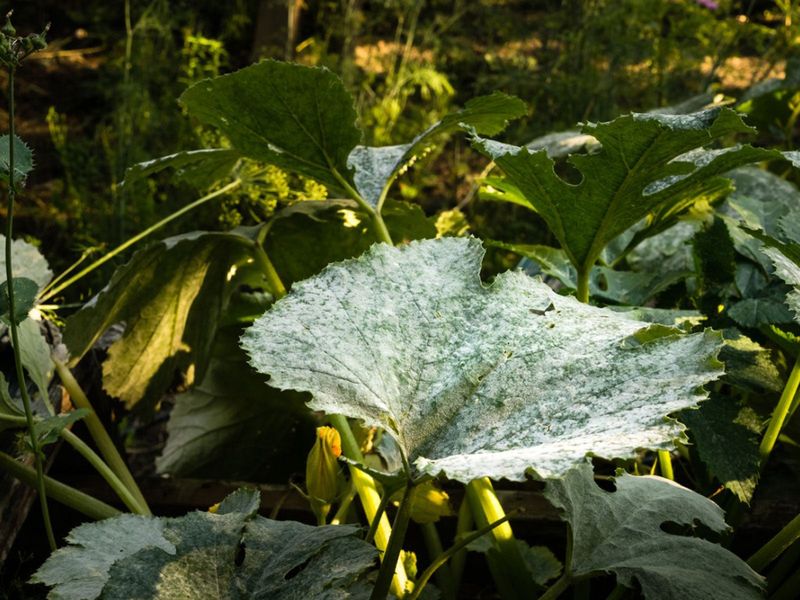
Gardeners often notice powdery mildew for the first time in late summer, and there is a logical reason for that, though it is not as simple as “heat causes mildew.” The disease builds through the growing season and becomes more visible as the plant matures, the canopy thickens, and conditions within the foliage shift. Utah State University Extension’s cucurbit powdery mildew guide explains that the fungus favors moderate-to-warm temperatures combined with humidity or dew inside a dense canopy, rather than extreme heat or intense direct sunlight, which can actually suppress spore development.
Powdery mildew does not need rain or persistently wet leaf surfaces to take hold, which surprises many gardeners. What it does need is the kind of still, humid air that builds up inside a crowded, shaded plant canopy on warm nights.
Poor ventilation, plant stress, and dense foliage all contribute to conditions the fungus exploits.
Regional patterns matter here, and Southern gardeners should not apply a single nationwide rule. Florida EDIS squash disease guidance notes that powdery mildew is a recurring problem that can appear on young leaves, including in south Florida, and that the fungus can become problematic during relatively dry periods.
Meanwhile, Texas A&M AgriLife cucurbit disease information describes the disease as favoring cool, dry weather, which makes a blanket “hot weather causes mildew” statement misleading for Texas readers. Warm nights, humid air near the foliage, shade, and plant stress are a safer combined explanation than pointing at heat alone.
Inspect both sides before calling it another disease
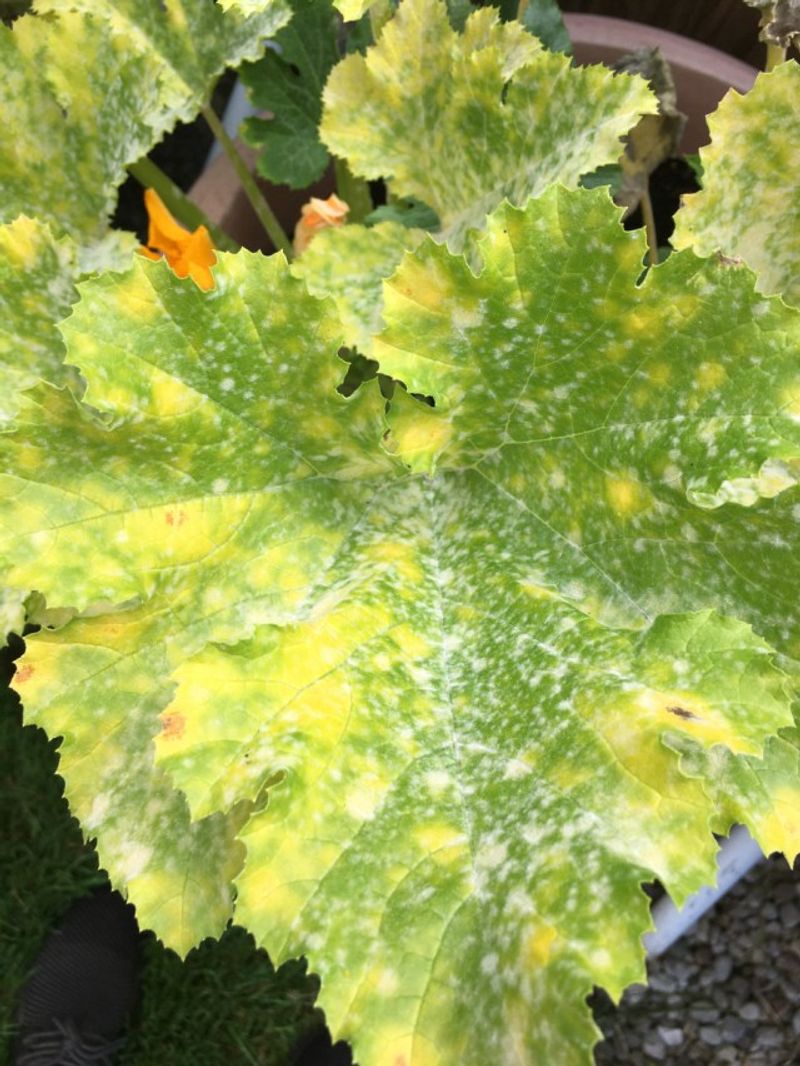
Rushing to treat powdery mildew when the real problem is something else can waste time and money, and occasionally make things worse. Flip the leaf over and examine both surfaces carefully before settling on a diagnosis.
Cucurbit powdery mildew produces a flour-like white or gray-white coating that can appear on either surface. Downy mildew looks quite different: it typically causes angular yellow-to-brown lesions on the upper leaf surface, and under wet or highly humid conditions, University of Florida EDIS cucurbit downy mildew documentation describes gray, purple, or dark sporulation developing on the leaf underside.
That underside coloration is the clearest separator between the two diseases when both are possible.
When inspecting for either problem, start with the oldest leaves and the densest, shadiest sections of the plant. University of New Hampshire Extension vegetable IPM reports note that cucurbit powdery mildew tends to establish in older foliage or within crowded canopy zones first, so those areas give you the clearest early evidence.
If the symptoms do not clearly match powdery mildew or downy mildew, acknowledge that uncertainty rather than forcing a diagnosis. Treating for the wrong disease, or treating a variety’s natural markings as a disease at all, is not a neutral action.
Open the canopy and change how you water
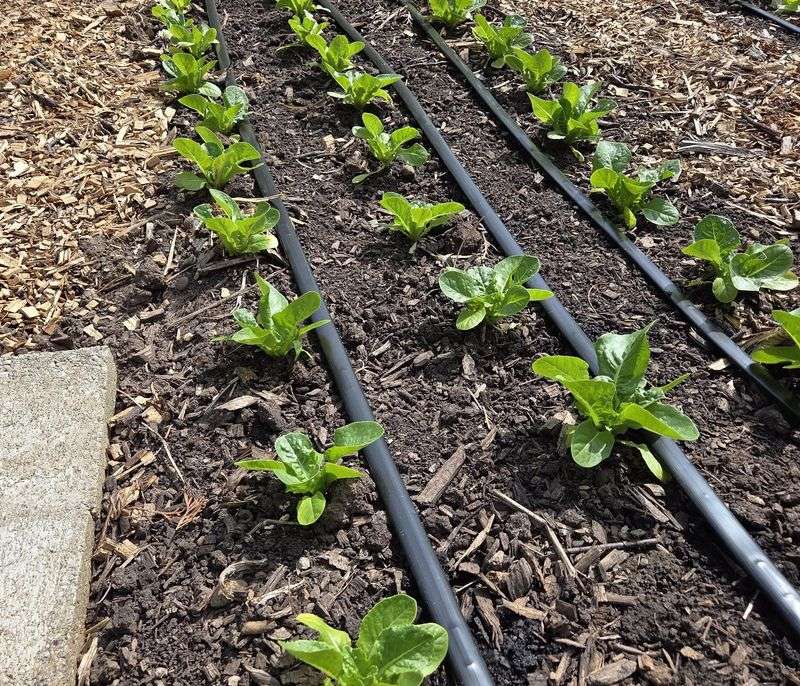
Once you have confirmed expanding, flour-like growth rather than natural markings, the first response is cultural rather than chemical. Improving airflow through and around the plant is one of the most practical steps you can take.
Utah State University Extension’s vegetable powdery mildew notes recommend controlling weeds, maintaining appropriate plant spacing, and reducing excessive canopy density to promote better air movement and lower the humidity that collects inside dense foliage.
How you water also matters more than many gardeners realize. Drip irrigation or any method that delivers water directly to the soil rather than onto the leaves is strongly preferred.
Water in the morning when possible so that any incidental moisture near the plant dries out during the day rather than sitting through a humid night. UC IPM’s cucurbit powdery mildew resource specifically recommends avoiding overhead irrigation for cucurbit disease management.
One piece of advice circulates online that is worth addressing directly: spraying water on leaves to wash off or kill powdery mildew is not supported and is not recommended. Powdery mildew does not require free water to infect, and routinely wetting the canopy can create the kind of humid surface conditions the fungus prefers.
These cultural steps reduce favorable humidity and support plant health, but they will not instantly remove established mildew growth that is already present on the leaves.
Prune the worst leaves without stripping the plant
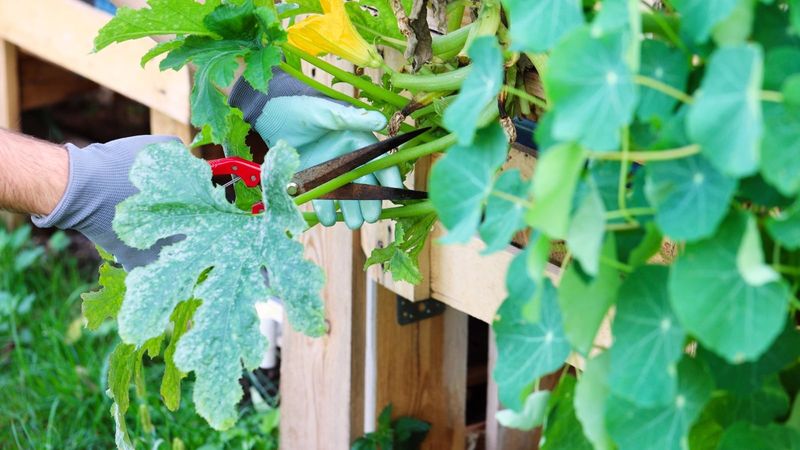
Selective leaf removal is a useful tool, but the word “selective” carries real weight here. The goal is to take off leaves that are badly infected, yellowing, browning, or clearly declining, not to strip every leaf that shows a spot or two.
UC IPM’s cucurbit powdery mildew guide cautions that removing severely infected material can reduce inoculum and improve airflow, but excessive pruning reduces the plant’s photosynthetic capacity. Fewer functioning leaves means less energy for the plant and, critically, less natural shading for developing fruit, which can lead to sunscald on exposed zucchini.
When you remove diseased leaves, do not leave them lying in the garden bed. Bag or dispose of them away from the garden to avoid leaving fungal spores where they can spread.
Utah State University Extension’s squash FAQ includes removing infected plant parts and disposing of them as a standard management step.
After the season ends, clearing out diseased plant debris is a reasonable sanitation habit that may reduce the amount of inoculum left in the bed. That said, this should be framed as general garden hygiene rather than a guaranteed method of eliminating overwintering mildew or preventing recurrence.
Powdery mildew dynamics vary by location, and end-of-season cleanup is one layer of management, not a complete solution on its own.
Use labeled treatments early and cautiously
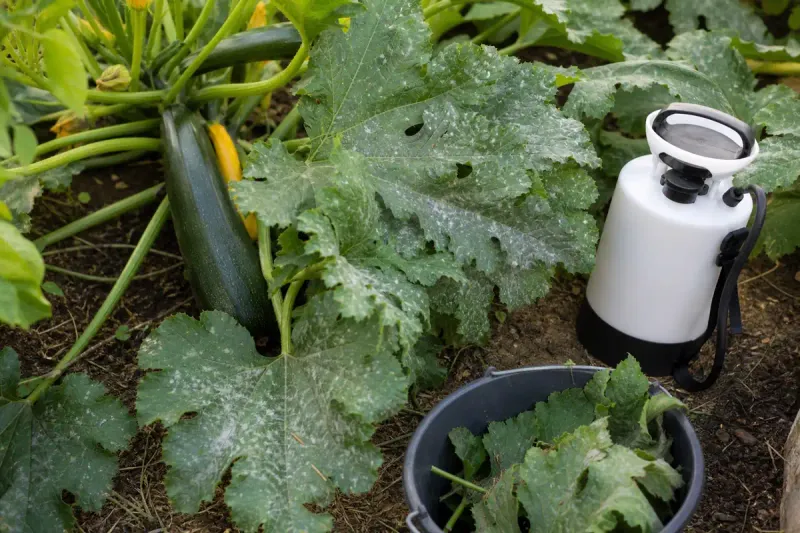
Fungicide products are an option worth considering when you catch powdery mildew early, but they work best at the first signs of disease rather than after leaves are heavily coated. UC IPM’s pest notes on powdery mildew in vegetables make clear that these products primarily protect new growth and may suppress or slow an existing infection.
They are not a cure for leaves that are already badly damaged.
Several types of products may be labeled for cucurbit powdery mildew, including sulfur, horticultural or plant-based oils, potassium bicarbonate, neem oil, and biological agents. Each carries its own set of conditions, restrictions, and risks.
Sulfur can be effective, but cucurbit varieties may be sensitive to it, and NPIC’s sulfur pesticide fact sheet and extension guidance both caution against applying sulfur during very hot conditions. Many extension sources commonly warn against applications at or above 90 degrees F, though the specific threshold on your product label controls.
Horticultural oils can help with mild to moderate infections, but should not go on drought-stressed plants or plants already exposed to high temperatures. Colorado State University Extension’s powdery mildew resource notes that oil and sulfur applications may need to be separated, with some guidance suggesting at least two weeks between them unless the label specifies otherwise.
Household baking-soda mixtures are sometimes mentioned online, but they are not interchangeable with a registered potassium bicarbonate product and can injure foliage. Because zucchini is a food crop, harvest intervals matter.
Always read the current product label, confirm the crop is listed, and check your state’s registration rules before applying anything. EPA pesticide label guidance explains why the label is the legal document that governs every application.
Choose resistant cultivars and manage next season’s canopy
Planning ahead reduces how hard you have to fight this problem in future seasons. When selecting seeds or transplants, look for varieties that the seed supplier describes as powdery-mildew resistant or tolerant.
University of New Hampshire Extension’s zucchini variety trial research confirms that cultivars differ meaningfully in their susceptibility. Resistance lowers the odds and may slow disease progression, but it is not a guarantee that a plant will stay disease-free under severe pressure.
Beyond variety selection, the cultural practices covered earlier carry over directly into next season’s planning. Appropriate spacing from the start, consistent weed control, soil-directed watering, and keeping the canopy from becoming excessively dense all reduce the conditions that favor mildew.
These are repeatable habits rather than one-time fixes, and they compound over time as you get to know your specific garden’s airflow and moisture patterns.
One concern that sometimes comes up is whether zucchini mildew will spread to roses, grapes, or other plants in the yard. University of Minnesota Extension’s plant disease resource notes that many powdery mildew fungi are host-specific, meaning the pathogen on your zucchini is not automatically the same one affecting ornamental plants nearby.
You do not need a yard-wide treatment response. Volunteer cucurbit plants or nearby alternate hosts could be a contributing factor in some situations, but that is a location-specific consideration rather than a universal rule.
A few affected leaves do not end the harvest
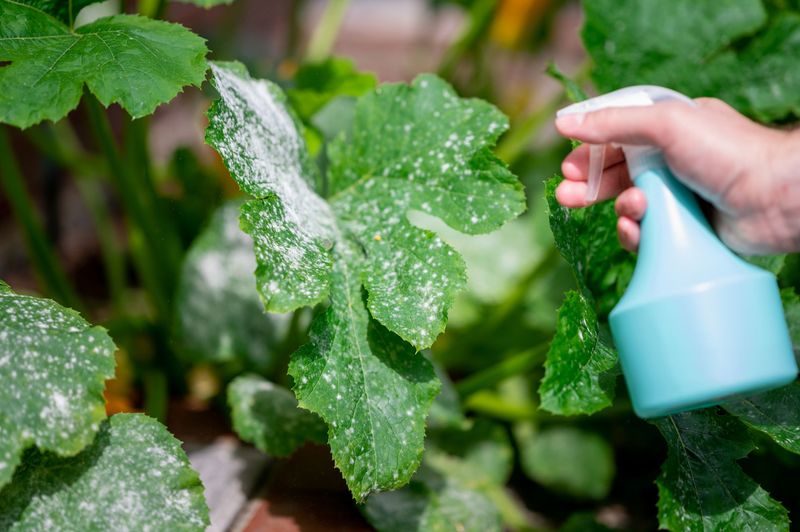
Finding powdery mildew on your zucchini is not a death sentence for the plant. University of Minnesota Extension’s mid-summer garden challenges article frames the real concern as progressive leaf loss, declining vigor, premature plant decline, and reduced yield rather than immediate plant death from a few infected leaves.
Confirm that the patches are expanding and flour-like rather than fixed varietal markings, then act: open the canopy, water at the soil, remove only the worst leaves, and consider a label-compliant treatment early if the infection is spreading. Watch for continuing leaf loss and declining plant energy as the signs that the situation is worsening.
Zucchini plants that get prompt cultural attention often keep producing through the rest of the season. The goal is to slow the disease’s progress and protect new growth, not to achieve a perfect cure.
A plant with a few mildewed lower leaves and healthy upper growth still has plenty of season left in it.