
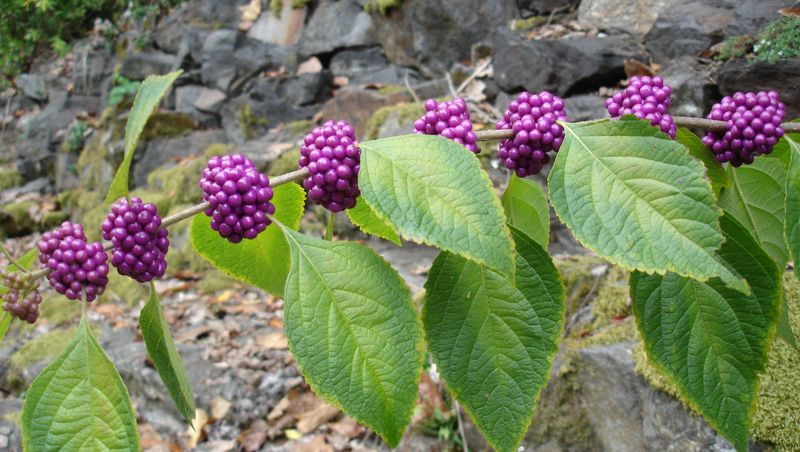
A shrub with vivid purple berries clustering tightly around every stem is turning heads in Florida yards, and it happens to grow happily along fence lines with very little fuss. That plant is American beautyberry, a southeastern native that feeds birds, supports pollinators, and carries a genuinely interesting scientific story about mosquito bite-deterrent compounds found in its leaves.
The catch is that the science is more nuanced than most headlines suggest, and knowing the difference between laboratory research and backyard reality helps you get the most out of this plant.
American beautyberry is the native shrub behind the corrected claim
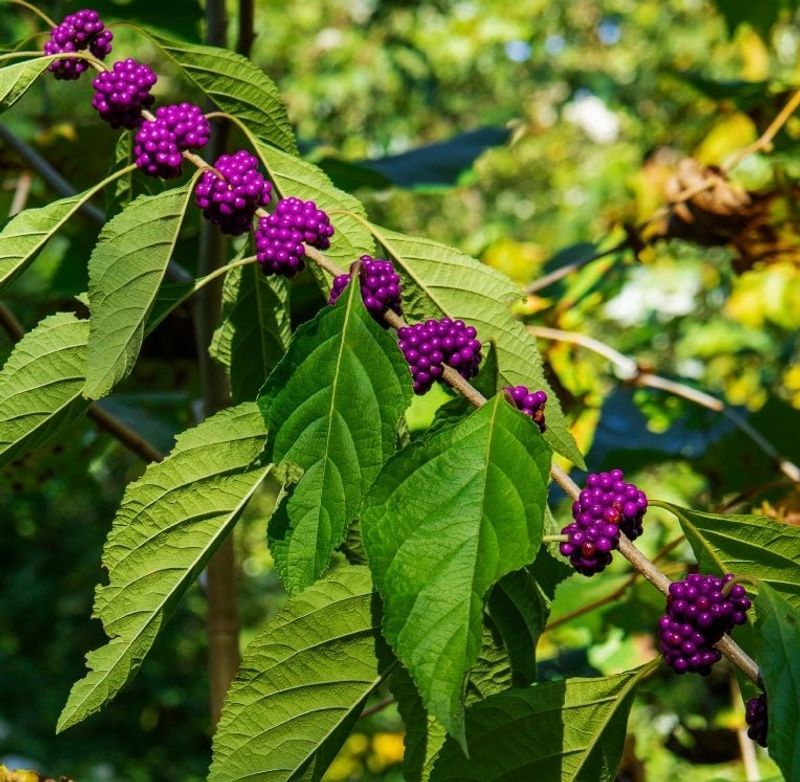
Walk past an American beautyberry in late summer and the fruit stops you cold. Tight clusters of glossy, vivid purple berries ring each stem like beads on a bracelet, and the effect is unlike almost anything else growing in a Florida yard.
The arching branches carry pale pink-to-lavender flowers earlier in the season, attracting bees and butterflies before the fruit takes over as the main event.
Callicarpa americana is native to the southeastern United States, including Florida, and UF/IFAS extension guidance on American beautyberry describes it as low-maintenance and adaptable to full sun or light shade across a range of soil types. The USDA Forest Service species review for Callicarpa americana documents the plant across the Southeast, noting its natural occurrence in forest edges, roadsides, and disturbed areas where it thrives alongside other native vegetation.
Those are the same kinds of informal, partly shaded corridors that define many Florida fence lines.
The mosquito angle comes from real science: compounds found in beautyberry leaves, including callicarpenal and intermedeol, showed bite-deterrent activity against Aedes aegypti and Anopheles stephensi in controlled laboratory tests, as documented in a peer-reviewed study published in the Journal of Agricultural and Food Chemistry. That research is legitimately interesting.
What it does not establish is that a living shrub planted along your fence will reduce mosquito populations in your yard season after season. The accurate promise for beautyberry is ornamental beauty, seasonal wildlife value, and a fascinating scientific backstory, not a substitute for proven pest management.
A fence line gives beautyberry room to form a living border
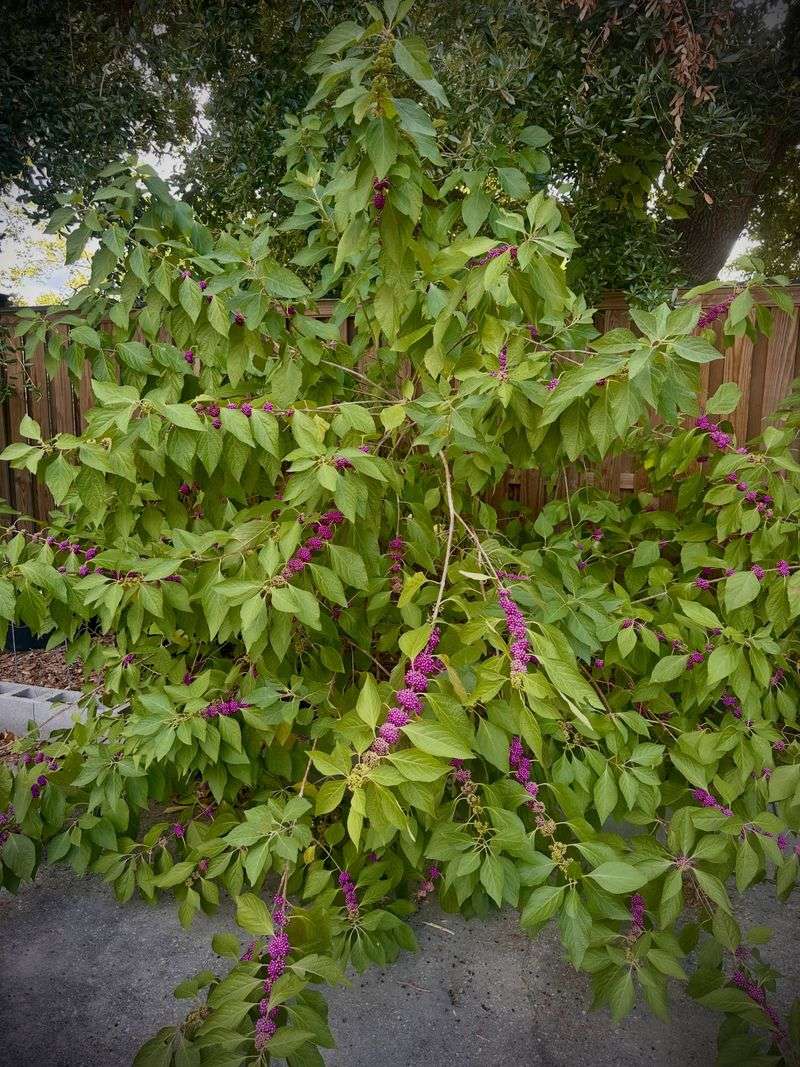
Fence lines in Florida yards tend to collect two things: unwanted vines and wasted space. Beautyberry turns that corridor into something productive without demanding much from the gardener.
UF/IFAS recommends the shrub for naturalized areas, informal screens, borders, pollinator gardens, rain gardens, and spots near water, and a fence line with decent light checks most of those boxes at once.
The habit of the plant matters before you commit to a location. Beautyberry is not a clipped hedge and should not be treated like one.
Its branches arch outward and droop slightly under the weight of fruit, and the overall silhouette is broad, open, and relaxed rather than tight and formal. The UF/IFAS EDIS publication on Callicarpa americana notes that the shrub can become large and sprawling, with a recommended plant spacing of 36 to 60 inches.
That means a mature planting will push toward paths, structures, and the fence itself, so leave a generous buffer from the start.
Sun and soil flexibility make siting easier than it sounds. Beautyberry grows in full sun through light or dappled shade, which covers the range of conditions most fence lines offer depending on orientation and neighboring trees.
It tolerates acidic, slightly alkaline, sandy, loamy, and clay soils, so Florida’s famously variable ground rarely rules it out entirely on texture alone.
The one site factor that can rule it out is salt. UF/IFAS rates beautyberry’s salt tolerance as poor, which matters for gardeners near the coast or anywhere that irrigation water carries measurable salinity.
Salt spray from the ocean or saline well water can stress or damage the plant over time. If your fence line sits within a few blocks of the coast or you irrigate with water that tests salty, check with your local UF/IFAS extension office before planting.
The mosquito study examined leaf compounds, not a living fence-line shrub
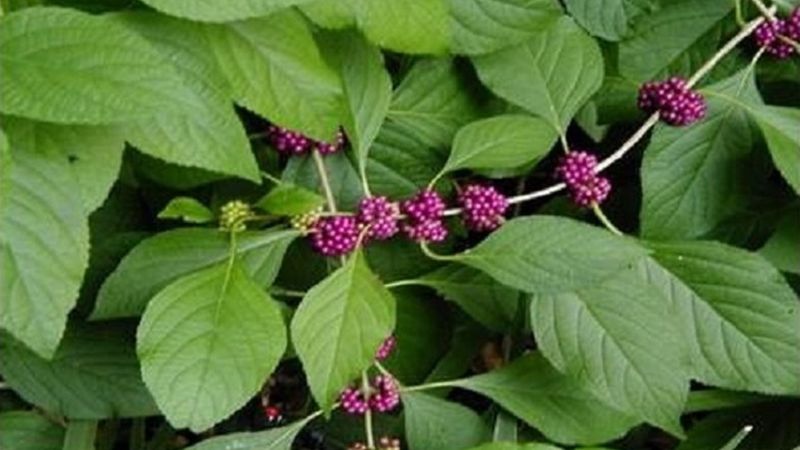
The research behind beautyberry’s mosquito reputation is real, carefully conducted, and frequently misread. Scientists identified terpenoid compounds, particularly callicarpenal and intermedeol, in the leaves of Callicarpa americana and tested their activity against two mosquito species: Aedes aegypti, the yellow fever mosquito common in Florida, and Anopheles stephensi, a malaria vector.
The compounds showed meaningful bite-deterrent activity under controlled laboratory conditions.
What the study actually tested matters. Researchers worked with isolated compounds and leaf extracts, not with intact shrubs growing in a yard.
The USDA Agricultural Research Service publication record for this work reflects the same laboratory framework: concentrated material applied under controlled conditions, not ambient exposure from a living plant. Moving from that setup to a claim about seasonal mosquito reduction in a backyard requires evidence that does not yet exist.
Several questions the study leaves unanswered are worth naming plainly. The research did not measure how long the deterrent effect lasts under outdoor conditions.
It did not test performance against the full range of Florida’s mosquito species, which number more than 80. It did not examine whether planting density changes outcomes, or whether the compounds disperse into the surrounding air at concentrations that affect mosquito behavior.
Most critically, the study measured bite deterrence, not mosquito reproduction, survival, or population size.
Bite deterrence and population control are different outcomes. A compound that discourages a mosquito from landing on a treated surface does not necessarily kill that mosquito, prevent it from breeding, or reduce the number of mosquitoes emerging from nearby water sources.
That distinction is the gap between interesting laboratory chemistry and a proven yard-wide effect, and beautyberry has not crossed it.
A standing beautyberry does not create a mosquito-free yard
There is a gap between what beautyberry chemistry can do in a lab and what a living shrub does in your yard, and that gap is large enough to matter for every mosquito decision you make this summer. UF/IFAS Duval County extension guidance on what works for mosquito control states clearly that mosquito-repelling plants would need to be crushed to release their essential oils at all.
A beautyberry shrub simply growing along the fence is not releasing callicarpenal into the air at concentrations that push mosquitoes away from your patio.
Penn State Extension’s guidance on pollinator-friendly mosquito control reinforces this point: living aromatic plants generally do not contain enough accessible oil to repel mosquitoes effectively. The oil is bound up inside leaf tissue, and until that tissue is broken, the chemistry stays put.
A standing shrub is an ornamental plant and a wildlife resource. It is not a mosquito barrier.
Crushing the leaves changes what you are working with, but it does not create a proven or safe skin treatment. Homemade plant extracts have not been tested for safety on human skin, and plant material applied directly can cause irritation in some people.
CDC guidance on preventing mosquito bites recommends EPA-registered repellents for protection from disease-carrying mosquitoes, and that recommendation exists because registered products have been evaluated for both effectiveness and safety under real-world conditions.
The EPA list of registered skin-applied repellent active ingredients does not include beautyberry, callicarpenal, or any beautyberry-derived compound. That is not a reason to dismiss the plant’s scientific interest, but it is a clear reason not to treat crushed leaves as a substitute for DEET, picaridin, or oil of lemon eucalyptus when you actually need protection from mosquito-borne illness.
Beautyberry’s strongest insect benefit comes through diverse habitat
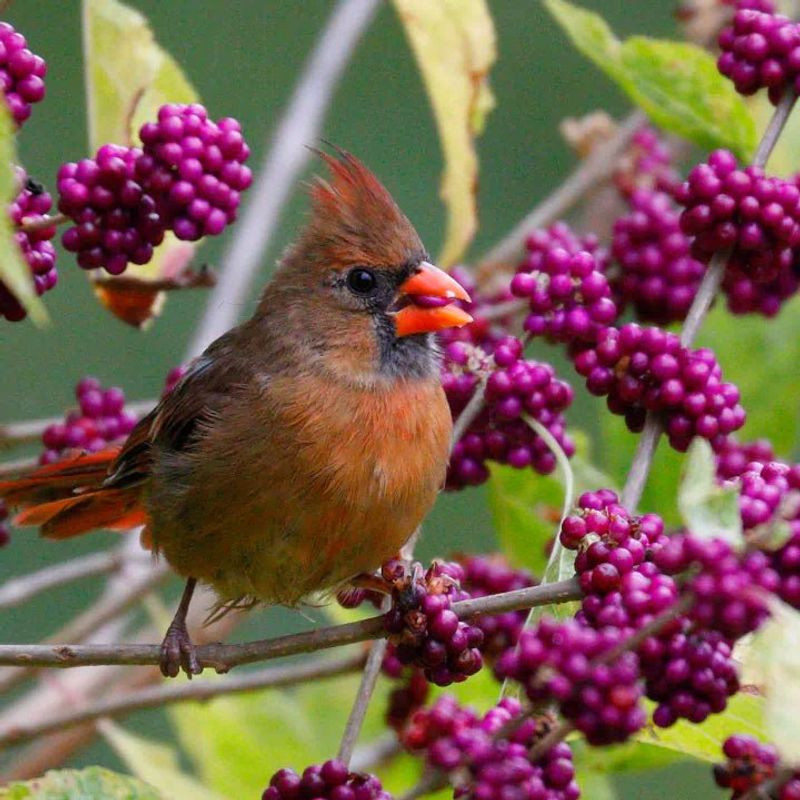
Strip away the mosquito claims and what remains is genuinely valuable. Beautyberry flowers attract pollinators during the blooming season, drawing bees and butterflies to a fence line that might otherwise offer nothing.
The shrub also hosts the spring azure butterfly and the snowberry clearwing moth, two species that depend on specific native plants to complete their life cycles, according to UF/IFAS documentation on Callicarpa americana.
The fruit is where the wildlife value becomes most visible. The USDA Forest Service species review reports that at least 10 bird species feed on beautyberry fruit, including mockingbirds, robins, and brown thrashers.
Small mammals use it too. The berries ripen in late summer and fall, exactly when migrating birds moving through Florida need high-energy food sources along the route.
The broader habitat benefit, the part that connects loosely to pest management, comes from what a diverse planting supports rather than from beautyberry alone. UF/IFAS guidance on supporting beneficial insects explains that flowers, foliage, shelter, and varied plant heights together create conditions where lacewings, assassin bugs, spiders, and parasitoid wasps can establish and hunt.
Those organisms prey on garden pests, and their presence is tied to habitat diversity rather than to any single shrub.
UF/IFAS community ecology guidance for Florida yards frames this honestly: biodiversity can reduce pest pressure over time, but the sources do not assign a predictable number of pests eliminated per beautyberry planted. Beautyberry contributes to that ecosystem when it is part of a mixed border.
On its own, it feeds birds and pollinators. That is a real and worthwhile outcome, even without a pest-reduction guarantee attached.
Plant beautyberry as part of an informal Florida-friendly border
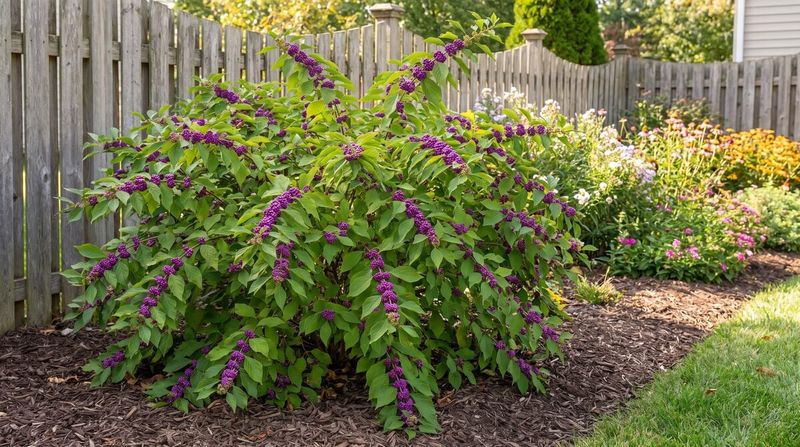
Getting beautyberry right on a fence line starts with spacing. The UF/IFAS EDIS planting guide for American beautyberry recommends 36 to 60 inches between plants and flags the shrub’s tendency to become large and sprawling at maturity.
For a fence-line planting, that means measuring from the fence face outward before you dig, not after the plant is already pressing against the boards.
Sun exposure and soil type rarely disqualify a site, but salt does. Beautyberry handles full sun through dappled shade and grows in sandy, loamy, and clay soils across a wide pH range.
Its drought tolerance is moderate, meaning it appreciates supplemental water during establishment and during Florida’s driest stretches, but it is not a plant that needs constant irrigation once settled. The UF/IFAS species fact sheet rates salt tolerance as poor, so coastal gardeners dealing with salt spray or saline irrigation water should confirm local suitability with their county extension office before committing to a planting.
Beautyberry works best when it shares the border with other natives rather than standing alone. Pairing it with plants that bloom at different times, such as firebush in summer or wild coffee in shade, keeps the border productive for pollinators across more of the year.
UF/IFAS beneficial insect guidance recommends reducing broad-spectrum pesticide use throughout the border, since those products kill predatory and parasitoid insects alongside the pests they target.
Expect some insects on the leaves, and leave them. UF/IFAS integrated pest management guidance and UF/IFAS ecological planting resources both advise tolerating non-damaging insect activity in a native border.
A functioning garden ecosystem includes insects at multiple levels of the food chain, and a fence line that supports that complexity is doing exactly what a Florida-friendly planting is supposed to do.
Pruning controls the spread without erasing flowers and berries
Beautyberry rewards gardeners who understand one key fact about its growth cycle: the flowers and fruit develop on new wood, not on old stems that have already fruited. That means the timing and style of pruning directly determines whether you get a seasonal display of berries or a well-trimmed shrub with nothing for birds to eat.
Heavy pruning of older wood is best done from late fall through early spring, after the fruit has dropped and before new growth pushes out. UF/IFAS pruning guidance for American beautyberry favors thinning cuts over repeated shearing.
Thinning removes entire stems back to the base or a main branch, which opens the plant and controls its spread without triggering a flush of dense, unproductive regrowth. Shearing, by contrast, removes the tips of branches indiscriminately and can strip away the developing growth that would have carried next season’s flowers and fruit.
For fence-line management, the goal is usually to keep the shrub from pressing too hard against the fence or flopping into a path while preserving enough arching branch structure to carry a good fruit crop. Removing one or two of the oldest, woodiest stems each winter keeps the plant rejuvenated and productive without forcing you into a full cutback every year.
UF/IFAS species notes and USDA Forest Service documentation both describe beautyberry as deciduous to semi-deciduous, so the plant will drop most or all of its leaves in winter depending on how cold the season gets. Do not mistake a bare winter shrub for a dead one; new growth returns reliably in spring.
Overly aggressive shaping, especially repeated hedge-style trimming through the growing season, undermines both the ornamental value and the wildlife benefit that made the planting worthwhile in the first place. Prune once, prune thoughtfully, and let the plant do its job.
Reliable mosquito reduction still starts with water, screens, and registered repellent
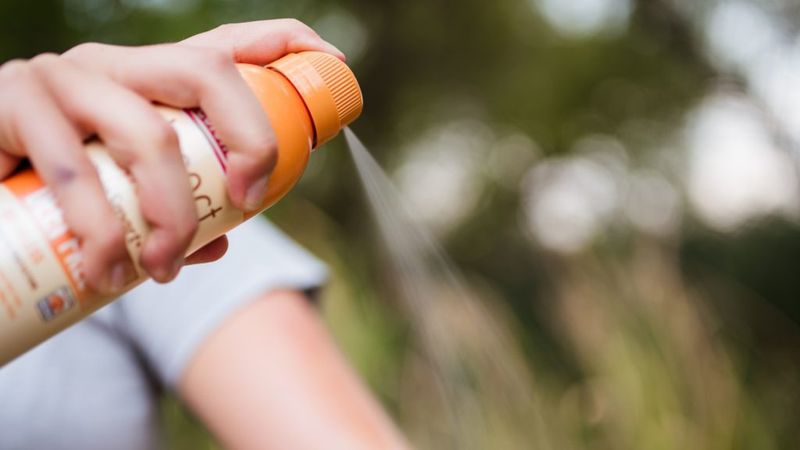
Beautyberry earns its place in a Florida yard through ornamental character and genuine wildlife value, not through mosquito management. Keeping those two things separate makes you a smarter gardener and a safer one.
For actual mosquito reduction around the home, CDC guidance on mosquito control at home points to a short list of high-confidence actions: remove standing water at least once a week from containers, gutters, saucers, and low spots; cover rain barrels with tight-fitting lids or fine mesh; keep door and window screens in good repair; and use EPA-registered repellents when you need personal bite protection outdoors.
Those steps work because they address where mosquitoes breed and how they reach you, two things a fence-line shrub cannot control. CDC mosquito prevention guidance recommends repellents containing DEET, picaridin, IR3535, or oil of lemon eucalyptus for protection from disease-carrying species.
None of those active ingredients come from beautyberry, and no beautyberry-derived product currently holds EPA registration for skin application.
Plant beautyberry where its native character fits the site: an informal fence line with enough room for the shrub to spread, decent light, non-saline soil, and tolerance for a loose, seasonal look that changes through the year. Add it to a mixed border of Florida natives with staggered bloom times, step back from broad-spectrum pesticides, and let the habitat do what habitat does over time.
A yard that feeds birds, shelters beneficial insects, and grows something genuinely beautiful is already doing more than most. The mosquitoes still need water control and a good repellent – but the beautyberry earns its spot on the fence for every other reason.