
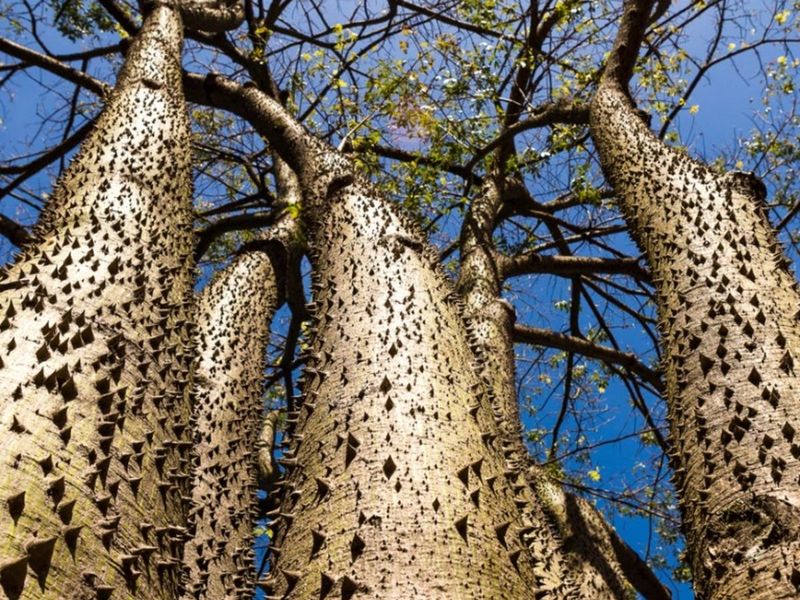
Somewhere in a South Florida yard, park, or cultivated garden, a large tree with a spiny gray trunk is quietly building pressure inside its woody fruit. When those capsules finally split, they crack loud enough to startle anyone nearby and send seeds flying faster than most people can react.
The tree is most likely Hura crepitans, commonly called the sandbox tree or dynamite tree, and it brings three separate hazards: sharp trunk spines, caustic milky sap, and explosively splitting seed capsules. Knowing what it looks like and how to stay clear of it is practical knowledge for anyone spending time in Miami-Dade or Monroe County.
A distinctive South Florida tree has a dangerous-looking identity
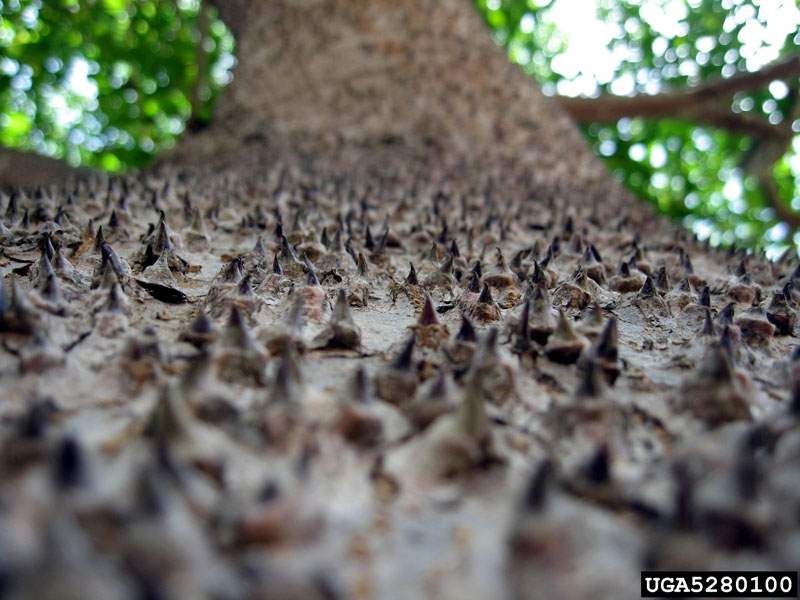
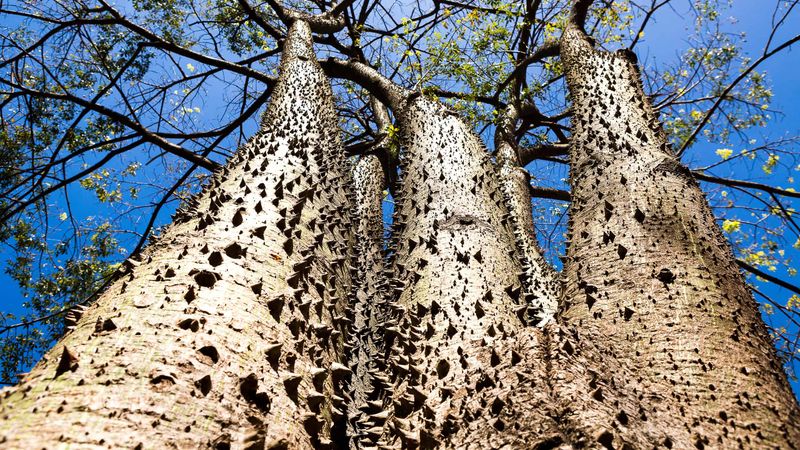
Gray bark studded with dozens of short, hard, conical spines is the sandbox tree’s most immediate giveaway. Botanically known as Hura crepitans, the tree also goes by dynamite tree, jabillo, sandboxtree, and possumwood, and each nickname hints at a different facet of its character.
Flora of North America’s entry on Hura crepitans describes a large tree with gray bark bearing numerous sharp conical spines, broad leaves with a heart-shaped base, inconspicuous red flowers, and depressed, pumpkin-shaped woody capsules.
No single visual feature is enough to confirm an identification with certainty from a headline description alone. A reliable match comes from the combination: the spiny trunk, the broad leaves, and those distinctive ribbed capsules sitting on or beneath the tree.
If you spot what looks like a pumpkin that has been pressed flat and left to dry on the ground, you are likely looking at a sandbox tree fruit.
Three separate hazards come with this tree, and they operate through different mechanisms. The conical trunk spines cause mechanical puncture injuries if someone brushes against or grabs the trunk.
Damaged tissues release a milky latex that can irritate or blister exposed skin and eyes. And the mature woody capsule splits explosively, launching seeds and producing a sharp, startling crack.
Observe the tree from a comfortable distance rather than reaching out to touch or inspect it by hand, and keep that distance until you have confirmed what you are looking at.
Florida records place it mainly in Miami-Dade and Monroe counties
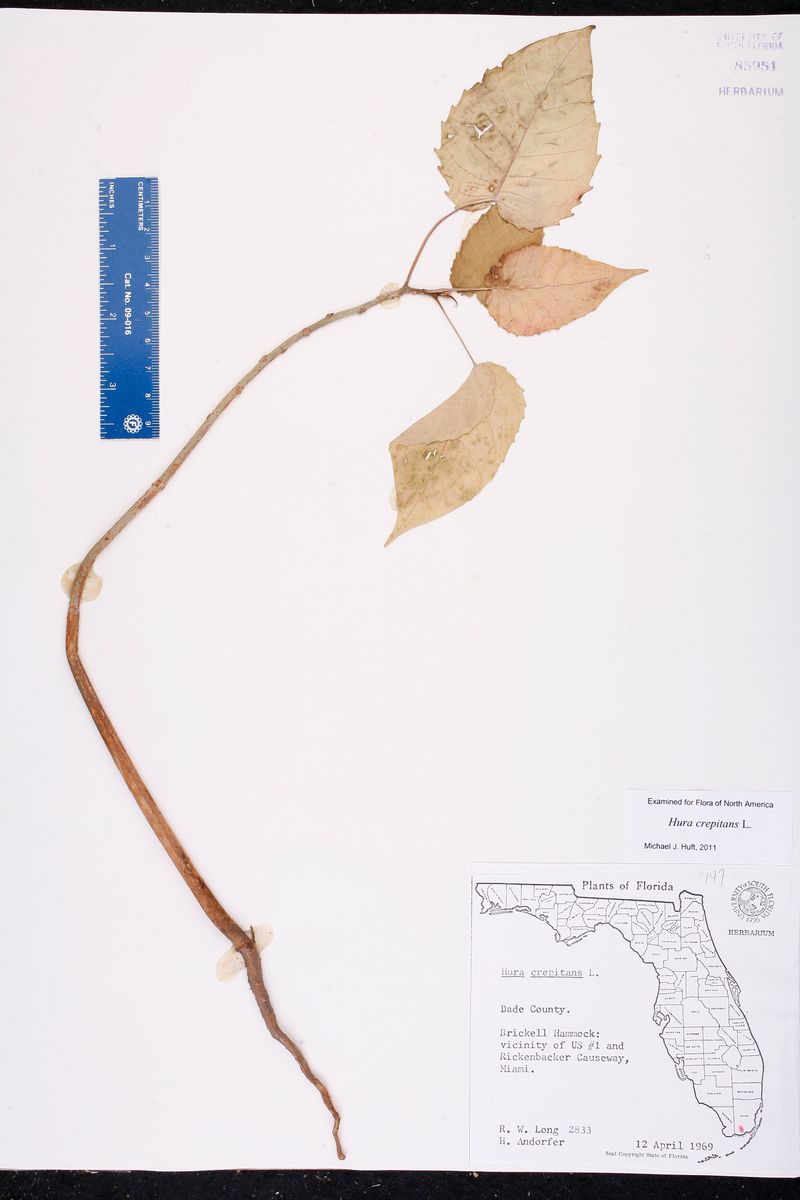
Plenty of alarming tree stories are written as though the danger lurks in every Florida backyard, but the sandbox tree’s documented U.S. range is narrower than that framing suggests. Florida flora records place Hura crepitans in Miami-Dade County and Monroe County, which includes the Florida Keys, and the Institute for Regional Conservation’s floristic inventory of South Florida describes the species as introduced, cultivated, and sometimes naturalized in that region, not as a native or a widespread residential tree.
Specific cultivated specimens appear at notable South Florida sites including Deering Estate, Simpson Park, and Vizcaya. These are curated landscapes where the tree was planted intentionally, often decades ago, as a shade or specimen tree.
Encountering it in a managed garden or historic estate is more likely than finding one planted as a routine street or yard tree in a newer neighborhood.
That geographic precision matters for practical reasons. A homeowner in Gainesville or Tampa reading this article should not assume the warning applies to a spiny tree in their own yard without confirming the species.
Conversely, anyone in Miami-Dade or the Keys who spots a large tree with a spiny gray trunk near a cultivated landscape, park, or older residential property has a genuine reason to take a closer look from a safe distance and consider a professional identification.
The sandbox tree is not a statewide threat, but within its documented South Florida range it is a real and distinctive presence. Treating it as a curiosity to be handled is the mistake to avoid, regardless of how familiar or unremarkable the setting feels.
Spines cause punctures; milky latex causes chemical irritation
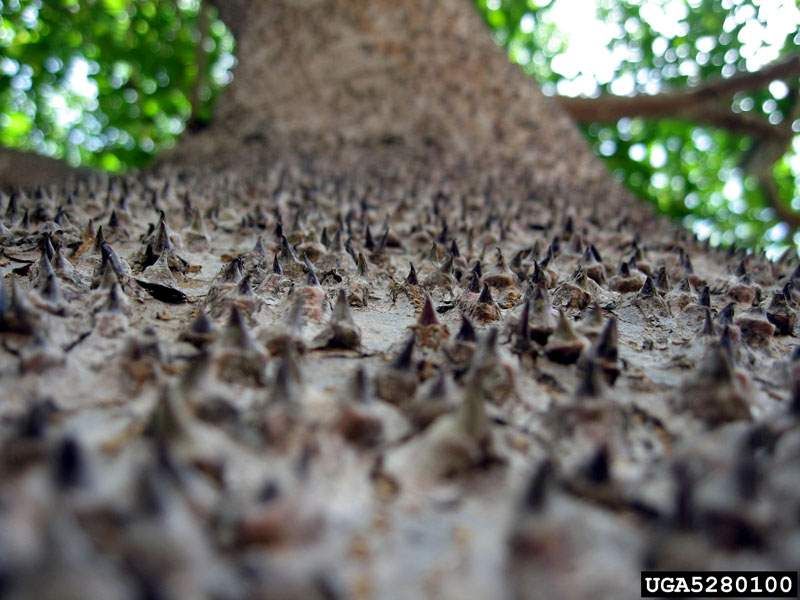
Two entirely different injury mechanisms live in the same tree, and it helps to understand them separately. The conical spines covering the trunk are a purely mechanical hazard: they are hard, sharp, and angled in a way that makes grabbing or leaning against the trunk genuinely painful.
A person who tries to climb the tree, steady themselves against it, or reach past it in a garden bed is at real risk of puncture wounds, particularly on the palms, forearms, and legs.
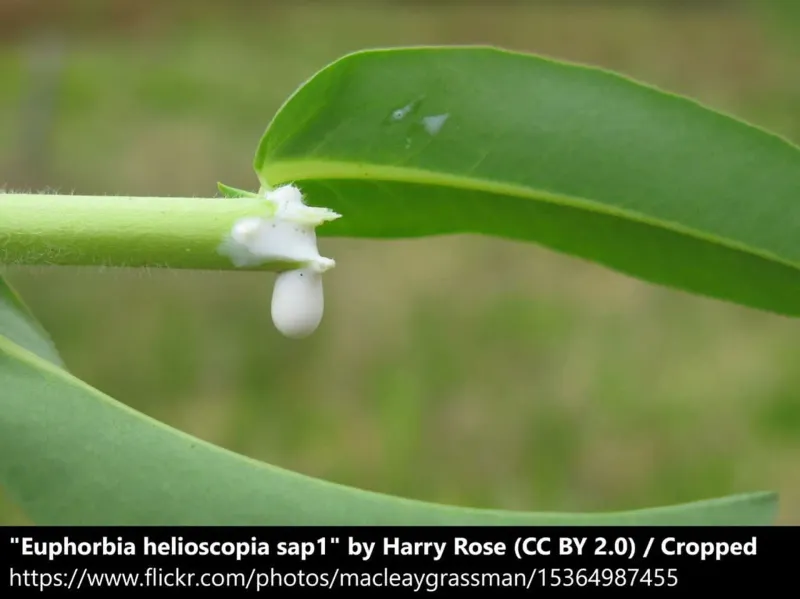
The second hazard activates when the tree’s tissues are damaged. Cut a branch, scrape the bark, or crush a fallen capsule, and the tree releases a milky white latex.
Florida Department of Agriculture and Consumer Services materials on poisonous plants list Hura crepitans sap as capable of causing skin irritation, swelling, and blistering, and note that contact with the eyes can produce possible temporary blindness. Those effects are serious enough to treat any sap exposure as a medical concern rather than a minor inconvenience.
Individual responses to the latex vary. Not every contact produces blisters; some people experience redness and swelling while others have a more pronounced reaction.
A published case report on allergic reaction after contact with Hura crepitans documented that exposure to the leaves and stems can trigger an allergic response in addition to the direct irritant effect, which means even brief or indirect contact carries risk for sensitive individuals.
The bark itself is not poisonous in the way a toxic mushroom is. The spines cause physical injury, while the chemical irritation comes specifically from the milky sap released when tissues are broken.
Keeping the tree’s tissues intact, which means not cutting, drilling, pruning, or scraping it without professional protective equipment, is the most reliable way to avoid latex exposure.
The dry capsule splits with a loud report and propels seeds
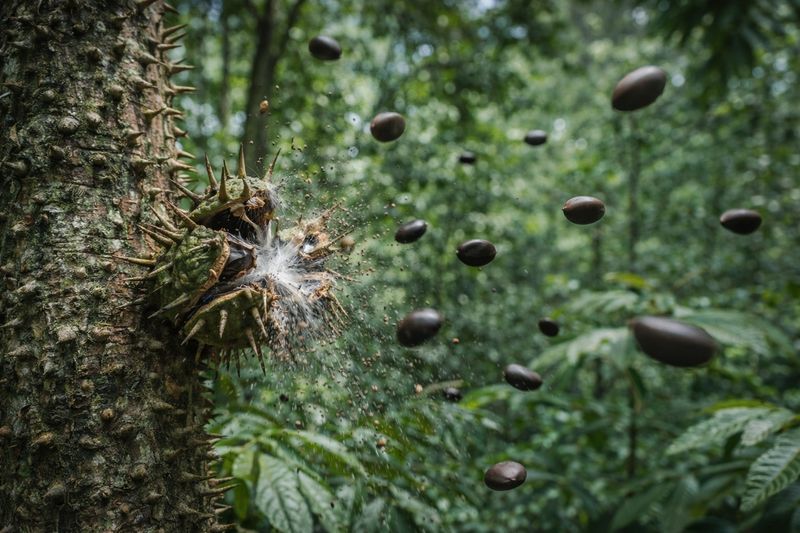
What most people call the sandbox tree’s “exploding seed pod” is more precisely a woody, pumpkin-shaped capsule that splits explosively when it becomes mature and dry. The tree itself does not detonate; the fruit’s outer wall builds stress as it dries, and when that stress exceeds the capsule’s structural limit, the sections separate suddenly and violently.
The result is a sharp crack or loud report that can startle anyone nearby, and it sends seeds flying outward from the opening capsule.
A peer-reviewed 1977 study on explosive seed dispersal in Hura crepitans measured the physical scale of this event directly. Typical initial seed velocities were around 43 meters per second, which is roughly 96 miles per hour.
One recorded measurement exceeded 70 meters per second, closer to 157 miles per hour, but that figure represents an upper recorded value, not the speed every seed reaches. Maximum dispersal distance in the study reached 45 meters, or about 148 feet, from the parent tree.
Those numbers help explain why standing under or near a mature, dry sandbox tree carries a plausible mechanical hazard. A seed traveling at even the typical speed of 43 meters per second has enough force to sting or injure exposed skin or eyes.
The loud report that accompanies the split is real and startling, though the sources reviewed do not provide a controlled comparison to any particular animal sound, so describing it as louder than a rattlesnake goes beyond what the evidence supports.
Fallen capsules on the ground deserve the same caution as capsules still on the tree. Picking one up, squeezing it, or attempting to open it manually creates an unpredictable situation.
The safest approach is to leave fallen capsules exactly where they land and to keep children and pets well away from areas where they accumulate beneath the canopy.
Do not mistake the sandbox tree for manchineel
South Florida has more than one tree with a reputation for causing serious harm, and confusing them can lead to the wrong identification and the wrong response. Manchineel (Hippomane mancinella) is a separate Florida species, native to southern Florida and coastal habitats, with smooth bark, small apple-like fruit, and sap known to cause severe burn-like blistering on contact.
UF/IFAS documentation on manchineel and the UF/IFAS Extension Volusia County overview make clear that manchineel’s hazards are real and well-documented, but they are distinct from those of the sandbox tree.
The practical differences in appearance are significant. Manchineel does not have the sandbox tree’s characteristic conical spines on its trunk, and its fruit looks like a small green apple rather than a ribbed, pumpkin-shaped woody capsule.
The sandbox tree does not produce apple-like fruit and does not share manchineel’s coastal-scrub habitat profile. Matching the right tree to the right description matters because the safety steps, the urgency of medical attention, and the professional guidance needed may differ.
The label “deadliest tree in the world” is sometimes applied to manchineel in popular media. That phrase is not a scientific classification, and it does not transfer to Hura crepitans simply because both trees have irritating sap.
Flora of North America’s treatment of Hura crepitans documents the sandbox tree’s hazards on their own terms without invoking that comparison.
If you are uncertain which tree you are looking at, do not touch either one. Photograph it from a distance and consult a local extension office, botanical garden, or certified arborist for a confirmed identification before taking any other action.
Keep people and pets away, and respond promptly to exposure
Around a sandbox tree, the simplest safety rule applies everywhere: do not touch the trunk, damaged branches, sap, fallen capsules, or seeds with bare hands. The combination of mechanical spines and irritant latex means that a casual grab or an accidental brush against damaged bark can produce two different injuries at once.
Children are especially vulnerable because the fallen capsules can look like interesting objects worth picking up, and pets may nose or paw at them on the ground. Keep both well away from any area where capsules have accumulated beneath the canopy.
Skin exposure to the sap requires prompt but straightforward action. Poison Control guidance on plant latex exposure recommends removing contaminated clothing immediately and gently washing the affected skin with soap and water.
Do not scrub aggressively, which can drive irritants deeper into the skin. Watch for redness, swelling, or blistering in the hours after contact and seek medical attention if symptoms are more than mild.
Eye exposure is a more urgent situation. Rinse the affected eye immediately with clean running water for a full 15 to 20 minutes, holding the eyelid open and letting water flow across the eye’s surface.
Do not use soap in the eye. After rinsing, seek medical or Poison Control guidance right away, particularly if there is pain, blurred vision, swelling, or any change in how clearly you can see.
U.S. Poison Control is available around the clock at 1-800-222-1222.
Calling early, before symptoms escalate, gives medical professionals the best chance to guide your response correctly. Do not collect a fallen capsule to bring to the doctor’s office or test its behavior at home; describe the tree and the circumstances of exposure instead, and let the professionals direct the next steps.
Arrange professional assessment before pruning or removal
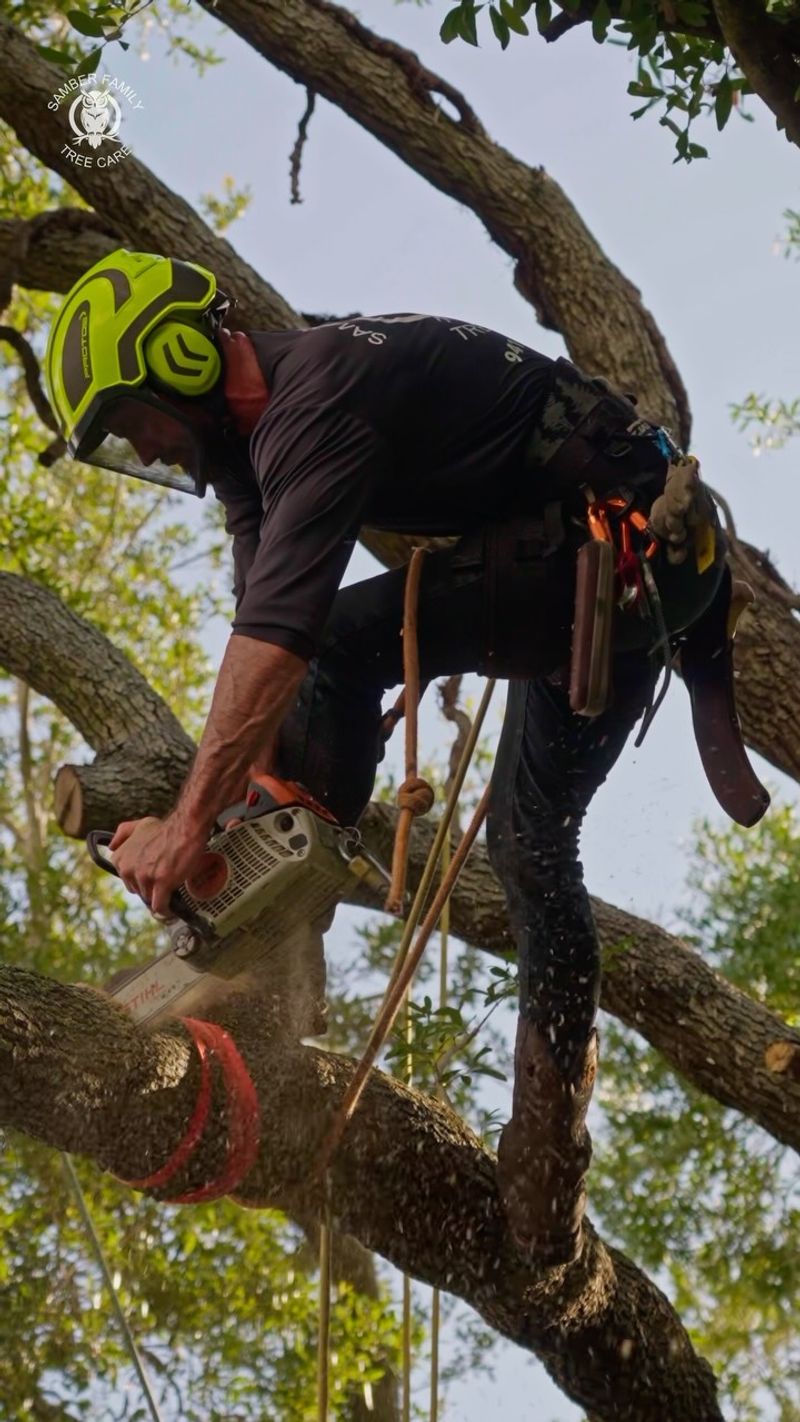
A sandbox tree near a house, walkway, power line, or storm-damaged area is not a do-it-yourself removal project. The spines alone make hand contact during cutting or climbing painful and potentially dangerous.
Add the irritant latex released every time a branch or trunk is cut, the risk of heavy falling limbs, and the elevated work required to reach the upper canopy, and the case for calling a professional becomes straightforward.
UF/IFAS guidance on getting the right tree care professional advises homeowners not to perform tree felling, climbing, aerial work, or chainsaw work beyond safe ground-level tasks, and recommends an ISA Certified Arborist for hazardous trees and difficult removals. An ISA Certified Arborist carries training specific to tree structure, safe cutting sequences, and the equipment needed to manage falling material without injuring people or damaging property.
A formal tree risk assessment can also help determine whether the tree poses an immediate structural threat, which affects how urgently removal or pruning should be scheduled.
Safe homeowner behavior around a sandbox tree comes down to three things: keeping clear of the canopy and fallen fruit, warning others who share the space, and arranging a professional evaluation before anyone attempts cutting, drilling, or climbing. Do not try to harvest the capsules as novelties, burn the wood yourself, or use a chainsaw on the trunk without professional guidance on handling the latex and managing the debris.
Accurate identification and a respectful distance are the two things that provide immediate protection while you arrange the right professional help. A tree this distinctive, once properly identified, is genuinely manageable, but only when the people nearby know what they are dealing with.