
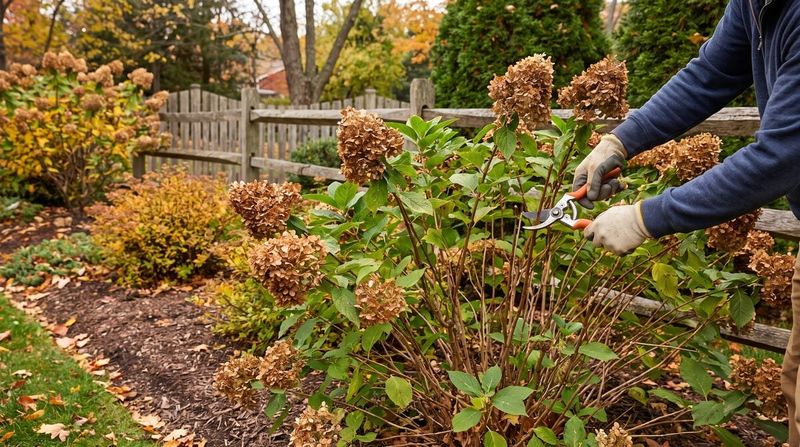
Fall is a tempting time to tidy up the garden, and hydrangeas with their faded, papery blooms can look like obvious candidates for a hard cut. But reaching for the pruners at the wrong moment on the wrong plant is one of the quietest ways to lose next year’s flower show before it ever starts.
The good news is that this mistake is completely avoidable once you know what type of hydrangea you have and what it needs from you right now.
The risky fall move is hard-pruning an old-wood hydrangea
Fall care does not threaten every hydrangea equally, and a quick tidy-up is not the same as a hard cut. The real danger is one specific move: shortening or removing the main stems of a bigleaf, oakleaf, mountain, or climbing hydrangea after the plant has already formed, or begun forming, next year’s flower buds on those stems.
These hydrangeas bloom on old wood, meaning the buds that will open into flowers next spring and summer develop on existing woody canes during late summer or early fall of the current year. Illinois Extension guidance on hydrangea pruning timing explains that hard pruning of old-wood types after bud formation can remove those buds and reduce or eliminate the following year’s bloom display.
A plant that looked perfectly healthy going into winter can emerge in spring with green leaves and almost no flowers, simply because the bud-carrying stems were cut away.
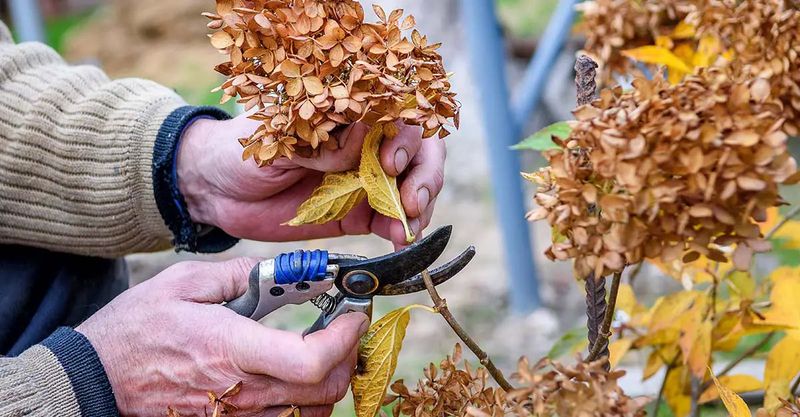
Removing a dried flower head is a different action entirely. Snipping off only the spent bloom cluster is not the same as shortening the woody stem beneath it, and the two should not be confused.
The governing decision before any fall work on a hydrangea is straightforward: identify the plant type first, then decide whether any cutting is appropriate at all.
Identify the hydrangea before you pick up the pruners
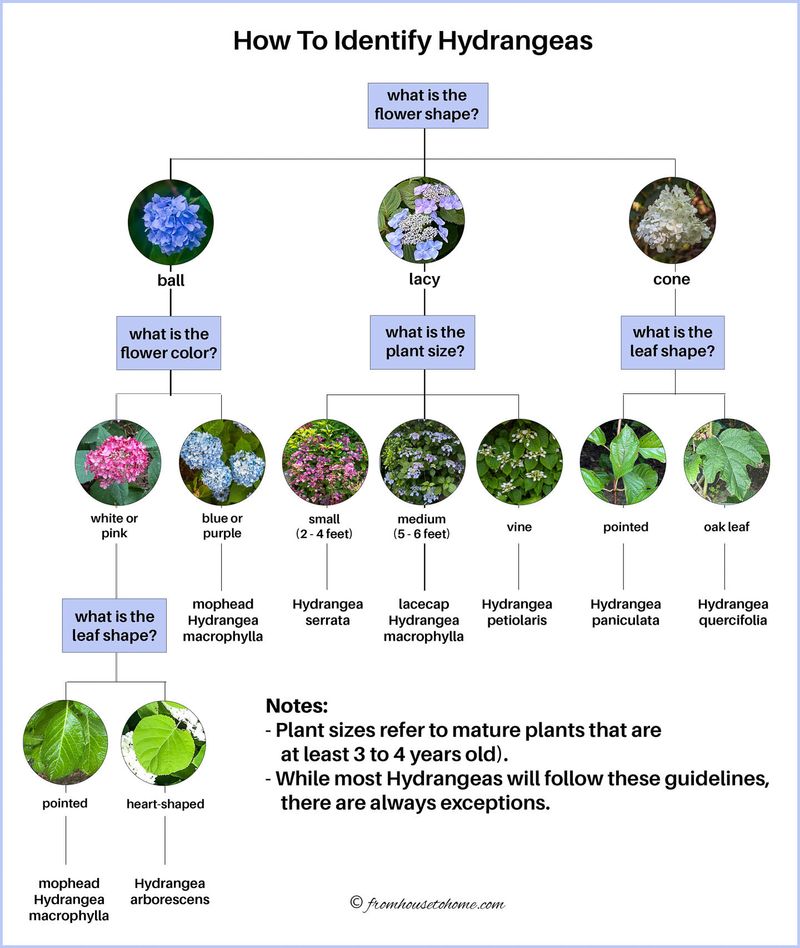
Knowing your hydrangea type is the single most useful thing you can do before fall arrives. The old-wood caution group includes bigleaf hydrangeas, also sold as mophead or lacecap types, oakleaf hydrangeas, mountain hydrangeas, and climbing hydrangeas.
These are the plants most at risk when stems are cut in fall after bud formation has begun.
Flower shape offers the clearest starting clue. Bigleaf mopheads carry large, rounded, ball-like clusters, while lacecap bigleafs have a flat center of small fertile flowers ringed by larger sterile ones.
Oakleaf hydrangeas produce elongated, cone-shaped clusters and have distinctive lobed leaves that turn reddish in fall. Illinois Extension’s detailed hydrangea pruning guide notes that panicle hydrangeas, which bloom on new wood, also carry cone-shaped clusters, so flower shape alone will not always separate an oakleaf from a panicle type.
Smooth hydrangeas, such as the well-known ‘Annabelle,’ generally produce very large, rounded white heads on new wood and tend to have simpler, oval leaves.
Common names at the garden center can mislead. A plant labeled simply “hydrangea” may not tell you enough, and some cultivar names sound nothing like a type name.
When one feature does not resolve the question, look at a combination of flower shape, leaf shape, and stem habit before making a confident call. If doubt remains, the conservative path is always safer than a guess that costs next year’s blooms.
Prune old-wood types shortly after flowering
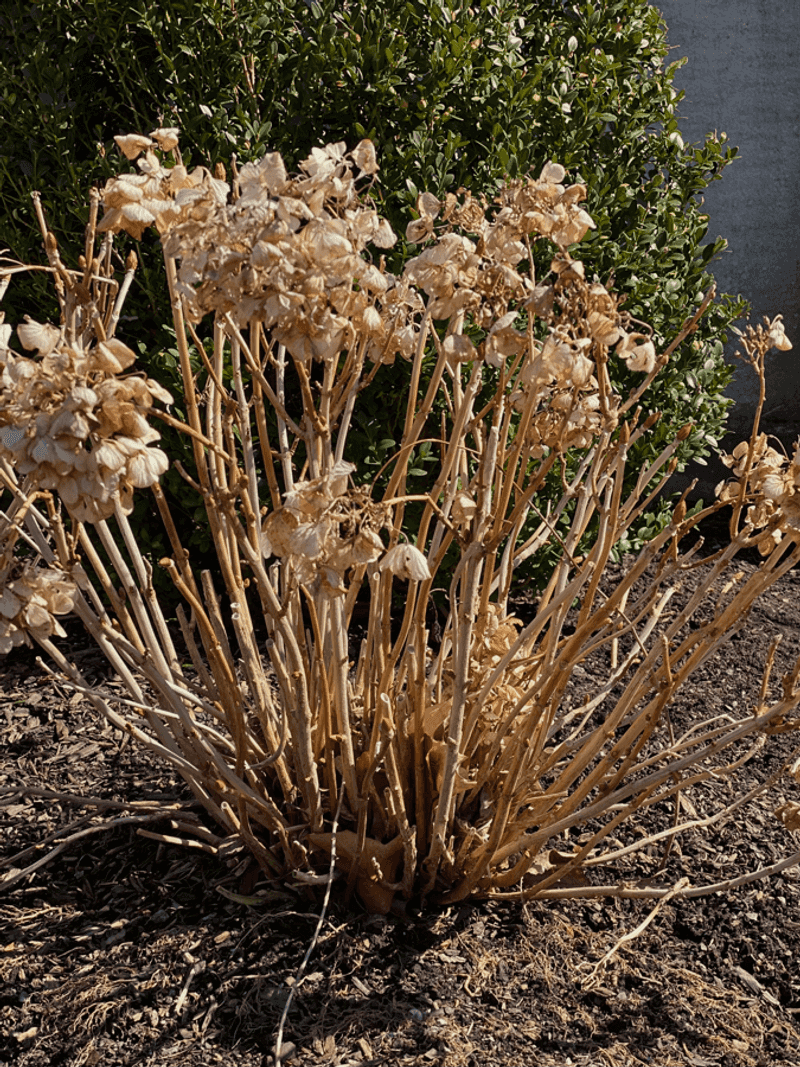
For bigleaf, oakleaf, mountain, and climbing hydrangeas, the right pruning window opens right after the flowers finish and closes before the plant begins setting next year’s buds. That timing gives the shrub enough growing season to produce new stems and to develop the buds that will carry next year’s display.
What this means in practice is that the calendar date matters less than where the plant is in its flowering cycle. Illinois Extension’s timing guidance makes clear that major shaping should happen immediately after flowering rather than in fall, winter, or early spring.
For a plant that finishes blooming in midsummer, that pruning window may fall in late summer, and late-summer pruning in that situation is entirely appropriate. Describing all late-summer pruning as wrong would be inaccurate.
The problem arises when pruning is delayed until fall, after the plant has already begun forming next year’s buds, or when it is pushed into winter or early spring. By those points, the buds are already on the stems, and cutting removes them.
Southern gardeners in Florida and Texas should judge this by what the specific plant and cultivar has actually done in their yard, not by a fixed calendar date. A cooler North Florida site and a hot Central Texas location can produce very different flowering timelines for the same type of hydrangea.
Deadheading is different from cutting back the shrub
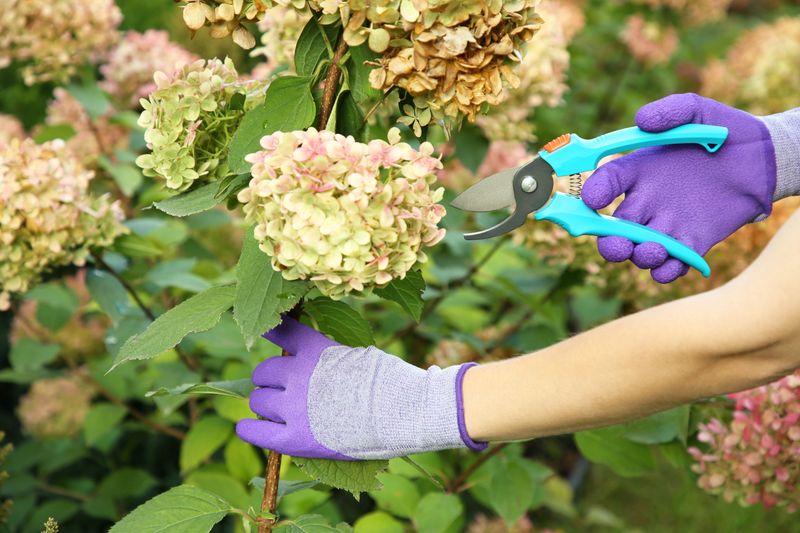
One of the most common fall-care mix-ups happens when a gardener sets out to remove old flower heads and ends up shortening the stems underneath them. Those two actions look similar but produce very different results on an old-wood hydrangea.
Deadheading, meaning removing only the spent flower cluster, is optional for plant health. University of Maryland Extension’s pruning resource confirms that leaving dried flower heads in place does not by itself prevent reblooming, and removing them is mainly an aesthetic choice.
Many Southern gardeners actually leave the papery blooms standing through winter because they add structure to the garden and can protect the buds just below them from frost.
For readers who prefer a cleaner look, the conservative approach on an old-wood hydrangea is to snip only the flower head or make the smallest possible cut just above the first healthy bud visible on the stem. Avoid using deadheading as a reason to shorten entire branches.
Once you move below that top cluster and begin cutting into woody stem tissue, you risk removing dormant buds that the plant spent all summer building. Keep the cut small, keep it high, and leave the rest of the stem alone.
When the type is unknown, preserve the existing stems
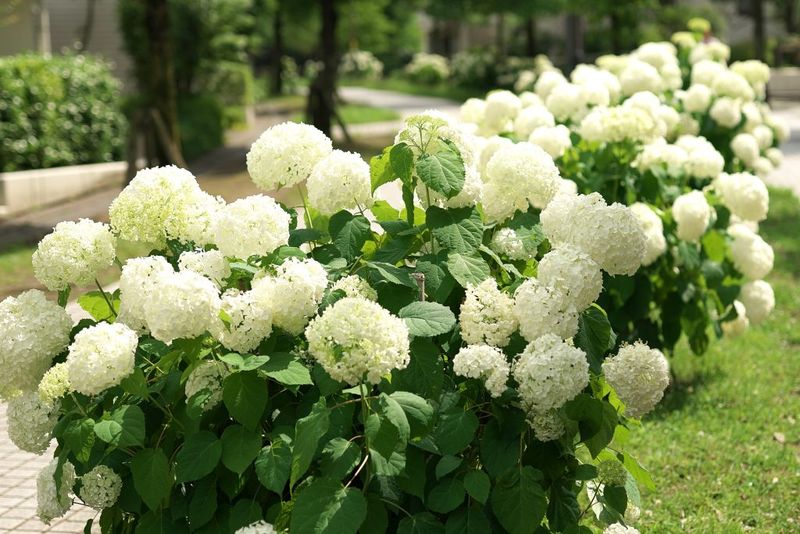
Not every gardener inherited a labeled plant or bought one with a clear cultivar tag. When the hydrangea type is genuinely uncertain, the safest fall action plan is also the simplest: do not reshape the shrub, and do not cut stems down.
Ask Extension’s hydrangea trimming guidance describes avoiding major pruning as the safer path when the type is unknown, rather than making a risky guess based on a quick visual check. In fall, remove only wood that is clearly dead, obviously diseased, or physically broken.
Dead stems are usually dry, brittle, and hollow or discolored at the center when scratched with a fingernail. Live stems feel firm and show green tissue under the bark.
Waiting until the plant leafs out in spring can make the distinction much easier. Dead stems will stay bare while live ones push new growth, and that contrast takes the guesswork out of the decision.
Uncertainty about plant type is not a problem to solve with the pruners. Treating it as a reason to be cautious rather than a prompt to take action is the choice that protects next year’s bloom potential.
A year of watching the plant flower and noting the flower shape, leaf shape, and timing will give you far more reliable information than any fall-season guess.
New-wood and reblooming types require a different judgment
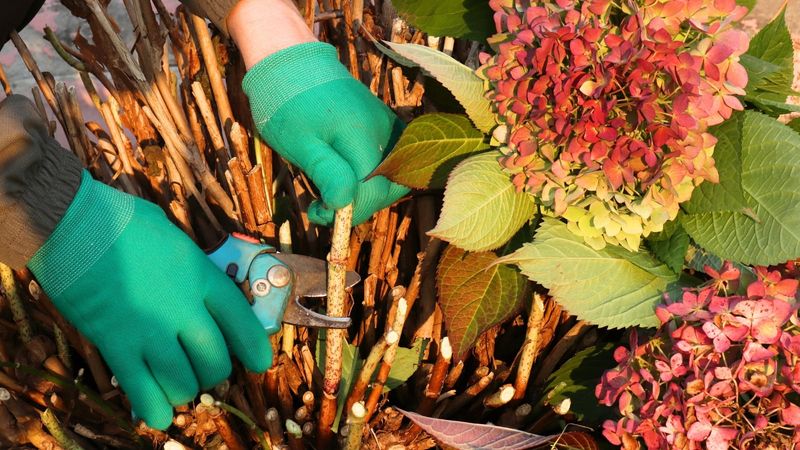
Panicle hydrangeas and smooth hydrangeas operate on a completely different schedule, and the fall-pruning warning that applies to bigleaf and oakleaf types does not transfer to them automatically. Both of these types bloom on new wood, meaning they produce their flower buds on growth that emerges in the current season.
Standard guidance places major pruning for panicle and smooth hydrangeas in late winter or early spring, just before new growth begins. Some sources allow fall pruning for these types as well, since removing old stems during dormancy does not cut away next year’s buds.
Illinois Extension’s pruning timing article notes this distinction clearly, while also pointing out that repeated drastic cuts can weaken even new-wood types over time. Tree-form panicle hydrangeas present an additional consideration: their trunks should be preserved rather than cut to the ground, even though the flowering branches on top are pruned back.
Reblooming cultivars, including some Endless Summer, Let’s Dance, and Tuff Stuff varieties, add another layer. These plants can flower on both old and new wood, which means they may produce some blooms even after old-wood buds are lost.
Illinois Extension’s cultivar-level guidance treats this trait as a qualification rather than a green light for indiscriminate fall pruning. Losing early old-wood buds still reduces the potential flower display, so the identification-first rule applies to reblooming types as well.
Support dormancy with moisture, mulch, and restraint
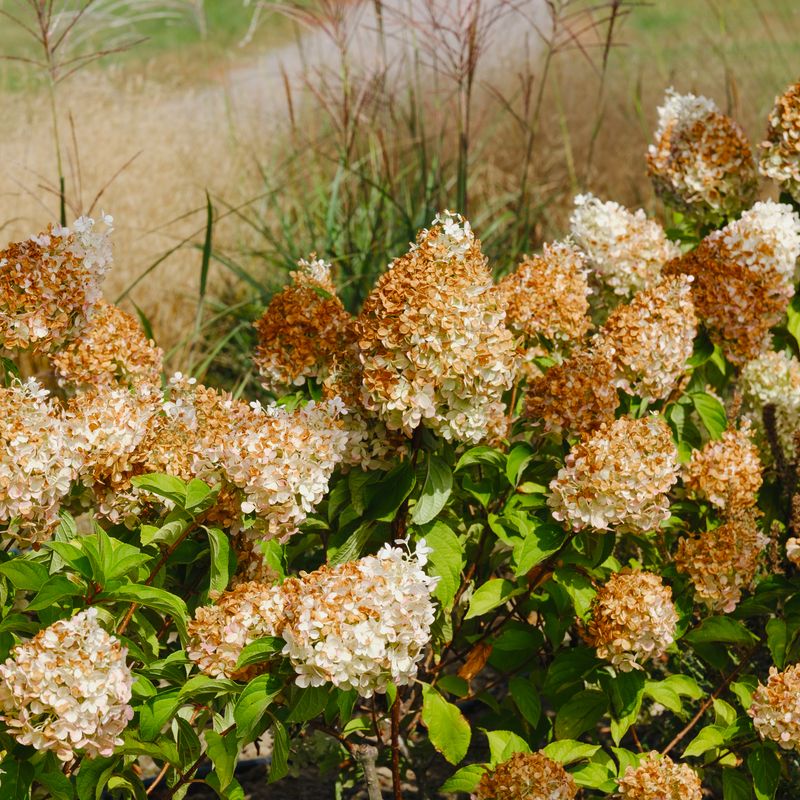
Once pruning decisions are settled, the remaining fall jobs center on keeping the plant stable as it moves toward dormancy. Moisture management is the first priority.
Hydrangeas need consistent soil moisture during dry fall stretches, but wet, poorly drained soil creates a different problem entirely.
Mississippi State Extension’s hydrangea guide recommends consistent moisture while noting that drought in late fall or winter can contribute to poor flowering the following year, and that saturated or poorly drained soil can lead to root rot. Southern gardeners in low-lying spots or heavy clay soils should be especially careful not to overwater during the cooler months when the plant is not actively growing.
A 2- to 3-inch layer of mulch around the root zone can help the soil hold moisture more evenly and moderate temperature swings that stress overwintering roots.
Fertilizer restraint matters just as much. Applying heavy nitrogen in fall is not a bloom booster; Mississippi State’s hydrangea publication warns that excess nitrogen can reduce flowering and push tender new growth at exactly the wrong time, when the plant should be hardening off for cooler temperatures.
Any fertilizer decision in fall should be based on a soil test, the product label, the plant’s visible condition, and guidance from your local Extension office rather than a general seasonal routine.
Protect the buds, then account for winter and regional conditions
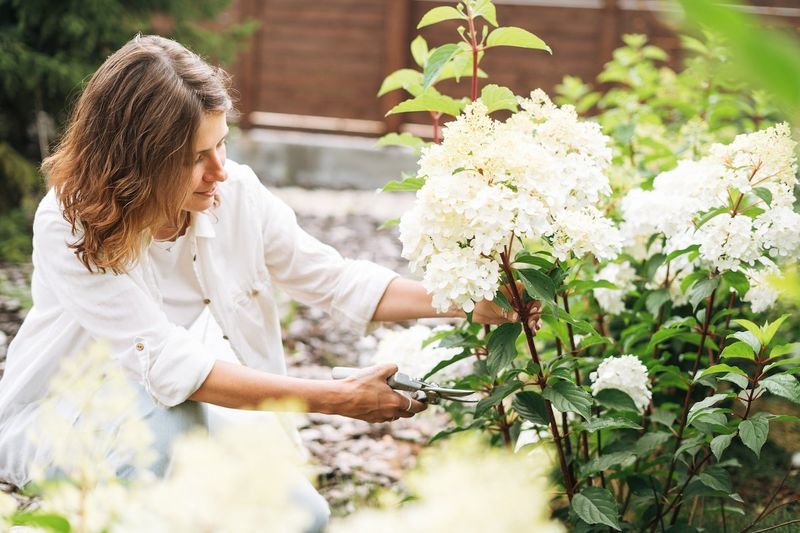
The decision rule for fall hydrangea care comes down to a short sequence. Identify the type, prune old-wood hydrangeas shortly after flowering and before bud formation rather than after it, avoid hard cuts when the type is uncertain, and deadhead lightly only if you want a tidier appearance.
Applying that sequence consistently protects the buds that carry next year’s display.
Correct pruning timing, though, does not guarantee a full bloom show on its own. UGA Cooperative Extension’s bigleaf hydrangea guide notes that winter injury, late freezes, and sudden temperature swings can damage or kill overwintering buds even on plants that were pruned at the right moment.
Drought, low light, poor drainage, cultivar genetics, and plant age all influence flowering as well. Mississippi State Extension reinforces that site conditions, not just pruning habits, shape what the plant can produce.
Southern gardeners should resist the pull of a one-size regional calendar. UF/IFAS guidance for Florida gardeners and their oakleaf hydrangea resource both emphasize that conditions vary widely by site, region, and plant type.
North Florida, Central Texas, coastal Mississippi, and the Texas Hill Country are not interchangeable gardening environments. Let the plant’s actual flowering cycle, combined with your specific site and climate, guide every decision.
The hydrangea that gets identified correctly and pruned at the right moment for its type is the one most likely to deliver a full display, whatever the season brings next.