
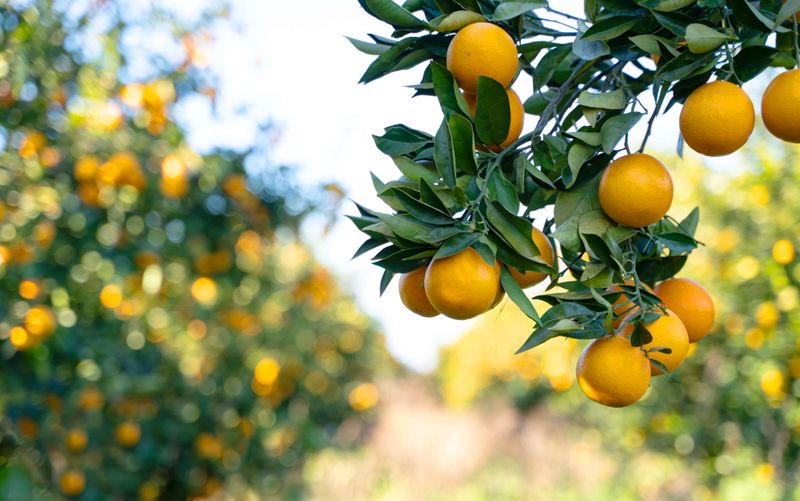
Most California citrus growers head into fall thinking the hard work is done, but the trees are still quietly active and may be carrying flowers, small fruit, or a maturing crop all at once. The single step that gets skipped most often is a hands-on irrigation check beneath the canopy, not a bag of fertilizer or a round of pruning.
Getting water delivery right in early fall can protect what is already on the tree, though it will not single-handedly control what blooms next spring. Read on to see exactly what to look for and what to leave alone.
Early-fall care protects fruit; it does not dictate every spring set
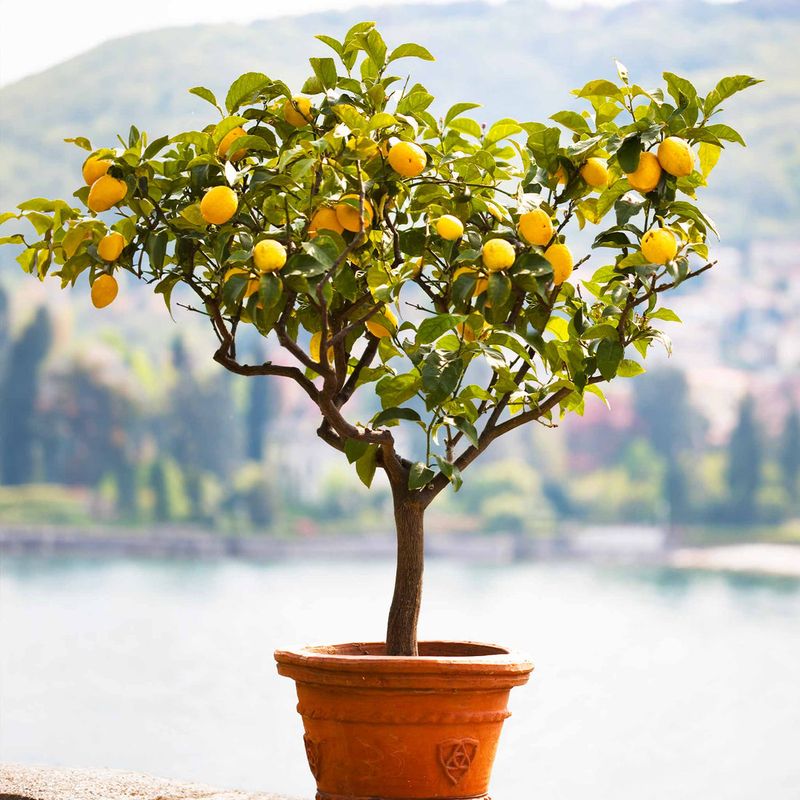
Citrus trees in California rarely take a full break. Depending on the variety growing in your yard, your tree may be holding a nearly mature crop, carrying small developing fruit, showing a flush of new flowers, or doing all three at once in early fall.
That overlap is what makes this season worth paying attention to, even if it does not come with a dramatic intervention to perform.
The most useful thing to understand upfront is that early-fall care is mainly about protecting what is already on the tree. UC Cooperative Extension guidance on California citrus makes clear that most common varieties, including navel oranges, mandarins, and grapefruit, produce their heaviest bloom and most significant fruit set during the spring flush.
For those trees, the next major fruit set is months away, and nothing you do in September or October will substitute for good conditions the following spring.
Lemons and some other acid citrus are a different story. They can flower and set fruit more continuously throughout the year, which means an active flower or young fruit on a lemon tree right now is directly affected by what happens to that tree this fall.
The same is true for any variety carrying a second or off-season flush.
Where does irrigation fit into all of this? UC ANR’s home citrus production guide identifies consistent water during fruit development as a key factor in fruit retention and size.
Checking and stabilizing irrigation is the most defensible early-fall action because it addresses something the tree needs right now, regardless of when the next major bloom arrives.
What this does not mean: a single watering adjustment will not guarantee next year’s crop. Fruit set depends on cultivar, tree age, temperature, nutrition, pest and disease pressure, and canopy condition.
Early-fall irrigation is one well-supported piece of a larger picture, and the article that follows treats it that way.
Water stress can turn flowers and young fruit into drop
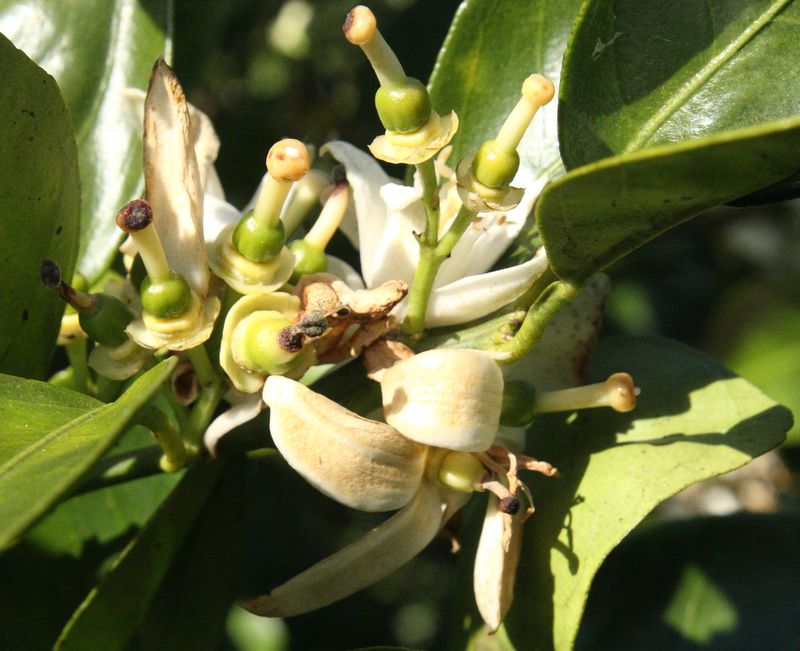
Citrus trees shed flowers and small fruit constantly, and that is completely normal. A tree that produces hundreds of blossoms will keep only a fraction of them as mature fruit, adjusting its crop load based on its own resources and the conditions around it.
Seeing dropped petals or marble-sized fruit on the ground beneath your tree is not, by itself, evidence that something went wrong.
The situation changes when water supply becomes unreliable. UC ANR research on home citrus production connects water stress during active flowering with increased flower and young-fruit drop.
When the tree does not have enough water to support both its vegetative tissue and developing fruit, it drops the fruit first. That is a survival response, not a failure of the fruit itself.
The same problem shows up later in the season in a different form. When rapid fruit growth is underway and water becomes scarce, the fruit that stays on the tree may end up noticeably smaller than it should be.
Adequate water during fruit development supports both retention and final fruit size, so the timing of any shortage matters as much as the shortage itself.
A note on perspective: UC IPM’s overview of citrus fruit drop explains that the natural shedding of blossoms and small fruit is built into the way citrus manages its crop load. A dropped flower does not prove the homeowner missed a critical treatment.
The concern worth acting on is excessive or unusual drop that coincides with drought symptoms, saturated soil, pest activity, disease, nutrient problems, or a tree that looks generally unwell.
If your tree is shedding what looks like a normal volume of blossoms and tiny fruit while otherwise appearing healthy, the right response is to verify that irrigation is working well, not to add extra inputs. The goal is steady, adequate water rather than a rescue intervention after stress has already built up.
UC research on regulated deficit irrigation confirms that deliberate water restriction is a specialized commercial strategy, not a blanket home-garden recommendation, and that water stress during flowering carries real risk of increased drop.
The first check belongs in the root zone
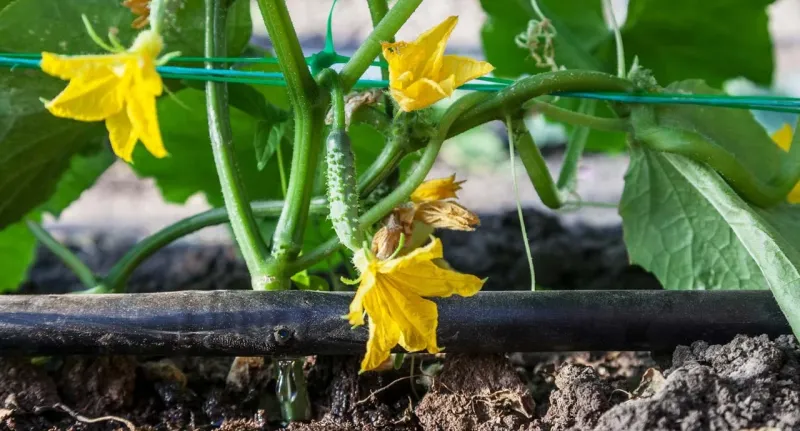
Before adjusting anything on your irrigation controller, go outside and check the soil. Timers and schedules are useful starting points, but they do not account for clogged emitters, uneven coverage, compacted soil, or the way a tree’s water demand shifts with temperature and canopy size.
The only way to know what is actually happening in the root zone is to look.
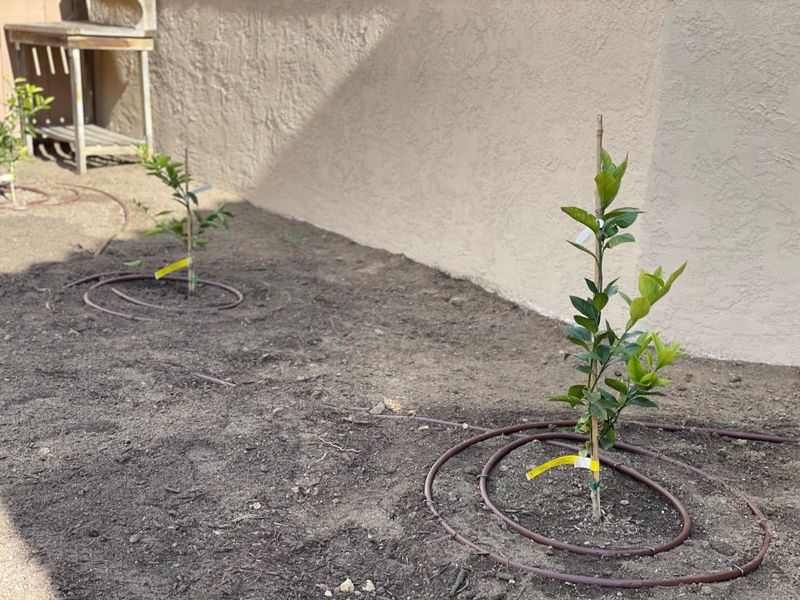
Start beneath the canopy rather than at the base of the trunk. Citrus feeder roots are concentrated in the upper soil layers and spread outward toward and beyond the drip line, which is the outer edge of the canopy.
UC IPM’s cultural tips for growing citrus recommend applying water at or near the drip line rather than against the trunk, where it does little for root uptake and can create problems for bark and crown tissue.
Push a finger or a screwdriver several inches into the soil at a few spots around the drip line. Soil that crumbles and feels dry at depth needs water.
Soil that feels consistently moist is in reasonable shape. Soil that is soggy or smells sour may be staying too wet, which is its own problem.
Look for dry pockets on one side of the tree and wet areas on another, which often point to emitter failures, uneven spacing, or a head that is partially blocked.
Walk around the entire canopy perimeter and check each emitter or sprinkler head. A single blocked drip emitter can leave a quarter of the root zone dry while the timer shows the system running normally.
UC Master Gardener guidance on irrigation for established trees emphasizes verifying that water is actually reaching the root zone evenly, not just that the system is technically on.
Once you have a clear picture of what the soil looks like and where coverage gaps exist, you have the information needed to make a real adjustment. UC Alameda Master Gardener drought-watering guidance reinforces that the right response to a dry tree is targeted, deep irrigation directed where the roots actually are, not a uniform schedule increase applied without inspection.
Deep, even watering beats both drought and saturation
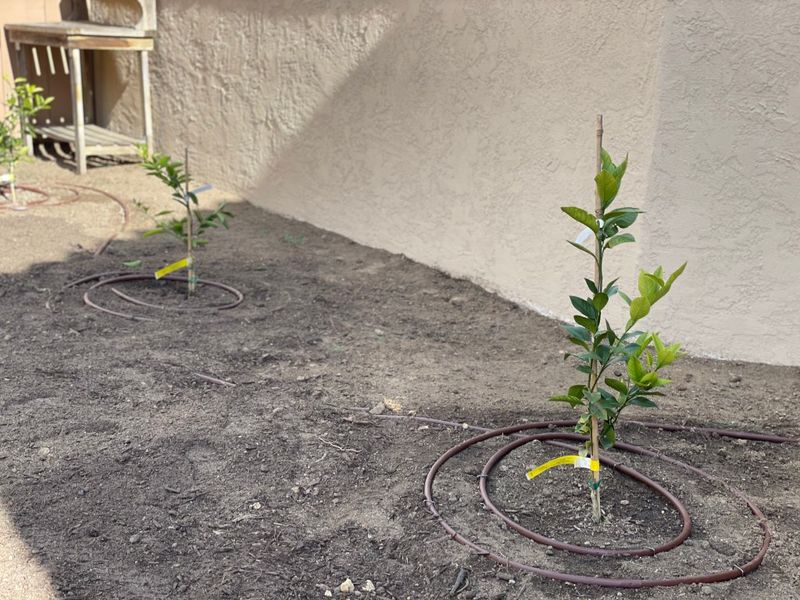
Once you know what the soil looks like, you can make a watering adjustment that actually helps. The goal is deep, consistent moisture through the root zone, which for most established citrus trees means the top two to three feet of soil.
Shallow, frequent watering encourages surface roots that dry out quickly; infrequent but deep watering encourages roots to follow moisture downward, making the tree more resilient between cycles.
UC ANR’s home citrus guide describes deep irrigation during the summer through fall period as important for fruit development, with frequency adjusted for soil type, weather, tree age, canopy size, and cultivar. No single schedule works across all California yards.
A tree in sandy soil in the Central Valley needs water more often than the same cultivar growing in clay near the coast. Your job is to match the schedule to the actual conditions, not to follow a fixed calendar.
Keep water distribution near the drip line and away from the trunk and crown. Wet bark around the base of a citrus tree creates conditions that favor Phytophthora, a water mold that causes root and crown rot.
UC IPM’s guide to Phytophthora root and crown rot identifies prolonged soil saturation and water contact with the crown as primary risk factors. If your current emitters sit close to the trunk, moving them outward is a simple fix with real protective value.
Avoid swinging between extremes. Letting the soil go bone dry and then applying a heavy soak is associated with citrus fruit cracking, where the rind splits as the fruit rapidly takes up water after a period of drought.
UC Cooperative Extension Ventura County guidance on citrus fruit cracking links irregular water supply to this problem, which is more common on navel oranges and some mandarins. Consistent moisture is a better strategy than dramatic corrections.
UC IPM cultural guidance also cautions that waterlogged soil can damage roots and reduce both water and nutrient uptake, which means overwatering carries its own costs beyond just disease risk.
Your citrus type and California climate change the schedule
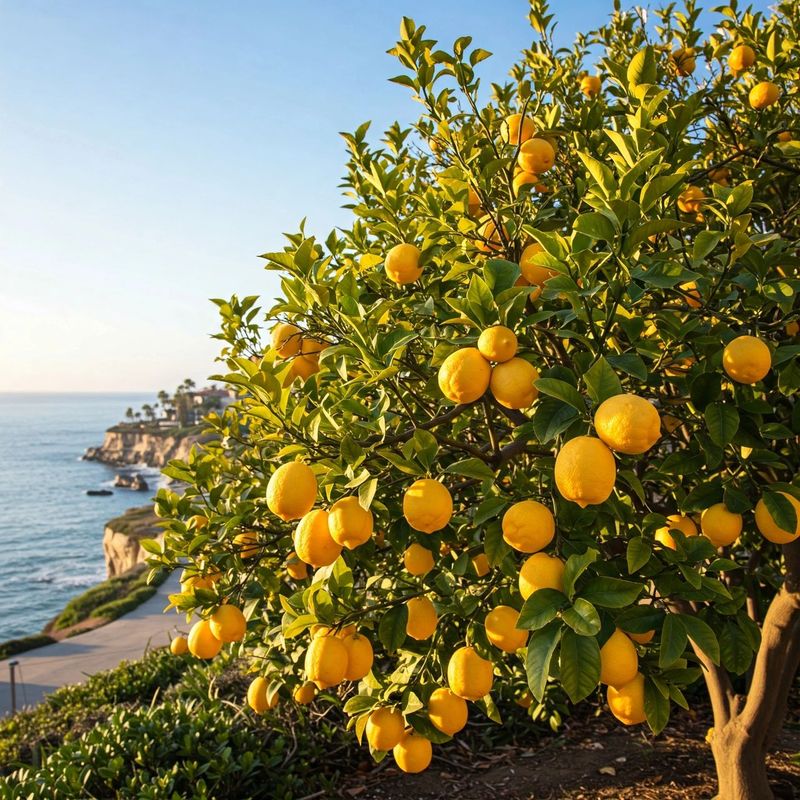
A coastal lemon tree in Santa Cruz and a navel orange in Fresno are both California citrus, but they are operating in almost completely different worlds. Applying the same watering schedule to both would be a mistake, and the same logic applies across all of California’s varied growing conditions.
Inland-valley and desert locations deal with higher summer temperatures, lower humidity, and faster soil drying. Trees in those areas often need more frequent irrigation through the summer-to-fall transition, and the consequences of skipping a watering cycle can show up quickly in fruit drop or stressed foliage.
Coastal areas tend to be cooler and may receive marine influence that slows soil drying, but they are not immune to dry stretches. Foothill and mountain-adjacent locations add the complication of cold nights arriving earlier in fall, which can affect both irrigation needs and the risk of late-season growth flushes.
UC IPM’s citrus cultural guidance lists soil type, irrigation method, tree age, canopy size, recent weather, and local restrictions as all relevant to setting an irrigation schedule. Accounting for recent rainfall matters too: if your area received meaningful rain in late September, the soil moisture picture looks very different than after a dry stretch.
Citrus is evergreen, which means it does not enter the same deep dormancy as deciduous fruit trees in winter. UC ANR home citrus guidance and UC Cooperative Extension irrigation research both note that established citrus may still need supplemental water during dry winter periods, even after summer irrigation is reduced.
Irrigation should be scaled back when sustained winter rain begins, not automatically shut off on a fixed date.
Cultivar differences also affect timing. UC Ventura County Cooperative Extension citrus FAQ and UC San Luis Obispo Master Gardener citrus notes both distinguish between lemons and other more continuously flowering acid citrus, which may have active flowers and young fruit right now, and varieties like navels and mandarins, whose next significant fruit set is tied to the following spring bloom.
Knowing which type you are growing helps you understand exactly what is at stake in early fall.
Skip the fall fixes that create new problems
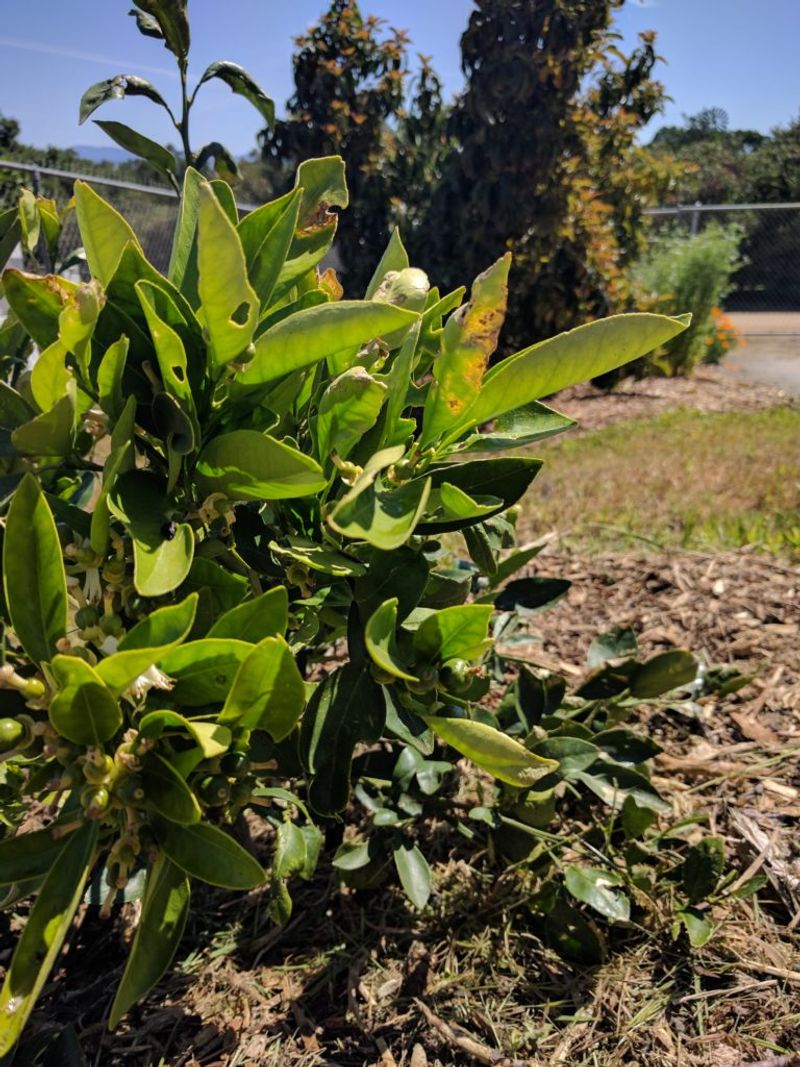
When a citrus tree looks off or fruit drop seems heavier than expected, the instinct to do something is understandable. Homeowners reach for fertilizer bags, pruning shears, or advice suggesting that stressing the tree into blooming is the answer.
Most of those moves either do not help or actively create new problems.
Late or heavy nitrogen fertilization is one of the most common missteps in early fall. California Department of Food and Agriculture fertilization guidelines for citrus place the bulk of annual nitrogen between the early spring flush and fruit set, with applications completed by early fall.
Pushing nitrogen late in the season can stimulate a flush of tender new growth that has little time to harden before cooler temperatures arrive. UC IPM citrus guidance warns that late-season nitrogen can also delay fruit coloring and contribute to rough or coarse rind texture.
UC San Luis Obispo Master Gardener citrus cultural practices place the primary nitrogen application in late winter or early spring, not fall.
Deliberately withholding water to stress the tree into blooming is sometimes suggested as a home remedy, but it is not safe advice for most homeowners. UC research on regulated deficit irrigation describes this as a precision commercial strategy that depends on specific cultivars, growth stages, measured soil water potential, and careful monitoring.
Applied without that structure, water restriction during active flowering increases the risk of flower and young-fruit drop rather than reducing it.
Heavy or unnecessary pruning in early fall carries its own risks. University of Arizona Extension pruning guidance for citrus notes that citrus generally does not need annual shaping, and excessive cuts remove the foliage that supports fruit development and shades the trunk from sun damage.
Late-season pruning can also push out tender new growth that is vulnerable to cold injury in locations where temperatures drop significantly in late fall or winter.
Phosphorus products marketed as bloom triggers should not be applied without a diagnosed deficiency. University of Florida IFAS citrus production guidance notes that poor citrus production has many possible causes, and adding nutrients without knowing what is actually short can harm fruit quality and contribute to runoff problems.
If you suspect a nutrient issue, a soil test or leaf analysis gives you something concrete to act on.
Normal fruit drop still leaves room for diagnosis
Citrus trees are prolific flower producers, and they drop the majority of what they make. A navel orange that sets thousands of blossoms may ultimately carry only a few dozen mature fruit to harvest.
That ratio is not a problem; it is how the tree manages its resources. Seeing fallen petals and pea-sized fruit on the ground in early fall is, in most cases, completely ordinary.
UC IPM’s guide to citrus fruit drop explains that natural shedding occurs in waves tied to the tree’s crop-load adjustment process. Most of that shedding is normal and self-correcting.
A homeowner who sees dropped fruit and immediately applies extra fertilizer or adjusts the irrigation dramatically may be responding to something that required no response at all.
The drop worth investigating is the kind that comes with other signals. A tree losing fruit heavily while also showing wilted or yellowing foliage, trunk discoloration, weeping bark, or a thinning canopy is telling you something more specific.
Pest activity, fungal disease, root damage, or prolonged drainage problems can all produce fruit drop as a symptom rather than the cause.
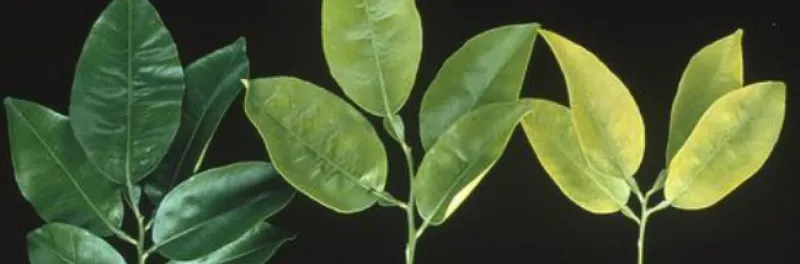
Yellow leaves and wilted foliage are particularly easy to misread. UC IPM’s guidance on water deficit and excess points out that both drought stress and waterlogged soil can produce yellowing and wilting in citrus.
Adding more water to a tree that is already sitting in poorly drained soil will make things worse. Check soil moisture and drainage before deciding which direction to adjust.
If the soil is saturated, the drainage is poor, and you are also noticing trunk or crown symptoms such as oozing, discoloration, or a soft, water-soaked appearance at the base, UC IPM’s Phytophthora root and crown rot resource describes what to look for and confirms that prolonged saturation is a primary contributing factor. That situation calls for improving drainage and correcting irrigation placement, not increasing water supply.
Make the early-fall irrigation check an ongoing habit
The action sequence for early fall is straightforward. Go out and push your fingers into the soil beneath the canopy near the drip line.
If it is dry several inches down, the tree needs water. If it is consistently moist, hold the current schedule and check again in a few days.
If it is waterlogged, back off and look at your drainage before adding anything.
When you do water, apply it deeply and near the canopy’s outer edge. Keep the trunk and crown dry.
UC ANR home citrus guidance and UC IPM citrus cultural tips both support deep, targeted irrigation as the foundation of healthy citrus care through fall. As weather cools and any winter rain begins, reduce irrigation to match what the tree actually needs rather than running a fixed summer schedule into December.
Repeating this check every week or two through fall costs almost nothing and catches problems, like a blocked emitter or a dry pocket under the canopy, before they translate into dropped fruit or stressed foliage. A citrus tree that arrives at spring bloom well-hydrated and structurally sound is simply better positioned for whatever comes next.
Good irrigation habits are less a seasonal task than a practice of staying curious about what is happening just beneath the surface.