
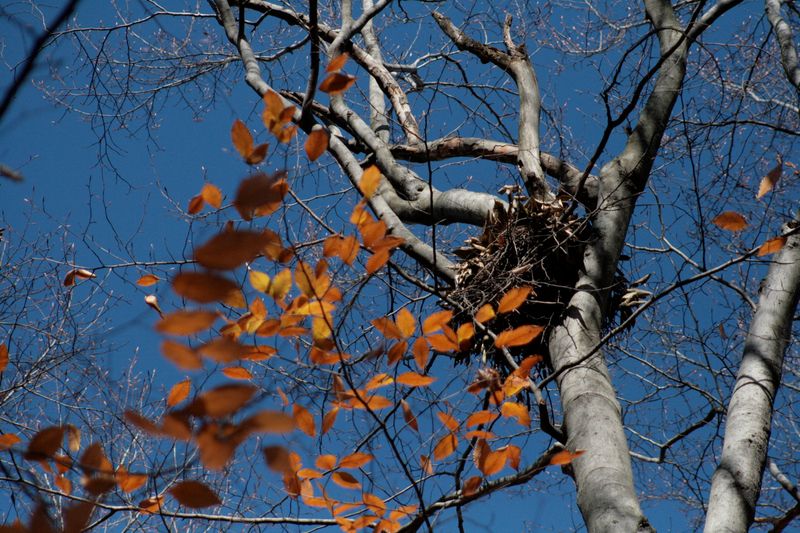
Look up at a Florida oak on a cool morning and you may spot a round clump of leaves wedged in the branches. It could be a squirrel nest, and it may have been there all year, hidden by foliage.
Knowing what these leafy balls can and cannot tell you helps you enjoy the wildlife in your yard without worrying about your tree.
A leafy ball may be a squirrel leaf nest
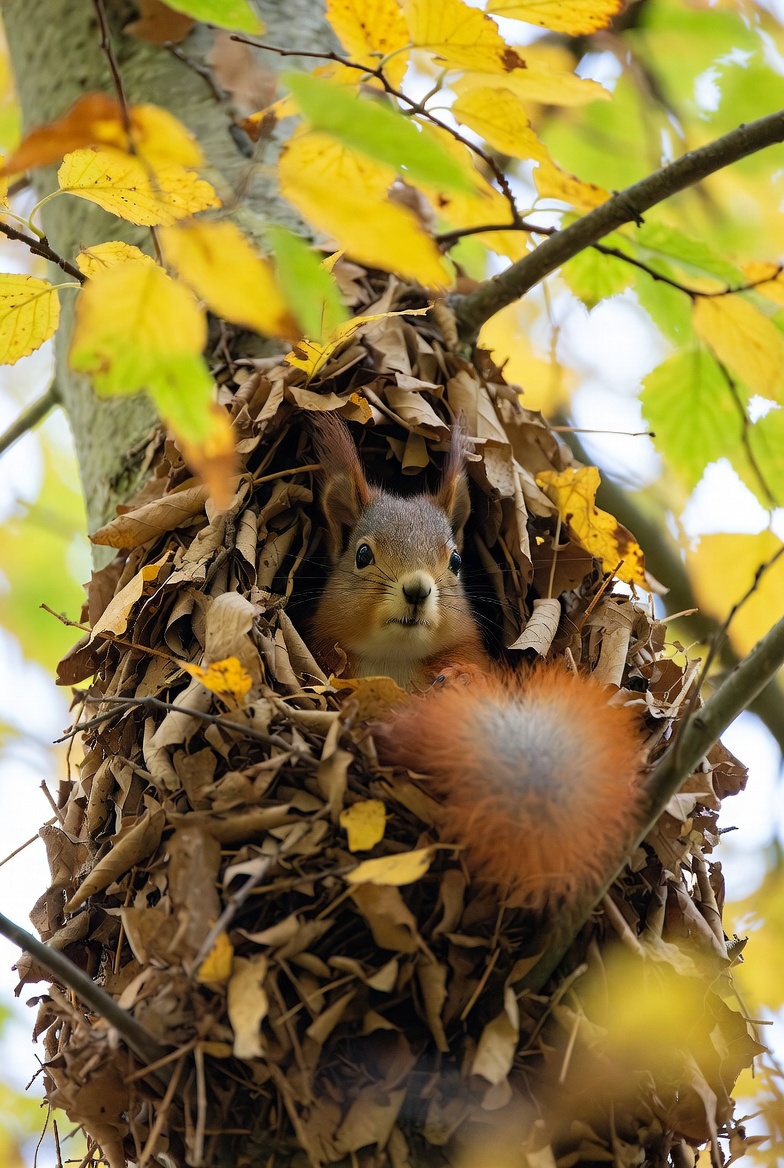
A tight ball of leaves and twigs sitting in the branches of an oak is consistent with a squirrel leaf nest, often called a drey. Squirrels build these shelters high off the ground, usually in a fork or against a sturdy limb.
Florida’s wildlife agency lists eastern gray, fox, and southern flying squirrels as the squirrels found in the state, so there are several possible neighbors in your trees.
Looks alone cannot settle the question. A leafy mass is a good clue, but it is not a definite identification.
Clumps of debris can also form in branches for other reasons, so it is best to call a leafy ball a possible or likely squirrel nest.
Squirrels also do not rely only on leaf nests. Tree cavities can serve as shelter too, and UF/IFAS describes the value of oaks to wildlife, including the homes and food they provide.
That means a tree with no visible nest may still be in use.
So why do these nests seem to appear out of nowhere? In some trees, the answer has to do with what the leaves are doing.
Thinning foliage can reveal nests, but Florida oaks vary
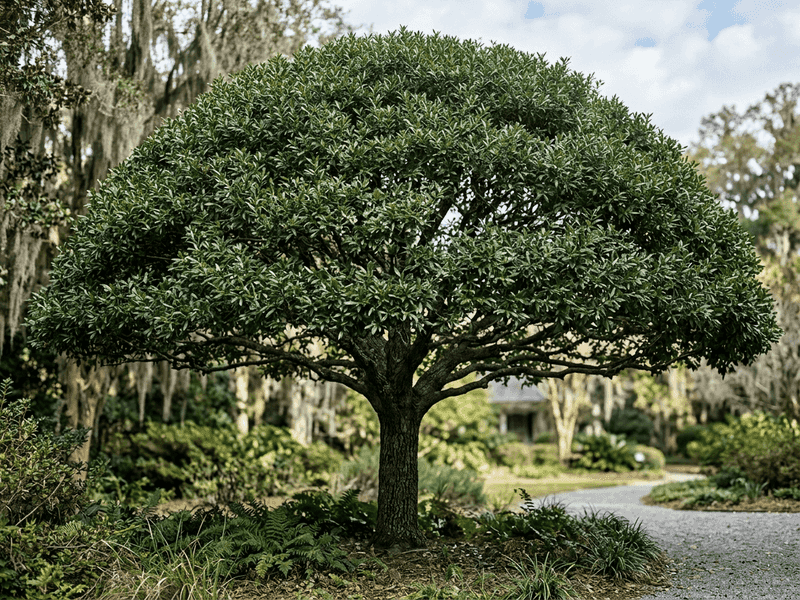
When leaves thin out, a nest that was hidden all summer can suddenly stand out against the sky. That makes winter a plausible time to notice one, at least in some trees.
Think of it as a seasonal observation, not a rule.
Florida oaks do not all follow the same calendar. UF/IFAS notes in its guide to oaks and wildlife that many oaks hold their leaves later than other deciduous trees.
A laurel oak or water oak may look patchy in January, while a neighbor’s tree still looks full.
Live oaks behave differently again. Their leaves are replaced gradually over time instead of all dropping in fall, which is covered in UF/IFAS Adopt a Tree materials.
A live oak can keep a nest tucked behind green leaves all winter.
A practical tip: if you want to look for nests, wait for a bright day and scan from the ground with binoculars. Check the forks where big limbs meet the trunk.
If you see nothing, that does not mean no squirrel uses the tree.
Gray and fox squirrels use mature oaks
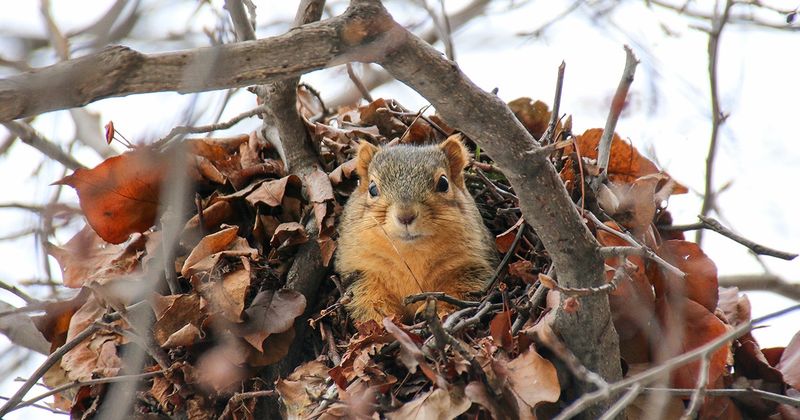
Two squirrels get most of the attention in Florida oaks: the eastern gray squirrel and the fox squirrel. Gray squirrels build nests in tree forks, and UF/IFAS reports that gray and fox squirrels often nest in large, mature oaks, as laid out in its oak and wildlife publication.
Older oaks offer sturdy branches, cover, and acorns close by.
Fox squirrels may build leaf nests with oak leaves. A U.S.
Forest Service review of fox squirrels in the Southeast documents leaf nests in several trees, including live, laurel, and turkey oaks. So a leafy ball in your oak fits what is known about both squirrels.
That said, you cannot tell which squirrel built a nest by looking at it. FWC’s squirrel profile lists the species found in Florida, but the sources offer no visual test that separates a gray squirrel’s nest from a fox squirrel’s.
Leaf nests are also only part of the picture. Squirrels can use tree cavities as well, and cavities may be especially useful shelter in colder weather in northern Florida.
An oak with a hollow limb and no visible nest could still be home to a squirrel.
A nest cannot confirm occupancy or tree condition
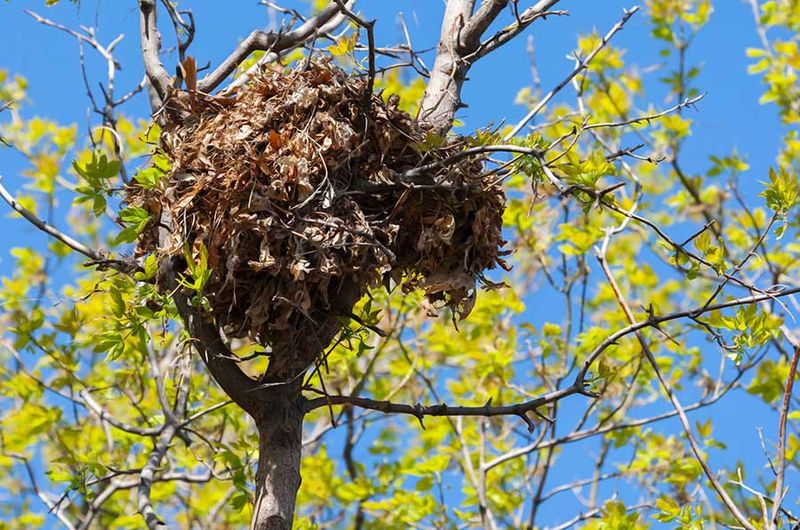
Seeing a nest is a bit like seeing a house with the curtains closed. You know someone built it, but not whether anyone is home.
A drey shows that a squirrel has used the tree or may use it for shelter or nesting, and that is about all.
Occupancy is the first thing a nest cannot tell you. A leafy ball may be active today, empty this week, or left over from earlier use.
Florida’s authoritative sources document that squirrels use nests, but they do not offer a reliable way to judge from the ground whether one is occupied.
The species is the second thing. As covered in FWC’s squirrel profile, several squirrels live in the state, and appearance does not sort them out.
Watching the tree on a few mornings, and noticing which squirrels come and go, gives you a better clue than the nest itself.
The third is tree health. UF/IFAS describes oaks as valuable wildlife trees, and healthy mature oaks are the very trees squirrels favor.
A nest is not evidence that an oak is unhealthy or damaged. If anything, it suggests a tree that offers good shelter and food.
Assess tree damage separately from the nest
If you are worried about an oak, look at the tree itself rather than the leafy ball. Squirrel nests do not diagnose decline.
Real damage shows up in other places, and each sign deserves its own check.
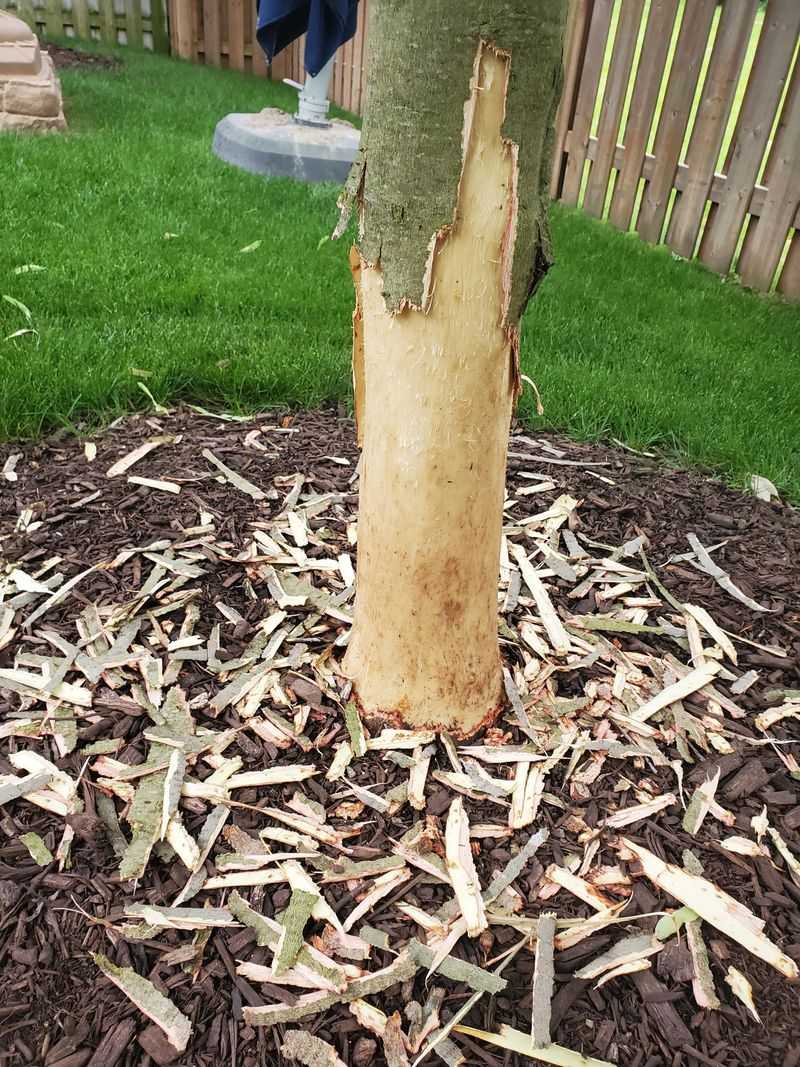
One sign is stripped bark. UF/IFAS lists bark removal by gray squirrels as a source of tree damage in its guide to identifying wildlife damage.
Look for patches of bare wood on branches, often with shredded bark scattered below.
Another sign is a girdled twig or limb. A Duval County Extension fact sheet on why branches die explains that girdling can kill a branch by interrupting water and nutrient transport.
A ring of missing bark, with leaves that wilt or turn brown beyond it, is the pattern to watch for.
Other things can cause dead branches too, so do not blame squirrels by default. If you find stripped bark or a dying limb, take photos from the ground and note where it is on the tree.
For anything large or high up, a certified arborist can judge the cause and the risk. Keep the nest and the damage as two separate questions.
Observe from the ground and check before disturbing a nest
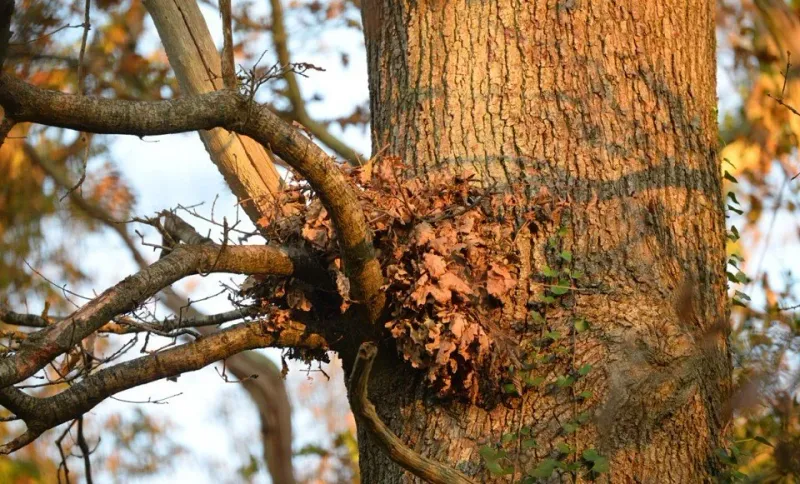
The simplest response is also the safest: watch from the ground. Do not climb, shake the branch, or poke at a nest to see who is inside.
That can hurt you and the animals, and it will not give you a reliable answer anyway.
Florida’s wildlife rules matter here. According to FWC’s page on other wildlife regulations, wildlife nests generally may not be taken except as specifically permitted.
Exceptions exist, so the rules are not a blanket statement that a nest can never be touched.
Nuisance-wildlife provisions can also apply. FWC’s nuisance wildlife FAQs are the place to start if a nest is causing a real problem, such as one pressed against a roofline.
Contact FWC before disturbing or removing a nest, and ask a qualified professional if work near the tree is needed.
For most yards, there is nothing to fix. Keep pets back from the trunk, trim only for sound tree-care reasons, and enjoy a few minutes of squirrel-watching.
A leafy ball high in an oak is often just a neighbor’s house, and the best thing you can do is let it stay one.