
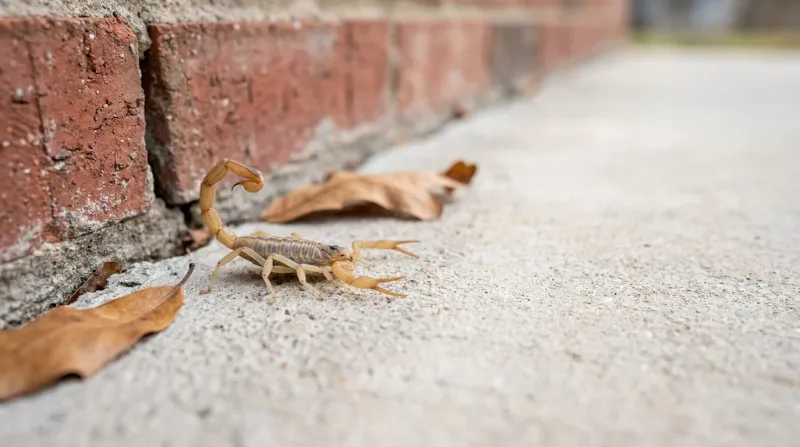
Chilly nights have settled over Central Texas, and many homeowners are wondering about scorpions in the garage. Nobody has shown that the cold is sending more of them indoors, but a garage with gaps can still let them in any time of year.
A few simple checks around your doors, walls, and yard can cut down the ways they get inside. Here is what to look at, what to skip, and what to do if someone gets stung.
What the cold snap does—and does not—tell us
Weather first. LCRA reported a chilly night in mid-November, with lows in the upper 30s across the Hill Country and in the lower 40s around Central Texas.
That part is documented.
What is not documented is a jump in scorpion sightings in local garages. The sources reviewed for this article do not show a current surge, and they do not show that cold weather caused one.
A chilly night and a scorpion in your garage may simply be two separate events.
There is one case where weather and indoor pests are linked in Texas. Texas A&M described indoor pests increasing during unusually hot, dry conditions.
That account is about heat and drought, not about cold snaps, so it cannot be borrowed to explain what is happening this week.
Here is the useful part. Whether or not the weather is changing scorpion behavior, a garage with a worn door seal or open gaps gives them a way in.
Fixing those spots costs little, works in any season, and does not depend on settling the question of why scorpions show up. The next sections walk through the species you are most likely to meet and the checks worth doing.
The striped bark scorpion is the likely Texas visitor
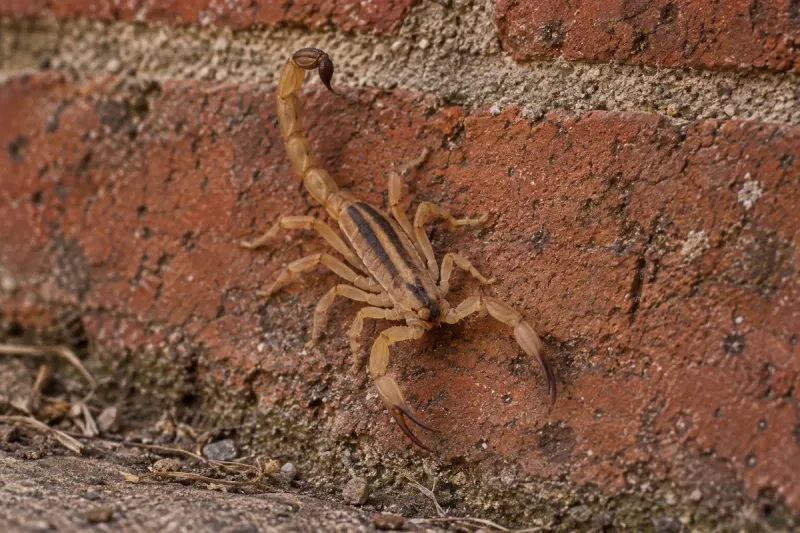
If you find a scorpion in a Texas garage, odds are it is the striped bark scorpion, Centruroides vittatus. Texas A&M AgriLife describes it as a species found across Texas, living both outdoors and inside buildings.
It is pale yellowish-tan, often with two dark stripes down its back.
Two habits matter for homeowners. It is active at night, so you may never see it during the day.
It can also climb walls, which means a scorpion on a garage wall or near the ceiling is not unusual and does not mean it came through the door.
You may hear the name bark scorpion tied to frightening stories. Those usually come from the Arizona bark scorpion, a different species, C. sculpturatus, linked to the Sonoran Desert region.
Texas A&M says that species is not found in Texas, so the Arizona stories do not describe what your garage is likely to hold.
That difference should not make anyone casual about stings. Texas Parks and Wildlife notes that most Texas stings are not serious, but they are painful, and some people have allergic reactions.
Treat any scorpion as something to keep out of living spaces and away from bare hands.
Inspect the garage door and nearby doors
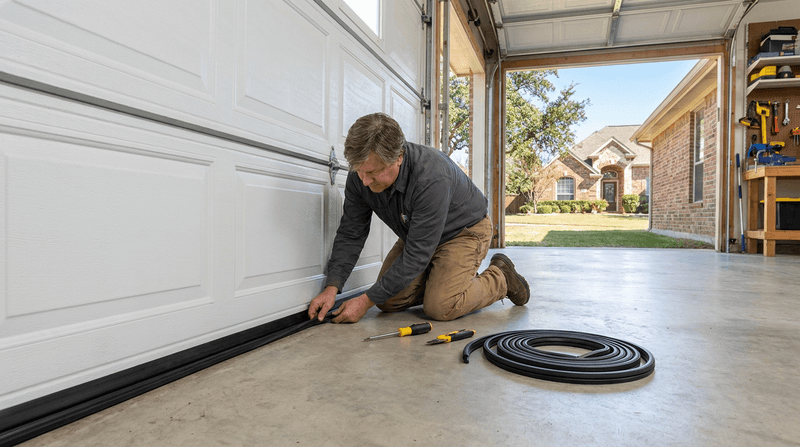
Start at the bottom edge of the garage door, since that is where most gaps show up. Run your eyes and hand along the full length of the seal, looking for cracks, flattened sections, or places where it has pulled loose.
A worn brush or rubber bottom seal should be fitted or replaced. A University of Arizona pest-proofing guide recommends one of those seals for garage doors.
Next, check the sides and top of the door. Close it and look for daylight or openings where the door meets the frame, and where the track hardware passes through the wall.
Concrete floors that dip or crack near the door can also leave a gap under a good seal.
Then walk to the door between the garage and the house. This one is easy to forget, yet it is the last barrier between a garage visitor and your living room.
Check its sweep and weatherstripping, and repair them if they are worn.
For regular exterior doors, a different test applies. The same Arizona guide says no outside light should be visible under them, and it suggests repairing thresholds and keeping sweeps and weatherstripping in shape.
Do not use that light test on a garage door, which has its own seal advice above. Texas A&M school IPM guidance also lists weatherstripping among exclusion steps.
No source gives a safe gap size, so aim for a snug fit with no visible opening. Even then, a seal reduces entry but cannot promise zero scorpions.
Close other gaps and reduce nearby shelter
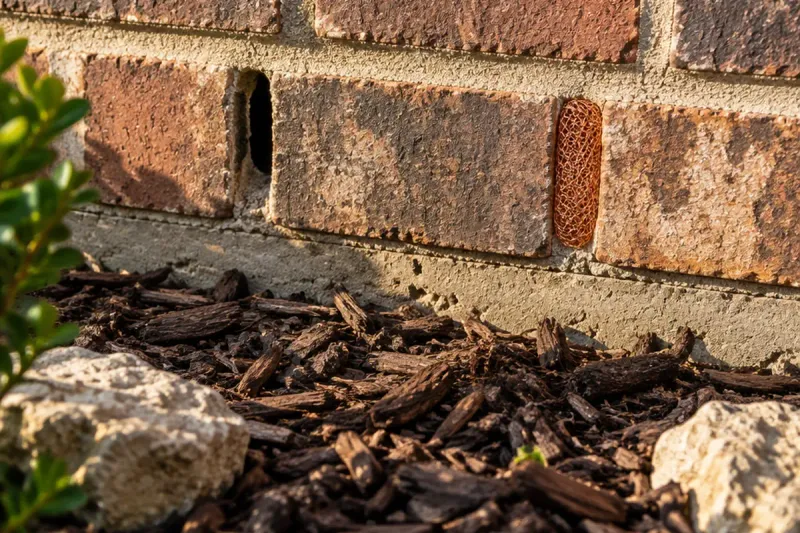
Once the doors are handled, walk the outside of the house slowly. Texas A&M AgriLife’s scorpion guide points to sealing structural openings as a control measure.
Good places to check are spots where pipes and cables enter the wall, gaps under roof eaves, and cracks around windows.
Window screens deserve a look too. A torn screen or one that does not sit tight in its frame is an easy entry point, and it is a quick repair.
Caulk or other sealants can close small cracks, while larger openings may need a different patch.
Next, think about where scorpions hide before they ever reach your wall. The same AgriLife guide recommends clearing boards, rocks, wood, and debris from beside the structure.
A forgotten pile of lumber or flat stones along the slab gives them a daytime shelter right at your door.
Plants count as well. Keep shrubs, vines, and overhanging branches from touching the house, because they can act as a bridge.
Stack firewood away from the walls, and do not carry it inside until you plan to burn it.
Think of these jobs as layers. Texas A&M school IPM guidance treats exclusion, sanitation, and inspection together.
Each step lowers the odds, but none guarantees a scorpion-free home.
Monitor for activity without mistaking it for a cure
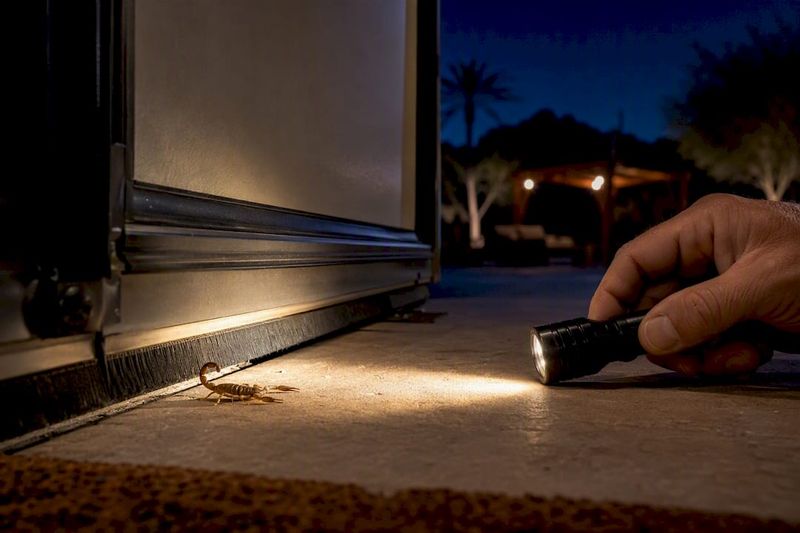
Monitoring tells you where to look, not whether you have won. Texas A&M’s sticky trap fact sheet explains that these traps catch pests and show where they may be moving.
For scorpions, that means placing them along walls near likely entry points such as the garage door and the house door.
An empty trap does not prove the problem is solved, and a catch does not mean an infestation. Keep checking and replacing traps, and use what they show to guide your next repair.
After dark, a UV or black light can help you find scorpions, since they glow under it. Texas A&M has noted this as a locating aid.
Never pick one up with bare hands, even a dead one that may not be fully dead. Use long tongs or a tool, or leave it to a pro.
Many people reach for a spray first. Texas A&M school IPM guidance says scorpions are difficult to control with insecticides alone and stresses exclusion, inspection, and sanitation.
AgriLife’s guide takes a similar habitat-focused approach.
If you do consider a pesticide, follow the product label exactly. A licensed pest professional can also look over your property and explain options.
Respond to a sting with appropriate care

If someone is stung, wash the area with soap and water, then call Poison Control for advice. Poison Control’s scorpion page is a good reference, and the specialists on the line can tell you what to do based on the person’s age and symptoms.
Keep the number handy before you need it.
Some symptoms mean skip the phone call and get emergency help. The American Heart Association and American Red Cross first aid guidelines recommend calling emergency services for whole-body symptoms such as trouble breathing, muscle rigidity, dizziness, or confusion.
Pain that is severe or spreading, or other signs affecting the whole body, also calls for medical care.
Small children, older adults, and anyone who has had allergic reactions to stings should be watched more closely. Allergic reactions can happen with Texas scorpions.
As for the species, the common Texas scorpion is the striped bark scorpion. Texas Parks and Wildlife says most stings here are not serious.
That is reassuring, but it is not permission to ignore a sting or wait out worrying symptoms.
A sealed door and a clear slab will not make a garage scorpion-proof, but they will leave the next visitor fewer ways in.