
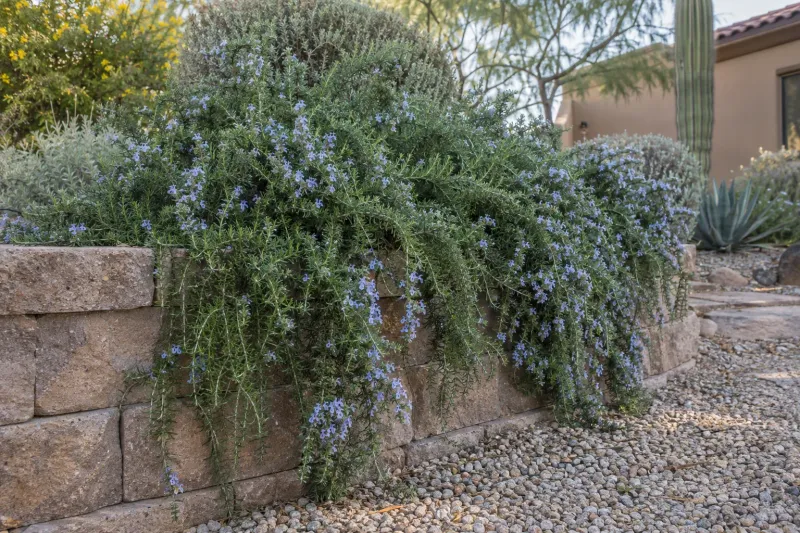
Prostrate rosemary is a low, spreading herb that smells wonderful, stays green all year, and draws bees when it blooms. Many homeowners wonder if it can take the place of bark mulch beside the house.
It can fill a bed with living cover, but where you plant it matters a great deal in fire country. Here is how to decide whether it belongs in your yard.
Keep the area nearest the house noncombustible

Start with distance, because it changes the answer. For the first five feet around a home, CAL FIRE recommends noncombustible surfaces such as gravel, pavers, or concrete.
It also says not to use combustible bark or mulch in that strip.
Rosemary does not get a pass here. UC ANR fire-safety guidance points out that rosemary contains oily resin and can catch fire easily during a wildfire.
Swapping bark for living rosemary does not remove the fire concern, because the plant itself is combustible.
So a rosemary bed pressed against the foundation is not the same as a planting several feet away. Rosemary is not fireproof or fire-resistant, and it is not a safer stand-in for bark in that first five-foot strip.
The better move is to keep that strip clear of anything that burns and to remove dead plants and debris.
Fire rules also depend on where you live. As of late 2026, the Board of Forestry page said the rule package for this nearest zone was still under final review.
Call your local fire authority or check its website for current requirements before you pull out any mulch or plant anything new.
Rosemary can provide fragrant, bee-attracting cover
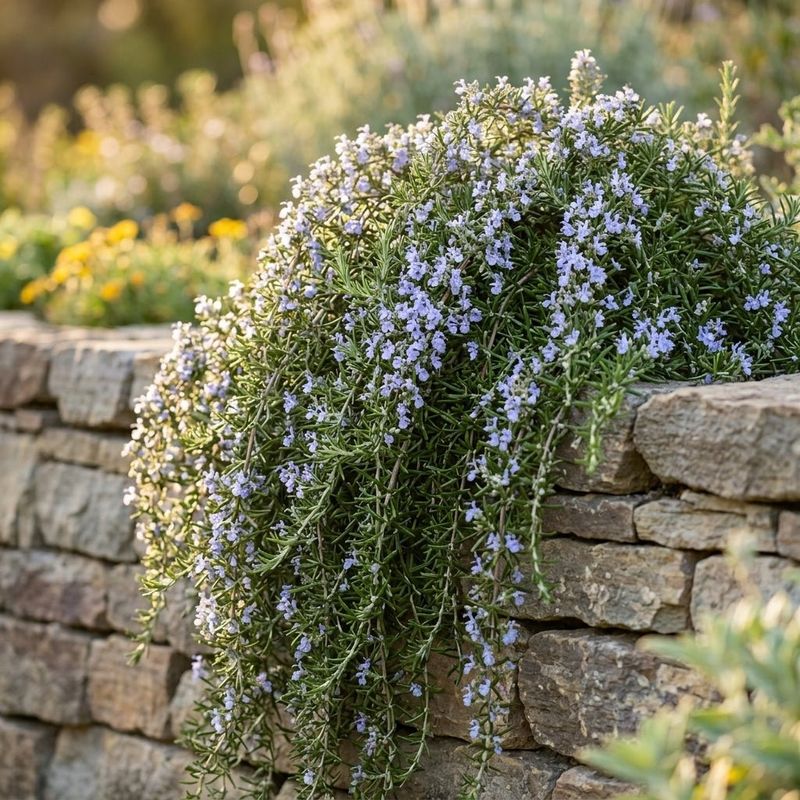
Brush against a creeping rosemary and the scent hits right away. Prostrate forms grow low and spread sideways, and UC Master Gardeners of Sonoma County describe them as usable groundcovers.
The foliage stays green through the year, so a planted slope or bed keeps its look in winter.
Bees are part of the appeal. The same Sonoma County source reports that rosemary flowers attract bees.
Flowering there often runs from October through March, but that is a local observation. Bloom timing shifts with climate, variety, and weather, and the plant does not flower nonstop.
One more point about the name. Rosemary is sometimes treated as a California regular, yet UC Marin Master Gardeners describe it as originating in dry Mediterranean climates.
It is not a California native. It suits our dry summers and mild winters because those conditions resemble its home range.
If supporting pollinators is your goal, think of rosemary as one useful plant in a mix rather than the whole answer.
Mulch and groundcover help in different ways

Gardeners often treat mulch and groundcover as rivals, but they do different jobs. According to UC IPM, mulch can suppress annual weeds, hold soil moisture, moderate soil temperature, and reduce erosion.
It works the day you spread it.
A living groundcover works more slowly. UC ANR weed guidance notes that dense, established groundcover can shade the soil and exclude many weeds.
The key words are dense and established.
Which one wins at weed control? The sources I reviewed do not show a head-to-head trial, so there is no basis for saying rosemary beats mulch.
Each approach has strengths, and the better pick depends on timing, site, and patience.
Keep the garden question separate from the fire question. Mulch benefits are real in a vegetable bed or a tree ring, yet CAL FIRE says not to use bark or mulch in the first five feet around a home.
A good garden material is not automatically a good material for the fire-exposed strip beside a wall.
Plan for weeds while the plants fill in
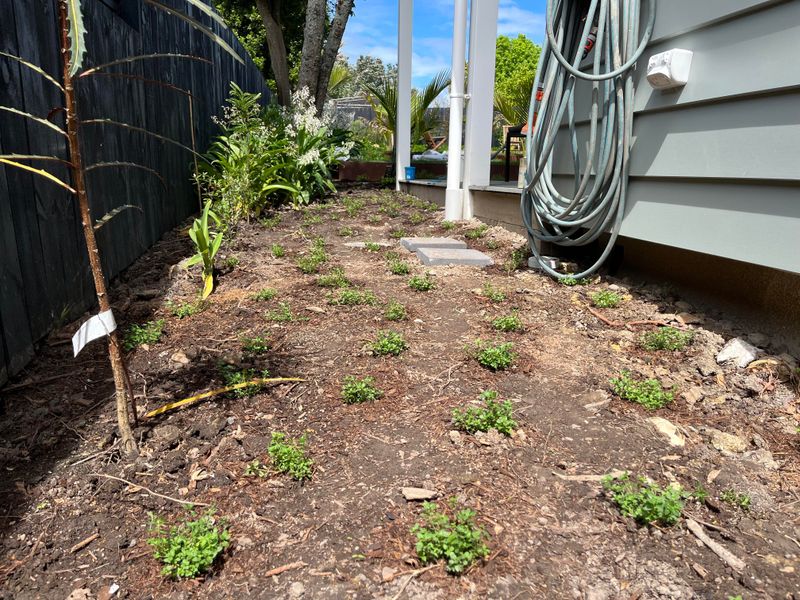
Young plants leave gaps, and weeds love gaps. Weed suppression from groundcover improves as the plants fill in, so the first season or two will look different from the finished picture.
A newly planted bed is not instant or maintenance-free weed control.
Preparation helps more than most people expect. UC ANR advises controlling perennial weeds before planting, since established perennials can keep coming back through a groundcover.
It also expects supplemental hand-weeding while the plants establish.
In practice, walk the bed every week or two in the growing season and pull small weeds before they set seed. Look for bare patches between plants, because those are where weeds will move in first.
Spacing is a trade-off. Closer plants fill in sooner but cost more up front.
Wider spacing saves money but leaves more open soil to weed for longer.
Match rosemary to the site and local guidance
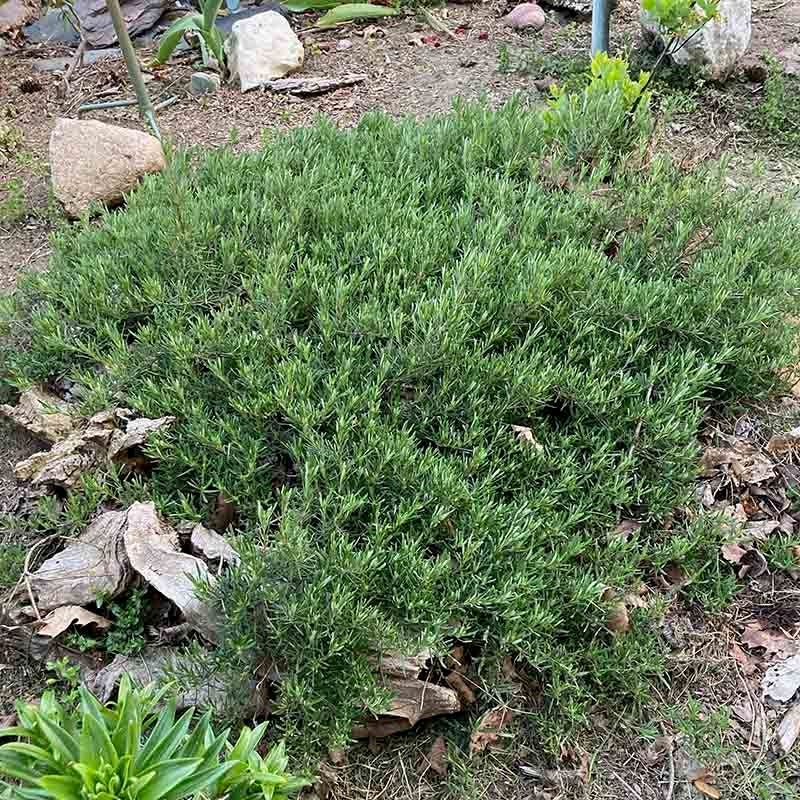
Rosemary is picky about a few things. UC IPM says it prefers sun and well-drained soil.
New plants need regular watering during their first year, and once established they are drought-tolerant and need little water. A new planting is not a no-irrigation project.
Heavy clay that stays wet can be a problem, so test drainage before you buy. Also check the mature spread on the plant tag.
A small starter can grow into a wide mat that crowds paths or walls.
Foundation clearance deserves thought. The sources I reviewed do not show that rosemary is safe against every foundation, and they say nothing proven about its roots protecting one.
Leave room between plants and the house, and check conditions at your own site.
Then bring in fire. A bed beyond the first five feet is a different situation from one touching the wall, but that distance is not a universal planting rule.
CAL FIRE’s defensible space guidance and the Board of Forestry zone page are good starting points. Your local fire authority has the final word on what applies to your property.
Use rosemary selectively

Here is a simple rule. Keep the strip nearest the house in line with current CAL FIRE guidance, and use rosemary only where its sun, drainage, and fire exposure fit the site.
Skip any promise that it beats mulch, since UC weed guidance only says dense groundcover can exclude many weeds once it fills in.
Before you buy plants, call your local fire authority. A fragrant, bee-friendly bed is lovely in the right spot and a gamble in the wrong one.