
When a heat forecast rolls in for California, it’s tempting to grab the hose and drench every tree in the yard. The problem is that watering a tree that doesn’t actually need it can cause just as much harm as ignoring one that does.
Knowing whether your tree’s root zone is genuinely dry before prolonged heat arrives is the step that separates a tree that handles the stretch well from one that quietly starts to fail. This guide walks through exactly how to make that call and what to do next.
Start with the soil, not the thermometer
A three-digit forecast does not tell you whether your tree needs water. Soil moisture, tree species, root health, drainage, prior drought exposure, and the expected length of the heat event are what actually determine whether pre-heat irrigation makes sense.
Reaching for the hose the moment a 100-degree day appears on the forecast app skips the one check that makes watering worth doing.
Before heat arrives, push a soil probe or a long screwdriver into the ground away from the trunk, somewhere between the middle of the canopy and its outer edge. If it slides in easily and comes out with damp soil clinging to it, the root zone still holds moisture.
If it meets resistance and comes out dry, the tree is already working from a deficit. UC IPM guidance on irrigating trees and shrubs recommends adjusting irrigation based on how deeply the soil is actually moist rather than following a fixed calendar schedule.
Soil texture changes how quickly moisture moves and how long it stays. Clay holds water longer but can stay deceptively moist near the surface while staying dry deeper down.
Sandy soil drains fast and dries out sooner. A tree with a large canopy shading the root zone may hold moisture longer than a recently transplanted tree in full exposure.
Weather leading up to the heat event matters too: a tree that went through several weeks of dry, windy conditions before the forecast arrived is in a different position than one that received a slow soak just days earlier.
The reason this pre-heat check matters is that heat sharply increases a tree’s water demand, and USDA Forest Service research on drought-related tree mortality shows that decline and death can lag behind the original stress event by weeks or even a full season. UC Davis Arboretum guidance notes that shade trees may need irrigation even when lawns are allowed to go dormant, but the starting point is always whether the root zone is actually dry.
Watering a root zone that already holds adequate moisture adds no benefit and can create oxygen-depleted, disease-prone soil.
Match the plan to the tree
Not every tree in a California yard has the same summer water needs, and treating them all the same before a heatwave is one of the most common ways well-intentioned watering causes harm. The category of shade tree covers an enormous range: coast live oaks, valley oaks, sycamores, red maples, ornamental pears, and recently planted nursery stock can all cast shade, but their water requirements during a hot dry summer are genuinely different.
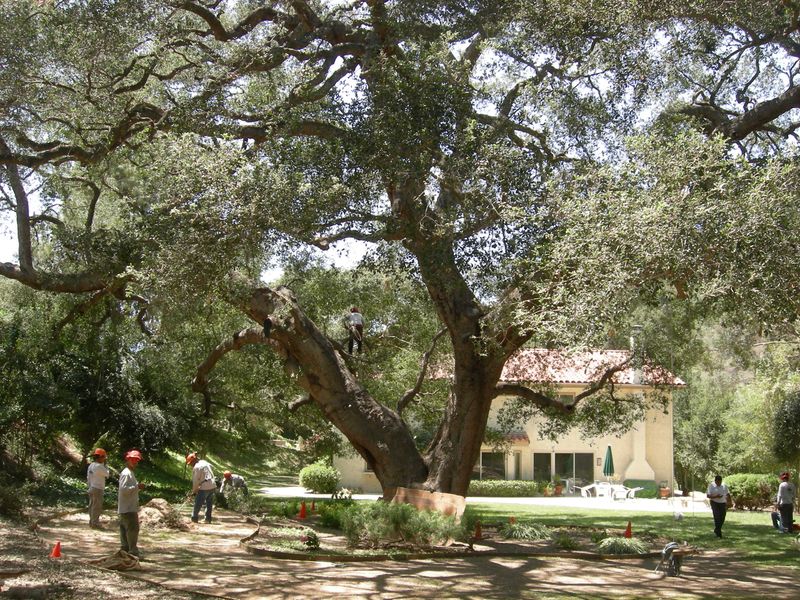
Established California native oaks are the most important exception to any general pre-heat watering recommendation. These trees evolved for long, dry summers, and their root systems and physiology are adapted to go without summer irrigation.
Frequent watering near an established oak, especially close to the trunk, can encourage oak root fungus and crown rot. UC ANR guidance on summer irrigation of established oaks advises that supplemental water may be appropriate during a prolonged drought or when there are clear signs of water stress, but it should be applied slowly, infrequently, and in the outer root zone, generally at least about 10 feet from the trunk when feasible.
When in doubt about an oak, consult a certified arborist before adding any summer water.
Young and recently planted trees sit at the opposite end of the spectrum. Their root systems are still confined to a relatively small area, which means they dry out faster and have less stored water to draw on during heat.
UC ANR’s landscape tree irrigation overview is clear that newly planted trees should not be treated like drought-established specimens; they need more frequent monitoring and more attentive irrigation.
Trees growing in or beside a lawn present a separate problem. When homeowners reduce or stop lawn irrigation to comply with drought restrictions, the trees that relied on that regular moisture may suddenly face a deficit they were not prepared for.
UC IPM’s overview of irrigation methods notes that lawn trees often need a separate irrigation strategy once lawn watering is cut back. Knowing which category your tree falls into before you plan any pre-heat watering is the step that makes everything else more accurate.
Target the active root zone
Most of the water a tree can actually use comes from fine absorbing roots, and those roots are not clustered at the trunk. Pouring water against the base of a tree or soaking the soil right next to the bark misses most of the root system and keeps the root crown wet in a way that can promote rot and disease.
The trunk is the wrong target, and understanding why changes where you stand when you water.
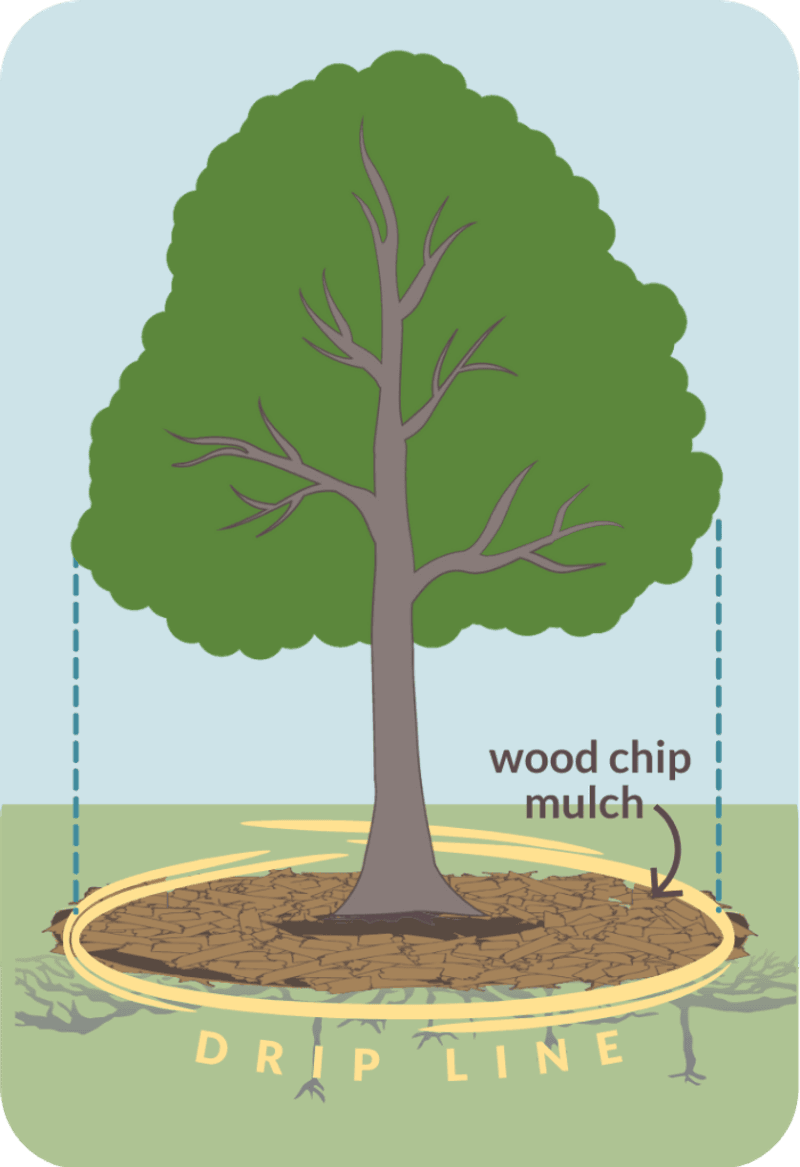
UC IPM guidance on tree and shrub irrigation directs homeowners to distribute water from roughly the middle of the canopy outward toward the drip line and, where soil conditions allow, beyond it. The drip line, the outer edge of the canopy, is a useful reference point but not a hard boundary.
Roots frequently extend well past it, particularly where soil is loose, well-drained, and free of compaction or physical barriers.
UC ANR’s guidance on watering landscape trees confirms that most active tree roots occupy the upper portion of the soil profile, generally within the top few feet, rather than plunging straight down. The practical goal is to moisten that upper layer broadly across the root zone, not to push water to some arbitrary depth.
Chasing depth by running water for excessive time wastes water, can saturate the lower soil, and does not necessarily improve root conditions.
Compaction, pavement, buried barriers, and existing root structure all influence where roots actually grow. A tree surrounded by compacted clay near a sidewalk will have a very different root distribution than one growing in well-amended loam with open space in all directions.
UC ANR’s tree water requirements resource notes that these site conditions matter when deciding where to place water. Avoid digging holes or using pressurized injection tools to force water downward; both approaches risk cutting or compressing roots.
Slow, broad surface application across the actual root zone is the safer and more effective approach for most California homeowners.
Apply water slowly and broadly
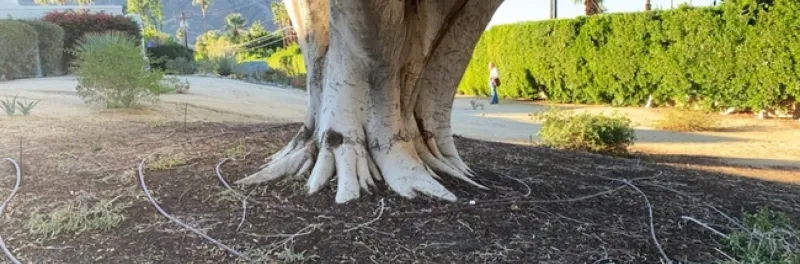
Speed is the enemy of effective tree irrigation. When water hits soil faster than it can infiltrate, it runs off the surface and does nothing for the root zone below.
Slow application gives water time to move into the soil, reach the roots that need it, and fill the pore spaces where it can be stored and drawn on during heat. The method matters as much as the amount.
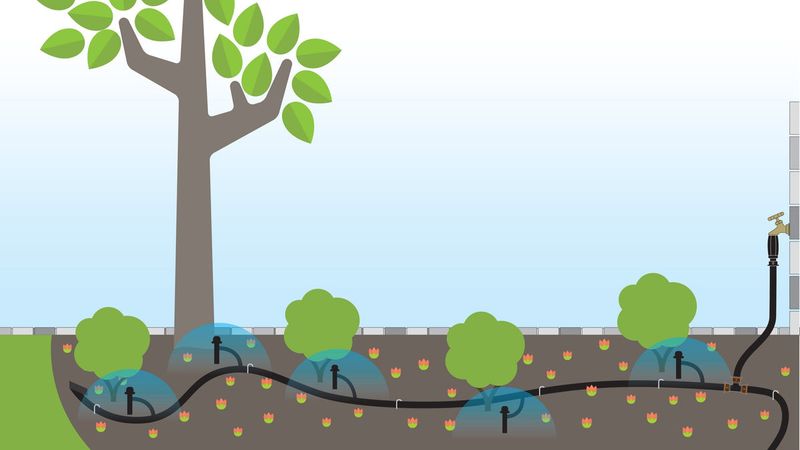
A garden hose turned to a low trickle and moved around the root zone is one of the simplest options. A properly designed soaker hose laid in a pattern that covers the root zone from mid-canopy outward works well for larger trees.
Low-volume drip irrigation, when emitters are placed broadly rather than clustered near the trunk, can also deliver water slowly enough to infiltrate without waste. UC Davis Arboretum advice on helping plants through heat recommends slow application as the baseline approach for trees before and during hot weather.
Whenever runoff begins, stop and wait. Letting water pool and sheet away wastes it entirely and tells you the soil is not absorbing at the rate you are delivering.
Pause until the surface has absorbed what is there, then continue. This cycle of slow application, brief pause, and resumption gets more water into the root zone than any amount of fast flooding.
UC ANR’s drought-priority guidance for landscape trees emphasizes that getting water into the soil where roots can reach it is the practical goal.
Deep watering means thoroughly moistening the active root zone, not applying as much water as possible. Saturated soil forces oxygen out of the spaces around roots, and roots need oxygen to function.
Waterlogged conditions can contribute to root disease, and UC ANR’s resource on estimating tree water requirements makes clear that both too little and too much soil moisture can damage trees. After watering, check the soil again with a probe to confirm that moisture has moved to a useful depth without the soil feeling saturated or muddy.
There is no universal number of minutes or gallons that works for every tree, soil type, and site condition, so the probe reading is what closes the loop.
Use timing and mulch to protect the soil
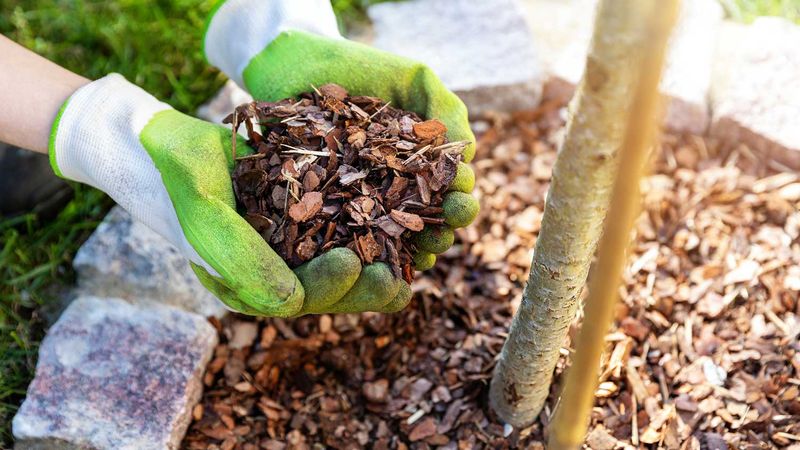
Watering at the right time and covering the root zone with mulch are two of the most practical ways to make pre-heat irrigation last longer. Neither replaces the soil check, but both reduce how quickly moisture disappears once you have applied it.
Early morning is the best default for irrigation. Temperatures and wind speeds are typically lower in the early hours, which means less water evaporates before it reaches the soil.
Overhead irrigation at night can leave foliage wet for extended periods, which raises the risk of fungal problems. UC IPM’s irrigation guidance identifies early morning as the preferred window for these reasons.
For drip or soaker systems that deliver water at the soil surface rather than overhead, timing is somewhat less critical, but morning is still a reasonable default.
Organic mulch applied over the root zone slows evaporation, moderates soil temperature, and can reduce the amount of irrigation needed to keep the root zone moist through a heat event. UC ANR guidance on tree water requirements and UC Davis Arboretum heat-stress recommendations both suggest roughly 2 to 4 inches of organic mulch over the root zone as a practical measure.
Wood chips, shredded bark, and similar materials work well. Keep the mulch several inches away from the trunk and root crown; piling it against the bark traps moisture against the wood and can cause decay.
A ring of clear soil around the base of the trunk, with mulch starting a few inches out and extending broadly across the root zone, is the right pattern. Apply or refresh mulch before the heat arrives so it is in place when temperatures climb.
Avoid fixes that add stress
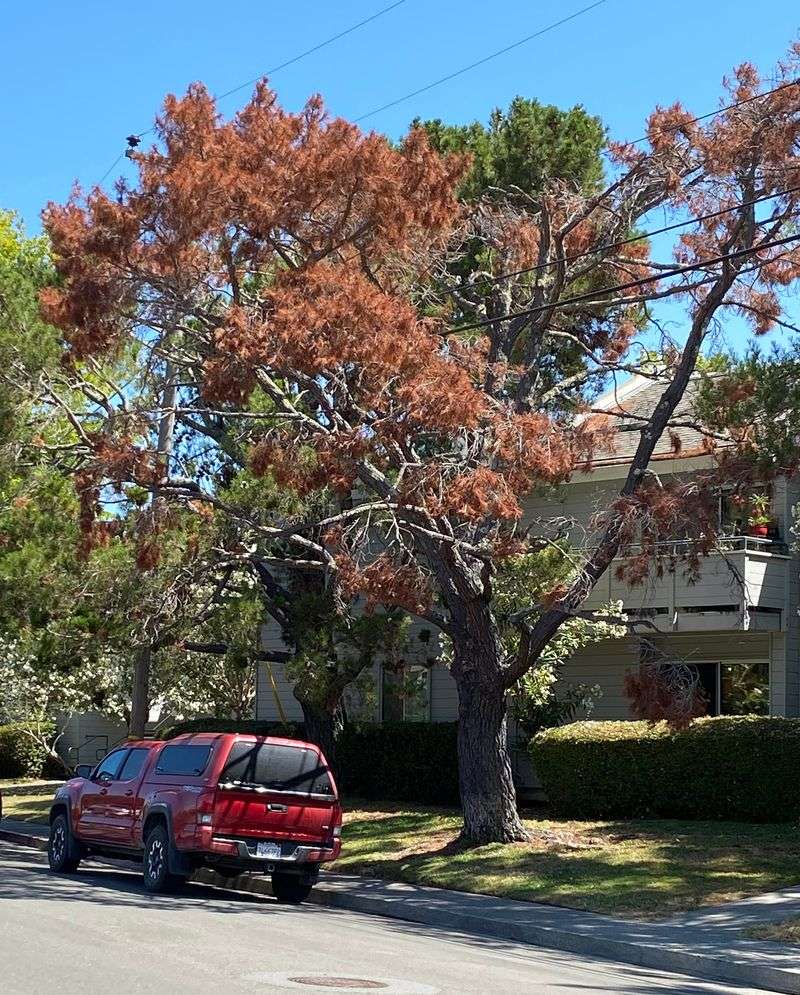
The instinct to do more when a tree looks stressed is understandable, but several common responses actually make the situation worse. Knowing what not to do during extreme heat or water stress is as important as knowing how to water correctly.
Fertilizing a heat-stressed or drought-stressed tree is one of the most counterproductive moves a homeowner can make. Fertilizer stimulates new growth, and new growth increases the tree’s water demand at exactly the moment it can least afford it.
Oregon State University Extension guidance on protecting plants during extreme heat advises against fertilizing during heat events. Heavy pruning carries a similar problem: removing foliage during stress reduces the tree’s ability to photosynthesize and recover, and fresh pruning wounds are harder to seal under heat load.
Transplanting during a heatwave or while a tree is water-stressed is almost always fatal to the tree.
More water is not always better. Overwatering waterlogged soil drives out oxygen and creates conditions where root-rot pathogens thrive.
This is especially true for California oaks, where excess summer moisture near the trunk can be a death sentence over time. OSU Extension’s overview of keeping trees alive notes that well-intentioned overwatering is a recurring cause of tree decline.
Mounding mulch against the trunk, sometimes called a mulch volcano, keeps the root crown constantly damp and invites the same rot and disease problems as overwatering at the base. Overhead watering to cool the canopy is also unnecessary for most shade trees; the more relevant concerns during hot weather are evaporation, runoff, and irrigation efficiency, not leaf temperature from water contact.
OSU Extension’s review of common gardening myths clarifies that the idea of water droplets burning leaves in sunlight is not supported as a general concern.
Heat damage also comes from more than dry soil. Wind exposure, compacted soil, restricted roots, pest pressure, pathogens, and prior drought stress all contribute to how a tree handles extreme temperatures.
Wetting the soil can improve water availability when the root zone is genuinely dry, but it cannot fix structural root problems, reverse prior damage, or protect against all of those other factors. Local water-supplier restrictions apply regardless of the situation, so check your water district’s rules before adjusting your irrigation schedule.
Monitor the tree after the heatwave
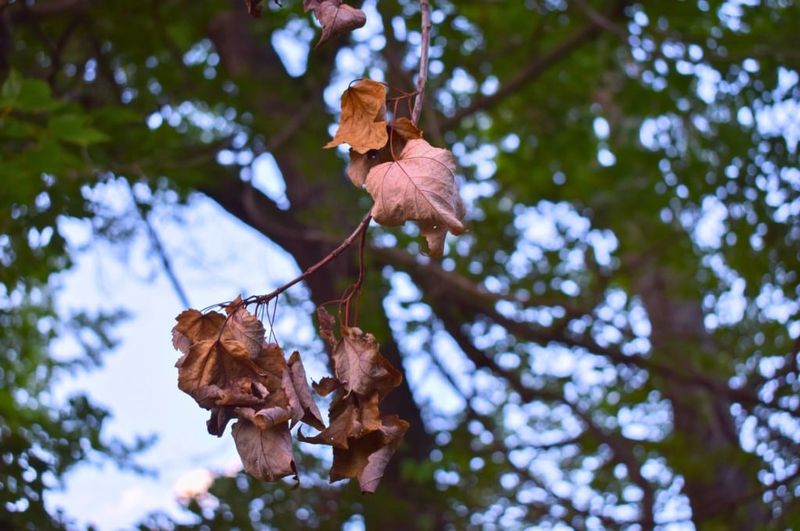
Temperatures dropping back to normal does not mean the tree is out of danger. One of the most frustrating realities of heat and drought stress is that a tree can look completely acceptable during the worst days and then begin showing serious decline weeks or even months later.
Assuming the tree came through fine because it did not wilt during the event is a mistake that leaves problems undetected until they are much harder to address.
USDA Forest Service research on drought-related tree mortality documents this lag clearly: tree death and decline often follow the original drought or heat event by a full season or more. OSU Extension’s guide to why trees die notes that delayed leaf loss, branch dieback, bark beetle attack, and secondary pathogen invasion are all patterns that can appear after the stress event rather than during it.
Watching the canopy and branches over the weeks following a heatwave gives you the earliest possible signal that something is going wrong.
Continue checking soil moisture after the heat passes rather than automatically repeating heavy irrigation. If the root zone is still adequately moist from the pre-heat watering and any rain that followed, the tree does not need more water just because it recently experienced heat.
OSU Extension’s analysis of the June 2021 heat dome’s effects on trees reinforces that post-heat monitoring is a distinct and necessary phase of care.
The full sequence comes down to this: identify what type of tree you have, check the root zone for actual dryness, water slowly and broadly only if the soil needs it, protect the root zone with mulch, and then keep watching. No single step in that sequence guarantees the tree comes through undamaged, but skipping the soil check at the beginning and the monitoring at the end are the two gaps most likely to leave a problem invisible until it is already serious.
A tree that gets through a California heatwave with its root zone in good shape and an attentive owner watching afterward is in the best position possible, which is all any of these steps can honestly promise.