

Every yard seems to have one spot that makes gardeners sigh: a sunny, dry bank where the soil bakes and plants struggle. One low, flowering perennial deserves a look for that kind of place.
Moss phlox, Phlox subulata, turns up naturally on dry, rocky slopes in the North Carolina mountains. Here is how to tell if it fits your bank and how to give it a good start.
Identify the plant before choosing it

Moss phlox, Phlox subulata, is a low, spreading perennial that may be a good fit for a sunny, well-drained bank. It is also sold as creeping phlox or moss pink, and those common names are where trouble starts.
NC State Extension’s plant profile says it occurs naturally in dry, rocky or sandy sites, including slopes, in North Carolina’s Appalachian Mountains.
That detail matters. The plant is not described as native to every part of the state, so a gardener in the Coastal Plain or Piedmont should not assume it belongs to the local landscape.
Matching plant choices to your own ecoregion is a core idea in NC State’s native plants guidance. Moss phlox can still be a reasonable garden choice outside the mountains, but call it a mountain native, not a statewide one.
Watch the label at the nursery, too. Phlox stolonifera is another groundcover sometimes called creeping phlox, and NC State’s page on it points to different growing conditions.
If the tag only says creeping phlox, look for the scientific name Phlox subulata before buying for a hot, sunny slope.
Expect a low mat, not a guaranteed blanket

Picture a tight, ground-hugging mat of narrow leaves, topped in spring with a sheet of small flowers. NC State Extension describes moss phlox as dense and spreading, roughly 4 to 6 inches tall and 2 to 3 feet wide.
The foliage is semi-evergreen, and flowering comes around late April to early May.
Extension also lists it for sunny slopes and notes tolerance of drought and erosion. Those are encouraging traits, but they describe the plant in general.
They do not promise that it will fill in a particular bank, or that it will hold soil on its own.
Plan on a gradual process. Space plants so you can picture the mat forming over seasons, and expect some bare soil between them at first.
A thin layer of mulch in those gaps can help while the plants knit together.
Match the bank’s sun and drainage

Walk the bank at different times of day before you buy anything. Moss phlox likes full sun and well-drained soil, and NC State notes it handles hot, dry conditions better than many other phloxes.
In hot, humid summers, a bit of dappled shade may actually help it.
Aspect matters as much as sun hours. NC DEQ vegetation guidance says south- and west-facing slopes tend to be warmer and drier, and may need mulch along with drought-tolerant plants.
Test the soil with a simple check. Dig a hole, fill it with water, and see whether it drains within a few hours.
Water that lingers or soil that stays soggy points to a poor match, even if the bank gets plenty of sun.
Water new plants while they establish

Fall is a suitable time to plant, with spring as another good window. NC State’s Extension Gardener Handbook recommends regular irrigation for new groundcovers for about three months, or until they are established.
Drought tolerance describes a settled plant with roots that have spread. Newly planted phlox has small roots, and a slope sheds water quickly.
Soak the area slowly so water sinks in rather than running off, and check soil a few inches down before watering again.
Do not count on a quick fill. NC State’s plant profile gives mature size, not a speed, so judge progress season by season.
Pull weeds by hand while the plants are small.
Spring blooms add color and attract pollinators
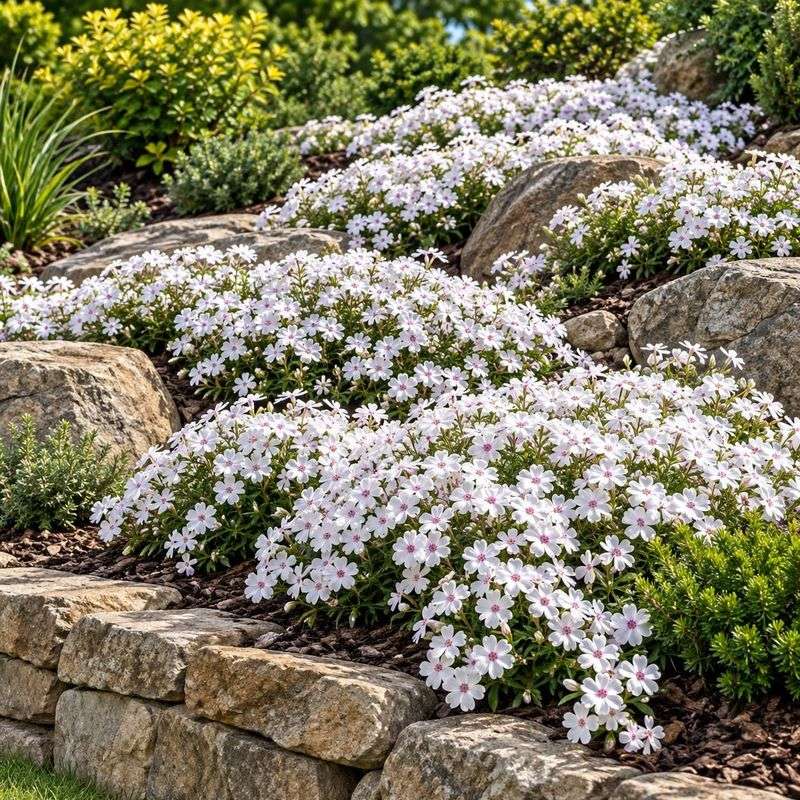
Late April to early May is when moss phlox earns its keep. The mat disappears under small, bright flowers, a welcome splash after winter.
The blooms are also a nectar stop. University of Maryland Extension reports that bees, skippers, and butterflies visit the flowers.
NC State adds hummingbirds and other pollinators to the list of visitors. Stand near the bank on a warm spring morning and watch who shows up.
Keep expectations modest: this is one early-season nectar source, not a full pollinator habitat on its own.
Trim after flowering and set care expectations
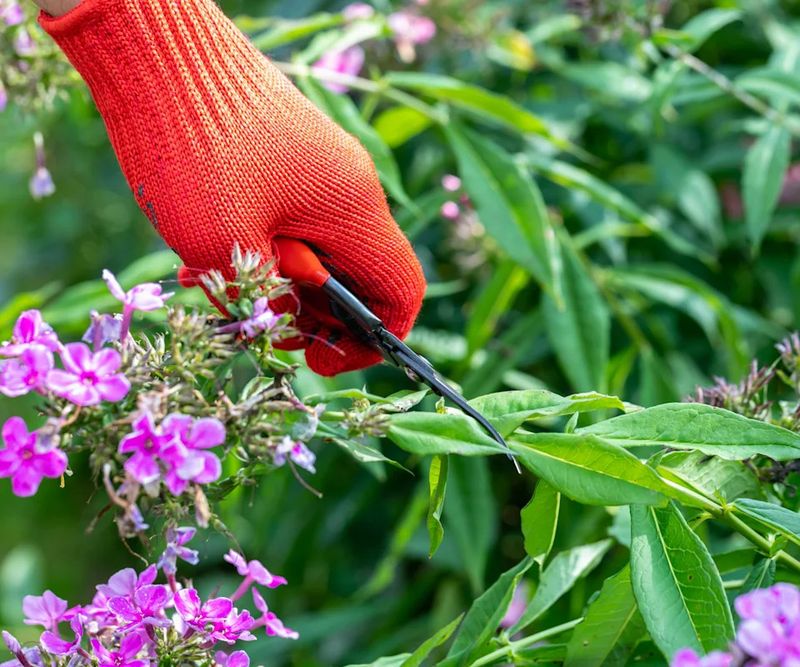
Once the flowers fade, grab hand pruners. NC State Extension says cutting stems back by about half can help maintain shape and encourage dense growth.
The foliage is semi-evergreen, so expect green to carry through much of the year, but not flawless cover. Some leaves may brown in cold snaps or hot spells, and a few thin patches are normal.
Browsing is a practical concern. NC State says the foliage is less palatable to deer, which is not the same as deer-proof.
Rabbits may eat it, so protect young plants with temporary fencing if you see nibbling.
Treat serious erosion as a site problem

Moss phlox has limits. NC State lists erosion tolerance, but the sources reviewed do not show that this plant alone stabilizes a steep or actively eroding bank.
Start by looking at slope steepness and where stormwater flows. NC Cooperative Extension in New Hanover County advises considering erosion-control fabric and, in some cases, regrading or terracing.
Warm, dry exposures add another layer, and NC DEQ guidance mentions mulch and drought-tolerant plants for them. Gullies, exposed roots, or soil washing onto walkways call for fixing the site first.
Moss phlox belongs on that list as one possible planting piece. On a bank that is merely sunny and dry, it may be the spring show.
On one that is moving, it is a finishing touch.