
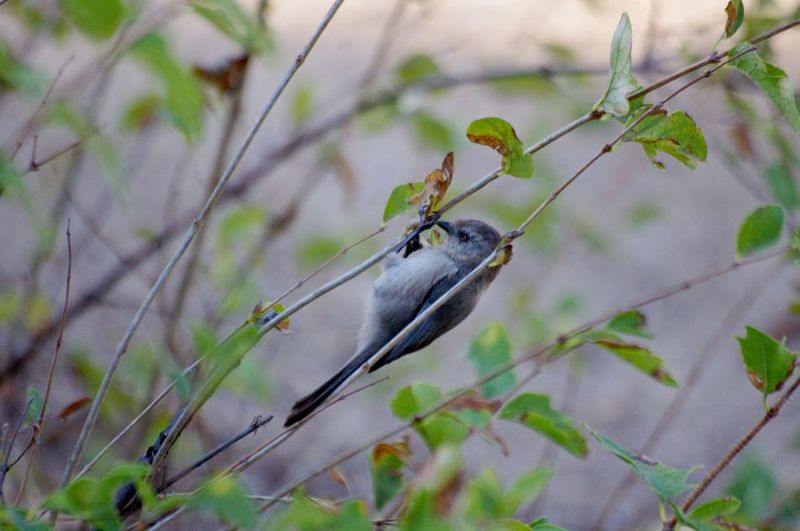
A tiny bird is working through your shrubs right now, and most California homeowners have never noticed it. The Common Bushtit, Psaltriparus minimus, is a year-round California songbird that forages on aphids, scale insects, caterpillars, and dozens of other small creatures hiding in your foliage. What it needs most is the dense, layered shrub structure that many well-meaning yard routines quietly remove. Understanding what this bird actually does, and what it genuinely needs, can help you make smarter choices about pruning, pest management, and wildfire safety all at once.
Meet the Bushtit moving through your shrubs
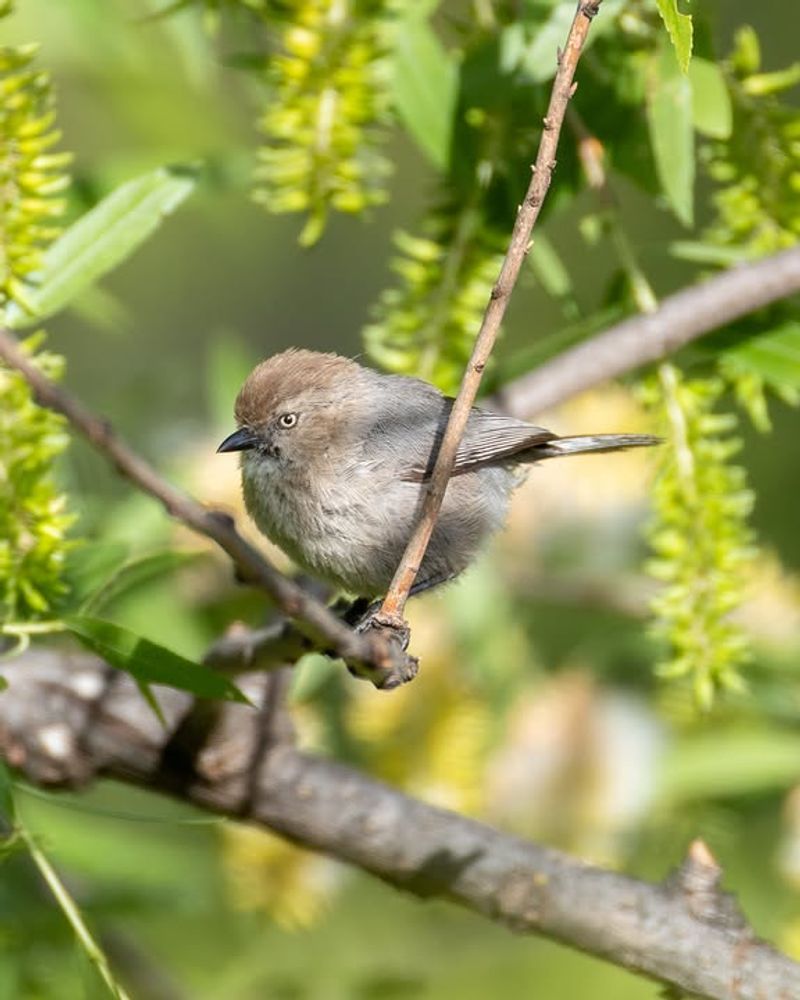
Spot a loose cluster of tiny gray birds moving fast through a California shrub and you have probably just seen a Bushtit flock at work. The Common Bushtit, Psaltriparus minimus, is one of the smallest birds in North America, weighing roughly as much as two pennies, and it spends most of its life in motion. Flocks of a dozen or more individuals work steadily through foliage, twigs, and branches, rarely pausing long enough for a homeowner to get a good look before the group moves on.
According to California’s Wildlife Habitat Relationships life history account, Bushtits glean foliage, twigs, and branches in trees and shrubs across a wide range of California habitats, from chaparral and oak woodland to well-wooded suburbs. That last category matters for homeowners. Bushtits are not wilderness birds that occasionally wander into residential areas; they are regulars in suburban yards with enough vegetative structure to support foraging and cover.
The shrubs in your yard are not just decoration to a Bushtit. They are a foraging surface, a travel corridor, and a potential nesting site. The bird moves through dense foliage precisely because small invertebrates shelter there, tucked into leaf undersides, stem joints, and bark crevices. A yard that offers layered, connected shrub structure gives a passing flock more reason to slow down and stay awhile.
Recognizing the bird takes a moment of attention. Bushtits are plain gray-brown, lack bold markings, and travel in chattering groups that sound like a soft, continuous twittering. Once you know what to look for, you will notice them regularly in mature shrubs, ornamental trees, and native plantings throughout California’s suburban neighborhoods. Their presence is easy to miss, but the foraging activity they bring along with them is worth understanding.
Bushtits eat aphids and scale, but they do not guarantee control
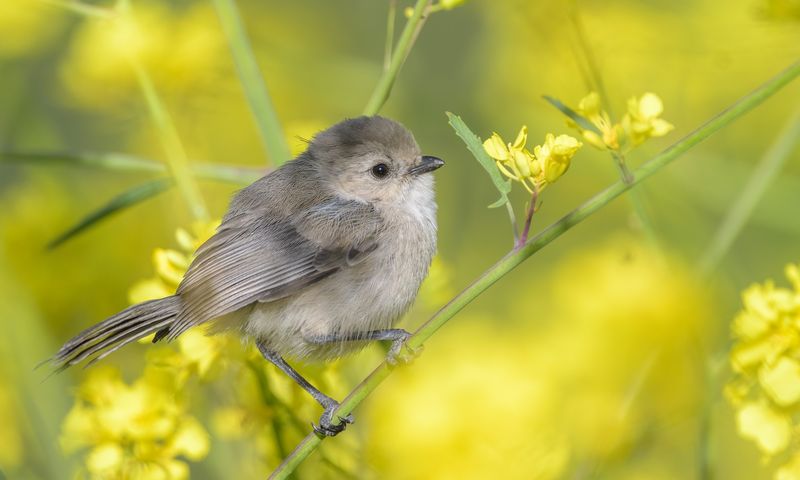
Authoritative species accounts confirm that the Bushtit’s diet is genuinely broad. The Audubon Field Guide for the Bushtit lists aphids, scale insects, caterpillars, beetles, leafhoppers, wasps, ants, and spiders among its documented prey. UC Agriculture and Natural Resources notes the same variety in its seasonal garden guidance. That range matters because it means Bushtits are generalist arthropod foragers, not specialists targeting only the pests that bother gardeners.
Eating pest insects is meaningfully different from controlling them. Species accounts show what Bushtits consume; they do not show how many individual pests a flock removes per hour, whether pest populations on a specific shrub fall below damaging thresholds, or whether Bushtits outperform the other natural enemies already present in a yard. A flock working through your roses may pick off dozens of aphids. Whether that reduces the colony to a manageable level depends on the aphid reproduction rate, the presence of ants protecting the colony, recent pesticide applications, weather, and many other factors that have nothing to do with the birds.
Broader research on birds and pest suppression adds important nuance. A 2023 meta-analysis on avian regulation of crop and forest pests found that birds can reduce arthropod pest loads in some systems, but the effect is highly context-dependent and not reliably predictable across different landscapes. A separate study published in Ecology found that insectivorous birds can sometimes interfere with parasitoid wasps and other natural enemies that also attack aphids, producing mixed or neutral outcomes at the garden level. Research published in PMC similarly found that aphid control by natural enemies depends heavily on landscape complexity and interactions among multiple predator types.
The practical takeaway is straightforward. Bushtits may contribute to natural pest suppression in California yards, and their presence alongside healthy shrubs is a reasonable ecological goal. Expecting a flock to keep shrubs pest-free, or to replace a timely intervention when a serious infestation is building, sets an unrealistic standard that the available evidence does not support.
Dense shrub structure supports feeding, nesting, and shelter
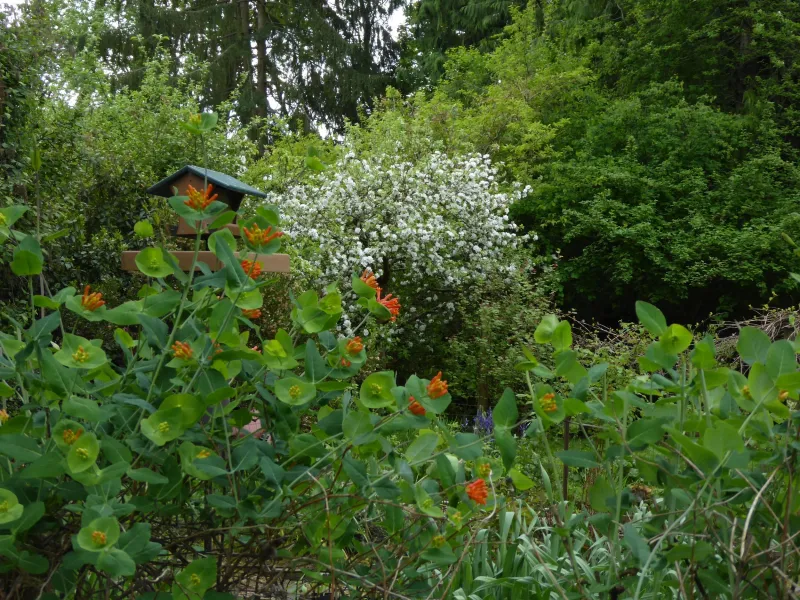
A Bushtit needs more from a shrub than a perch. Dense foliage provides the foraging surface the bird works across all year, the predator cover it retreats into when a hawk passes, and the structural material it weaves into one of the most distinctive nests in California. The pendant nest, a hanging pouch constructed from spider silk, plant fibers, and soft plant material, can take weeks to build and is typically tucked inside a shrub or tree. The California Wildlife Habitat Relationships account places most nests below roughly 12 feet, while the Audubon Field Guide describes a broader typical range of about 8 to 35 feet, depending on available vegetation.
UC Agriculture and Natural Resources guidance on gardening for birds with native plants describes layered habitat as valuable for birds precisely because it provides different functional zones: canopy for travel, midstory for foraging and nesting, and ground-level cover for shelter. Bushtits use all of those layers at various times. A yard with some shrubs pruned into tight geometric shapes and others left to grow with natural interior branching offers more usable structure than one where every plant is trimmed to the same open, airy form.
Supporting Bushtit habitat does not require an unmanaged yard. Retaining a few sections of denser shrub growth, particularly where plants connect across a bed rather than standing isolated, can meaningfully increase the habitat value of a residential landscape. The California Native Plant Society notes that native shrubs with layered canopies and dense interiors are especially useful for birds that forage and nest close to the ground.
Pruning is a normal part of yard care, and this section is not suggesting otherwise. The relevant point is that every time a shrub’s interior branching is thinned out or its height reduced significantly, some amount of foraging surface and cover disappears. That reduction may be small and temporary, or it may affect whether a Bushtit flock finds the yard worth revisiting. Keeping at least part of the landscape structurally complex gives the birds a reason to stay.
Inspect for nests before you prune
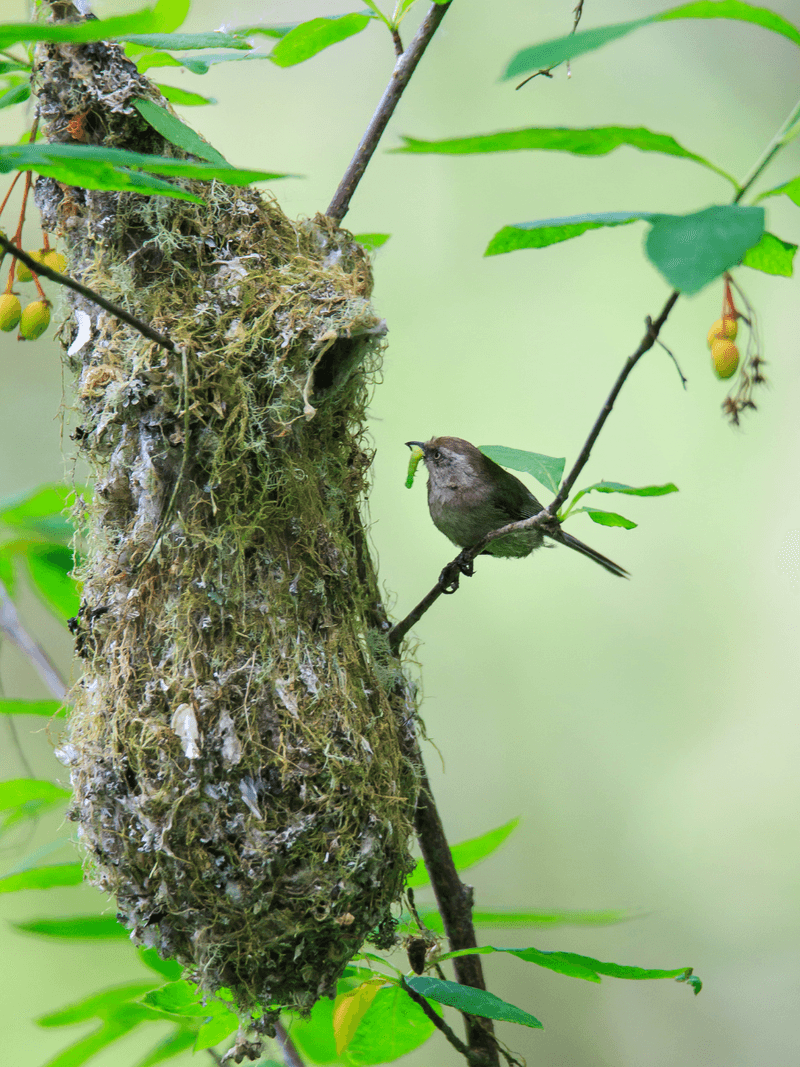
Before picking up the pruning shears, spend two or three minutes looking into the shrub. Bushtit nests hang like small gray-green socks from interior branches, blending remarkably well with surrounding foliage. Other California birds build cup nests, platform nests, or cavity nests in the same vegetation. A slow visual sweep from multiple angles, combined with watching for adult birds flying in and out repeatedly, is usually enough to reveal active nesting activity before any cuts are made.
CDFW’s California Outdoors Q&A guidance on nesting birds and yard work recommends doing nonessential yard work outside the general February-through-August window used as a nesting-season guideline for many California birds. The same guidance cautions that nesting varies by species, location, and year, and can occur outside that window in some areas of the state. A warm coastal neighborhood in January may already have nesting activity; a high-elevation yard may see it compressed into a shorter summer window. The February-August guideline is a starting point, not a guarantee.
When an active nest is present, CDFW advises delaying the work where feasible. Human presence and noise can cause nesting birds to abandon eggs or young, and pruning that removes or crushes an active nest ends the nesting attempt entirely. Where the work is genuinely nonessential, waiting a few weeks costs little and avoids real harm.
California Fish and Game Code section 3503 makes it unlawful to take, possess, or needlessly destroy the nest or eggs of any bird. The statute’s language covers needless destruction broadly, not only the moment a nest contains eggs or chicks. That said, section 3503 is not a blanket prohibition on pruning. Routine yard maintenance that does not encounter or disturb a nest is not what the statute addresses.
The practical standard is to inspect first, avoid disturbing active nests, postpone nonessential work when feasible, and contact CDFW or a qualified biologist when the situation is unclear. That approach respects both the law’s intent and the reality that California homeowners have legitimate maintenance needs.
Use integrated pest management instead of waiting for birds to fix every problem
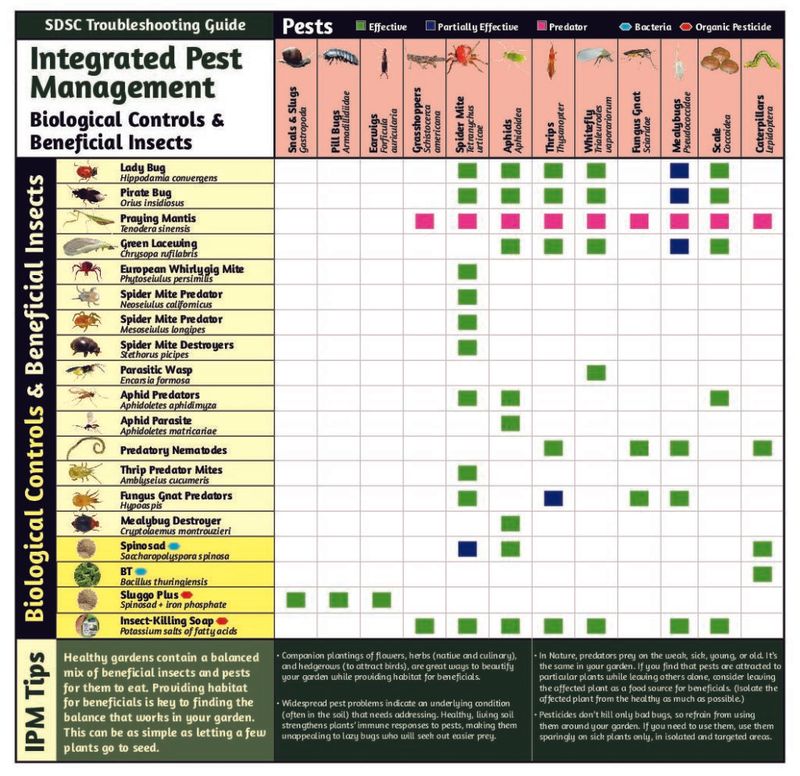
Finding aphids or scale on a shrub is not automatically a reason to spray. The first step is identification: confirm what pest is actually present, because different organisms require different responses and some apparent pest problems are minor enough that the plant recovers on its own. UC IPM’s guidance on home landscape insects advises assessing whether the pest is present at levels that are actually causing plant damage before choosing any treatment. Visible aphids on a few stems do not necessarily mean the shrub is in trouble.
Once a genuine pest problem is confirmed, look at what natural enemies are already working on it. Ladybeetles, lacewing larvae, parasitoid wasps, and predatory midges all attack aphids in California gardens. Scale insects have their own suite of parasitoids and predators. Bushtits may be part of that picture, but they are one component of a broader community of organisms, not the only line of defense.
Letting that community work before reaching for a product is often the most effective first response.
UC IPM’s guidance on protecting natural enemies and pollinators explains that broad-spectrum insecticides can harm the beneficial organisms that would otherwise suppress pest populations. A spray that kills aphids may also kill the parasitoid wasps and predatory beetles that were already reducing the colony, leaving the plant more vulnerable to reinfestation once the residue fades. Systemic products and those with long residual activity carry particular risk for beneficial organisms that arrive after the application.
When treatment is genuinely needed, UC IPM’s biological control resources describe how to choose least-disruptive options: targeted application timing, selective products with shorter residual windows, and physical controls such as a strong water spray for soft-bodied insects. No pesticide should be treated as automatically harmless to birds or beneficial organisms. Exposure route, product formulation, application timing, drift, and residues all affect risk. Following the label and choosing the narrowest-spectrum effective option are the consistent principles.
Bushtits cannot be expected to resolve a severe infestation, a plant under serious drought stress, or a disease problem that is reducing the shrub’s natural defenses, and waiting for them to do so can allow preventable damage to compound.
Keep habitat improvements compatible with defensible space
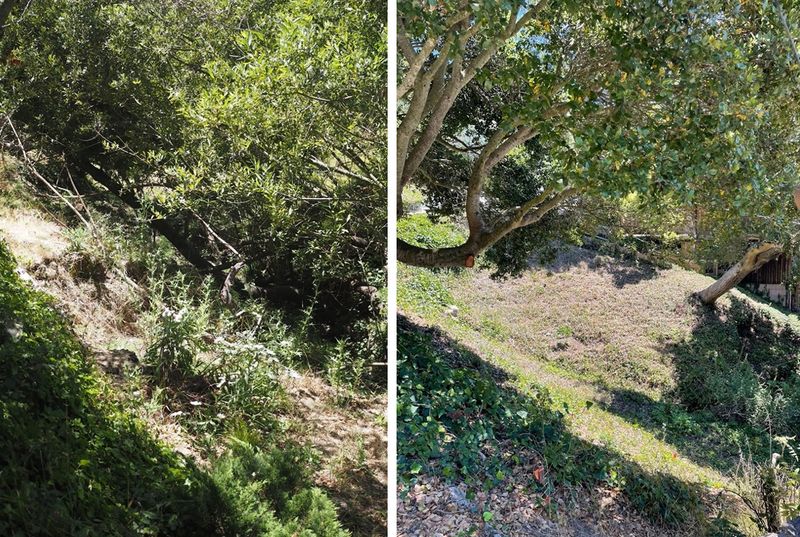
Retaining dense shrub structure for wildlife is sound advice in many California yards, and it comes with a firm condition: it applies only where defensible-space requirements allow it. For homeowners in fire-hazard severity zones, or anywhere CAL FIRE and local fire agencies have jurisdiction, vegetation management rules take priority over habitat goals. No wildlife benefit justifies keeping dry, continuous, or ladder-fuel vegetation where fire safety rules require its removal.
CAL FIRE’s defensible space program requires removing dead or dry plant material and creating horizontal and vertical separation between shrubs and trees within the designated zones around a structure. Zone 1 extends 30 feet from the home and requires the most aggressive vegetation management; Zone 2 extends from 30 to 100 feet and calls for reduced fuel density with more spacing between plants. Within those zones, the goal of retaining dense, connected shrub cover directly conflicts with fire-safety requirements.
The California Board of Forestry and Fire Protection’s guidance on defensible space zones notes that counties and local fire agencies may impose requirements stricter than the state baseline. Slope, local wind patterns, vegetation type, and proximity to wildland areas all affect what is required at a specific address. The only way to know what applies to your property is to check with your local fire agency or CAL FIRE directly.
The practical resolution is to think about where on your property habitat improvements make sense. Areas farther from structures, on the non-fire-exposed side of the lot, or in regions with lower fire hazard ratings may offer room for layered native plantings that support Bushtits and other wildlife. Closer to the house, compliance with defensible-space rules comes first. Choosing fire-resistant native species within required spacing guidelines can satisfy both goals partially, but the spacing and fuel-reduction requirements are not negotiable based on wildlife preferences.
Support Bushtits with a better-observed, less chemical-dependent yard
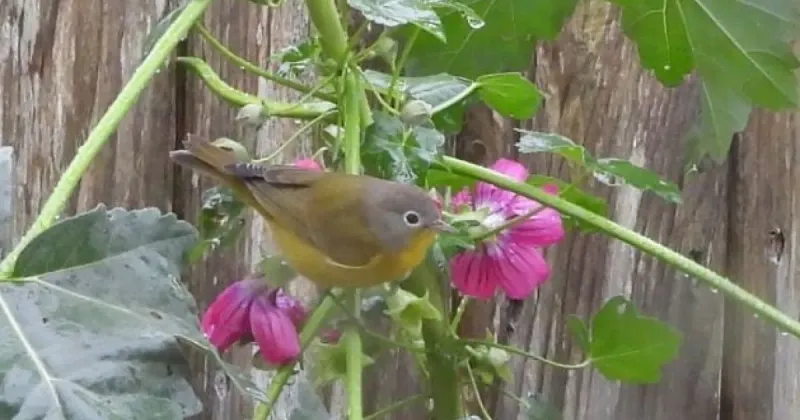
Watching a Bushtit flock move through your shrubs is worth a few minutes of stillness. The birds work quickly and methodically, and observing which plants they favor, and where they linger, gives you better information about what your yard is already offering than any checklist can. That kind of low-tech observation is also the most direct way to notice a pendant nest before you accidentally disturb it.
The actions that support Bushtits are modest and practical. UC ANR’s guidance on gardening for birds with native plants points to retaining layered shrub structure as one of the most effective things a homeowner can do for resident bird populations. Keeping some sections of your landscape structurally complex, where fire rules permit, costs nothing extra and improves habitat value for a wide range of beneficial species beyond Bushtits. Reducing unnecessary pesticide applications, particularly broad-spectrum products applied on a schedule rather than in response to a confirmed problem, preserves the natural-enemy communities that do the quiet work of pest suppression year-round.
UC IPM’s insectary plant resources describe how diverse plantings can support beneficial insects that, alongside birds, contribute to a more balanced garden ecology.
Inspect shrubs before pruning, delay nonessential cuts when nesting birds are present, and follow CDFW guidance on avoiding active nest disturbance. Where CAL FIRE defensible-space requirements apply, meet them fully and look for habitat opportunities in the portions of the property where denser planting is compatible with fire safety. None of these steps guarantee that a Bushtit flock will settle in your yard. What they do is make the yard a more functional place for the birds that are already moving through it.
A yard managed with that kind of attention tends to work better for plants, wildlife, and the people living in it than one managed purely for appearance.