
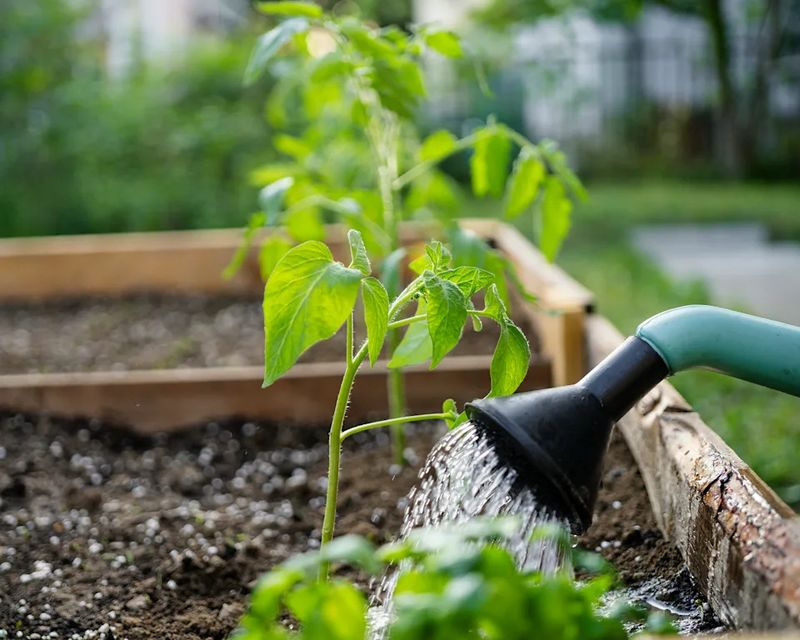
Growing tomatoes in California sounds simple enough, but a surprisingly common watering habit can quietly lead to blossom-end rot, fruit cracking, and disappointing harvests before you even realize something is wrong. The culprit is not pests, not heat alone, and not bad luck.
Letting the soil around your tomato plants swing from bone dry to heavily soaked, or watering in frequent shallow sips, puts real stress on developing fruit. Understanding what is actually happening in your soil is the first step toward a better harvest this season.
The moisture mistake behind specific fruit problems
Most tomato problems in California home gardens do not start with bugs or blight. They start in the root zone, quietly, between waterings.
The specific habit that contributes to blossom-end rot and fruit cracking is not watering too often or too little in absolute terms. It is the pattern of letting the soil dry out substantially and then flooding it with a heavy soak, or giving plants repeated shallow drinks that never fully wet the root zone.
According to UC IPM guidance on watering tomatoes, applying water only to the top few inches of soil can stunt root development and leave plants more exposed to drought stress, even when you think you are watering regularly. Roots that stay shallow have less access to stable moisture deeper in the soil, making the plant more vulnerable to the very swings you are trying to avoid.
A common misunderstanding is that daily watering is always the wrong approach. That is not accurate.
Utah State University Extension research on vegetable water needs makes clear that containers, newly transplanted starts, and gardens in extreme heat may genuinely need water every day. The problem is not the frequency; it is whether each watering actually reaches the root zone and whether the soil stays reasonably stable between sessions.
What this article focuses on is the moisture-related damage that shows up as specific fruit disorders: the sunken, leathery spots of blossom-end rot, the split skins of cracking fruit, and the shallow root systems that make both worse. Heat, pests, disease, cultivar choice, and other factors also affect tomato harvests, but those are separate conversations.
UC IPM’s overview of blossom-end rot identifies moisture fluctuation as a key contributing factor to the disorder, and that is where the practical correction begins.
How uneven moisture affects developing tomatoes
Tomatoes move calcium through their tissue using water as the delivery system. When the root zone dries out and then gets flooded, that process gets disrupted.
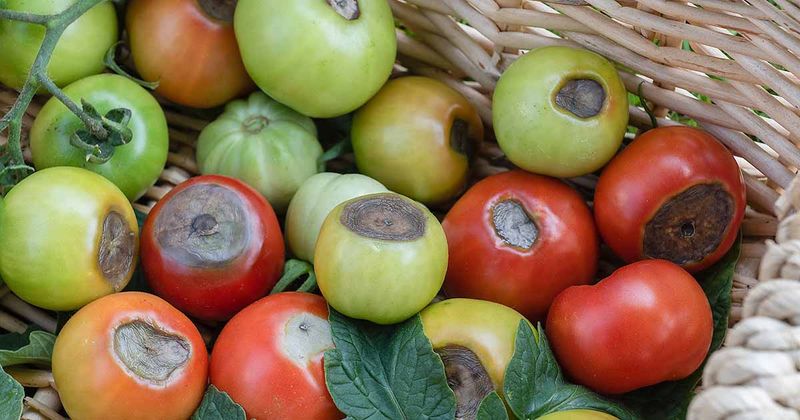
Calcium is not transported on demand the way some nutrients are; it moves passively with water flow, and any interruption in steady water uptake can leave developing fruit without enough calcium reaching the blossom end. The result is a physiological disorder called blossom-end rot, described by UC IPM as a condition driven by water imbalance and its interference with calcium transport.
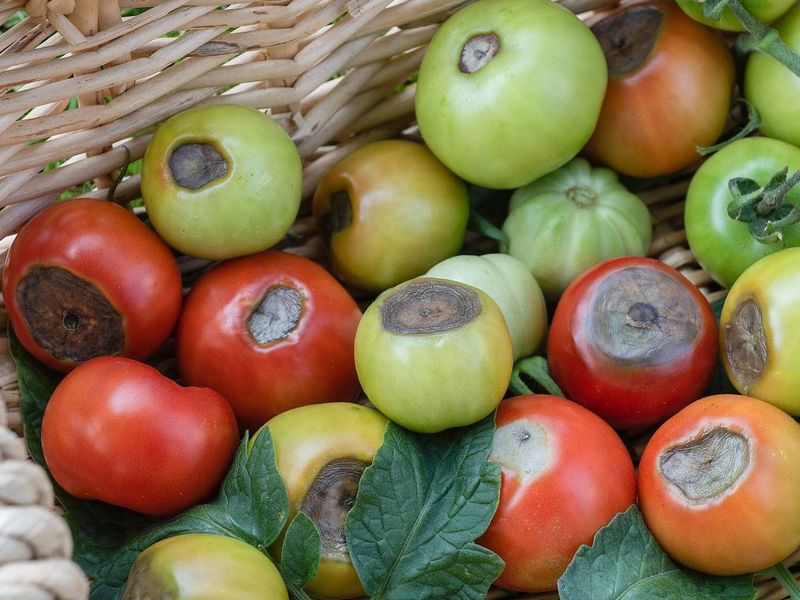
The lesion itself is distinctive. It typically appears as a dark, sunken, leathery patch at the bottom of the fruit, the end opposite the stem, where the flower once attached.
It is not fuzzy or soft at first, though secondary molds can move in later. Seeing that marking on your tomatoes does not mean you have a contagious disease spreading through the bed or that a pest has been feeding on the fruit from the inside.
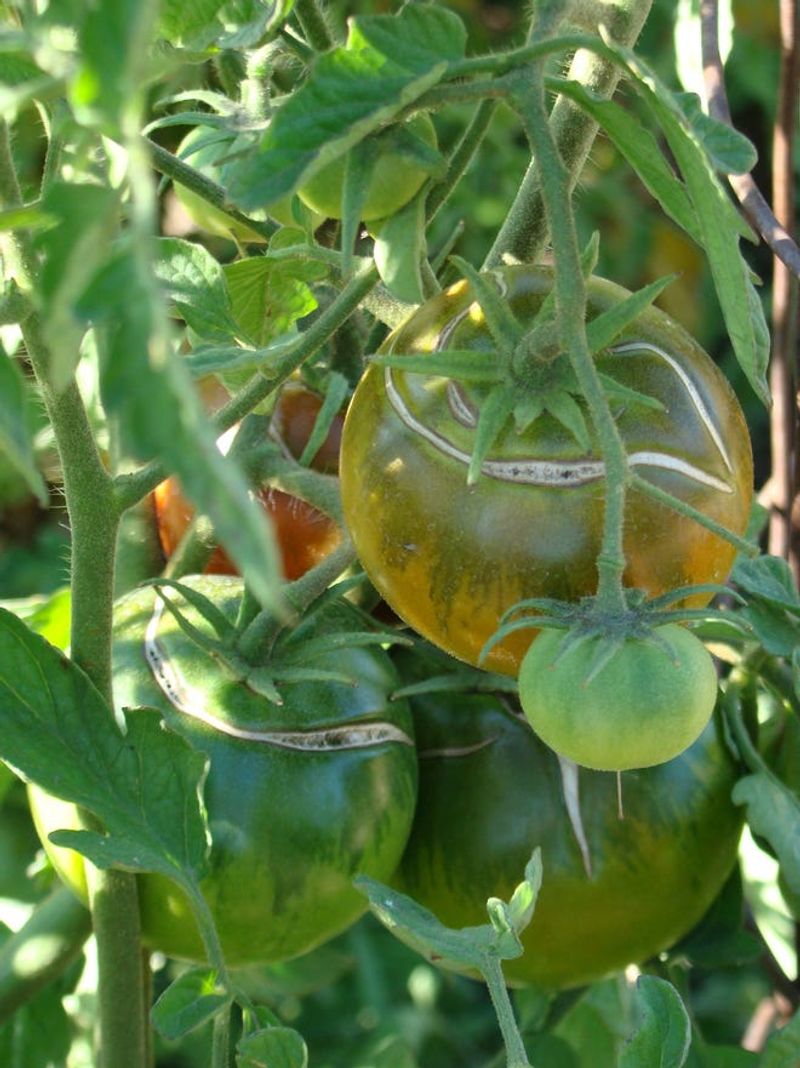
Fruit cracking is a related problem. University of Minnesota Extension irrigation guidance explains that cracking tends to occur when dry conditions are followed by a sudden surge of water, whether from heavy irrigation or rain.
The fruit skin, which hardened during the dry period, cannot expand fast enough when the interior fills rapidly with moisture. Concentric cracks circle the stem end; radial cracks run from stem toward blossom end.
Both are signs that moisture delivery was not steady enough during fruit development.
Shallow watering compounds both problems. When only the top layer of soil stays moist, roots concentrate near the surface, where soil temperature swings more dramatically and moisture evaporates faster.
UC Master Gardeners of Tulare and Kings Counties note that shallow-rooted plants are more susceptible to the moisture stress that triggers these disorders, because they have less buffering capacity against dry spells between waterings. Getting water deeper encourages roots to follow, which gives the plant more stability over time.
Separate watering stress from heat, pests, and calcium myths
Not every problem on a tomato plant traces back to how you watered it. Heat, pests, disease, cultivar genetics, and soil fertility all play roles in how well your harvest turns out, and confusing one cause for another leads to fixes that do not actually help.
Blossom-end rot is a physiological disorder, not a contagious infection and not evidence of pest feeding. UC Master Gardeners of Tulare and Kings Counties are explicit that the condition does not spread from plant to plant the way a fungal disease would.
Heat creates its own category of damage that looks different from moisture stress. When temperatures climb above roughly 95 degrees Fahrenheit during the day or stay above 75 at night, tomato flowers can drop before they are pollinated, or the pollen itself becomes nonviable.
University of Minnesota Extension’s tomato growing guide notes that fruit abortion, sunburn on exposed shoulders, poor red color development, and slow ripening are all heat-driven outcomes. These can happen even when irrigation is perfectly managed, and they require different responses, such as shade cloth, heat-tolerant cultivars, or adjusted planting timing.
The calcium connection is real but widely misunderstood. Blossom-end rot involves calcium not reaching the fruit in sufficient amounts, but that does not automatically mean your soil is calcium-deficient.
UC ANR’s guide to managing blossom-end rot explains that fluctuating moisture, root damage, high soil salt levels, and excess water can all interfere with calcium uptake even when the soil contains plenty of it. Adding eggshells, lime, or gypsum without a soil test is not a reliable correction and can alter soil pH in ways that create new problems.
Pests and diseases can also cause dark spots, soft patches, and harvest losses that superficially resemble moisture disorders. Oregon State University Extension’s tomato problem-solving guide points out that accurate diagnosis matters before treatment.
If you see fuzzy growth, insect frass, entry holes, or spreading lesions across multiple plants, the cause is more likely biological than a watering habit. Correcting irrigation will not fix a pest infestation or a fungal disease that has already established in the garden.
Water slowly until the root zone is wetted
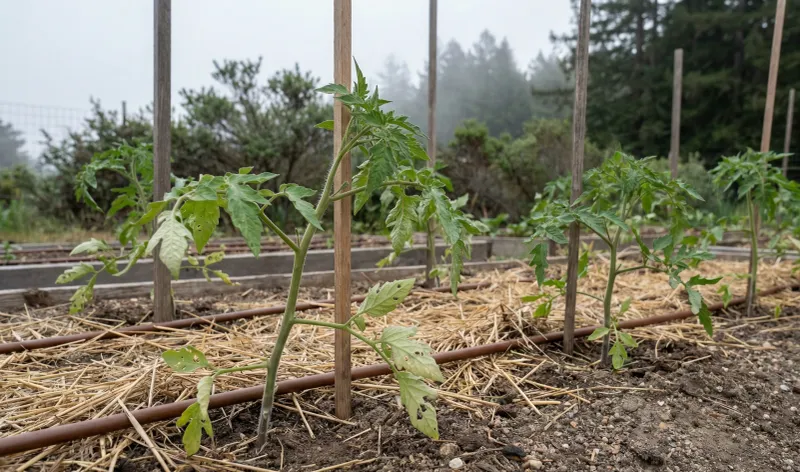
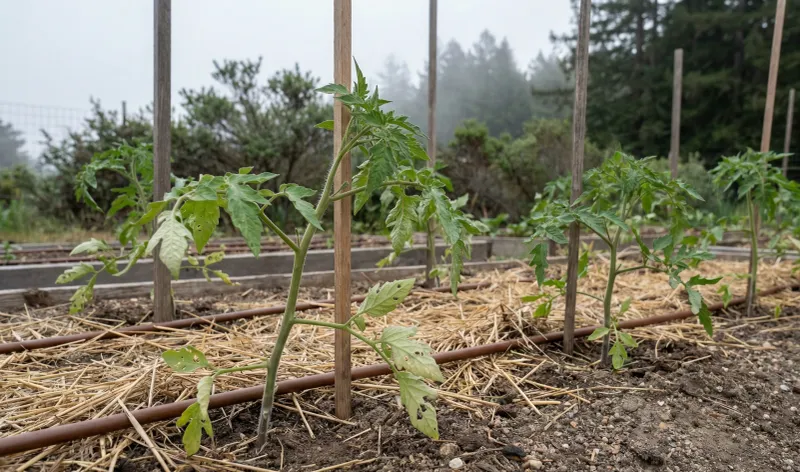
The practical correction to moisture-related fruit problems starts with how water is applied, not just how often. Watering slowly, directly at the soil surface near the base of the plant, gives water time to move downward into the root zone rather than running off or evaporating before it penetrates.
Drip lines and soaker hoses are well-suited to this because they deliver water at a rate the soil can absorb, and they keep moisture off leaves and fruit, which matters for disease management.
UC IPM’s watering guidance for tomatoes recommends wetting the root zone rather than just the top layer of soil. For established garden-grown tomatoes, that means water should reach several inches down, where the bulk of the root system is active.
A quick pass with a hose that wets only the top inch or two does not accomplish this, regardless of how frequently it is repeated.
Checking the soil before watering is more reliable than following a fixed schedule. For established in-ground plants, push a finger or a wooden dowel several inches into the soil near the plant base.
If it comes out moist, the plant likely does not need water yet. If it comes out dry, water thoroughly.
Utah State University Extension’s vegetable watering research treats one to two inches of water per week as a useful starting reference for garden-grown tomatoes, but emphasizes that actual needs vary with weather, soil, and plant size. That range is a benchmark to calibrate against, not a fixed rule.
Avoid prescribing a specific number of minutes with a hose or sprinkler, because emitter flow rates, soil texture, bed depth, and plant size all determine how long thorough watering actually takes. University of Minnesota Extension’s home tomato guide reinforces that the goal is consistent root-zone moisture, not a rigid time-based rule.
Water until the zone is wetted, confirm with a soil check, and let that guide when you water next rather than watching the clock.
Adjust frequency to California’s local conditions
California is not one climate, and a single watering schedule cannot serve a coastal garden in Pacifica, a raised bed in Sacramento’s Central Valley, a hillside plot in the foothills, and a container on a San Francisco balcony equally well. The deep-watering principle stays the same across all of them, but how often you apply it changes based on what the soil, weather, and plant are actually doing.
Sandy soils drain quickly and dry out faster, so they typically need more frequent watering than clay soils, which hold moisture longer but become waterlogged more easily and drain poorly when saturated. Hot, dry, or windy days pull moisture out of the soil faster than cool, calm ones.
Large, actively fruiting plants draw more water than small transplants. Rainfall, even partial, reduces how much supplemental irrigation is needed.
Utah State University Extension’s vegetable water research notes that all of these variables shift the actual irrigation requirement away from any fixed weekly amount.
Containers deserve their own attention. They hold far less soil volume than garden beds, so they lose moisture much faster, especially in heat or wind.
UC Master Gardeners of San Mateo and San Francisco Counties recommend checking container soil at the top inch and watering when that layer feels dry, which during very hot periods can mean daily watering. This is not a harmful habit in containers; it is a necessary one.
The risk in containers is not frequency but failing to water deeply enough each time so that water runs through the entire root mass rather than just wetting the surface.
The UC Master Gardener Program of Alameda County’s tomato guide recommends checking established in-ground soil roughly two to three inches down before deciding to irrigate. California gardeners can also use local evapotranspiration data from resources referenced by the California Department of Water Resources’ model water-efficient landscape ordinance to match irrigation timing to actual local conditions rather than relying on a generic calendar.
The state’s water-efficient landscaping guidance reinforces that good irrigation accounts for soil type, plant need, and efficient delivery equipment together.
Use mulch and heat planning to hold moisture steady
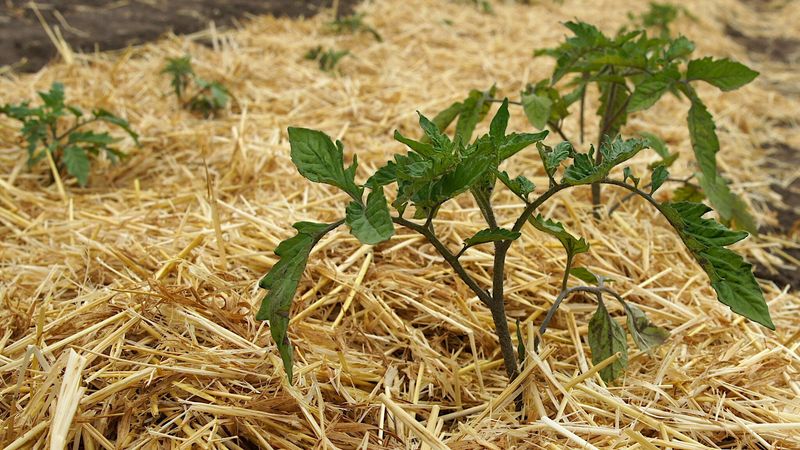
Changing how you water is the core correction, but two supporting practices make it much easier to keep the root zone stable between sessions. Mulch and proactive heat planning work together to reduce the moisture swings that cause the most damage.
A two-to-three-inch layer of organic mulch, such as straw, wood chips, or shredded leaves, applied around the base of each plant slows evaporation from the soil surface, moderates soil temperature during hot days, and cushions the effect of irregular watering intervals. UC IPM’s blossom-end rot overview lists mulching as a recommended practice for reducing moisture fluctuation.
Keep the mulch pulled slightly away from the plant stem, leaving an inch or two of bare soil at the base, to reduce the risk of stem rot and moisture-related crown problems.
Before a forecast heat wave, water the root zone thoroughly so plants go into the stress period with stable soil moisture. UC ANR’s blossom-end rot management guide recommends this approach, while also cautioning against saturating the soil, since waterlogged roots suffer their own damage.
The goal is a well-hydrated but well-drained root zone heading into high temperatures, not a soggy one.
Routine overhead watering with sprinklers is worth reconsidering. UC IPM’s tomato watering guidance and the UC Master Gardener Program of Alameda County both note that wetting foliage and fruit regularly can increase disease risk through wet leaf surfaces and soil splash onto lower leaves.
Drip or soaker irrigation keeps water at the soil level where it is needed and away from the plant tissue where it can cause trouble. If overhead watering is the only option available, watering early in the morning so leaves dry quickly during the day reduces but does not eliminate that risk.
Keep the root zone moist, not waterlogged
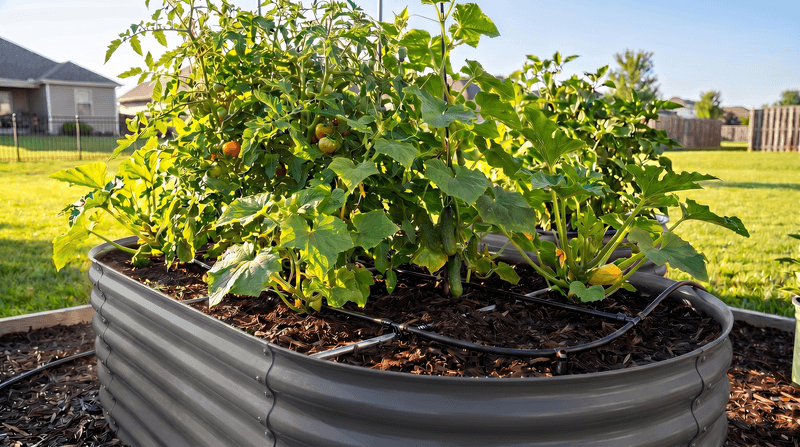
A reliable routine does not require a rigid schedule or a complicated system. Check the soil several inches down near the plant base before each watering session.
If it feels moist, wait. If it feels dry, water slowly and thoroughly at the base until the root zone is wetted, then check again in a day or two rather than watering by the calendar.
UC IPM’s tomato watering guidance supports this soil-check approach as more reliable than fixed schedules across California’s varied conditions.
Use mulch to extend the time between necessary waterings, and use drip or soaker irrigation to deliver water efficiently at the root zone. Utah State University Extension treats consistent root-zone moisture as the underlying goal, not a specific number of days between waterings.
Containers need more frequent checks, sometimes daily in summer heat, while in-ground plants in mulched clay soil may go several days between thorough waterings. Let the soil and the weather tell you when to irrigate, and align that with California’s water-efficient irrigation principles to avoid both under- and over-watering.
Improving moisture consistency can meaningfully reduce blossom-end rot and fruit cracking, but it cannot remove every risk. Cultivar susceptibility, heat events, pests, diseases, and soil conditions all continue to influence what ends up on the vine.
Existing lesions on fruit that developed under stressful conditions will not disappear after you correct your watering; those fruits are already affected. What changes is the environment for the next round of developing fruit.
A tomato garden managed with steady, deep, site-adjusted watering gives each new fruit the most stable start possible, and that is where the real difference shows up.