
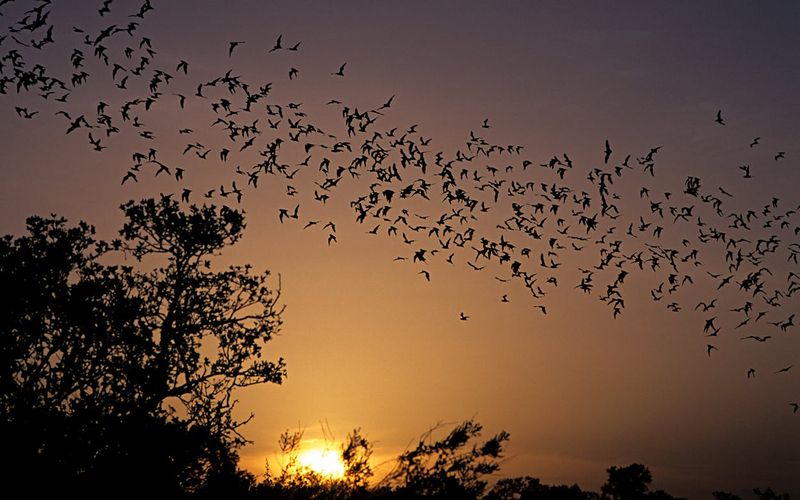
Most California homeowners who spot bats swooping over their patio at dusk feel one of two things: relief that something is eating the mosquitoes, or low-grade alarm that something has moved in. Both reactions make sense, but neither tells the whole story. Understanding what those bats are actually doing, and what they genuinely cannot do for you, makes it a lot easier to share a yard with them without fear or false expectations.
Dusk flight usually means normal foraging
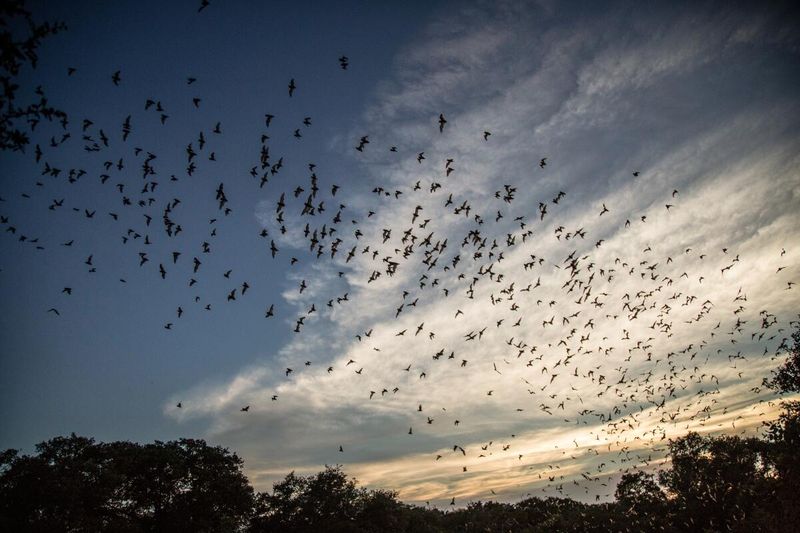
Watching a bat make repeated, looping passes over a patio or lawn as the sky turns orange is one of the more striking things a California backyard can offer. That erratic, darting flight is not random. California Department of Fish and Wildlife guidance confirms that California’s bats are generally nocturnal or crepuscular, meaning dusk and dawn are their active windows. A bat flying outdoors at dusk is behaving exactly as expected.
California is home to 25 bat species, most of which eat insects. That diversity means the animal over your yard could be a tiny western pipistrelle, a Mexican free-tailed bat cruising a drainage corridor, or a pallid bat working the edge of a tree line. Flight behavior alone does not identify the species, and it does not tell you whether a colony is using your attic, a nearby tree, a bridge, or a rock crevice as a roost.
Bats may be feeding well away from wherever they sleep, so outdoor activity above your yard does not show where they live. According to National Park Service research on Brazilian free-tailed bat feeding habits, bats can travel considerable distances from a roost to reach productive foraging areas, which means the animals over your patio could be roosting blocks away. The central distinction worth holding onto is this: the bats overhead are almost certainly hunting insects, but their presence alone does not reveal which insects they are catching or how much they are changing local pest pressure.
Their menu includes much more than mosquitoes
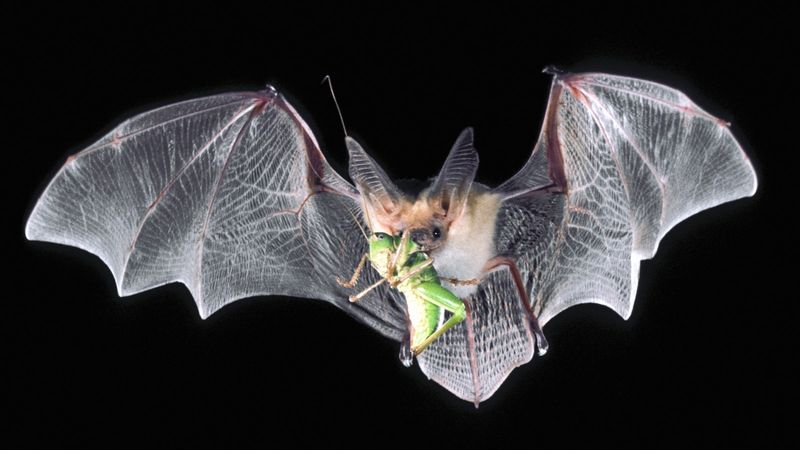
California bats are genuinely impressive insect hunters, but the popular image of a bat as a mosquito-seeking missile oversimplifies a much richer food web. UC IPM’s bat profile documents prey that includes moths, beetles, ants, wasps, leafhoppers, crickets, and other flying or readily captured insects. Pallid bats, a species found across California’s drier regions, can also take larger prey directly from foliage or the ground, including scorpions and large beetles.
Mosquitoes do appear on the menu for some species. DNA-based diet studies have detected mosquito prey in multiple North American bat species, and research on bats in the southeastern United States confirmed consumption of mosquito species known to carry arboviruses. That is meaningful evidence that bats eat mosquitoes, but diet varies considerably by bat species, geographic location, prey availability, and even time of night, so no single study applies uniformly to every California yard.
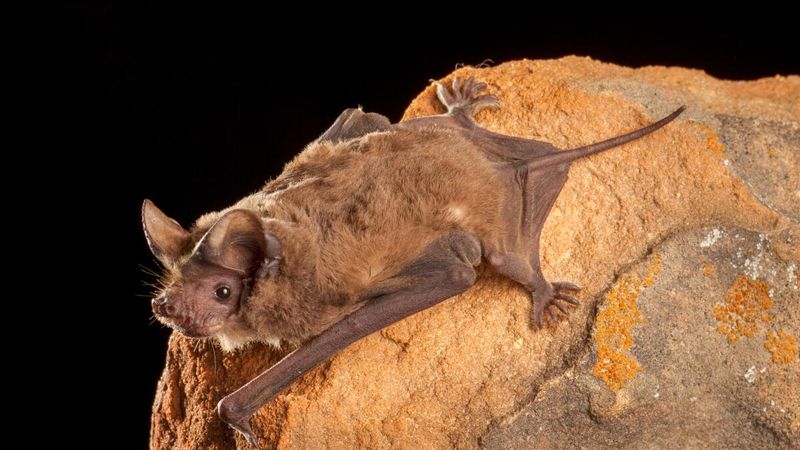
The Brazilian free-tailed bat offers a useful example of why generalizations break down. This species ranges across the Southwest and is one of California’s more recognizable bats, yet a Journal of Mammalogy diet study found that guano samples rarely showed evidence of mosquito consumption, with moths and beetles making up the bulk of what these bats actually ate. The frequently repeated claim that one bat eats hundreds or thousands of mosquitoes per hour is not supported as a normal wild-bat or California-yard measurement.
A more accurate picture is this: bats are flexible, opportunistic hunters that eat whatever flying insects are available and energetically worthwhile. Mosquitoes are small, low-calorie prey compared with a fat moth or a beetle, so bats take them when they are abundant but often pass them up in favor of more rewarding targets. That makes bats a genuine part of the nighttime food web without making them a dedicated mosquito-control service.
Why bats do not prove a mosquito-free patio
Seeing bats loop overhead feels like confirmation that something productive is happening, and in a general ecological sense, it is. But a backyard observation does not translate into a measurable reduction in mosquito bites at one patio. A 2023 global review of pest suppression by bats found extensive documentation of bats eating pest insects alongside a consistent finding: specific management practices have limited demonstrated ability to directly increase pest suppression at the level of an individual property.
Part of the mismatch comes down to where mosquitoes breed versus where bats hunt. California’s Aedes mosquitoes, the container-breeding species responsible for many backyard bites, develop in small water-holding objects like saucers, buckets, and clogged gutters just a few feet from where people sit. Bats, meanwhile, forage in open airspace and may be working a habitat corridor that stretches across several properties or along a drainage channel. UC IPM’s mosquito management guidance makes clear that container breeding sites near homes are a primary driver of residential mosquito pressure, a problem that aerial predation does not address at the source.
Bats may also be traveling while foraging, as noted in the earlier section on Brazilian free-tailed bat habits, meaning they could be consuming insects produced in a pond, field, or drainage area nowhere near your yard. Their presence above a patio does not prove the insects being caught came from that yard, and it does not prove local mosquito numbers have dropped.
Cockroaches deserve a separate note. Some California bat species do take large or ground-associated insects, but National Park Service bat ecology information and the reviewed California sources do not establish that bats routinely suppress household or patio cockroach populations. Cockroach management requires its own approach, focused on sanitation, exclusion, monitoring, and targeted baits, rather than on attracting bats.
Start mosquito management with breeding sites and exposure

The most direct mosquito-management steps start below the bats, at ground level, where mosquitoes breed. UC IPM’s mosquito management program recommends removing or regularly emptying standing water from pots, saucers, buckets, toys, birdbaths, gutters, and any other containers that hold water. Even a bottle cap with a little rainwater can support mosquito development, so the goal is to eliminate or refresh these sources at least once a week.
Reducing exposure to the mosquitoes that are already present matters just as much as reducing their numbers. Intact window and door screens keep mosquitoes out of living spaces without chemicals. Appropriate repellents registered by the EPA, applied according to label directions, provide personal protection outdoors. Wearing long sleeves and pants during peak mosquito hours, especially around dawn and dusk, cuts down on bites when mosquito activity is highest.
For water features or other sources that cannot be emptied, a larvicide containing Bacillus thuringiensis israelensis, commonly called Bti, can be used to kill mosquito larvae before they become adults. Bti is a naturally occurring soil bacterium, and formulations labeled for residential use are available at garden centers. Apply it only when the product label and any applicable local guidance permit it, and follow the directions for the specific product and water volume.
These measures target breeding and exposure directly, which is why they work. Bats contribute to nighttime insect consumption in a broader, less targeted way, and that contribution is real but not predictable enough to substitute for source reduction. Removing a single breeding container from your yard does more for your mosquito situation than hoping the bats overhead happen to be hunting the ones from your garden.
Support bats without promising pest control
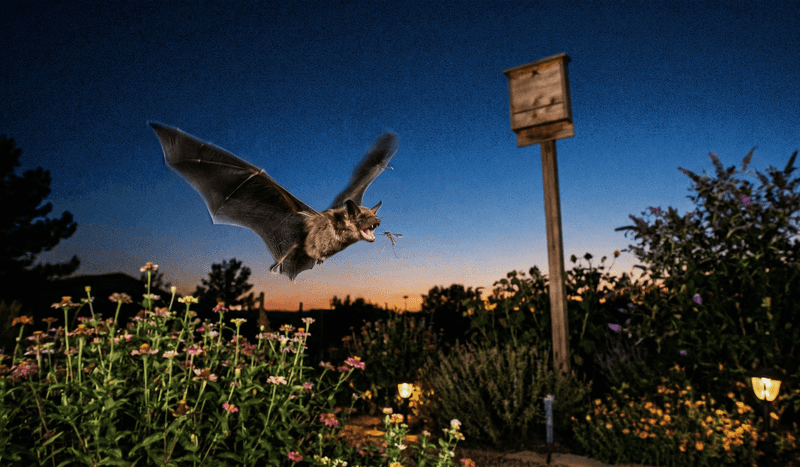
Making a yard more welcoming to bats is a worthwhile stewardship goal, and it does not require believing that bats will solve a pest problem. One of the simplest changes is adjusting outdoor lighting. California Department of Fish and Wildlife recommends turning off nonessential outdoor lights as a conservation measure because artificial light can disturb nocturnal animals and alter the behavior of the insects they depend on. The practical approach is to reduce or shield lights that serve no safety, security, or access purpose, while keeping any lighting that is genuinely needed for visibility or fire safety.
Bat houses are another option, and they can provide supplemental roosting habitat in areas where natural roosts, such as old trees with loose bark or rock outcroppings, are limited. That said, UC IPM is direct on this point: there is no clear evidence that bat houses significantly reduce garden insect problems or prevent bats from using nearby buildings. A bat house is a habitat-support measure, not a mosquito trap. Mount it somewhere that receives several hours of morning sun, away from areas where people gather, and give it a full season before expecting any occupants.
Wildlife-friendly landscaping, including native flowering plants that support moth and beetle populations, contributes to the broader insect food web that bats depend on. The 2023 global review of bat pest suppression found that habitat quality influences where bats forage, but noted that linking specific landscaping choices to measurable pest reduction at individual properties remains difficult to demonstrate. Planting for habitat is still a reasonable choice; just frame it as supporting local wildlife rather than as a guaranteed insect-management strategy.
Pesticides and ultrasonic devices marketed to repel bats are not appropriate options. No pesticides or chemical repellents are registered in California for controlling or repelling roosting bats, and tested ultrasonic devices have not proven effective.
Know when an outdoor bat needs help
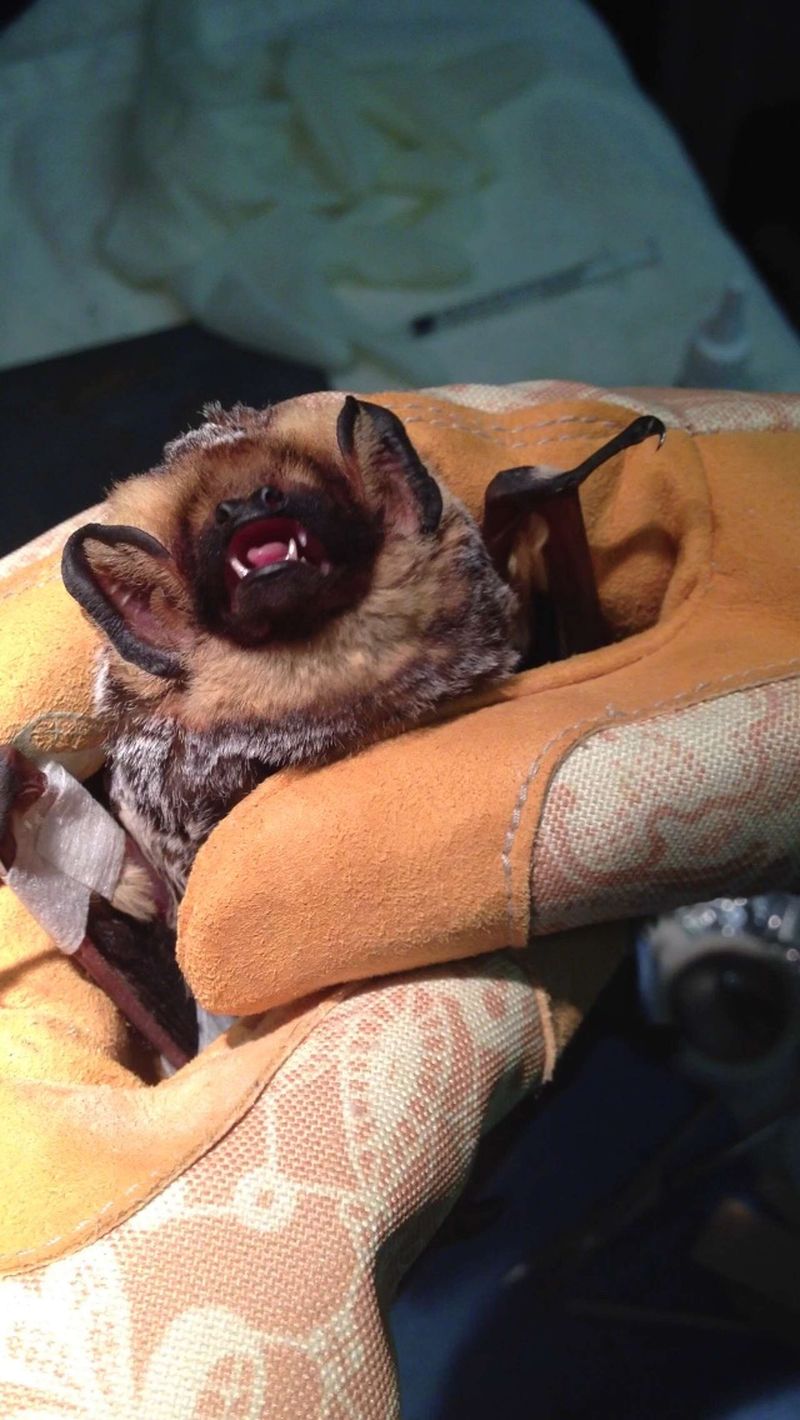
A bat making fast passes overhead at dusk is behaving normally and does not need intervention. The situations that do require a response look quite different: a bat found on the ground, clinging to a wall at mid-day, moving slowly, unable to fly, or acting unusually approachable. Those are signs that something may be wrong, and they call for a different set of actions than simply watching a healthy animal hunt.
Handling any bat with bare hands is never appropriate, regardless of how it looks or behaves. California Department of Fish and Wildlife’s wildlife rehabilitation guidance advises contacting a licensed wildlife rehabilitator or CDFW directly if a bat is injured, weak, grounded, or otherwise distressed. If you need to move a bat out of an immediate hazard before help arrives, use thick leather gloves or a folded towel, and never touch it with bare skin.
An indoor bat is a separate situation. If a bat gets inside, keep children and pets out of the room, close interior doors to confine it, turn off bright lights, and open an exterior window or door when feasible. A healthy bat that can fly will often find its way out on its own once it has an exit. Chasing or swatting at it makes things harder for both of you.
Any situation involving possible direct contact, including waking up in a room where a bat was present, warrants prompt consultation with a healthcare provider or local public-health department. Bat bites can be small enough to go unnoticed, and CDC guidance on rabies prevention recommends a rabies-risk assessment when direct contact occurred and a bite or scratch cannot be definitively ruled out. Bats do not all carry rabies, but the risk assessment is fast and the consequences of skipping it are serious enough to make the call worthwhile.
Use careful timing for attic and wall exclusion
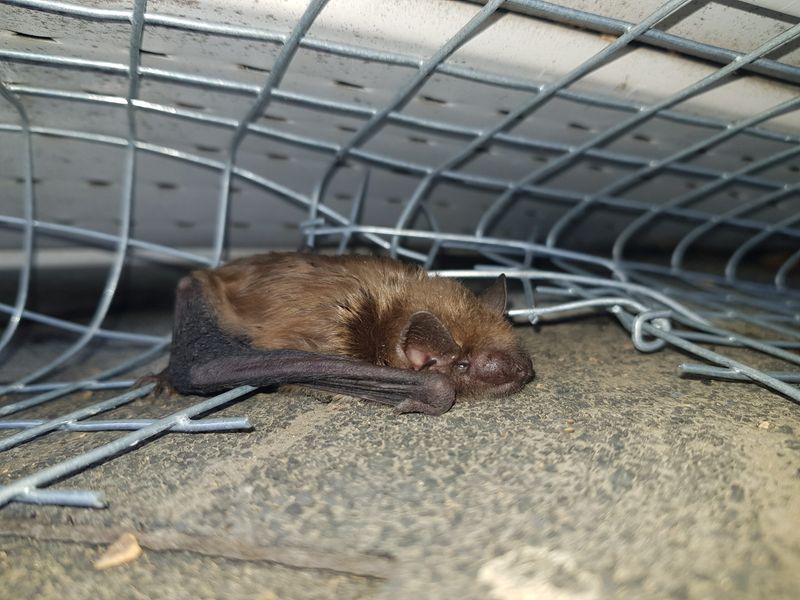
Discovering that bats are roosting inside an attic or wall is a different problem from watching them forage outdoors, and it calls for a specific, carefully timed response. The first rule is not to seal entry points immediately after spotting bats outside. Outdoor foraging does not confirm an indoor colony, and sealing gaps hastily during the wrong season can trap bats inside, including flightless young that cannot escape on their own.
UC IPM’s bat management guidance recommends humane exclusion as the appropriate method for removing bats from a structure. Exclusion involves identifying entry points and installing one-way devices or netting that allow bats to exit but not re-enter, followed by permanent sealing once the colony has left. Poisoning and trapping are not legal or effective options for bats in California, and no pesticides are registered for that purpose.
Timing is critical. Flightless young are typically present in California bat colonies from May through September, the maternity season. Exclusion during that window can separate mothers from pups or trap young bats inside, where they will die. Winter is generally the preferred period for permanent exclusion because colonies are smaller or absent, and young are not at risk.
If you are uncertain about the timing or the scope of the colony, consulting a pest management professional with bat experience is a reasonable step.
Bat guano in an attic or wall should be handled with care. Disturbing dried droppings in a way that creates airborne dust is a health concern. Cleanup inside a structure is a separate job from exclusion, and it should be done with appropriate respiratory protection rather than a broom and an open window.
Let the bats hunt while you manage what you can control
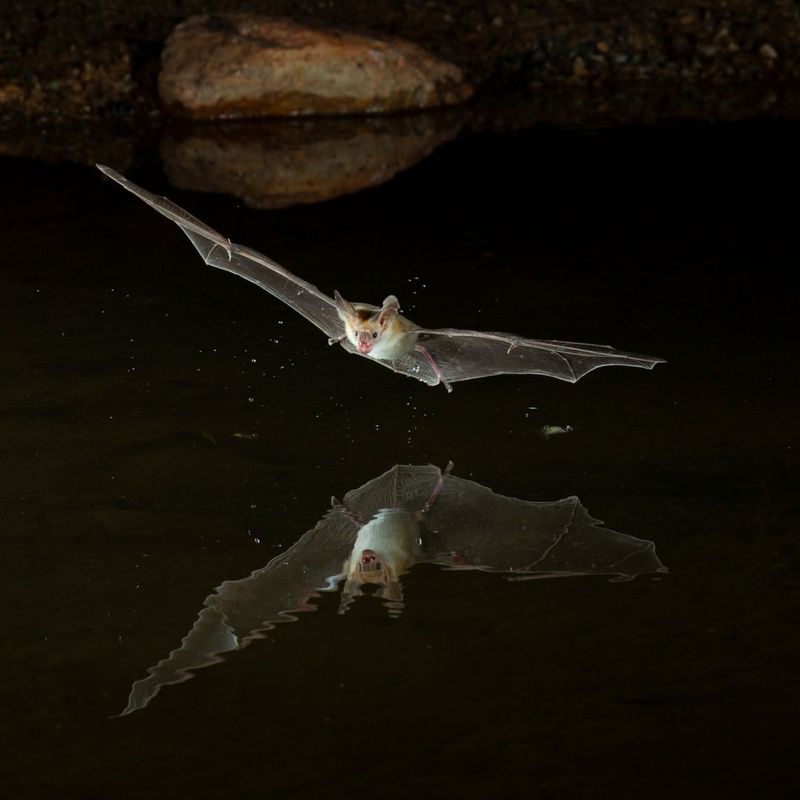
Dusk-flying bats signal something genuinely good: a functioning nighttime food web in your neighborhood. They may well be eating some of the insects that would otherwise land on you, and that contribution is worth appreciating. What they are not doing is providing a measurable guarantee that your patio has been cleared of mosquitoes, roaches, or any other specific pest.
The practical order of operations is straightforward. Leave normal outdoor bats alone. Remove standing water to cut off mosquito breeding at the source, as UC IPM recommends. Use screens, repellents, and protective clothing to reduce your own exposure.
Manage cockroaches through sanitation and targeted methods rather than expecting aerial hunters to handle them. If a bat enters your home or shows signs of distress, respond carefully and get professional guidance. If bats are roosting in a structure, time any exclusion to avoid the maternity season and use humane methods.
CDFW describes California bats as an important part of our ecosystem, and that framing is the right one. Supporting their habitat, dimming lights you do not need, and leaving healthy outdoor animals alone are all things a California homeowner can do without expecting anything in return. The bats will keep hunting whether or not anyone is watching, and a yard that makes room for them is a more interesting place to spend a summer evening.