
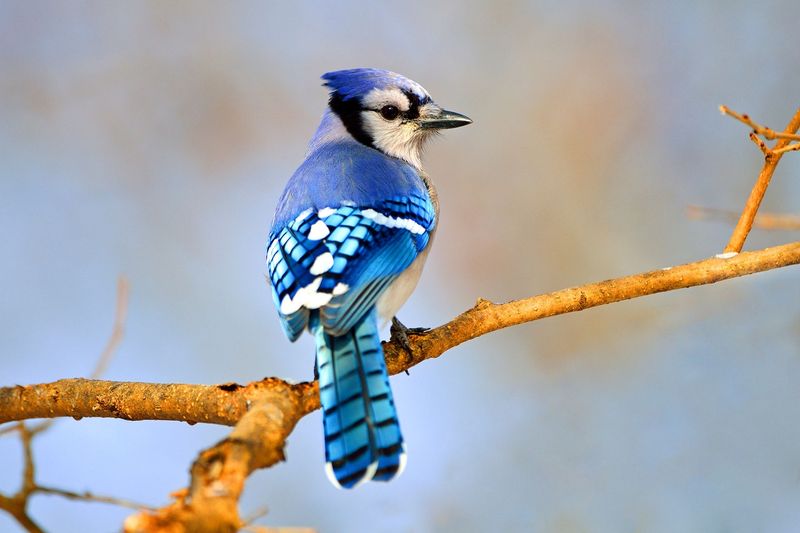
Most Florida mornings start the same way: coffee, humidity, and a Blue Jay somewhere in the oak tree screaming like the yard is on fire. Before you assume something is seriously wrong with your tree or your neighborhood, take a breath. Blue Jays are naturally loud, socially complex birds, and their repeated morning calls almost always reflect ordinary bird business rather than one specific alarm. Understanding what they might actually be doing can turn a daily annoyance into something genuinely interesting to watch.
The calls do not translate into one exact message
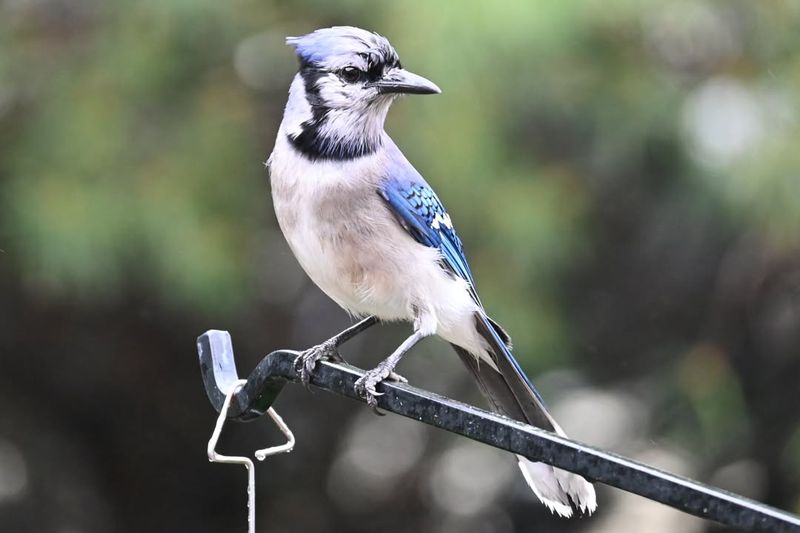
Loud, repeated Blue Jay calls are easy to hear but surprisingly hard to decode. Cornell Lab of Ornithology’s Blue Jay species account describes the bird as highly vocal and conspicuous, typically calling from a perch in a tree, which is exactly what your Florida oak provides. The problem is that the same harsh, raspy scream can mean several different things depending on what is happening around the bird at that moment.
Blue Jays produce a wide variety of sounds. Cornell’s life history profile notes that the species has a large vocal repertoire and uses both vocalizations and body language to communicate. A single call type can appear during an alarm response, a territorial dispute with another jay, contact between family members, competition over food, or ordinary social interaction within a flock. Hearing one sound without watching what the birds are doing at the same time leaves most of the story missing.
The oak and the morning timing add useful context, but neither pins down a single explanation. Your tree may offer a useful perch, a lookout, cover, or access to food, and the birds may simply be starting their day from a familiar spot. The National Park Service’s Blue Jay overview reinforces that jays are active, communicative birds in woodland edges and residential yards, not secretive ones with a single message to deliver.
Rather than trying to translate the sound alone, shift your attention to what the birds are physically doing. Are they converging on a single spot? Diving repeatedly? Sitting still and calling back and forth?
Each pattern points toward a different likely explanation, and the sections that follow walk through each one. Sound is the starting point, not the answer.
Why a Florida oak becomes a useful Blue Jay headquarters
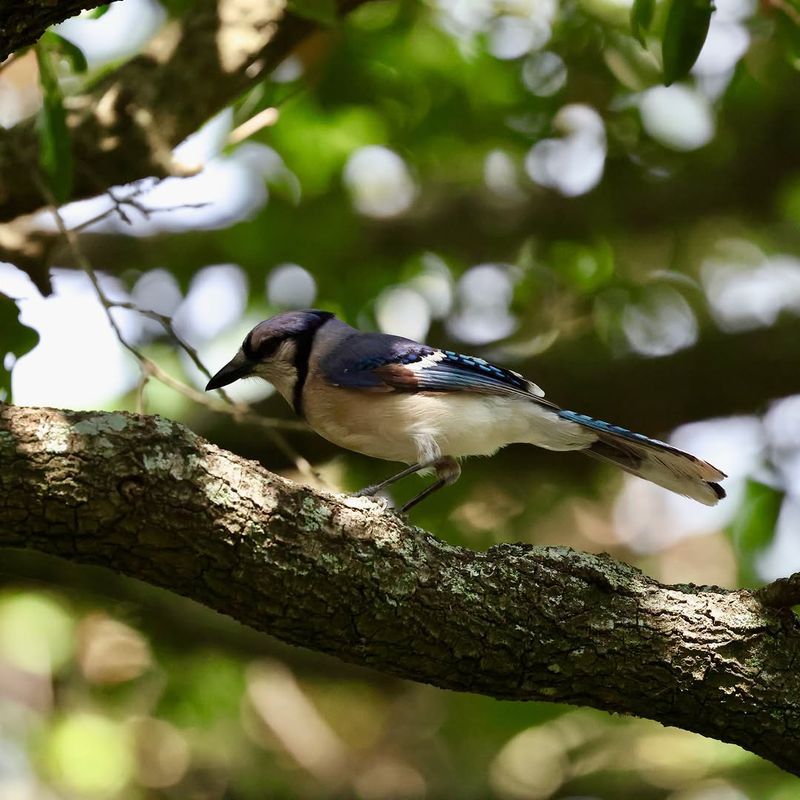
Florida live oaks offer something that most ornamental trees simply cannot match: a combination of dense canopy, sturdy perches, reliable food, and year-round leaf cover. Blue Jays thrive in exactly this kind of setting. Cornell’s identification guide places the species in woodland edges, woodlots, parks, and residential yards, which describes a typical Florida suburban lot with a mature oak almost perfectly.
Acorns are a central part of the picture. The National Park Service’s oak species spotlight describes oaks as keystone trees that support an exceptional number of wildlife species, with acorns serving as a critical food source. Blue Jays eat acorns, carry them in a throat pouch, and cache them in the ground some distance from the source tree, which can help disperse oak seeds across a landscape. UF/IFAS Extension’s guide on managing oaks for wildlife identifies jays among the animals that rely on Florida oak acorns and notes that Florida’s oak species occupy habitats ranging from dry sandy uplands to wetter soils, covering a wide range of suburban conditions.
That said, the oak’s value goes beyond food. Blue Jays use large trees as lookout posts, travel routes between foraging areas, cover from aerial predators, and potential nesting sites. A jay calling from your oak may not be there because the tree is producing an exceptional acorn crop or showing signs of stress. The bird may simply be using a familiar, elevated perch while calling to a flock member, watching for a competitor, or pausing between feeding stops elsewhere in the neighborhood.
Seeing Blue Jays in your oak regularly is a sign that the tree is ecologically functional, not that something is wrong with it. Their presence reflects the tree’s habitat value, and that is worth recognizing before assuming the calls signal a problem.
Watch posture and movement to narrow the possibilities
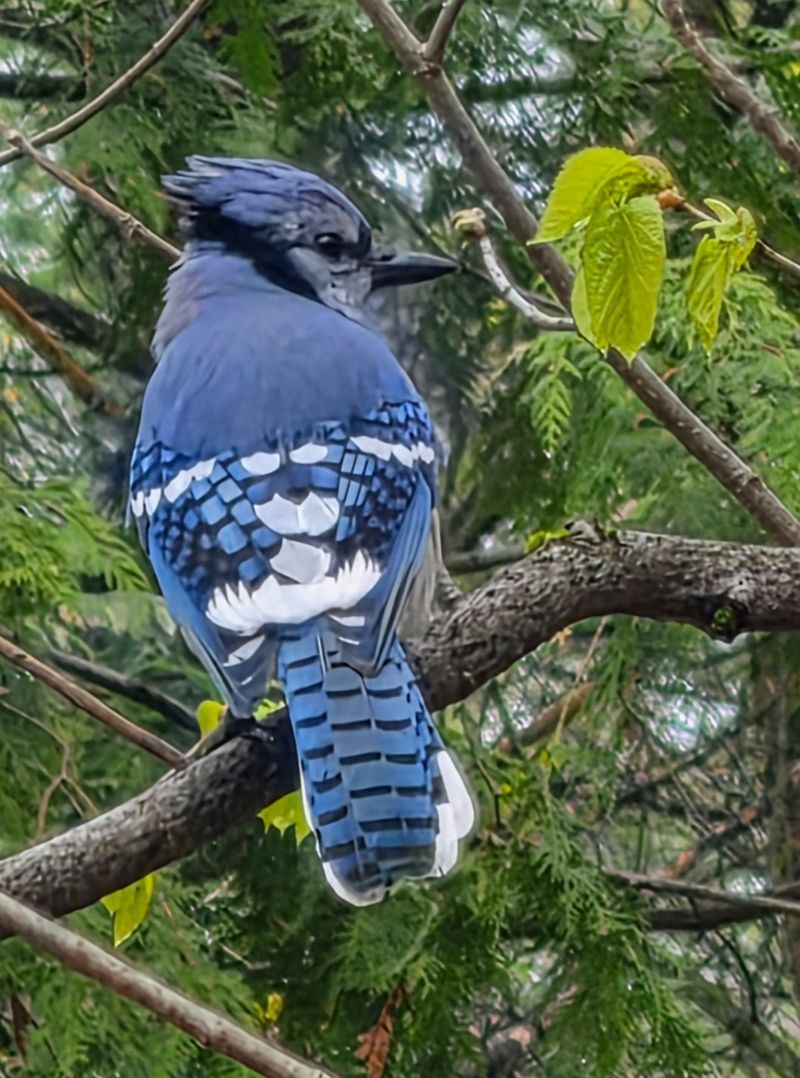
Sound alone rarely settles the question of what a Blue Jay is communicating. Watching the bird’s body and tracking its movement across a few minutes gives you far more to work with than listening to the call in isolation.
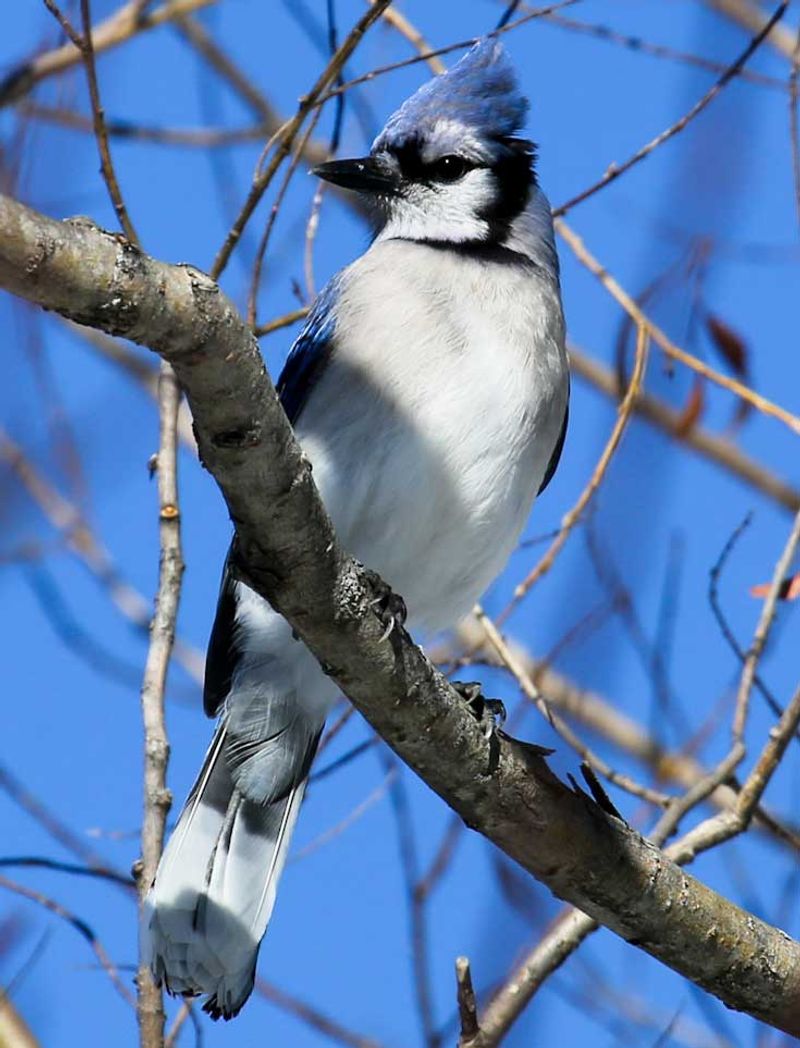
Start with the crest. Cornell’s life history profile notes that Blue Jays communicate partly through body language and that a raised crest is associated with greater agitation or aggression. When a jay squawks with its crest fully erect, it is likely in a heightened state, though that state could reflect alarm, territorial tension, or competition over food rather than one specific threat. A bird calling with a relaxed or slightly lowered crest may be engaged in more routine contact with nearby flock members.
Movement patterns are equally telling. A group of Blue Jays converging on one spot in the canopy, diving repeatedly toward a branch or the ground, and calling in short rapid bursts is behaving in a way consistent with mobbing, where birds gang up on a perched owl or hawk to drive it away. The National Park Service’s Blue Jay overview confirms that groups of noisy Blue Jays may be mobbing a predator, though that is one possibility among several. Look for the object of their attention before concluding a predator is present.
Compare that with two birds facing each other on adjacent branches, calling back and forth while one edges closer, which fits a territorial or competitive interaction rather than an alarm. Or consider a loose cluster of jays moving through the canopy together, calling intermittently as they travel, which is consistent with flock contact calls that help birds stay coordinated.
Food competition has its own signature. Jays jostling at a feeder or on the ground under the oak, lunging at each other between calls, are most likely arguing over a resource rather than warning anyone about a predator. Putting each of these patterns together with the crest position, the direction the birds are looking, and any obvious trigger nearby gives you a much better working guess than any single call type could provide on its own. Every interpretation stays plausible rather than certain, but observation gets you closer to the truth than listening alone ever will.
Morning increases activity without fixing the meaning
One reason the calls feel so noticeable is simple timing. Birds across many species ramp up their vocal activity around dawn, which means your oak may host a concentrated burst of Blue Jay noise right when the yard is otherwise quiet and you are trying to enjoy your morning. The regularity of it can make the behavior feel purposeful or alarming, but the dawn timing itself does not reveal what the birds are communicating.
Cornell’s nest-observation guidance specifically cautions against approaching nests early in the morning, when birds are most active, which reflects just how heightened dawn activity tends to be for many species. Cornell’s Blue Jay life history does not assign one special meaning to calls made at dawn, and no authoritative source reviewed for this article does either. Morning is when birds are active, full stop.
What dawn timing does offer is a reliable observation window. If you spend five to ten minutes watching the oak at the same time each morning for several days, patterns become easier to spot. Does the calling stop when a car passes? Does it intensify when a neighbor’s cat appears?
Does it quiet down once the birds move to a feeder or disperse into the neighborhood? Changes tied to specific triggers, food sources, disturbances, or the arrival of other birds give you far more diagnostic information than the time on the clock. Use the predictable morning window as an opportunity to watch, not just listen.
Hawk-like sounds require observation, not a diagnosis
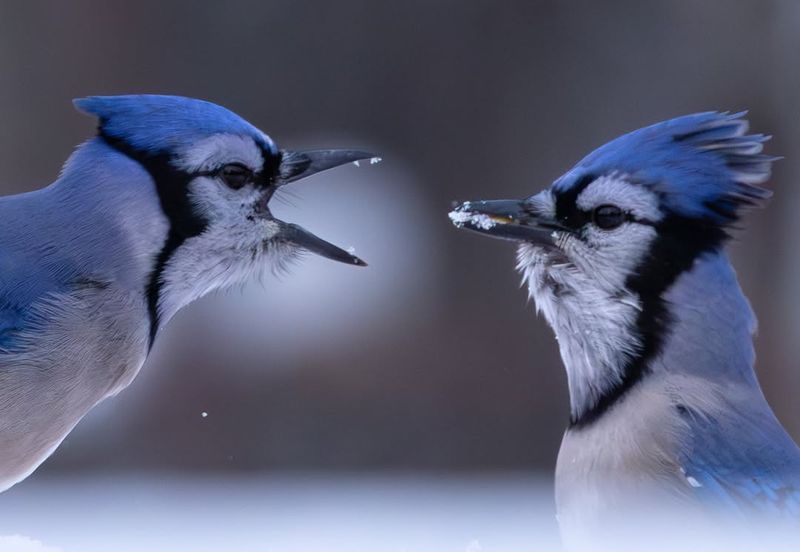
Florida residents sometimes hear what sounds unmistakably like a Red-shouldered Hawk coming from the oak, only to look up and find a Blue Jay. This is not an accident. The National Park Service confirms that Blue Jays are capable mimics and can produce convincing imitations of Red-shouldered and Red-tailed Hawk calls. Hearing that sound from your tree does not mean a hawk is present.
Why jays do this is less settled than the fact that they do it. A peer-reviewed review of vocal mimicry in corvids notes that the function of mimicry is not always known and varies across species and contexts. One hypothesis is that jays use hawk-like calls to scatter competitors from a food source, but this has not been confirmed as the sole or universal explanation. Another possibility is that the call is part of an alarm or social communication sequence that happens to sound like a predator to human ears.
The practical takeaway is straightforward. Before deciding that your yard has a hawk problem based on what you hear from the oak, spend a moment actually looking. A genuine mobbing event, where jays converge and dive repeatedly toward one spot, often produces a mix of harsh calls and visible movement toward a target. If you see that convergence and then spot a perched raptor, the alarm interpretation gains real support.
If you hear a hawk-like call and the jays are simply sitting on branches or moving through the canopy calmly, vocal mimicry or a different social call is a more likely explanation. Let the birds show you what is happening before settling on a conclusion.
Food attractants can keep the congregation returning
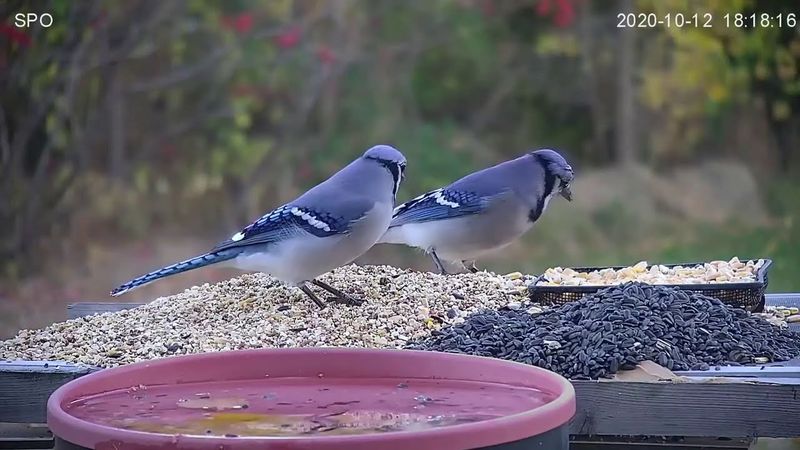
A predictable food source will concentrate Blue Jays faster than almost anything else. If the same birds appear at the same oak every morning, it is worth walking around the yard and asking what is drawing them to that exact spot. A feeder within sight of the tree, spilled seed under a platform feeder, fallen fruit from a nearby tree, unsecured pet food left outside overnight, or an open garbage container can all act as magnets that bring birds back on a reliable schedule.
The Florida Fish and Wildlife Conservation Commission warns that feeding wildlife, even unintentionally, can create crowding, increase disease risk, encourage nuisance behavior, and attract predators. The solution is not to feed Blue Jays intentionally in hopes of keeping them quiet or friendly. Concentrated feeding tends to increase activity and noise rather than reduce it, and it can draw in animals you did not plan to attract.
FWC’s tips for securing attractants recommend bringing in bird seed, pet food, fallen fruit, and garbage each evening and keeping containers sealed. Reducing or eliminating accessible food may lower the concentration of Blue Jays around the oak, though it will not guarantee silence since the tree itself remains a useful perch and travel point.
FWC’s guidance on unintended wildlife visitors points out that native plants can attract birds naturally and that intentional supplemental feeding is not necessary for wild birds to thrive in a Florida yard. If you prefer to keep a feeder running, UF/IFAS Extension’s bird feeder selection guide recommends avoiding platform feeders where droppings can mix with food and suggests wire-mesh bottoms for better drainage. Larger feeder styles tend to attract Blue Jays specifically, so feeder type matters if your goal is to shift the bird mix rather than eliminate feeding altogether.
Give nesting birds space instead of trying to silence them
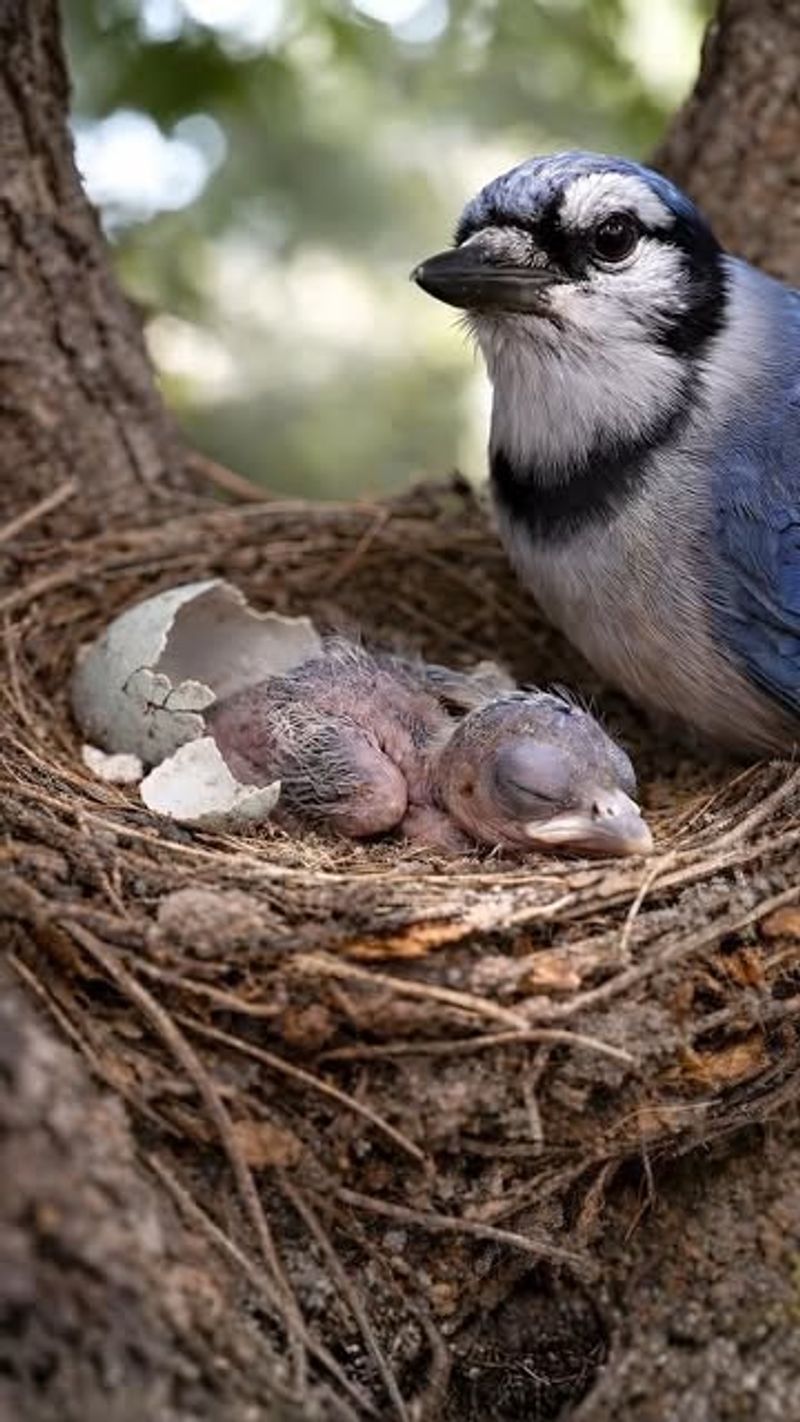
Persistent calling near one section of the oak, combined with adults repeatedly diving at people, pets, or other birds passing below, can be a sign that a nest is close by. Blue Jay nests are typically well hidden in trees, and the birds may be calling from a perch some distance from the actual nest, so the exact location is not always obvious. Cornell’s life history profile notes that Blue Jay nests are usually placed in trees and are often difficult to spot.
If you suspect nesting activity, the right response is to reduce your presence rather than investigate up close. Cornell’s nesting guidance recommends keeping distance, limiting foot traffic near the nest area, and avoiding activities that cause the adults to flush repeatedly. Cornell’s nest-observation advice specifically cautions against approaching nests early in the morning and against disturbing young that are close to fledging.
A young Blue Jay found on the ground is not necessarily abandoned or injured. Fledglings often leave the nest before they can fly well, continue begging loudly for food, and remain dependent on their parents for several weeks. If the bird appears alert and uninjured, the parents are likely nearby and watching. Leave it alone unless it faces an immediate hazard such as a roaming cat or a busy road.
The U.S. Fish and Wildlife Service explains that most migratory bird nests receive legal protection, and USFWS permit guidance on nest disturbance makes clear that destroying a nest containing eggs, chicks, or dependent young can violate the Migratory Bird Treaty Act. Moving an active nest is not a safe or legal option in most circumstances. If you are uncertain about a bird’s condition or face an urgent situation, contact a licensed wildlife rehabilitator in Florida for qualified guidance rather than handling the bird yourself.
Confirm the species before applying Florida-specific advice
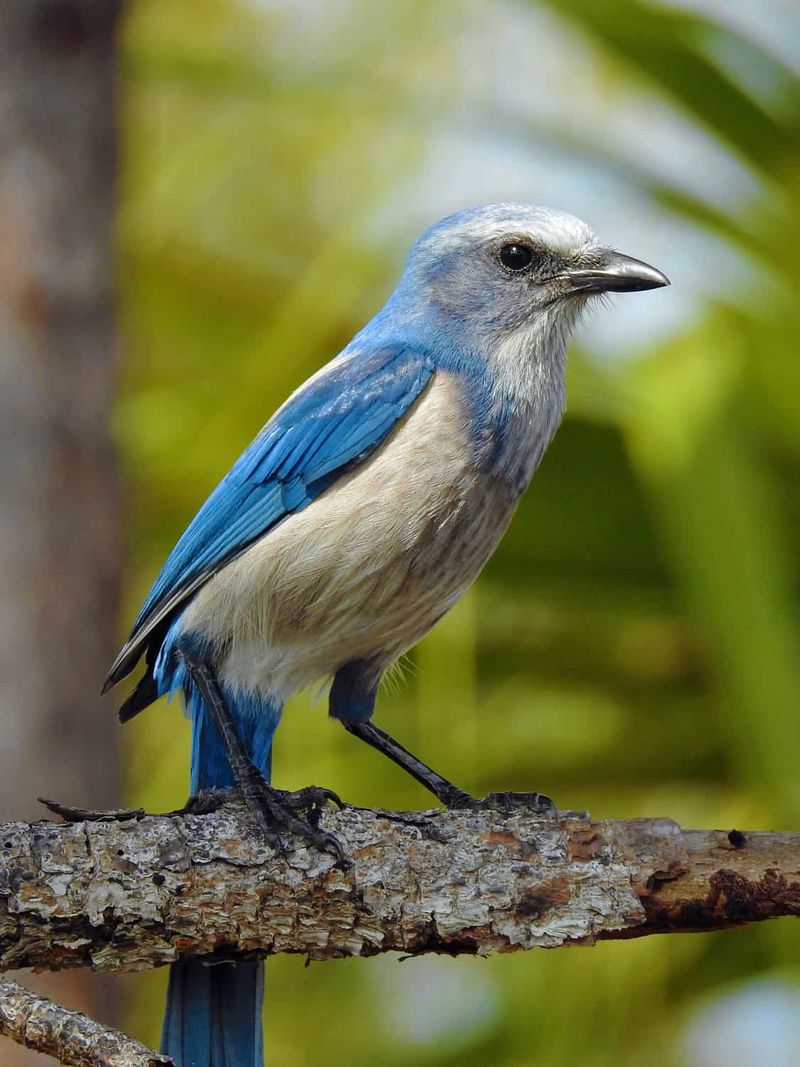
Before acting on anything you read about Blue Jays, take a close look at the bird in your oak. Florida is home to two very different jay species, and mixing them up leads to the wrong conclusions.
The common Blue Jay is hard to miss. Cornell’s Blue Jay identification guide describes a medium-large songbird with a bold blue, white, and black pattern and a prominent pointed crest on top of the head. The crest is the most reliable field mark at a glance. Blue Jays are widespread across Florida in suburban yards, parks, and wooded edges, and they are the bird most Florida residents encounter in a live oak.
The Florida Scrub-Jay is a completely different bird with a very different story. Cornell’s Florida Scrub-Jay identification guide describes a jay with no crest, a gray back and belly, and blue wings and head. It is noticeably plainer than the common Blue Jay and is restricted to Florida’s open oak scrub and scrubby flatwoods habitats, not suburban yards with a live oak in the lawn. FWC identifies the Florida Scrub-Jay as a threatened species, and its breeding season generally runs from March through June.
An ordinary suburban live oak does not create Florida Scrub-Jay habitat. If the crested, boldly patterned bird you see matches the common Blue Jay description, the general advice in this article applies. If you spot an uncrested, gray-bellied jay in true scrub habitat, the situation carries more ecological and legal weight. Disturbing or altering habitat for a threatened species requires a more careful and informed response, and contacting FWC for guidance is the right starting point.
Choose observation and habitat protection over tree removal
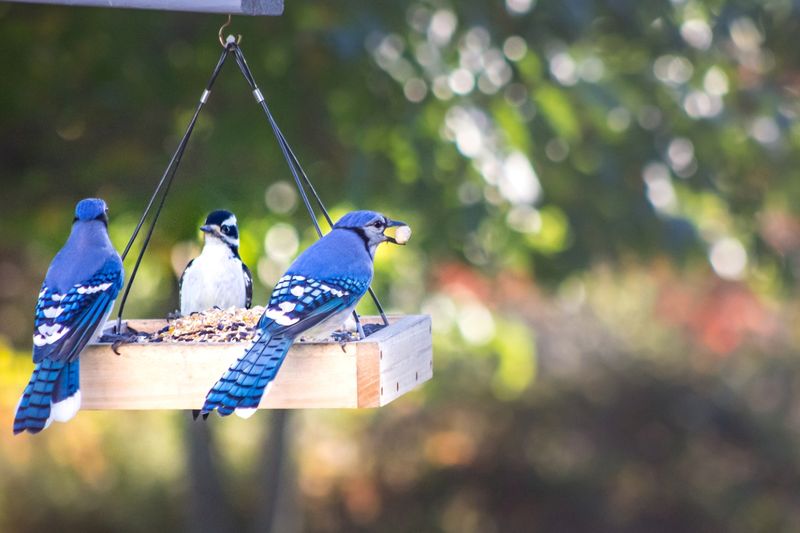
Repeated morning calls from a Blue Jay in your oak are a sign of active, communicating birds using good habitat, not a confirmed warning, a guaranteed nest, or evidence that the tree needs to come down. The oak itself is almost certainly doing something right by offering perches, food, cover, and a reliable gathering point for wildlife.
The most useful responses are practical and low-effort. Observe from a comfortable distance using binoculars when possible, note what triggers changes in the calling, and use what you see to narrow down whether alarm, territorial conflict, food competition, or flock contact is the most plausible explanation on a given morning. FWC recommends securing food attractants such as seed, pet food, fallen fruit, and garbage as a first step if concentrated bird activity becomes a concern. Reducing accessible food may ease the intensity of morning gatherings without harming the birds or the tree.
Keep cats indoors or otherwise prevented from roaming freely. FWC advises keeping cats inside both to protect the cats themselves and to reduce predation pressure on songbirds, including fledglings that may be on the ground near your oak. If nesting activity is present, USFWS guidance on bird nests is a clear reminder to give active nests a wide berth until the young have moved on.
A loud Florida oak most mornings is, in the end, a working piece of local habitat. The Blue Jays chose it for a reason.