
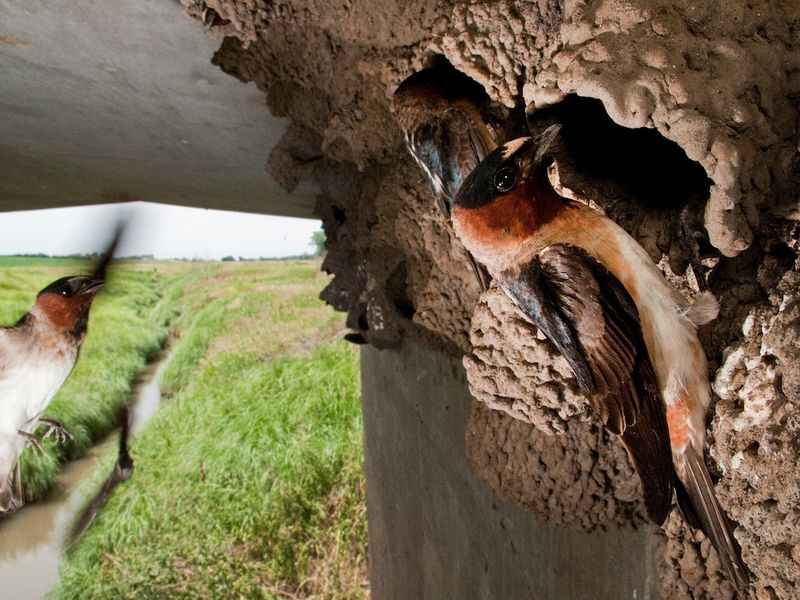
Mud-plastered bumps appearing under your eaves one spring morning are not random – they are the work of Cliff Swallows, one of California’s most industrious colonial birds. These small, fast-flying birds are genuine insect eaters, and that has led to a popular idea that a colony will scrub mosquitoes right off your patio. The reality is more complicated and, honestly, more interesting: the birds do eat flying insects including mosquitoes, but the evidence does not support the idea that they will make your outdoor seating area mosquito-free. Understanding what the nests actually signal, what the birds genuinely do, and how to handle the real mosquito problem on your property will serve you far better than the myth.
What a Cliff Swallow nest under your eave reveals
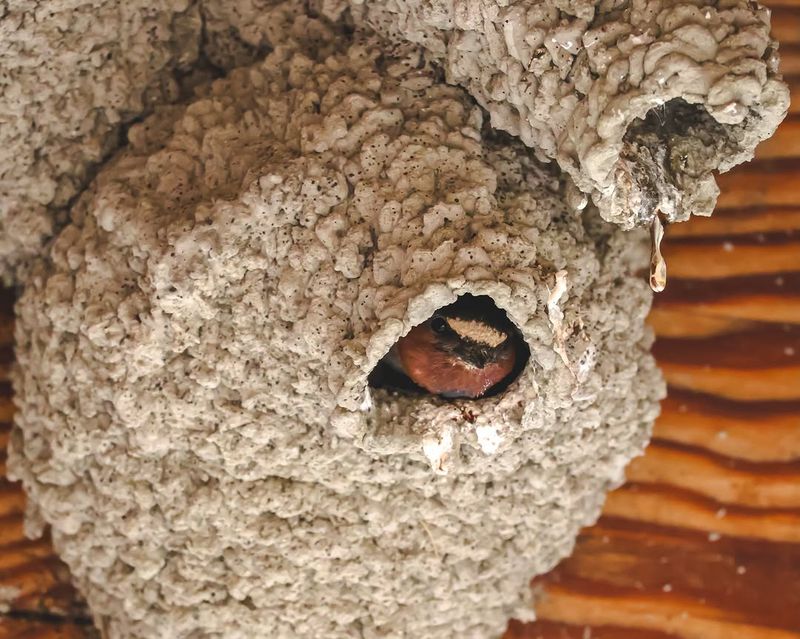
A rounded lump of dried mud packed beneath an eave is one of the more distinctive construction projects in the California bird world. Cliff Swallows (Petrochelidon pyrrhonota) build enclosed, gourd-shaped nests made from hundreds of individually carried mud pellets, and they almost always build in groups. A single overhang might hold a dozen nests; a busy bridge or overpass can support hundreds. Each nest has a narrow, tube-like entrance that points downward or to the side, giving the colony a look that is easy to recognize once you know what to search for.
Before assuming you have Cliff Swallows, it helps to rule out their close relative the Barn Swallow. UC IPM’s Cliff Swallow pest notes draw a clear line between the two: Cliff Swallow nests are fully enclosed with that signature tunnel entrance and tend to appear in tight clusters, while Barn Swallow nests are open cups, more like a small bowl of mud attached to a vertical surface. Getting the identification right matters because management advice differs between species.
Cliff Swallows choose nest sites based on a few practical requirements. They need a protected overhang that shields the nest from rain, a source of wet mud nearby for construction, fresh water for drinking, and open sky for foraging. Cornell Lab’s Cliff Swallow life history confirms that eaves, bridges, culverts, and overpasses all meet these criteria. One thing the nest’s location does not tell you is where the birds actually hunt.
Cliff Swallows forage on the wing over wide stretches of open habitat, which may include fields, ponds, wetlands, or roadsides well beyond your backyard fence. Finding a nest under your eave means the birds chose your structure for shelter, not necessarily that they are patrolling your patio.
What Cliff Swallows actually eat in flight
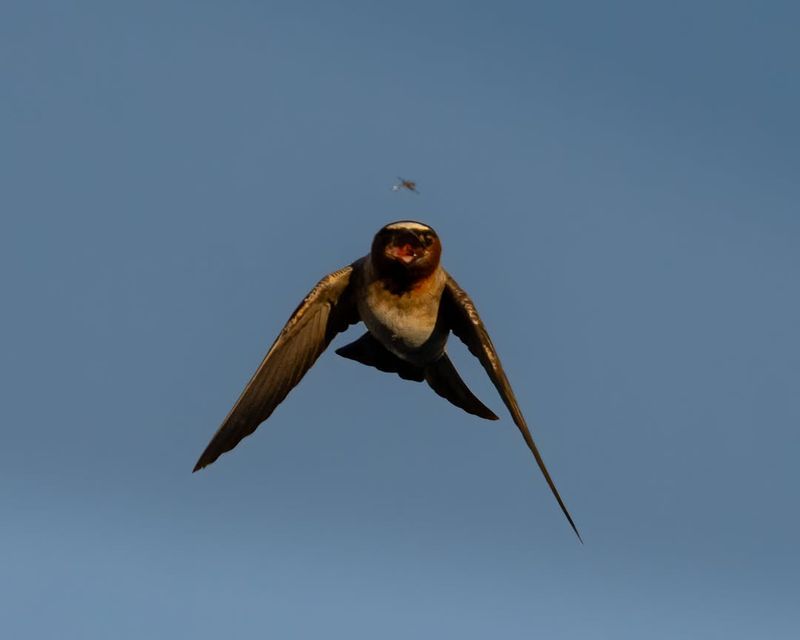
Watching a Cliff Swallow work the air above an open field gives you a quick sense of how relentlessly it hunts. The birds feed entirely on the wing during daylight hours, sweeping back and forth with their mouths open to scoop up whatever flying insects cross their path. Cornell Lab’s life history account lists the prey mix: flies, bees, wasps, ants, beetles, lacewings, moths, grasshoppers, dragonflies, and other flying insects. Mosquitoes appear on the menu too, confirmed by a USGS-linked study on Cliff Swallow diet and West Nile virus exposure, which identified mosquitoes among the species’ prey items.
That diet list is genuinely broad, and a healthy colony does remove flying insects from the local environment. The catch is that “broad and opportunistic” also means the birds eat whatever happens to be most available on a given day. Prey composition shifts with season, weather, temperature, and the insects that are actually flying at that moment in that habitat. A colony foraging over a warm pond edge on a calm evening will encounter very different prey than one sweeping over a dry hillside at midday.
One claim that circulates widely online is that each Cliff Swallow eats thousands of insects or thousands of mosquitoes every day. Neither Cornell Lab’s account nor the USGS study supports that specific number for this species. The sources describe diet composition and foraging behavior, not a validated daily tally. Treating that figure as fact overpromises what any single bird or colony can deliver and sets up homeowners for disappointment when mosquitoes keep biting despite a nest on the eave.
The defensible takeaway is simpler and still meaningful: a colony of Cliff Swallows is catching real insects every day, and mosquitoes are among the prey types, even if the exact count and proportion vary considerably.
Why a colony cannot promise a mosquito-free patio
Knowing that Cliff Swallows eat mosquitoes is useful, but it is a long step from “eats some mosquitoes” to “keeps the patio clear.” The gap comes down to scale, geography, and biology. A foraging Cliff Swallow covers large stretches of open sky, and the colony nesting under your eave may spend most of its hunting time over a nearby pond, a grassy park, or an agricultural field rather than hovering over your seating area. Cornell Lab’s life history data describes wide-ranging foraging behavior, not targeted hunting over a single yard.
There is also a fundamental mismatch between what swallows can address and where mosquito problems actually start. Swallows catch adult insects already airborne. Mosquitoes, by contrast, breed in standing water and emerge continuously as long as that water remains. A bird eating adults at dusk does not reduce the number of larvae developing in a clogged gutter or a neglected plant saucer twenty feet away.
Catching some adults may trim the population at the margins, but it does not interrupt the breeding cycle that keeps replenishing it.
No reviewed research establishes that leaving Cliff Swallow nests in place produces a measurable drop in patio mosquito numbers, and no source shows that removing nests causes mosquito numbers to rise noticeably. Both of those cause-and-effect claims appear in informal pest-control and wildlife content, but CDC guidance on mosquito control at home focuses on source reduction, physical barriers, and repellents as the reliable primary responses, not on bird activity. Cliff Swallows are a genuine ecological asset, but framing them as a mosquito-control system sets expectations the birds cannot meet.
Use water management and barriers for the mosquito problem you can control
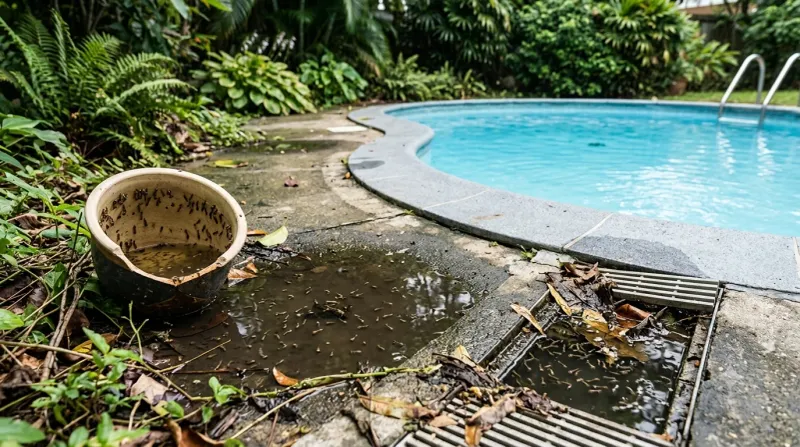
Mosquito control that actually works starts in your own yard, and the single most effective action is removing standing water where mosquitoes breed. CDC guidance on mosquito control at home is direct: empty, scrub, cover, or remove any container that holds water at least once a week. Scrubbing matters because mosquito eggs can cling to container walls and survive brief drying, so a rinse alone may not be enough.
Walk your property with fresh eyes and check the spots that are easy to overlook: buckets left upside-down but still collecting water in a lip, plant saucers under potted trees, birdbaths, clogged gutters, children’s toys, tarps pooling rainwater, rain barrels without tight covers, and drip-irrigation equipment with standing puddles. California Department of Public Health information on invasive Aedes mosquitoes explains why this matters especially now: Aedes aegypti and Aedes albopictus, now established in many California counties, can complete their larval development in amounts of water as small as a bottle cap, and unlike native mosquito species, they bite aggressively during the day rather than just at dusk.
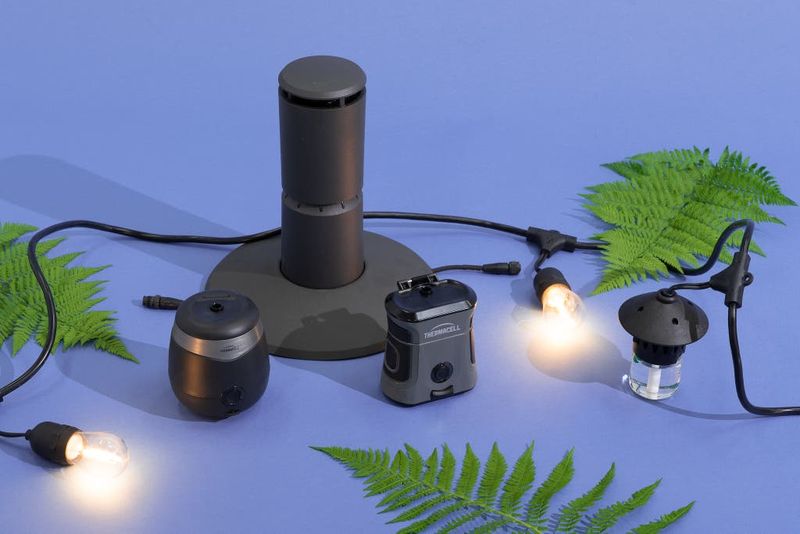
Beyond water management, screens are one of the most underused tools. Repair or replace any window or door screen with tears, gaps around the frame, or mesh that has stretched loose. A screen that does not seal completely is not doing its job. When you are outdoors, use an EPA-registered repellent applied according to the label directions; products containing DEET, picaridin, IR3535, or oil of lemon eucalyptus are all recognized options.
CDPH mosquito control FAQ guidance also recommends contacting your local vector-control district when problems persist or when you find a large breeding source you cannot eliminate on your own. Local vector-control programs can inspect, apply larvicide to water features that cannot be drained, and monitor disease risk in your area. That combination of source reduction, physical barriers, repellents, and professional support is the reliable path to fewer mosquito bites, regardless of what the birds nesting under your eave happen to be eating that week.
Check for active birds and bats before touching any nest
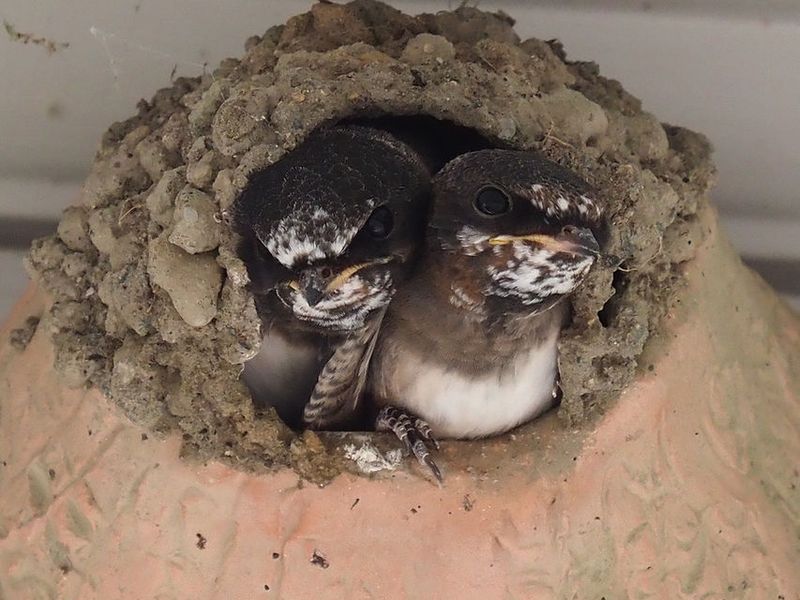
Before anyone reaches for a hose or a scraper, the first step is observation, not action. Stand back from the eave at a comfortable distance and watch the nest for signs of life over several visits at different times of day. Adults flying in and out, chicks calling from inside the entrance, or fresh mud additions are all signs of active use. An active nest containing eggs or nestlings may not be touched or destroyed without authorization under federal law.
The U.S. Fish and Wildlife Service’s guidance on nuisance swallows draws a clear line: active nests are protected, while inactive, empty nests generally do not require a federal permit for removal. Separately, California Fish and Game Code section 3503 prohibits the needless destruction of the nest or eggs of any bird. Both layers of protection apply to exterior nests attached to eaves, and neither is waived simply because the nest is on private property.
California adds one more complication that surprises many homeowners: Cliff Swallow mud nests can shelter bats year-round, not just during nesting season. California Department of Fish and Wildlife documentation on bats in swallow nests confirms that some bat species use the enclosed mud structures as roost sites. A nest that appears completely empty of birds may still be occupied by bats, and disturbing roosting bats creates its own set of legal and safety concerns. If you suspect bats may be present, contact a licensed wildlife professional before proceeding.
One more distinction worth making: federal regulations under 50 CFR section 21.14 provide a limited authorization for prompt removal of birds and nests from inside a building’s interior under specific conditions. That rule does not automatically extend to nests built on the outside of a structure. Eave-mounted nests are exterior nests and are subject to the standard protections. When in doubt about status or applicable rules, a call to your local USFWS office or California Department of Fish and Wildlife can clarify what applies to your specific situation before you take any action.
Choose exclusion over repeated scraping when nests become a nuisance
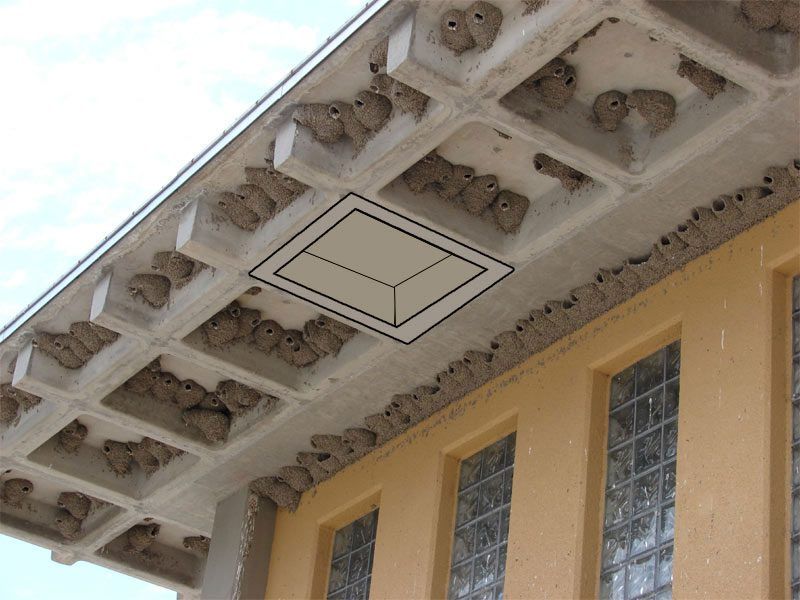
Droppings accumulating on a porch railing, chunks of dried mud falling onto a doorstep, and the possibility of mites or swallow bugs spreading from a nest are all real concerns. UC IPM’s Cliff Swallow pest notes acknowledge these nuisances without minimizing them. A large colony directly above a doorway or over a child’s play area is a legitimate problem, and homeowners do not have to simply accept the mess.
Physical exclusion is the approach that actually solves the problem long-term. Installing netting or other barriers that prevent swallows from reaching the eave surface stops nest construction before it starts, which means no droppings, no falling mud, and no annual removal cycle. The U.S. Fish and Wildlife Service’s nuisance swallow guidance identifies physical barriers as the preferred method for keeping birds out of unwanted locations, and UC IPM recommends netting specifically for eave exclusion.
Washing down or knocking off nests that are under construction or are confirmed empty and inactive can reduce the immediate problem, but it rarely ends the conflict on its own. Cliff Swallows are persistent rebuilders. A colony that loses its nests early in the season will often attempt to rebuild on the same surface repeatedly, and the same birds or their offspring are likely to return to the same site the following year. UC IPM notes that removal during nest building may need to be repeated multiple times in a single season before the birds give up on that location.
Exclusion barriers installed before the birds return in spring – before the first mud pellet lands – are far more effective than reactive scraping after construction is underway. Barriers should cover the full surface area between the eave and the wall, leaving no accessible gap. 50 CFR section 21.14 and UC IPM both frame exclusion as a preventive measure applied to structures, not as a way to address mosquito numbers. Keep the goal clear: exclusion manages a nesting nuisance on your exterior, and mosquito control remains a separate task handled through water management, barriers, and repellents.
Make a California decision based on tolerance, safety, and prevention
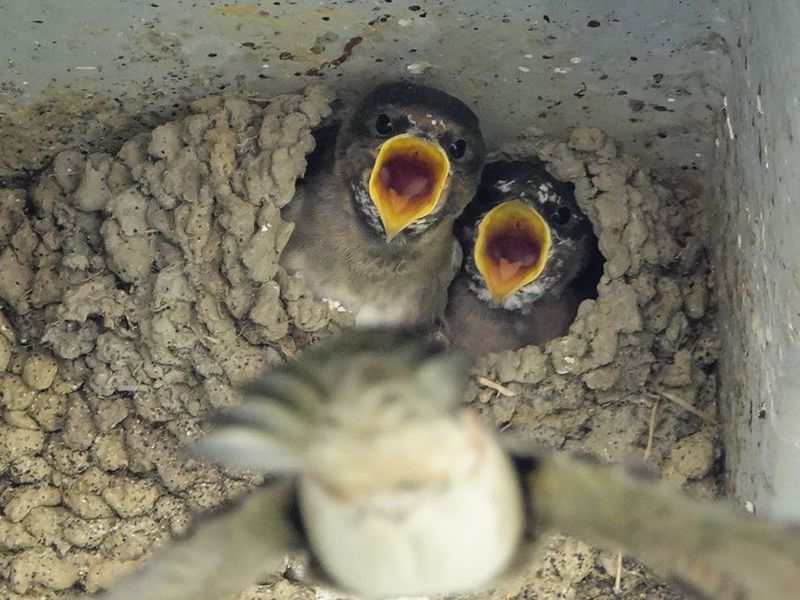
Working through the Cliff Swallow situation comes down to three separate choices, and keeping them separate makes each one easier. First: if the colony is nesting actively and the nuisance is manageable, tolerating it is a reasonable option. The birds are eating flying insects, including mosquitoes, and that provides some local ecological benefit even if it does not translate into a mosquito-free patio. UC IPM’s guidance and USFWS nuisance swallow information both treat tolerance as a legitimate first choice when the situation allows it.
Second: if you decide to remove a nest, confirm that it is inactive and that no birds or bats are present before touching it. Verify the nest status through direct observation over multiple visits. If there is any sign that bats may be using the structure, get professional advice before proceeding. Check applicable federal and California rules, and proceed only when you are confident the nest is empty and removal is lawful.
Third: if the same eave draws nesting attempts year after year, physical exclusion installed before the birds return in spring is the most durable fix. Netting that blocks access to the eave surface ends the cycle without requiring repeated scraping or confrontations with active nests.
Whichever path you take with the birds, address patio mosquito risk through the methods that reliably work: empty and scrub water-holding containers at least weekly, repair screens, use an EPA-registered repellent as directed when you are outdoors, and contact your local vector-control district when the problem is beyond what you can manage alone. CDC home mosquito control guidance lays out these steps clearly. Cliff Swallows are worth appreciating for what they actually are: agile, beneficial aerial hunters whose presence adds something real to a California yard, even if a mosquito-free evening on the patio still depends on you.