
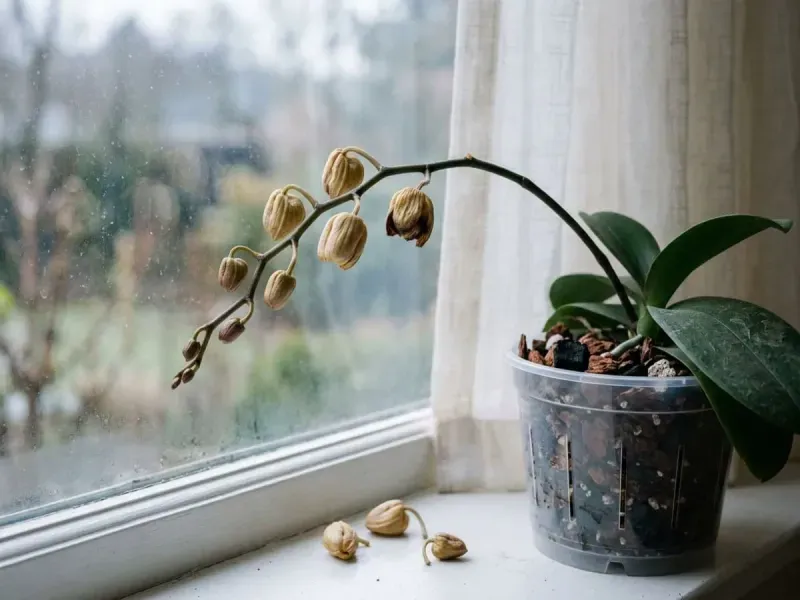
You wait weeks for those little buds to swell, and then they shrivel and fall off before a single flower opens. Gardeners call this bud blast, and it can make you feel like you did something wrong.
Watering is one common suspect, but it is not the only one. Here is how to check your own routine and look at the other clues around your plant.
Bud drop is a symptom, not a diagnosis
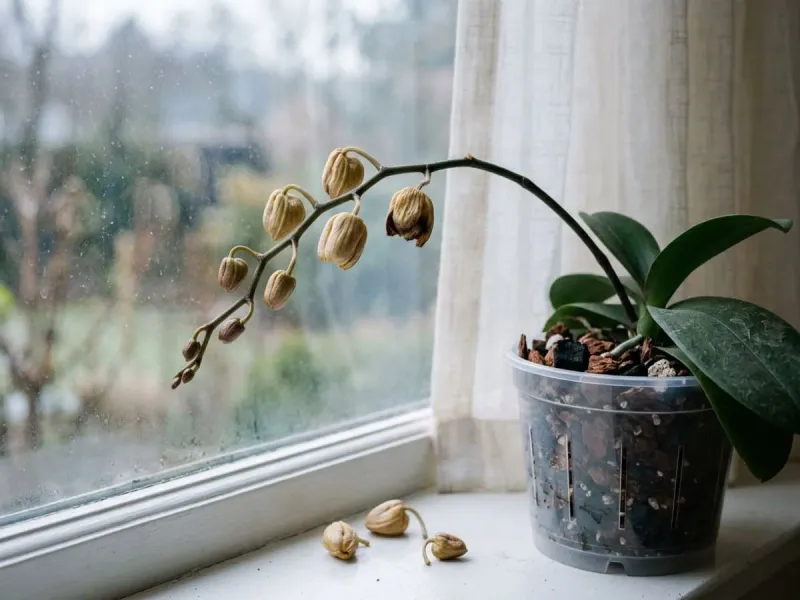
Few things sting like watching a row of plump orchid buds turn yellow and tumble off just before opening. That is bud blast, and it is a symptom, not an answer.
The plant is telling you something is off, but it does not say what.
Watering problems are possible contributors. According to the American Orchid Society’s bud blast guidance, both too little and too much water can play a part.
The same source also lists temperature swings, drafts, fumes, too much or too little light, and pests.
That means a dropped bud alone cannot prove your watering was the cause. Two growers can see the same thing for very different reasons.
Adjusting your watering may help in some cases, but it will not rescue buds that have already dropped, and it cannot promise the next flower spike will be safe.
The next sections walk through how to judge your watering first, then how to look beyond it if your routine seems reasonable.
A fixed calendar cannot account for every orchid
Watering every Sunday feels tidy, but your orchid does not read calendars. A pot in a bright Texas window in July can dry out far faster than one in a shaded room in winter.
Adding a splash of water just in case can leave the roots wetter than they want to be.
Timing depends on several things at once. Texas A&M AgriLife Extension notes that Phalaenopsis water needs vary with humidity, media, pot type and size, and time of year.
Iowa State Extension also describes different media and watering needs across orchid types.
None of this says a calendar is the secret cause of bud drop. It simply means a set interval can miss what your plant needs on a given week.
A calendar can still be a handy reminder to look at the plant, as long as the plant gets the final vote.
So instead of asking what day it is, start asking how dry the mix actually is.
Too much water and too little can both affect buds
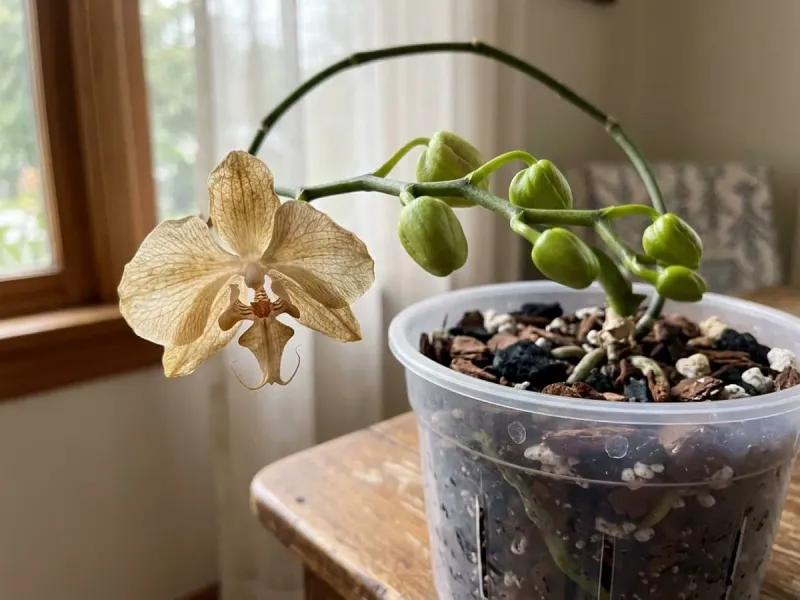
Watering trouble comes in two forms, and they work differently. When a plant stays too dry for too long, it may pull moisture away from the buds to protect itself.
The buds are left short of water and can shrivel and fall.
Waterlogged media is a different story. Roots sitting in soggy mix can be damaged, and damaged roots cannot take up water well.
So a pot that feels wet does not mean the plant is drinking enough, and buds can still go thirsty.
The American Orchid Society lists both underwatering and overwatering among the common causes of bud blast.
Here is the tricky part. Dropped buds look the same either way, so the buds cannot tell you which problem you have.
Clues are in the pot instead: firm silvery-green roots point one direction, while brown, mushy or hollow roots point another.
Check the mix before you water
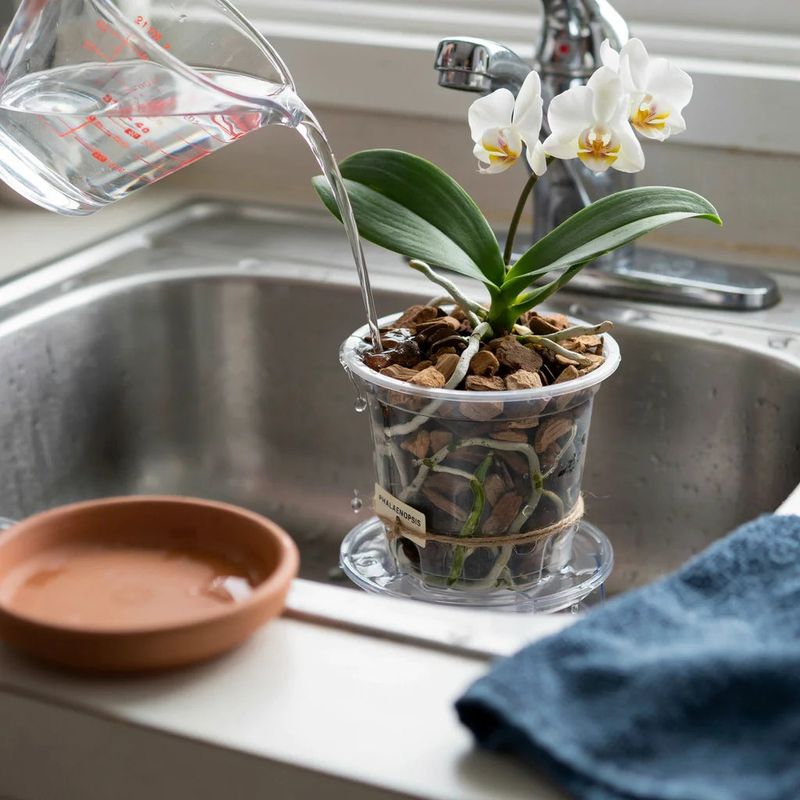
Before reaching for the watering can, take a quick look. Lift the pot to feel its weight, peek at the roots through a clear pot, and check the mix.
For a Phalaenopsis, the goal is mix that has dried somewhat between waterings, not bone dry and not soggy.
Healthy roots often look plump and silvery-green when they need water, and greener right after a drink. North Carolina State Extension notes that mature plants may need water weekly or more often in summer heat, which shows why checking beats guessing.
Smithsonian Gardens also gives care guidance built around the plant rather than a fixed interval.
Keep in mind that this advice is for Phalaenopsis. The American Orchid Society explains that some orchids should dry fully between waterings, while others are watered just before they dry.
If you own a different type, look up its own needs.
Water thoroughly, then let the pot drain
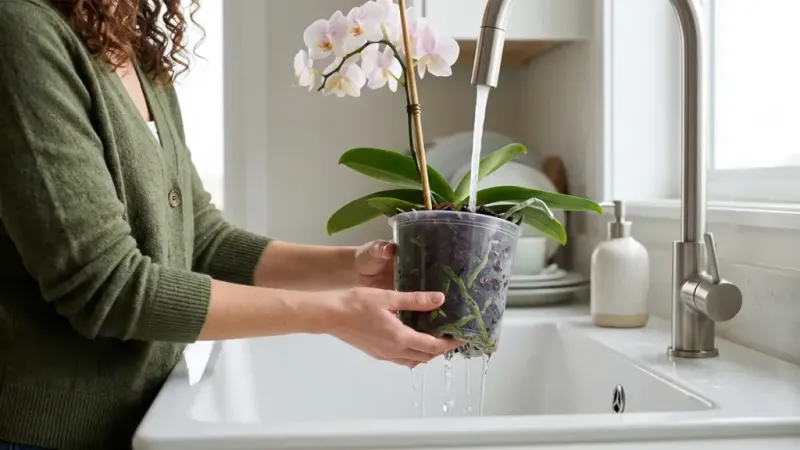
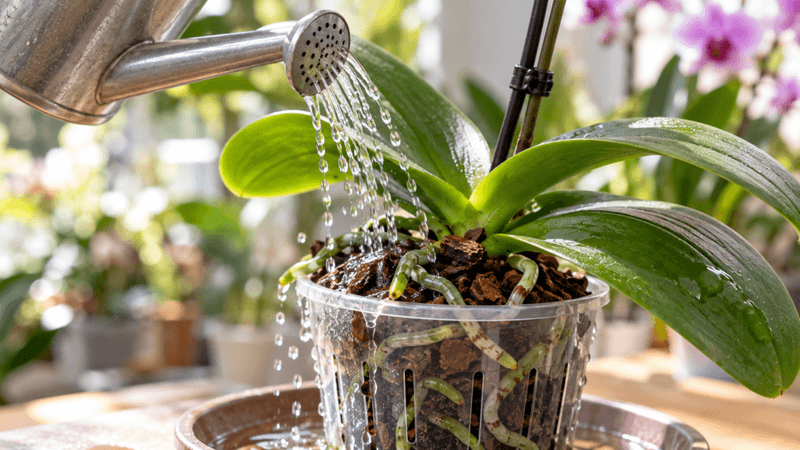
Once the mix has dried somewhat, give it a real drink. Water the medium until it runs freely out of the drainage holes, then let the pot drain fully.
A quick sprinkle only wets the surface, while a thorough soak reaches the whole root zone.
Draining matters as much as watering. Empty any water from the saucer or decorative outer pot so the roots are not left standing in it.
American Orchid Society culture guidance and Iowa State Extension both favor well-drained setups.
You may have heard that ice cubes cause problems. A 2017 study tested weekly ice cubes against the same amount of room-temperature water on four bark-grown Phalaenopsis cultivars and found no decrease in flower life or display life.
It did not look at bud blast or other orchid types, so it settles little beyond that.
For roots, N.C. State also stresses watching conditions rather than a rigid routine.
The pot and medium affect drying time
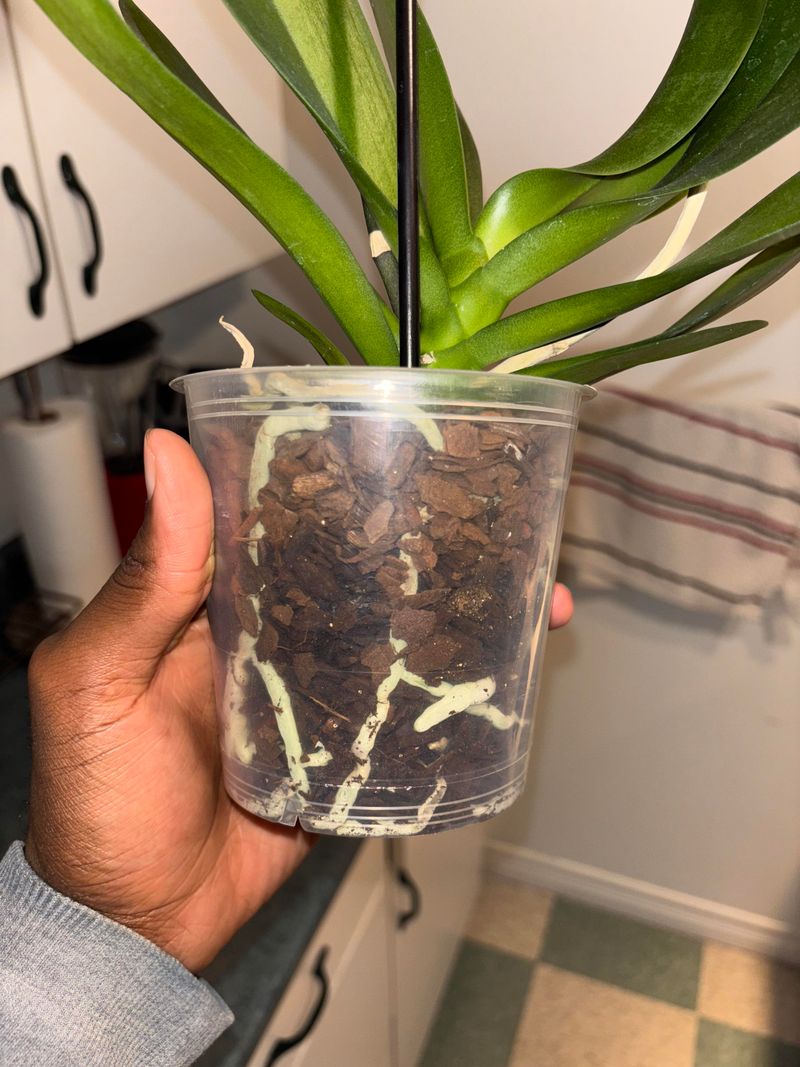
What your orchid grows in changes how often it needs water. Bark drains quickly and dries faster.
Sphagnum moss holds more moisture, which can raise the risk of overwatering and root rot if you water on the same rhythm.
So two orchids in the same room can need very different attention. A bark mix in a warm Florida sunroom may be ready for water sooner than a moss mix in a cooler spot.
Iowa State Extension describes these media differences and recommends choosing a well-draining mix.
Pick a pot with drainage holes, too. The American Orchid Society Phalaenopsis culture sheet supports good drainage as part of healthy culture.
Use these differences to read your plant, not to invent a new fixed schedule. Note how long your own pot takes to dry, then keep checking, because that number will move with the season.
Keep water out of buds and sheaths
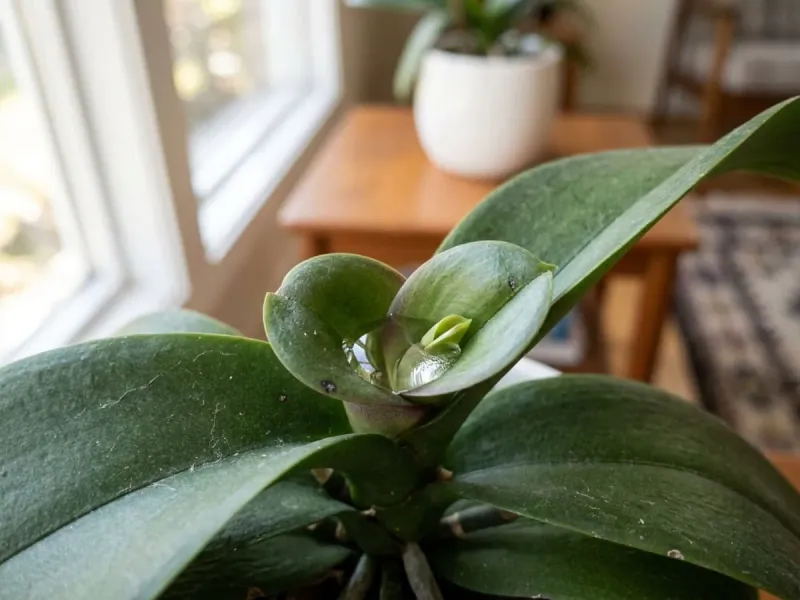
Watering the pot and wetting the plant are two different things. Water that lingers in buds or bud sheaths can encourage fungal or bacterial rot.
The American Orchid Society points this out especially for budding Cattleyas.
A narrow-spout can helps you aim at the mix. If water splashes on buds or flowers, blot it away with a paper towel or let air move across the plant so it dries.
Avoiding wet foliage and flowers is also a standard disease-prevention step, and UF/IFAS recommends it for Florida growers, where warm humid air already favors fungus.
Wet buds do not explain every case of bud blast. Treat this as one habit worth tidying up, and keep reading if your buds are still dropping.
If watering looks reasonable, check other conditions
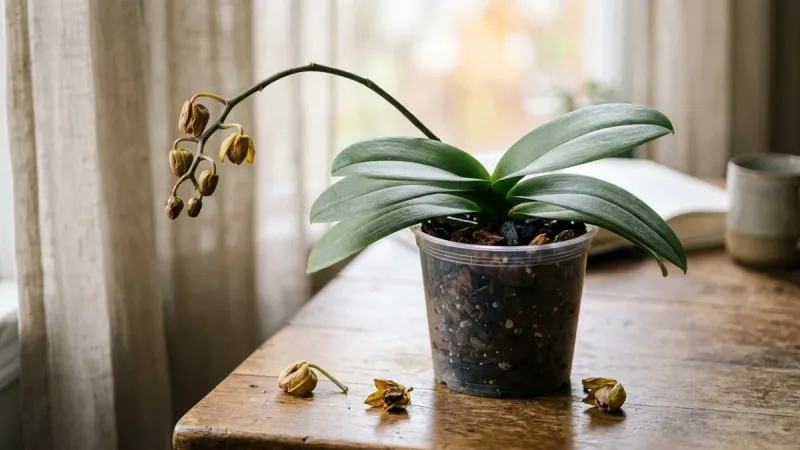
When your routine seems sound and buds still fall, widen the search. Think about whether the plant was recently moved, brought home from a store, or shifted to a new room.
Orchids can react to a change in location by dropping buds.
Look at the surroundings next. A draft from a door, vent or window, or a sudden temperature swing, may be involved.
Low humidity, which is common in air-conditioned Texas and Florida homes, and light that is too dim or too harsh are also on the list. The American Orchid Society names these along with fumes and pests.
Fumes can come from gas stoves, fresh paint or ripening fruit nearby. Check leaves and buds for tiny insects too.
N.C. State offers care details that help you compare your conditions.
These are possibilities, not diagnoses. Check the plant and its surroundings before changing your watering frequency again.