
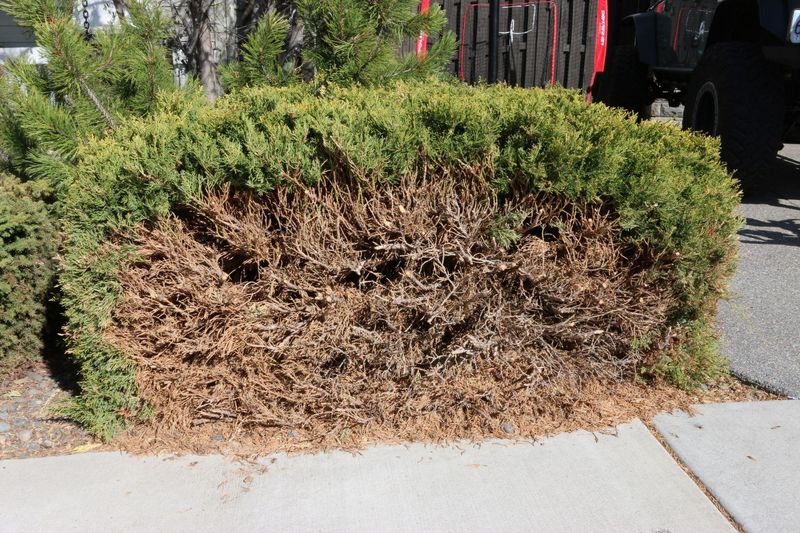
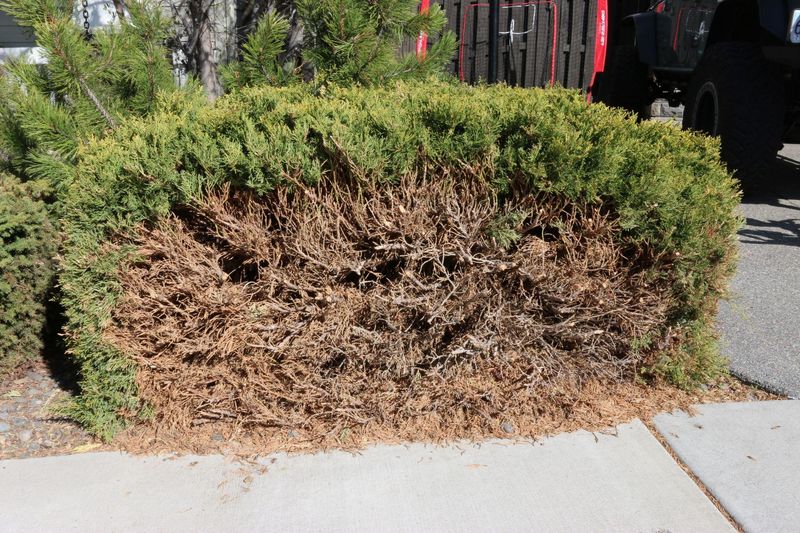
A hedge can look perfectly healthy from the sidewalk and still hide a surprise deep inside. In some California yards, dead twigs and dried leaves build up behind the green outer layer where nobody looks.
That hidden material is a maintenance chore worth knowing about before fire season. A short, careful check can tell you whether your hedge needs attention or is fine as it is.
A green exterior can conceal a dry interior
Picture a tidy privet or similar hedge running along the side of a California home. The outside is leafy and bright, so it seems like there is nothing to worry about.
Yet some hedges build up a hidden layer of dead branches and dried leaves where sunlight no longer reaches.
A UC Cooperative Extension guide points out that hedges can contain a lot of interior dead wood and may need extra maintenance. It recommends regular cleanup and thinning so leaves are not trapped inside the shrub and the branching structure does not catch embers as easily.
Not every hedge fits this picture. Conditions vary by plant type, age, how it has been cared for, and where it grows.
A young, regularly maintained hedge may have very little dead material, while an older one that has been sheared for years without thinning may have quite a bit.
Green foliage is also not the same as fireproofing. UC ANR’s Fire Network says all plants can burn under the right conditions, and that plant structure, upkeep, placement, and seasonal moisture all matter.
At the same time, a green hedge is not automatically a hazard either.
Dead material inside a hedge is combustible fuel and a maintenance concern. It does not prove a hedge will ignite or cause a house fire.
Think of inspection and selective cleanup as ordinary yard care, the same as clearing a gutter, rather than a sign that your hedge is dangerous.
Look inside the hedge, not just at its surface
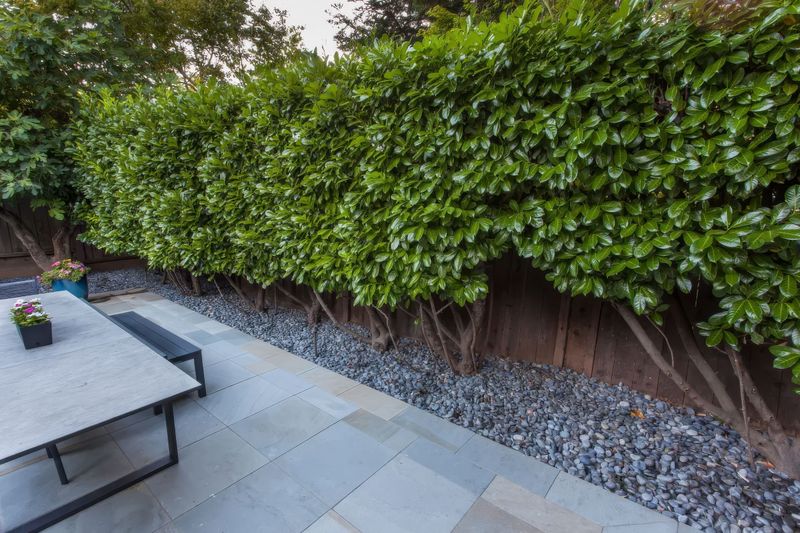
Start your check on a calm morning with gloves, eye protection, and a flashlight. Instead of judging the hedge by its leafy face, gently part the outer growth and look into the middle.
You are searching for gray or brown branches that are brittle, snap easily, and have no leaves or buds.
Next, look at the ground beneath and around the base. Dried leaves, twigs, and other plant debris can pile up under a hedge and between its lower stems.
UC ANR notes that some plants develop a highly combustible layer of dead thatch under their green growth, so the base is worth a close look.
A few simple clues can guide you. Heavy, tightly packed stems with little light inside often hide more dead wood.
Leaves caught in crotches of branches, or a thick mat of litter at the base, are other signs. A hedge pressed against a wall, fence, or eave deserves a bit more attention than one standing in open space.
Remember that this step is about finding material that may need attention. How a hedge looks cannot tell you for certain what would happen in a fire.
Some hedges will turn out to be fairly clean inside, and that is a perfectly good result.
Take a few photos or notes as you go. UC IPM’s landscape fire guidance recommends pruning out dead branches and clearing accumulated organic litter, and your notes will help you plan that work in the next step.
Remove dead material and thin crowded growth selectively
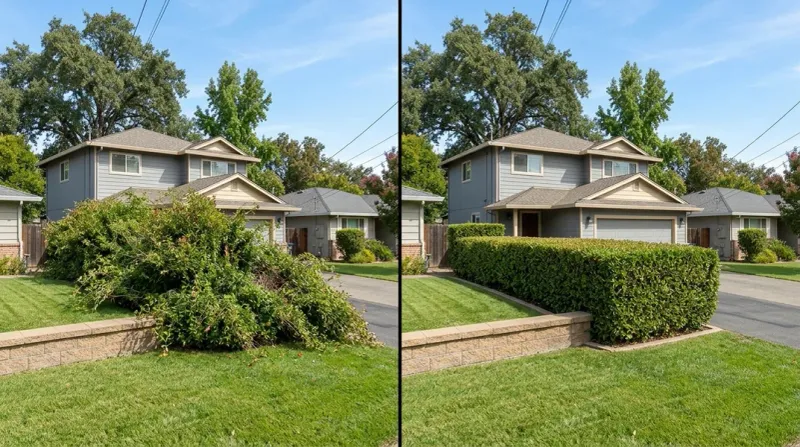
Once you know what is inside, the fix is usually modest. Cut out the dead branches first, making clean cuts back to living wood or to the base.
Then rake or hand-pick the dried leaves and twigs that have gathered beneath and within the shrub, and bag or haul them away.
Where the growth is crowded, thinning helps. According to UC Cooperative Extension, thinning can reduce dead-material buildup and limit leaves or needles being trapped and ignited by embers.
Remove a few of the oldest, most tangled woody stems so air and light can reach the interior.
Go slowly and selectively. You are not trying to turn a hedge into a bare stick.
A good thinning leaves the plant looking full from the outside while opening up the structure inside, and you can spread the work over several weekends if the hedge is large.
Skip any urge to strip every shrub in the yard. Healthy hedges provide shade, privacy, and habitat, and guidance supports selective removal, cleanup, and spacing rather than blanket cutting.
Shearing hard into old wood can also stress some species, so check the needs of your particular plant.
This work reduces dead fuel and trapped debris. It does not guarantee a hedge will not burn.
UC IPM treats it as one part of a broader landscape routine that also includes ongoing litter removal and sensible plant placement.
Assess spacing between the hedge and other vegetation

A hedge does not sit alone. If its branches touch the shrub next to it, which touches a tree, fuel can form a continuous path across the yard.
Breaking that chain up is often as useful as cleaning the hedge itself.
CAL FIRE gives spacing guidance for shrubs based on shrub height and slope, as laid out in its defensible space guidance. On slopes under 20 percent, aim for space equal to two times the shrub’s height.
On slopes of 20 to 40 percent, use four times the height. On slopes over 40 percent, use six times the height.
As an example, a flat-lot shrub 4 feet tall would call for about 8 feet of space under the first guideline. The same shrub on a 30 percent slope would call for about 16 feet.
A hedge forms a long row, so look at the gaps between it and other plants, not just its own width.
These numbers are CAL FIRE guidelines, not universal dimensions, and they are not a guarantee of safety. Local rules may be stricter, so your city, county, or fire district may ask for more.
You do not have to remove plants to improve spacing in every case. Sometimes trimming back one branch that bridges two shrubs, or moving a potted plant away from the hedge base, is enough to create a useful break.
Check defensible-space requirements before changing a hedge near home
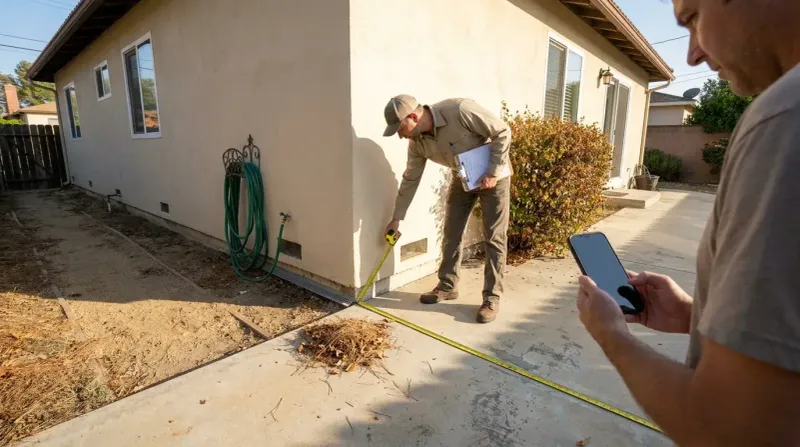
Hedge care fits into a bigger picture of defensible space. CAL FIRE describes the general area as 100 feet from a structure, or to the property line, whichever is closer, as explained on its defensible space page.
Dead or dry vegetation in that area should be kept cleared.
Exact requirements and enforcement can differ by location. Your county, city, or fire district may have its own inspection rules, so contact your local fire agency before making big changes to a hedge close to your house.
You may also hear about a proposed statewide rule for the first five feet around homes, often called Zone 0. Do not assume it is in effect.
The California Office of Administrative Law’s recent actions page listed the August 2026 Zone 0 package as withdrawn on September 8, as of November 4, 2026.
The Board of Forestry and Fire Protection had a proposed re-adoption vote on its November 5 agenda, so the situation could change. The November materials are drafts.
A draft summary describes phased requirements with some vegetation allowed in parts of Zone 0 and local flexibility.
So it would be wrong to say every California homeowner must remove every hedge within five feet of a house. Check current state and local requirements before acting on any specific legal obligation.
Prune with care and leave active nests undisturbed
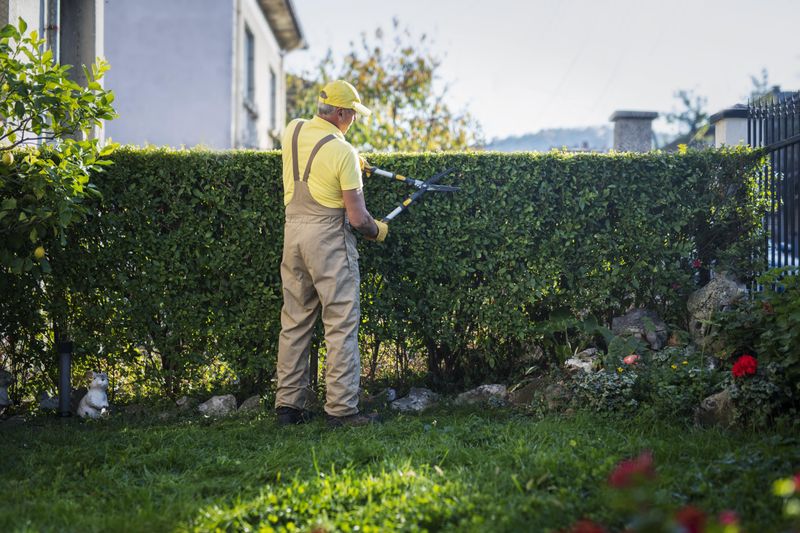
Timing and tools matter as much as technique. CAL FIRE’s guidance on clearing vegetation advises mowing before 10 a.m. and avoiding hot or windy days, when a stray spark can start a fire.
It also notes that string trimmers are safer than lawnmowers for clearing vegetation, since a mower blade striking a rock can throw sparks. You can read the details on the CAL FIRE defensible space page.
Before any pruning starts, look for birds. Hedges are popular nesting spots for finches, hummingbirds, and towhees.
Watch the hedge for a few minutes and listen for chirping, then peek in gently to see if adults are coming and going.
The California Native Plant Society recommends checking for active nests before pruning and delaying the work if nests are present. Nesting often runs through spring and into summer, so plan your cleanup for a time when the hedge is quiet.
If you find a nest, leave that section alone, mark it in your notes, and come back after the young have left. You can clear litter from the ground nearby or work on other parts of the yard in the meantime.
Careful pace beats rushed cutting. Work in short sessions, keep water and a phone nearby, and stop if the wind picks up.
Make the hedge check part of the pre-season yard reset
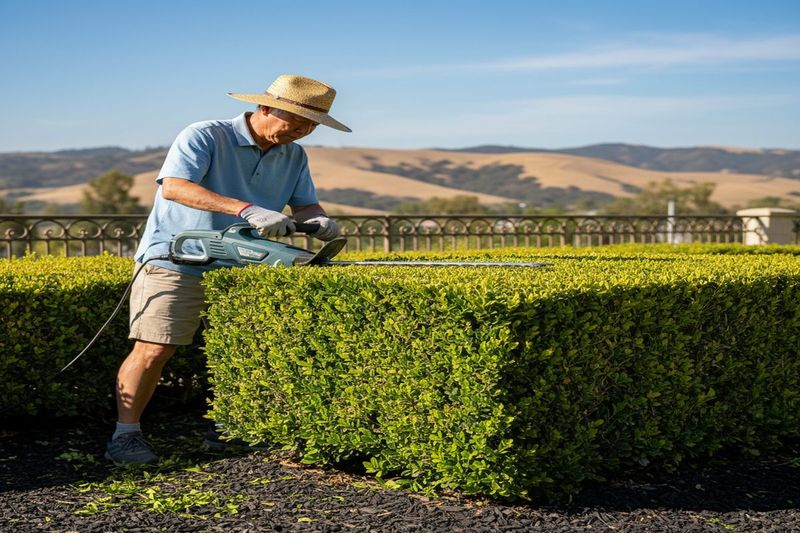
Fold the hedge into your yearly yard reset. Inspect inside and beneath it, clear dead material selectively, and look at the spacing around it using CAL FIRE guidance.
Check local requirements, and look for nests per CNPS advice before you cut. A healthy hedge can stay, as UC guidance favors upkeep over removal.
Green is not a verdict either way. What matters is what is inside it and what surrounds it.