
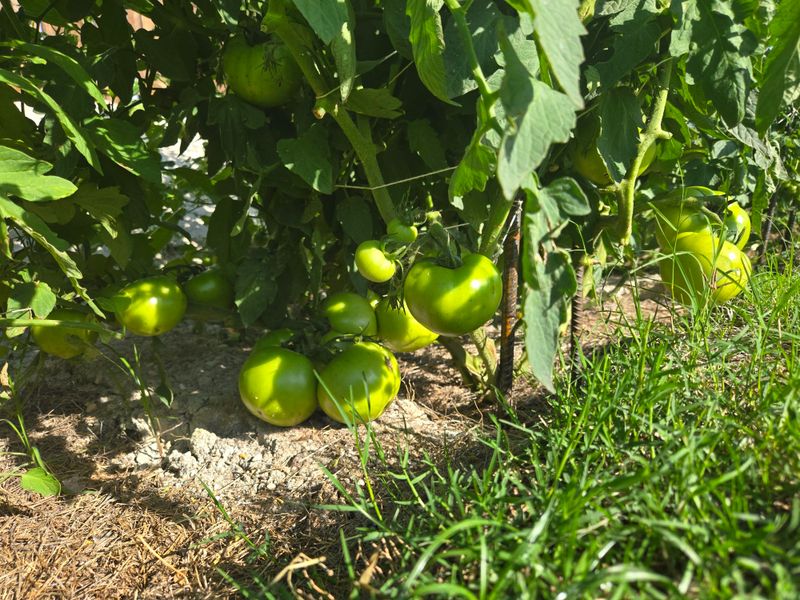
Central Texas fall tomato plants are often loaded with green fruit right when the weather starts to turn. A cold snap can end the season in a single night.
A few quick, well-timed moves can save the harvest you have worked on since summer. Here is how Austin-area gardeners can decide what to cover, what to pick, and what to let go.
An Austin freeze date is a planning marker, not a deadline
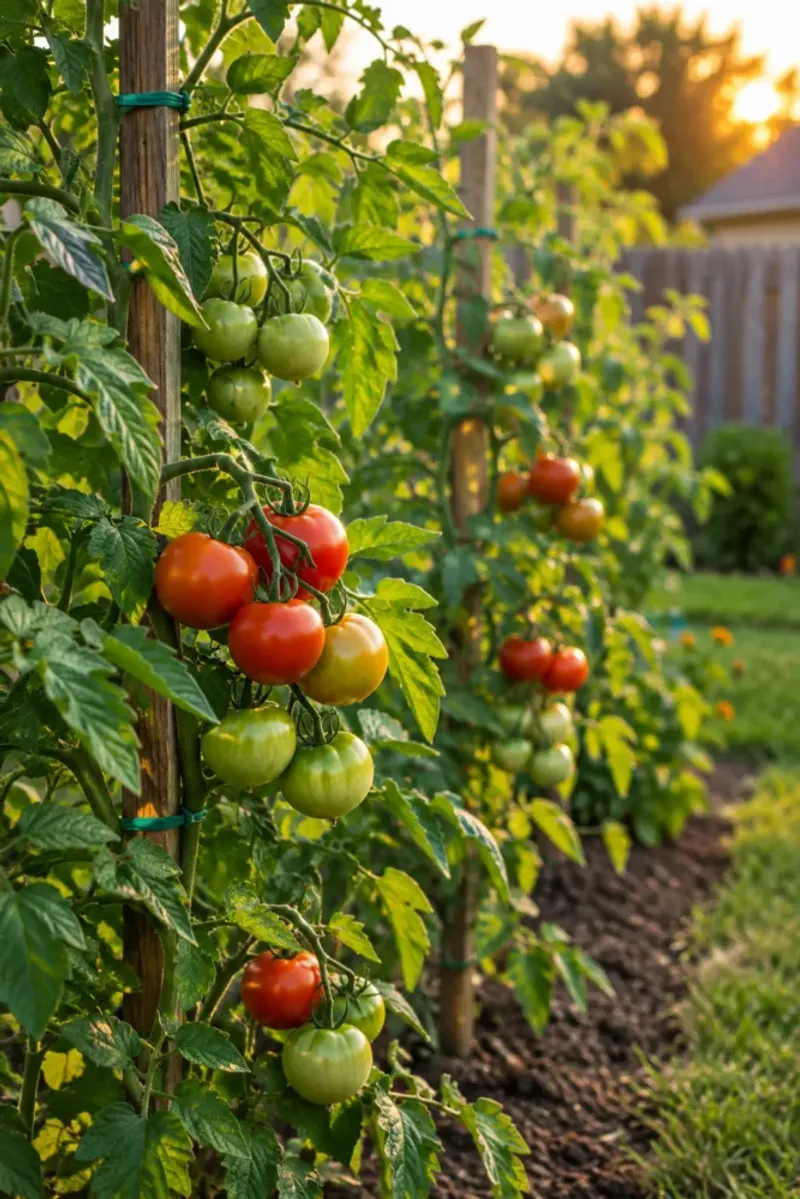
Fall tomatoes in Central Texas are planted in July and August, and ripe fruit is expected from October until frost, based on Texas A&M AgriLife’s tomato schedule. That same source lists November 29 as Austin’s average first fall freeze, with October 26 as the earliest on record in its data.
Those dates are handy for planning. They are not a prediction for your yard.
An average is just the middle of many different years. Some autumns stay mild into December, and others bring a chilly night in late October.
Treat the date as a reminder to start paying attention, not as a deadline that says you are safe until then.
The Travis County AgriLife guide, Weather Strategies for Austin Gardens, recommends watching the weather and staying flexible. Central Texas conditions swing a lot, so the local forecast is a better guide than the calendar.
Your own yard matters too. A bed on a low spot where cold air settles can get hit harder than one against a sunny south wall or near a house.
Also, first frost, first freeze, and a killing freeze are not the same thing. A light frost may nip leaves, while a longer, deeper freeze can kill the whole plant.
This advice is written for Central Texas and the Austin area. Gardeners in the Panhandle, the Gulf Coast, or the Rio Grande Valley face very different timing, so use your own local forecast.
The rule for the rest of this guide is simple: respond to cold that is actually approaching, not to the date alone.
A cover may buy time during a brief frost
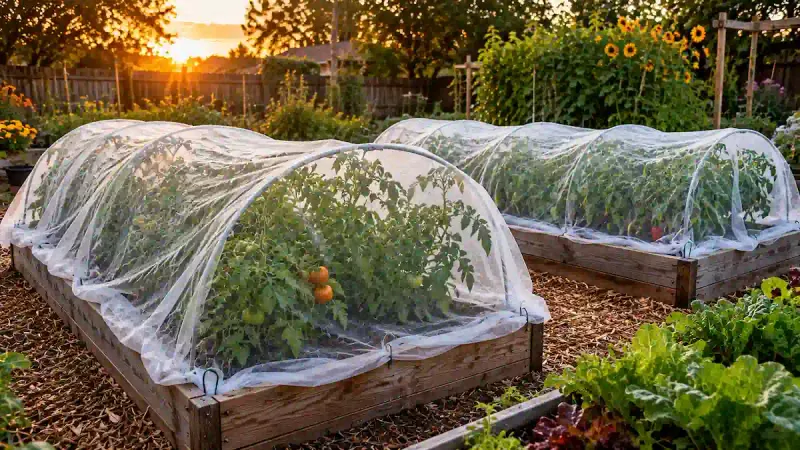
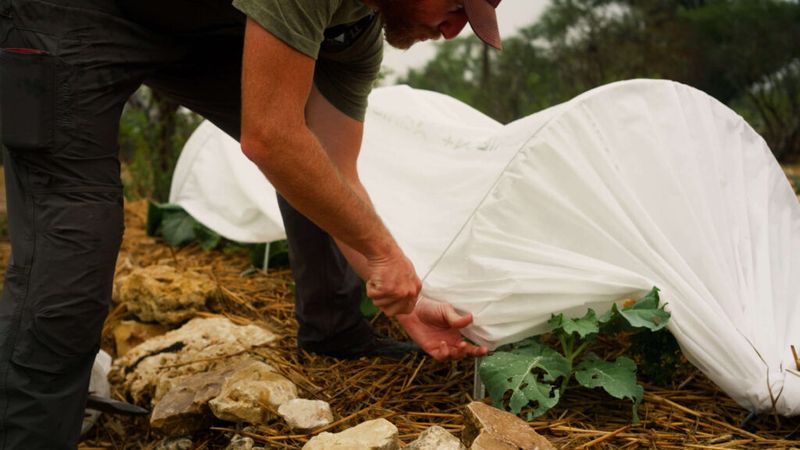
When the forecast shows a brief, light frost, a cover can make the difference for the night. A tarp, blanket, or row-cover fabric holds some warmth near the plants, as described in University of Illinois Extension row cover guidance.
Fabric that rests directly on leaves can pass cold right through. Hoops, stakes, or tomato cages that lift the cover off the foliage create an air gap and improve insulation.
Drape the cover all the way to the ground when you can.
Wind is the next problem. Secure the edges with bricks, stones, or garden staples so the cover does not blow off at 3 a.m.
Put it on in late afternoon, before the day’s warmth escapes.
Then watch the morning. Utah State University Extension, in its harvest and storage guide, notes that covers protect against frost.
Once temperatures rise, remove or open the cover so plants do not overheat and you do not trap moisture around the leaves.
Know what a cover cannot do. It is short-term protection for a light frost.
The sources do not show that a blanket or frost cloth reliably protects tomatoes through a hard or prolonged freeze. If the forecast calls for several hours at or below freezing, or a string of cold nights, plan to harvest instead of betting on fabric.
Harvest full-sized tomatoes before a hard freeze
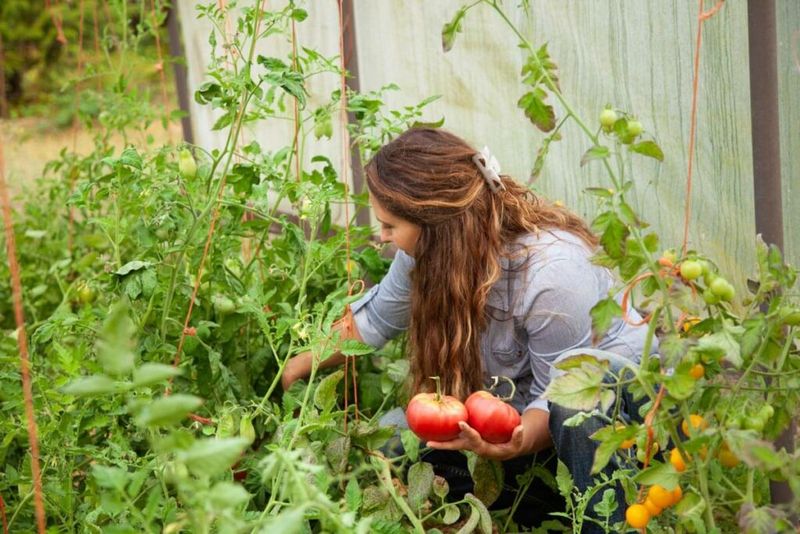
When a hard freeze is on the way, pick the tomatoes that have a real chance of ripening indoors. Look for fruit that is full-sized and either mature green or just beginning to show color.
Utah State University Extension advises harvesting usable mature green and slightly colored fruit before a hard frost.
Size is your best quick test. A full-sized tomato of its variety, with a glossy, slightly lighter green skin, has usually reached the stage where it can finish ripening off the vine.
Any hint of pink or yellow at the blossom end is even better.
Small fruit that is still uniformly dark green is a different story. University of Minnesota Extension notes that immature fruit may not ripen well.
Not every green tomato will become a good one, so do not expect miracles from the marble-sized ones.
Now look at the flowers. They can feel like a promise, but they are not fruit to rescue.
Utah State’s tomato growing guide says fruit needs roughly 25 to 35 days to mature after flowering, depending on temperature and variety. A blossom open in November has little chance of becoming a usable tomato before a freeze.
Pick by hand and handle gently, because bruises shorten storage life. Leave the tiny fruit and blossoms behind, and focus your effort on the tomatoes that can still pay off.
Sort the harvest before bringing it indoors
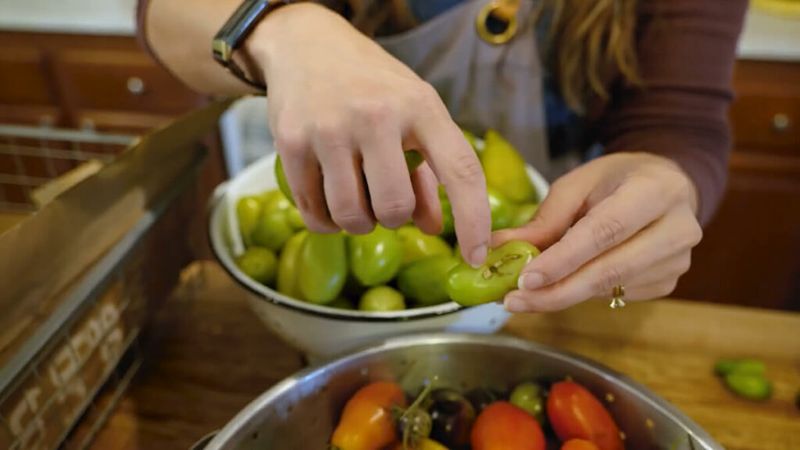
Once the tomatoes are inside, a few minutes of sorting protects the whole batch. One rotting fruit can spoil its neighbors fast, so start by pulling out anything cracked, split, bruised, or showing spots or mold.
Those can go to the compost or be used right away if the damage is minor.
Next, take a look at the stems. A bit of stem left on a tomato can poke into the fruit beside it and open a wound.
Remove stems from picked fruit so they cannot puncture neighbors, as suggested by Utah State University Extension.
Wipe off loose dirt gently with a dry cloth. Skip heavy washing for now, since extra moisture can encourage decay.
Then arrange the sound fruit in a single layer, or at most a double layer, in a shallow box, tray, or cardboard flat. Space them so air can move around each one and so you can reach them without digging.
A crowded deep bucket hides problems until it is too late.
Plan to check the tomatoes regularly, every couple of days at first. Look for soft spots, wrinkling, mold, or leaking fruit, and remove any problem tomato right away.
A quick daily glance keeps small issues from turning into a lost tray.
Room temperature helps mature tomatoes ripen indoors
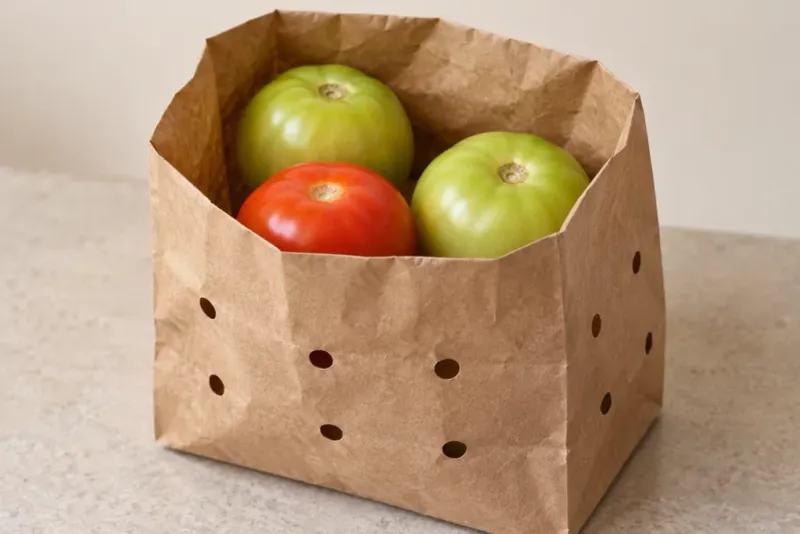
Moderate room temperature is the simple secret. The UC Davis Postharvest Center lists 65 to 70°F for good ripening, so a pantry, closet shelf, or interior room works well.
Colder spots slow the process, and hot spots do not help much either.
Keep ripening tomatoes out of the refrigerator. Cold slows ripening and can hurt flavor, and Texas A&M AgriLife also advises against chilling them.
Once a tomato is fully ripe, you can decide how to use it.
You do not need a sunny window. South Dakota State University Extension explains that light is not needed for harvested fruit to ripen, and direct sun can just warm the tomatoes unevenly.
A shaded shelf does the job.
Set your expectations honestly. Indoor ripening is a way to salvage mature fruit, and University of Illinois Extension treats vine-ripened tomatoes as the quality benchmark.
Your rescued tomatoes may be a little milder or less juicy.
They also will not turn undersized, dark-green fruit into great tomatoes. Expect the full-sized ones to color up over a week or two, and use them in sauces, salsas, sandwiches, and cooked dishes where a good-enough tomato shines.
Use the forecast to make the final harvest call
For Central Texas gardens, the sequence is short. Watch your local forecast, using the Austin-area AgriLife weather guidance as a reminder to stay flexible.
Cover plants only for a brief light frost. Before a hard freeze, bring in usable mature fruit.
Do not wait on late flowers, and do not assume every small green tomato will ripen, as Minnesota Extension cautions. The freeze decides the schedule, so let the thermometer have the last word.