
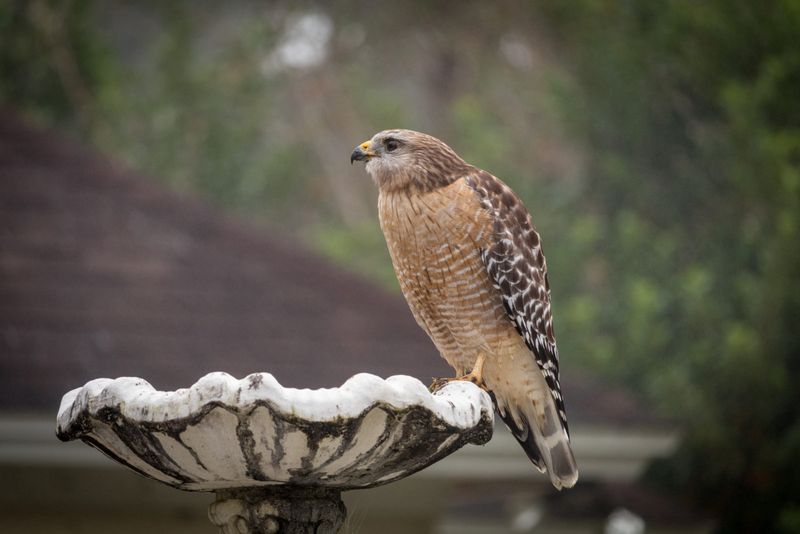
Spotting a hawk once in your yard is a treat, but when the same bird keeps showing up day after day, it is natural to wonder what is drawing it back. Hawks do not return to a yard by accident or out of habit alone. Something on or near your property is reliably worth the trip, and figuring out what that is can help you make smarter choices about your feeders, your chickens, and your yard as a whole.
A repeated visit usually points to a reliable resource
Most people assume a hawk that keeps returning is sending some kind of signal, whether that means the yard is especially healthy, overrun with rodents, or marked by the bird as its territory. The more practical explanation is simpler: the hawk found something useful and came back for more. That resource could be food, a convenient lookout spot, open ground that makes hunting easier, or habitat that extends from nearby woods or waterways onto your property.
Urban and suburban research backs this up. A peer-reviewed study on urban raptor distribution found that prey abundance was one of the strongest predictors of whether hawks established themselves in metropolitan areas. That finding applied most directly to Cooper’s and Sharp-shinned Hawks in city and suburban settings, but the underlying logic holds across species: where food concentrates, hawks follow.
Bird feeders can play a bigger role in this than most homeowners expect. Cornell Lab of Ornithology notes that hawk sightings in backyards have increased alongside the growth of supplemental bird feeding, because feeders gather songbirds, doves, and sparrows into a predictable, tight cluster. A hawk that learns your feeder schedule is not reading your energy; it is managing its hunting time efficiently.
Other resources matter too. A tall dead snag, a fence post with a clear sightline, a utility wire above an open lawn, or a stream corridor running through or beside your property can all make a yard worth revisiting. The hawk is not choosing your yard over every other yard in the neighborhood out of preference. It is choosing the combination of features that makes finding a meal or resting between hunts reliably worthwhile.
Circling does not automatically mean hunting
Watching a hawk wheel in slow, graceful circles overhead can feel dramatic, as if the bird is zeroing in on something below. That picture is often misleading. High, wide circles performed with minimal flapping usually have nothing to do with prey spotted in your yard.
Raptors are expert at finding and riding thermals, which are columns of warm air that rise from sun-heated ground. Cornell Lab explains how raptors exploit rising warm air to gain altitude without burning much energy, essentially using the atmosphere as a free elevator. A hawk circling at rooftop height or treetop level may be hunting, but one spiraling hundreds of feet overhead with stiff, flat wings is almost certainly soaring rather than tracking prey on your lawn.
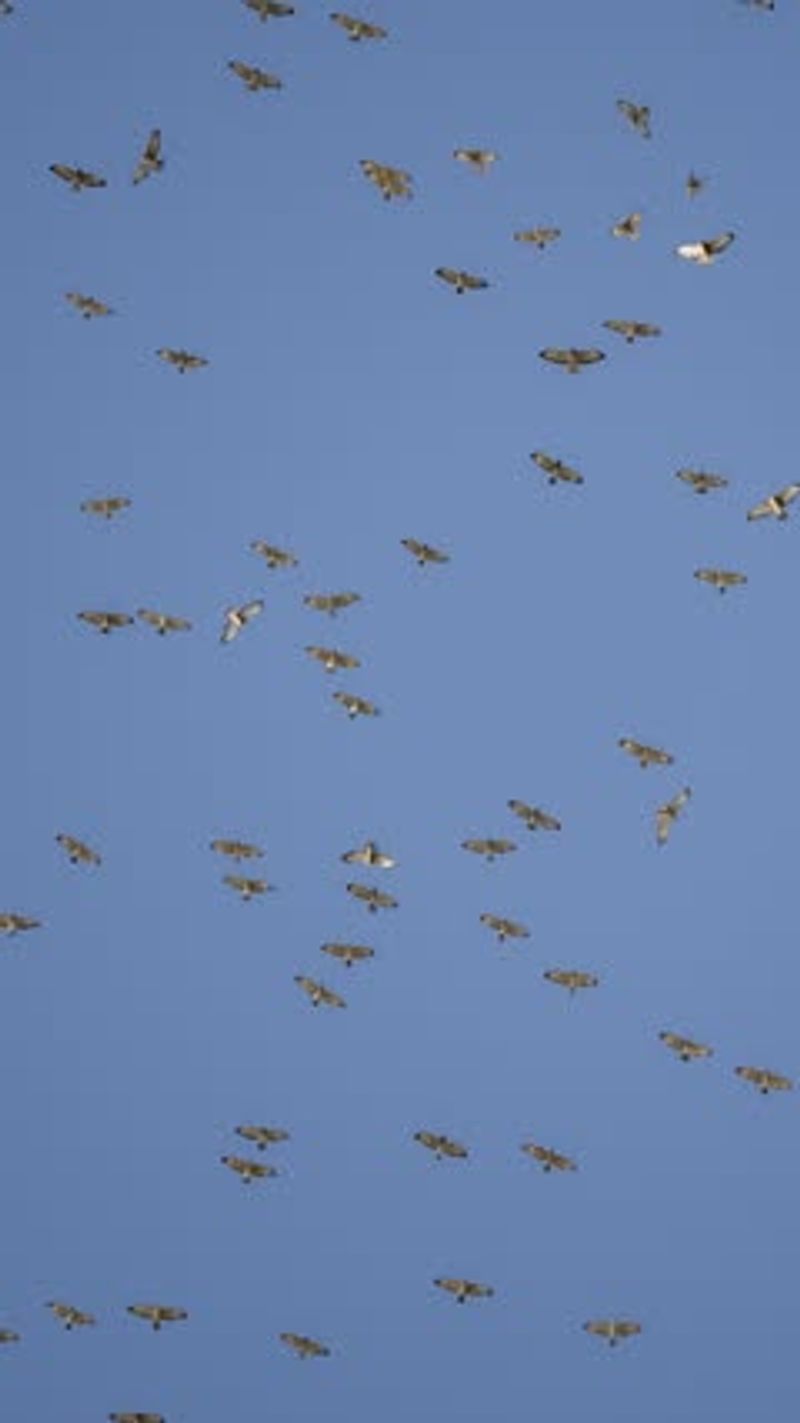
Migration adds another layer. Broad-winged Hawks, which pass through North Carolina each fall in large numbers, are famous for forming “kettles,” which are swirling groups of dozens or even hundreds of birds all riding the same thermal column upward before streaming south. Cornell notes that this kettling behavior is one of the most spectacular migration sights in eastern North America. If you see multiple hawks circling together in September or October, migration is by far the most likely explanation.
Courtship is a third possibility in late winter and early spring. Mated pairs of Red-tailed Hawks, for example, will soar together in wide arcs above their territory as part of pair-bonding behavior, with no active hunting involved. The practical takeaway is to watch how the bird behaves as it descends. Low passes, sudden directional changes, stooping toward a specific spot, or landing near a feeder are the behaviors that suggest active hunting.
A hawk drifting lazily in broad, effortless circles far overhead may simply be passing through your neighborhood on its way somewhere else.
Species and setting reveal what the yard may offer
Not every hawk that visits a North Carolina yard is the same bird doing the same thing. Species identity shapes almost everything, including what the hawk is after, where it prefers to hunt, and what your yard is actually providing. Treating every large, circling raptor as one interchangeable bird leads to conclusions that may not fit your situation at all.
Red-tailed Hawks are among the most common and conspicuous raptors across North Carolina. NC Wildlife describes the Red-tailed Hawk as a bird that typically watches for prey from an elevated perch, then drops onto open ground to make a catch. Lawns, fields, roadsides, and open edges near trees suit this strategy well. If a large, broad-winged hawk with a rusty-red tail keeps returning to the same fence post, utility pole, or treetop at the edge of your yard, it is almost certainly using that spot as a hunting perch over open ground.
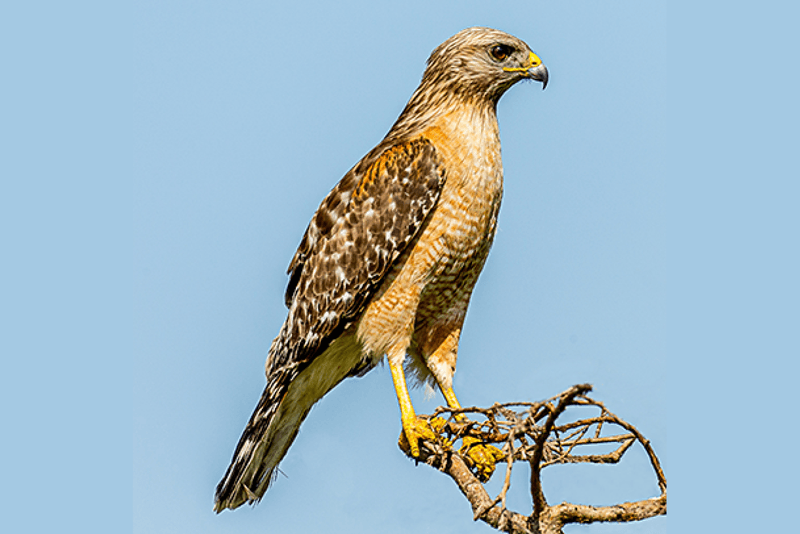
Red-shouldered Hawks, by contrast, are strongly associated with mature woods near streams, rivers, swamps, and wooded drainage corridors but can live comfortably in wooded suburbs. If your yard backs up to a creek, a wet drainage ditch, or a stand of older hardwoods, a Red-shouldered Hawk may be using those features as its core hunting range and only swinging through your yard incidentally.
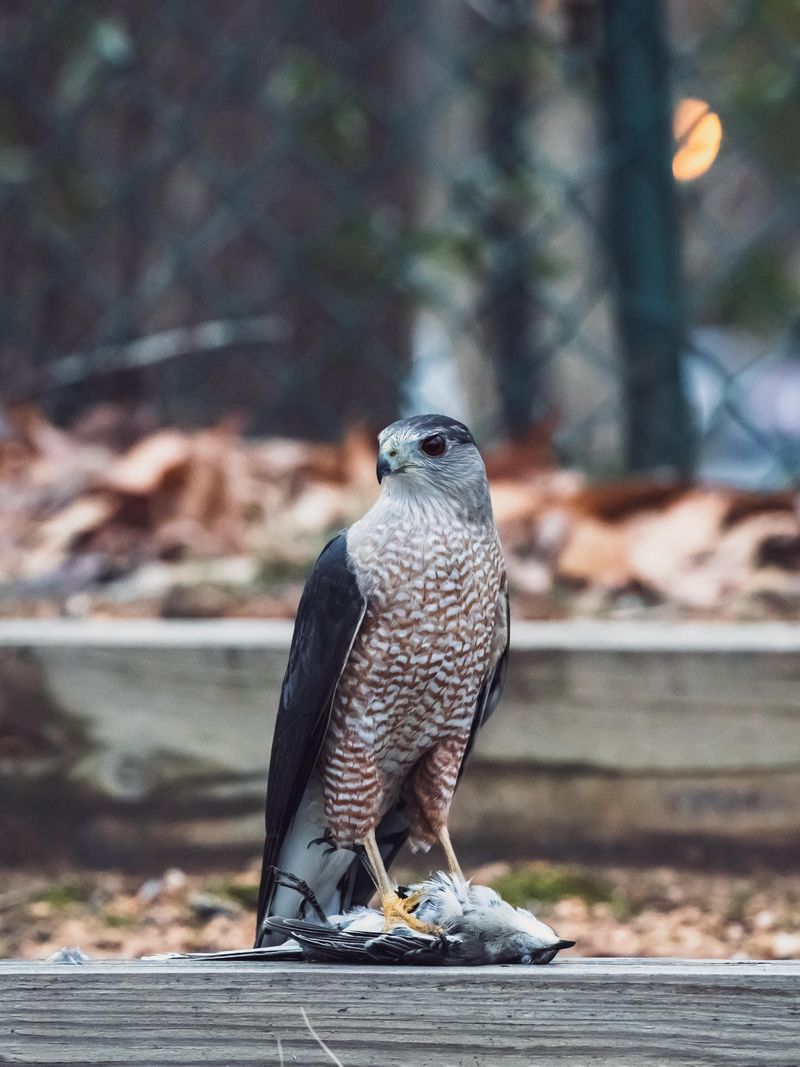
Cooper’s and Sharp-shinned Hawks are the species most strongly linked to backyard feeders. FeederWatch research found that these two accipiters navigate feeder environments differently, with Cooper’s Hawks tending to be bolder and more persistent around dense bird concentrations. Both are built for fast, agile flight through cover and specialize in catching other birds.
Reliable identification from a distance takes practice. Body shape, tail pattern, wing shape, the bird’s call, its flight height, and whether it is working open ground or threading through trees all carry more information than a quick silhouette does. When in doubt, note as many details as you can before drawing conclusions about what the hawk is hunting or why it keeps coming back.
Feeders can turn a normal yard into a hunting hotspot
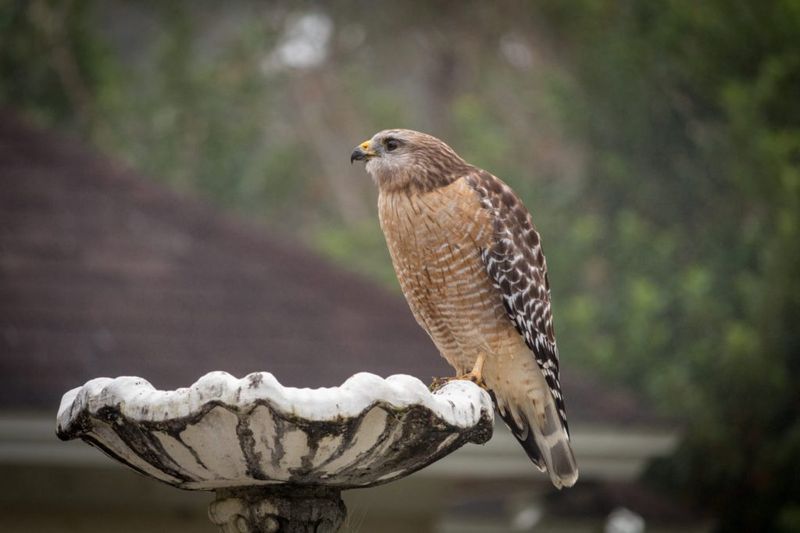
Bird feeders do something that most people do not intend: they guarantee that a large number of small birds will gather in one predictable spot at predictable times. For a Cooper’s Hawk or a Sharp-shinned Hawk, that is essentially a daily meal announcement. The hawk is not coming because of the seed; it is coming because of the crowd the seed attracts.
This connection between supplemental feeding and hawk activity is well documented. Research on urban raptor habitat use found prey concentration to be a key driver of hawk settlement in suburban areas, and feeders are one of the most reliable ways that prey becomes concentrated in a small space. Songbirds, doves, sparrows, and starlings that flock to a feeder are more exposed and more densely packed than they would be foraging across a wide area.
When repeated attacks at a feeder concern you, temporarily taking the feeders down is a practical and evidence-backed response. Cornell Lab recommends removing feeders for several days to a week or two to disperse the prey concentration and encourage the hawk to hunt elsewhere. Once the bird stops associating your yard with reliable hunting, it typically moves on.
Pausing feeders is not the same as dismantling your yard’s wildlife value. Native shrubs, mature trees, brush piles, and water sources continue supporting birds and other wildlife whether or not you are putting out seed. You are simply removing the artificial concentration that made your yard an unusually efficient hunting ground. Accepting that predation happens is also a completely legitimate choice.
Hawks are a natural part of North Carolina’s ecosystem, and some homeowners prefer to watch the whole food web play out without intervening. Both approaches are reasonable; the right one depends on how you feel about the tradeoff.
A returning hawk may use a territory, not a nest in the yard
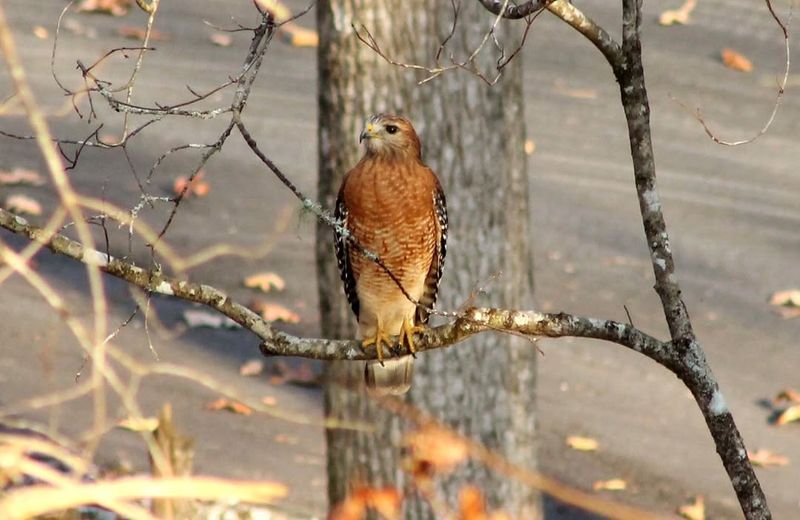
Seeing the same hawk multiple times a week is easy to interpret as proof that it has built a nest nearby, but repeated sightings and active nesting are two different things. A hawk’s territory can cover a substantial area that includes neighboring yards, patches of woods, stream corridors, and open fields well beyond the property where it is most often spotted. Your yard may simply be one convenient stop within a much larger range.
That said, nesting is possible, especially if a large, mature tree is nearby or if a wooded corridor borders your property. Nesting season in North Carolina can run roughly from late winter through summer, and during that period some raptors become noticeably more defensive near their nests. The U.S. Fish and Wildlife Service notes that several raptor species may act aggressively near active nests, which can include alarm calls, low passes, or occasionally striking at people or animals that get too close.
This behavior is temporary and localized to the nest area, not a general danger from every hawk in the neighborhood.
If you suspect a nest is nearby, the practical response is to give the area space. Avoid tree work, pruning, or construction close to a suspected nest site during the nesting season. Most migratory bird nests, eggs, and young are protected under federal law, and the Migratory Bird Treaty Act makes it illegal to disturb or destroy an active nest without authorization. Removing a nest on your own, even one that feels inconveniently placed, can put you on the wrong side of federal wildlife law.
If a nest location is causing genuine concern, contacting the North Carolina Wildlife Resources Commission or a licensed wildlife professional is the appropriate next step. They can advise on legal options and safe distances without requiring you to guess at the law on your own.
Simple yard choices can reduce conflict
Managing a returning hawk does not require dramatic action, and most of the steps that actually help are straightforward. The goal is to reduce situations where the hawk and your yard’s other residents, whether feeder birds, chickens, or people, keep running into conflict.
For feeder birds, the clearest option when repeated attacks are happening is to pause supplemental feeding. Cornell Lab suggests taking feeders down for several days to a week or two to break the prey concentration that is drawing the hawk in. Beyond that, keeping feeders clean matters year-round. Cornell recommends cleaning seed feeders roughly every two weeks, more often in wet weather or during heavy use.
If you find a sick or dead bird near your feeders, CDC guidance advises removing feeders and baths for two weeks and cleaning them thoroughly outdoors before putting them back up.
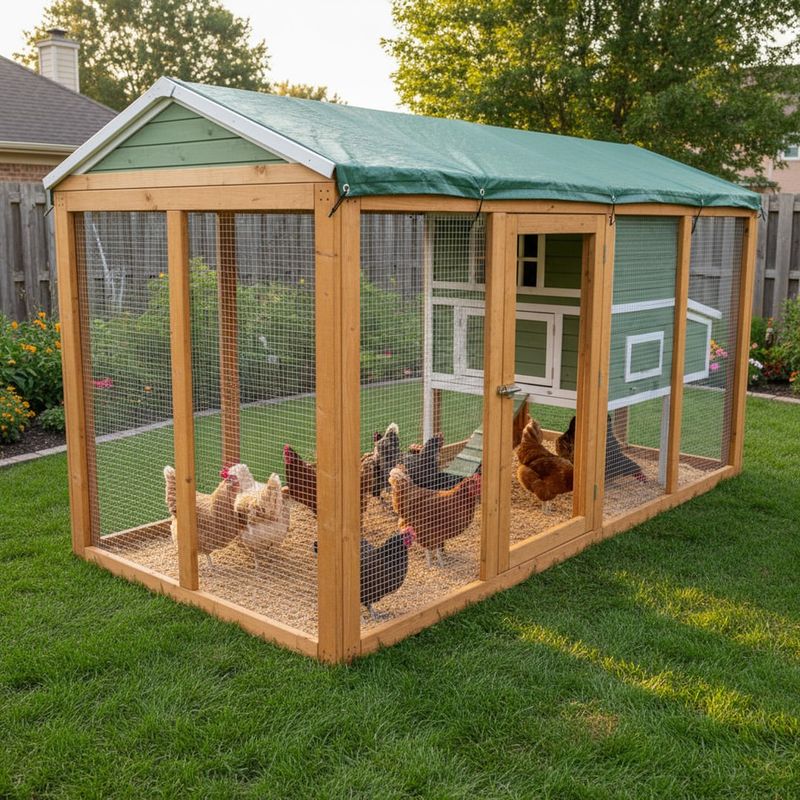
For chickens and other poultry, the most reliable protection is a covered run or secure coop with overhead protection. NC Wildlife specifically notes that hawks may take poultry that lacks secure housing and overhead cover. Hardware cloth over the run, a solid roof, and secure latches address the risk without requiring any action against the hawk itself.
On the topic of what not to do: do not attempt to scare, trap, poison, shoot, or harass a hawk in any way. All native hawks in North Carolina are protected under both federal and state law, and interfering with them carries real legal consequences. A hawk sitting on the ground is not automatically in distress either. It may be eating prey or feeding on roadkill that is too heavy to carry off.
Watch from a distance and only contact a licensed raptor rehabilitator through NC Wildlife’s injured wildlife resources if the bird shows clear signs of injury, illness, or is in immediate danger. Hawks are not a substitute for tick, mosquito, or rodent control, and treating them as one leads to disappointment and sometimes to poor decisions about the bird’s welfare.
Read the pattern before deciding what it means
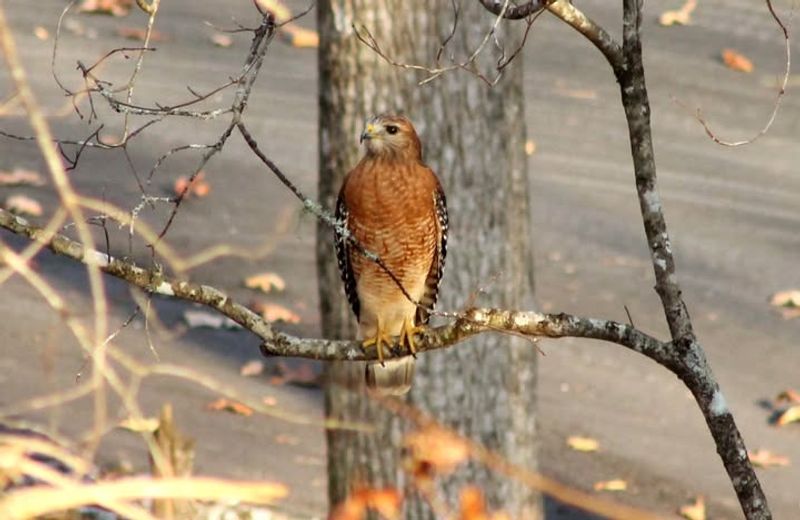
Before drawing any conclusions about why a hawk keeps returning, watch what it actually does. The behavior pattern tells you more than the bird’s mere presence does.
High, wide, effortless circles far overhead point toward thermal soaring, migration travel, or courtship, not active hunting over your specific lawn. Repeated low passes, sudden directional drops, or consistent perching close to a feeder or a cluster of smaller birds suggest active hunting pressure. A hawk that returns to the same tall pine, fence post, or utility structure day after day is almost certainly using it as a perch with a good sightline over open ground. Regular activity near a wooded edge, a stream, or a wet drainage area may mean the bird’s territory or nesting range extends into that habitat, with your yard sitting at its edge.
NC Wildlife’s Red-tailed Hawk profile and the Red-shouldered Hawk profile both describe the habitat features each species favors, which can help you match the pattern you are seeing to a likely explanation.
A hawk coming back to your yard means the landscape is offering something usable. It does not confirm a rodent infestation, guarantee pest control, or prove a nest is overhead. Cornell’s feeder hawk guidance and federal nest protections give you a clear framework for responding proportionately: observe carefully, adjust feeders if hunting pressure is a concern, protect poultry with covered housing, and respect the bird and any nest it may have. A hawk that keeps showing up in a North Carolina yard is, at its core, a wild animal doing its job in a landscape that still has room for it.