
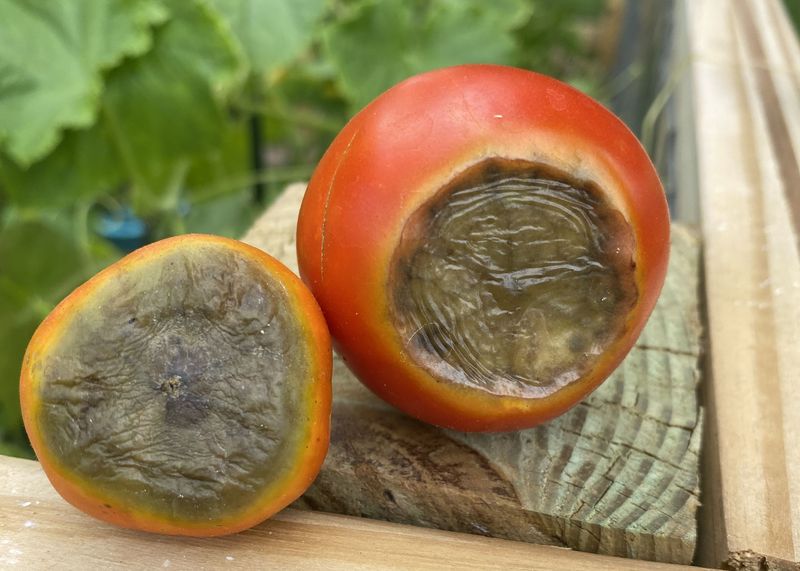
Pull back the leaves on a July tomato plant and you might spot it before you even pick the fruit: a sunken, darkened patch on the bottom of what should have been a perfect tomato. Blossom end rot shows up right when North Carolina gardens are at peak heat and peak production, and by the time you see it, that fruit is already done. The good news is that fruit still forming on the plant has a real chance, and a few practical steps taken now can help reduce the risk for the rest of your harvest.
The first clue appears opposite the stem
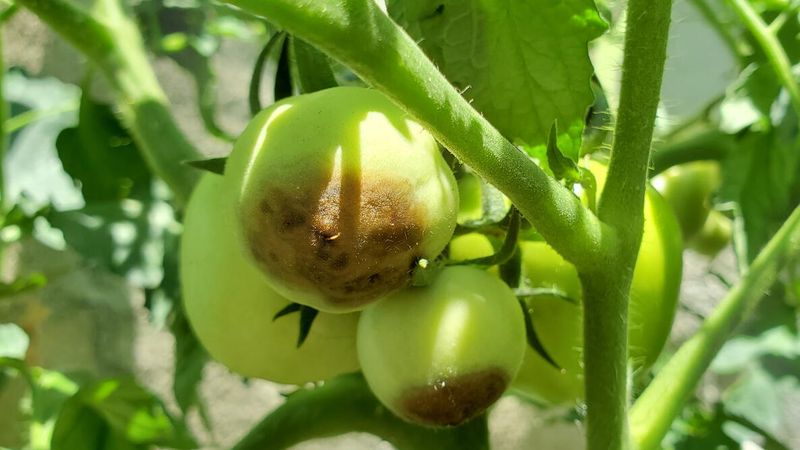
Spotting the problem early starts with knowing exactly where to look. Blossom end rot almost always begins at the blossom end of the fruit, which is the rounded bottom opposite the stem. NC State Extension’s guide on blossom-end rot describes the typical progression: a small tan, brown, or water-soaked area appears first, then the spot enlarges, darkens to a deep brown or black, sinks inward, and eventually becomes dry and leathery in texture.
That leathery, sunken quality is one of the most reliable diagnostic clues. As the damaged tissue breaks down, secondary fungi or bacteria may move in and colonize the wound, sometimes making the patch look softer, darker, or fuzzier than the original lesion. This secondary colonization can cause confusion, but the organisms that show up later are not what caused the disorder in the first place.
Several other fruit problems can look similar at first glance, and it helps to rule them out. Sunscald typically appears on the side of a fruit that faced direct sun and produces a pale, papery, or bleached patch rather than the classic dark, sunken bottom spot. Insect feeding wounds tend to be smaller, irregular, and may show puncture marks or frass. Cracking runs along the shoulders or around the stem and is usually tied to rapid water uptake after a dry spell.
Fungal or bacterial decay can appear anywhere on the fruit and often spreads from a wound or damaged area rather than starting cleanly at the blossom end.
University of Illinois Extension’s plant disease report on blossom-end rot is clear that this is an abiotic physiological disorder, meaning it is not primarily caused by insects and it does not spread from plant to plant the way a contagious fungal disease would. If you are unsure whether you are looking at blossom end rot or something else, your county Extension office or a state plant clinic can help you get a reliable diagnosis before you commit to a treatment plan.
July stress can disrupt calcium reaching the fruit
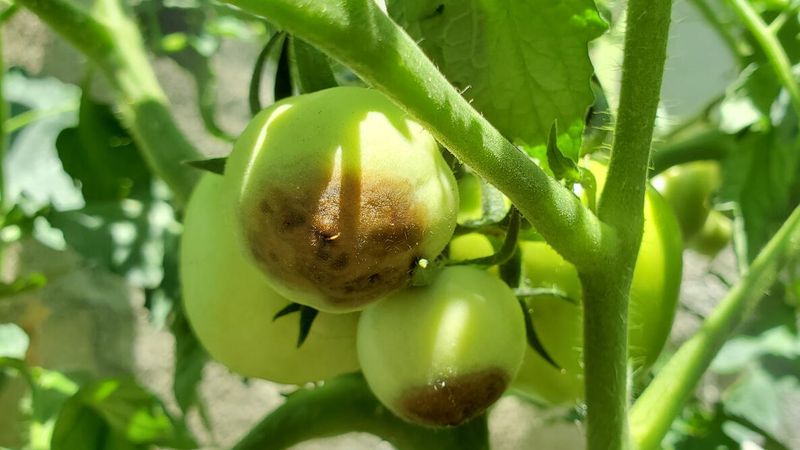
When blossom end rot shows up in July, the immediate physiological explanation is that developing fruit is not getting enough calcium to its tissues. Calcium is a structural nutrient that helps cell walls hold together, and when the supply to fast-growing fruit tissue falls short, those cells break down. What makes this tricky is that a calcium shortage in the fruit does not automatically mean the soil is running low on calcium.
University of Minnesota Extension’s tomato disorder guide makes this distinction plainly: the disorder can occur even when soil calcium is adequate, because the real problem is often in how well the plant can take up and move calcium under stressful conditions. Drought, sharp swings between dry and wet soil, waterlogged roots, root injury, high soil salinity, excessive nitrogen, and rapid leafy growth can all interfere with calcium uptake or distribution. North Carolina’s July heat compounds these pressures because high temperatures increase the plant’s water demand while also stressing roots that may already be struggling in compacted Piedmont clay or fast-draining Coastal Plain sand.
Researchers have debated the precise sequence of events for decades. One peer-reviewed review on blossom-end rot as a calcium- or stress-related disorder describes the problem as tied to calcium transport and uptake failures under water, heat, salinity, and nitrogen stress. A separate line of research has argued that calcium deficiency in the fruit may sometimes reflect broader abiotic stress rather than serve as its sole trigger. The precise causal sequence remains an open question in the literature.
For practical purposes in a North Carolina home garden, the takeaway is this: reducing avoidable water stress, root stress, salt stress, and excessive fertilizer use gives the plant a better chance of moving calcium where developing fruit needs it. NC State’s home tomato guide specifically connects blossom end rot risk to moisture fluctuations and recommends consistent irrigation as a key cultural practice during the fruiting period. Keeping the root environment as stable as possible is the most direct way to support calcium movement through the plant, even when the soil has plenty of calcium to offer.
Make soil moisture more even during fruiting
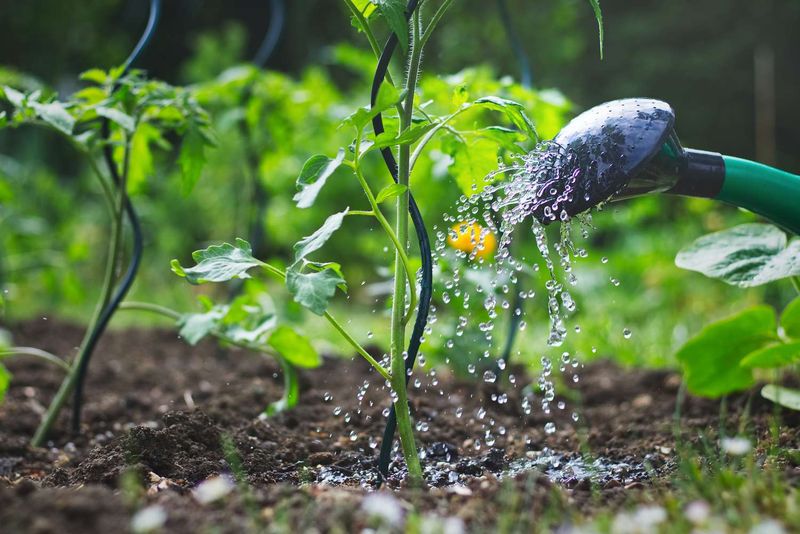
Getting water to the root zone consistently is the most practical step you can take right now to reduce blossom end rot risk in fruit that is still forming. NC State Extension recommends roughly 1.5 inches of water per week during the fruiting period, with soil soaked approximately 6 to 8 inches deep at intervals of about seven days. Think of those numbers as a reasonable starting point rather than a fixed schedule that applies to every garden in every part of the state.
Your actual frequency should account for several variables. Sandy soils in the Coastal Plain drain quickly and may need more frequent attention, while heavy clay in the Piedmont holds water longer but can also become waterlogged if overwatered. Container-grown tomatoes dry out faster than in-ground beds and often need water more than once a week during July heat. Recent rainfall should count toward your weekly total, so check the soil a few inches down before you water rather than going strictly by the calendar.
The technique matters as much as the timing. Watering deeply and less often encourages roots to reach down into the soil where moisture is more stable, rather than staying near the surface where conditions swing more dramatically. Repeated light sprinkling wets only the top inch or two and can actually encourage shallow roots that are more vulnerable to heat and drought. Aim to wet the full root zone without leaving the soil saturated and soggy.
The pattern to avoid is letting the soil dry out severely and then flooding it with a heavy irrigation or a sudden thunderstorm. That sharp swing from very dry to very wet is exactly the kind of stress that can disrupt calcium movement into developing fruit. University of Georgia Extension’s guidance on preventing blossom end rot emphasizes the same point: the goal is relatively even moisture in the root zone, not perfect saturation and not repeated drought cycles. A simple finger test, pushing into the soil a few inches near the base of the plant, can tell you more than any fixed schedule about whether your tomatoes need water today.
Use mulch and protect the roots
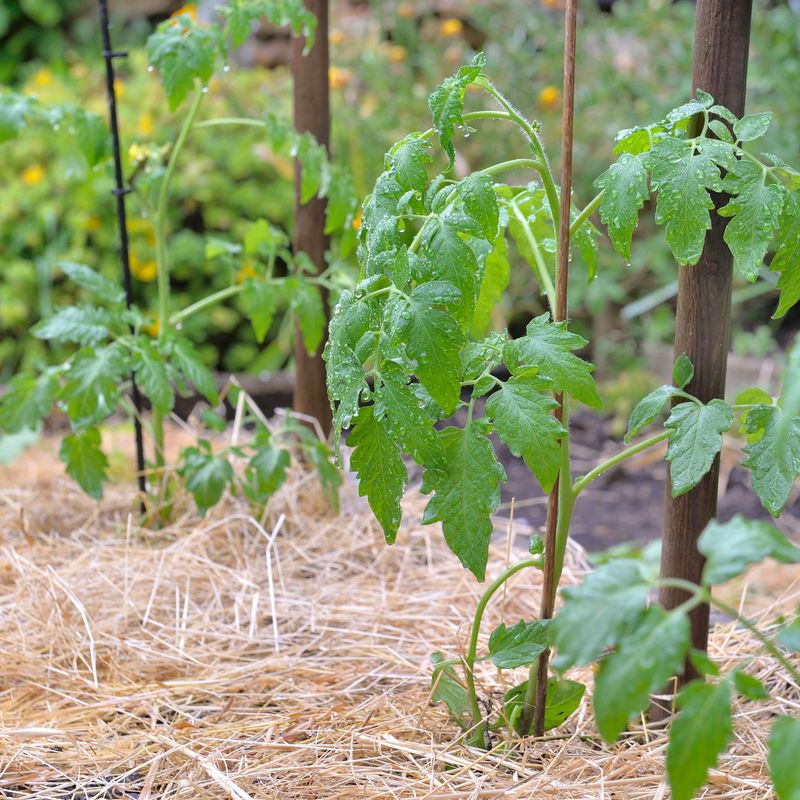
Mulch does two things that matter most during a North Carolina July: it slows evaporation from the soil surface, and it buffers the root zone against the wild temperature swings that come with hot afternoons and cooler nights. Both effects support the steadier moisture conditions that help the plant move calcium into developing fruit.
NC State Extension lists several materials that work well as tomato mulch, including straw, pine straw, composted sawdust, composted leaves, plastic sheeting, and even newspaper. A layer two to three inches thick around the base of the plant is generally enough to make a meaningful difference. Avoid piling mulch directly against the stem, which can trap moisture and encourage rot at the crown.
Root protection goes hand in hand with mulching and deserves its own attention. Tomato roots spread widely and shallowly, often extending well beyond the drip line of the plant. Deep hoeing or aggressive cultivation near the base of the plant can sever feeder roots that the plant depends on for water and nutrient uptake. University of Georgia Extension specifically flags root damage as a contributing factor in blossom end rot, because injured roots reduce the plant’s ability to take up water and the calcium dissolved in it.
If weeds are competing near the base of your tomato plants, hand-pulling is safer than hoeing once the plant is established. Shallow surface scratching to break up a crust is fine, but anything deeper than an inch or so close to the stem risks more damage than the weeds themselves. Think of the root zone as something to protect rather than disturb, especially during the fruiting weeks when the plant is under the most demand. Mulch and careful root management will not guarantee a clean harvest, but together they reduce two of the most avoidable stresses on your plants right now.
Remove damaged fruit and support what develops next
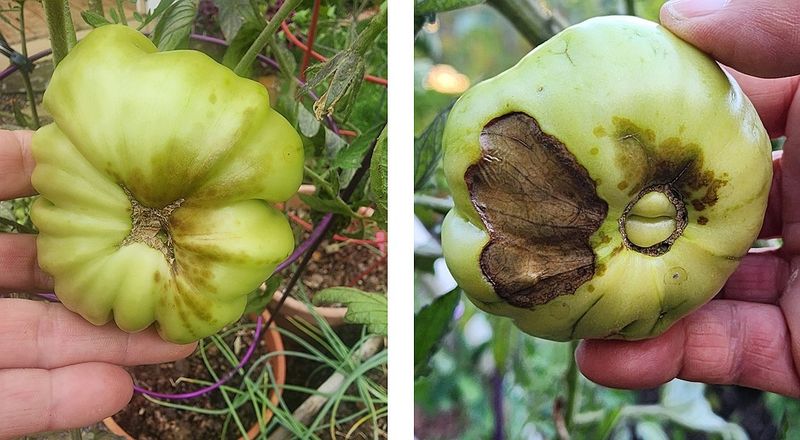
Finding a tomato with a classic blossom end rot lesion is discouraging, but the fruit itself is beyond saving. The affected tissue will not firm up, the dark patch will not shrink, and leaving the fruit on the vine does not help the plant redirect resources toward healthier fruit. Removing it cleanly is the right call.
University of Georgia Extension advises removing affected fruit and notes that later fruit on the same plant may develop normally once moisture and root conditions improve. Removal is about sanitation and letting the plant focus on what is still forming, not about curing the underlying problem. The underlying problem is a root zone or growth-rate stress that needs to be addressed separately through watering, mulching, and avoiding further root disturbance.
NC State Extension’s blossom-end-rot publication points out that the earliest fruit on a plant often shows the most damage, which is worth keeping in mind when you find a few bad tomatoes at the bottom of the vine. One or two affected fruits near the start of the season does not mean every tomato on the plant will follow the same path.
University of Minnesota Extension notes that larger slicer and elongated Roma-type tomatoes tend to be more susceptible than smaller-fruited types, so if you are growing a big slicer variety and your cherry tomato nearby looks fine, that difference in variety susceptibility is a normal part of the picture. After removing damaged fruit, shift your energy toward stabilizing the conditions for the tomatoes still developing on the plant. Consistent moisture, protected roots, and avoiding heavy nitrogen feeding give the next flush of fruit its best chance at reaching the table without that telltale black patch.
Let a soil test decide whether calcium or lime belongs
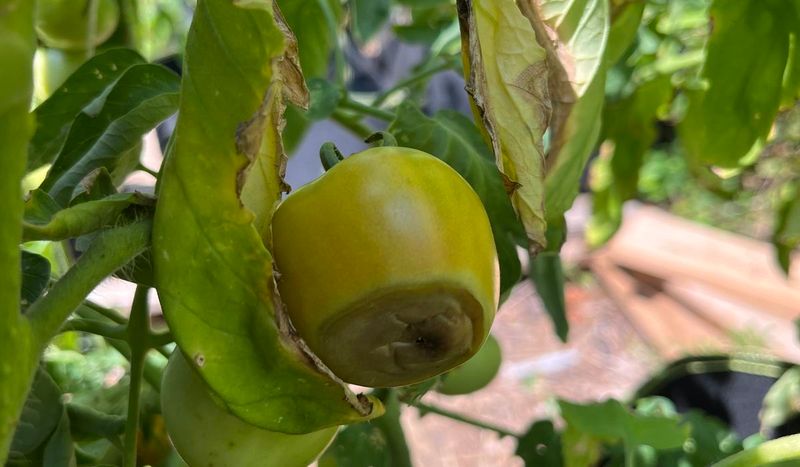
When blossom end rot appears, the instinct to add calcium immediately is understandable. Eggshells in the planting hole, a handful of lime scattered around the base, a spray bottle of calcium solution – these are common responses, and most of them skip a step that would actually tell you whether calcium or pH is the real issue in your soil.
North Carolina gardeners have access to soil testing through NC State Extension, and it is the most reliable way to know whether your soil genuinely needs lime or another amendment. NC State’s gardener’s guide to soil testing walks through how to collect a sample and what the results mean. The test will tell you your current pH and calcium levels, and the resulting recommendation will tell you whether lime is warranted and at what rate. NC State’s liming guide notes that the appropriate rate depends on soil class, current pH, crop, and other factors, which is why a blanket application without testing can overshoot and create new problems.
For tomatoes grown on mineral soils in North Carolina, NC State’s home tomato guide identifies approximately 6.5 as the target pH. If your soil is already near that range, adding lime will not fix blossom end rot and may push pH high enough to lock out other nutrients. Overfertilizing with nitrogen is another common mistake to avoid. University of Georgia Extension warns that excessive nitrogen can drive rapid leafy growth, which increases the plant’s calcium demand faster than roots can supply it, worsening blossom end rot risk even in well-irrigated gardens.
Foliar calcium sprays are sold as a quick fix, but the evidence behind them is mixed. A peer-reviewed study on calcium sprays and blossom-end rot in susceptible tomato varieties found inconsistent results among calcium products, and University of Georgia Extension notes that foliar calcium is poorly absorbed and unreliable as a primary treatment. If you decide to try a labeled calcium product, follow the product directions carefully and treat it as a supplemental measure rather than a replacement for consistent irrigation. Skip the homemade recipes, and do not expect any spray to repair fruit that is already showing symptoms.
Use July to lower risk, not to predict the whole harvest
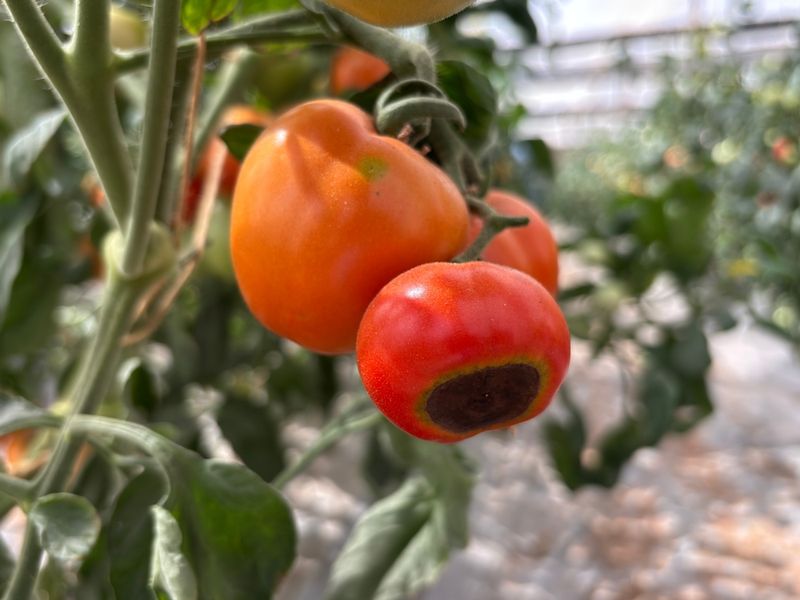
July is not a verdict on your tomato crop. It is an active, high-demand period when the steps you take now can meaningfully improve conditions for fruit that is still forming. Treating it as a practical window rather than a final judgment keeps the focus where it belongs: on what you can actually do this week.
A working checklist for right now: inspect each plant and remove any fruit showing the classic sunken, leathery blossom-end lesion. Water the root zone deeply enough to reach 6 to 8 inches, adjusting for recent rainfall, your soil type, and whether your tomatoes are in containers or raised beds. NC State Extension’s tomato guide recommends roughly 1.5 inches per week during fruiting as a baseline. Replenish mulch around the base of each plant to slow evaporation and buffer root-zone temperature.
Avoid hoeing or cultivating close to the stems, and hold off on any additional nitrogen fertilizer unless a soil test supports it.
Reserve lime or calcium amendments for decisions backed by a soil test, not panic. University of Minnesota Extension reminds gardeners that blossom end rot can occur even in calcium-rich soil, so adding more calcium without knowing your baseline may not help and could create new imbalances. None of these steps will eliminate all risk or guarantee a perfect harvest, but they lower the odds for fruit still developing. The tomatoes already marked are lost; the ones still forming are the reason to act now.