
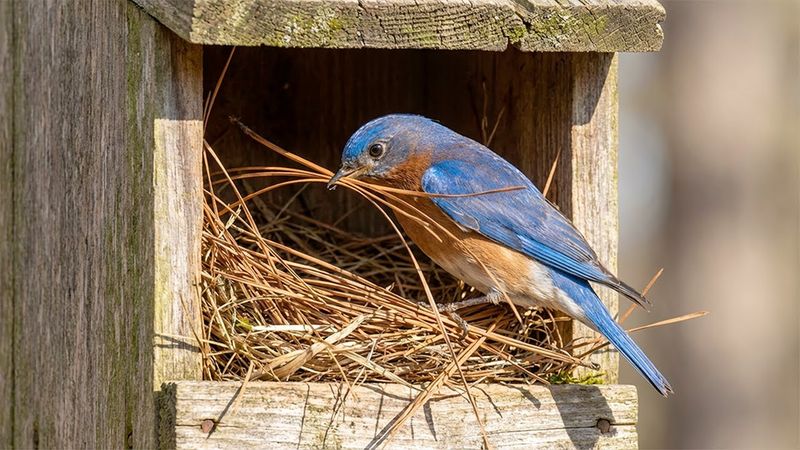
Eastern Bluebirds are one of the most recognizable birds in North Carolina, with their brilliant blue backs and rusty-orange chests showing up in open yards and field edges across the Piedmont, Coastal Plain, and mountains. Many homeowners notice more bluebird activity each spring and want to encourage a pair to nest nearby. The good news is that with the right box, the right spot, and a little habitat work, your yard could be the one a bluebird pair chooses when nesting season heats up.
Prepare for spring nesting, not a universal return
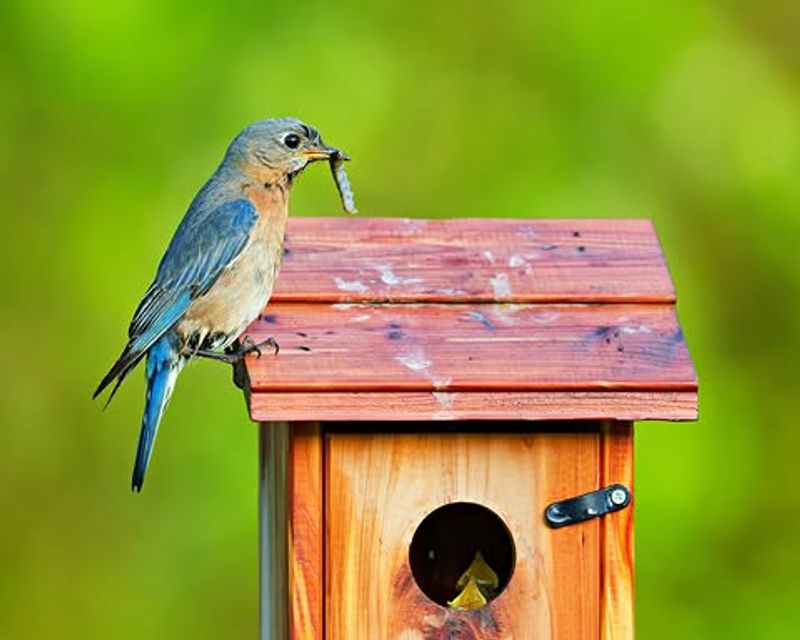
A common idea holds that North Carolina bluebirds migrate away every fall and return each spring like clockwork. That framing is too broad. The North Carolina Wildlife Resources Commission describes the Eastern Bluebird as a statewide species, and NC State Extension notes that bluebirds generally remain in North Carolina year-round. Some individuals may shift locally with the seasons, but the species as a whole is not departing the state each autumn.
What spring actually brings is a surge in nesting and territory-claiming behavior. Pairs begin scouting cavities, males defend patches of open ground, and the competition for suitable nest sites picks up noticeably. That seasonal intensity is the real reason to act before the calendar turns: bluebirds that are already present, or moving through nearby areas, will be actively searching for a place to raise young.
Framing the project as “getting ready for spring nesting” rather than “waiting for the birds to return” also sets honest expectations. Cornell Lab’s Eastern Bluebird overview makes clear that occupancy depends on habitat quality, existing territories, competition from other cavity nesters, predator pressure, and the availability of natural cavities nearby. A well-built and correctly placed box improves the odds, but it cannot promise a nest. Yards with open or semi-open foraging areas, scattered trees or shrubs, and few natural cavities offer the most promising conditions, and those habitat factors matter at least as much as the box itself.
Choose a box built for Eastern Bluebirds
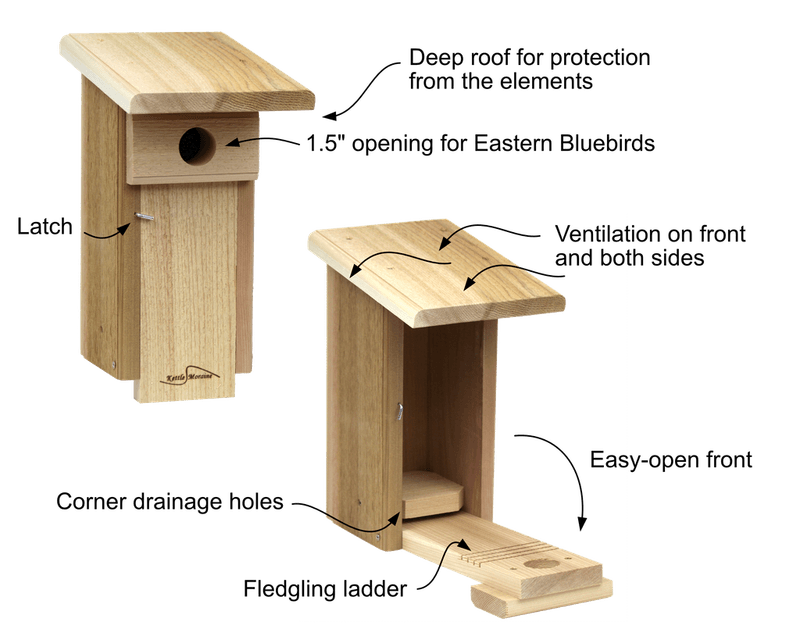
Not every birdhouse on a garden-center shelf will do. Entrance-hole size is the single most critical measurement: the USDA Natural Resources Conservation Service and Audubon’s DIY bluebird box guide both specify a 1.5-inch round hole for Eastern Bluebirds. That diameter is large enough for a bluebird to enter comfortably and small enough to stop European Starlings, which cannot squeeze through an opening that size.
Resist any temptation to enlarge the hole. A bigger entrance can let in competing species and makes it easier for predators to reach inside. Stick with the 1.5-inch standard and look for a box that is built rather than decorated: rough-cut or cedar lumber, no perch below the entrance (perches give predators and House Sparrows a foothold), and a roughened interior surface below the hole so fledglings can climb out when it is time to leave.
NestWatch’s Eastern Bluebird guidance also calls for a hinged roof or side panel that opens for inspection and cleaning, small ventilation gaps near the top, and drainage holes at the floor corners. These features let heat escape on hot Carolina afternoons and keep the nest from sitting in rainwater. Weather-resistant wood such as cedar or pine works well on the exterior; composite or recycled lumber is another option.
One firm rule: leave the interior untreated. No paint, no stain, no insecticide, and no chemical of any kind should go inside a box that bluebirds or any other bird might use. Cornell Lab’s educator’s guide to nest boxes notes that chemical treatments can harm nestlings, and the risk simply is not worth it. A plain, functional box built to the right dimensions will always outperform a fancy decorative one with the wrong hole size and no access panel.
Pair open foraging areas with nearby trees
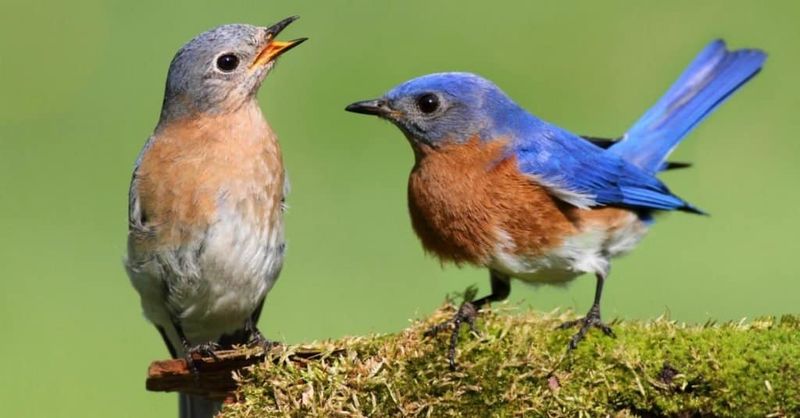
Bluebirds are birds of edges and openings. They hunt by dropping from a low perch to snatch insects on or just below the ground, which means they need a clear view of short grass or bare soil to forage successfully. A yard that is mostly shade trees and dense shrubs from fence to fence is unlikely to attract a nesting pair, regardless of how well-built the box is.
At the same time, nearby trees and shrubs are not obstacles to remove. The North Carolina Wildlife Resources Commission describes preferred bluebird habitat as open or semi-open areas with grassy patches and nearby woods. Scattered trees and shrubs give bluebirds the perches they use when scanning for prey, as well as cover and berry sources outside the breeding season. The goal is a balance: enough open ground for foraging, enough woody vegetation for perching and cover.
Good candidate sites in a typical North Carolina yard include a mowed lawn adjacent to a garden border, a field edge near a tree line, a utility right-of-way, or a pasture corner with a few scattered hardwoods. Cornell Lab’s Eastern Bluebird life history confirms that the species uses open country with scattered trees rather than dense forest interior.
NC State Extension’s urban bird habitat guide reinforces that microhabitat matters more than geography: Piedmont subdivisions, Coastal Plain properties with open lawn, and mountain yards near meadows or pastures can all support bluebirds when the local conditions fit. If the yard skews heavily wooded, consider whether there is even a modest open patch where the box could be sited, because that patch may make the difference.
Mount the box to resist weather and predators
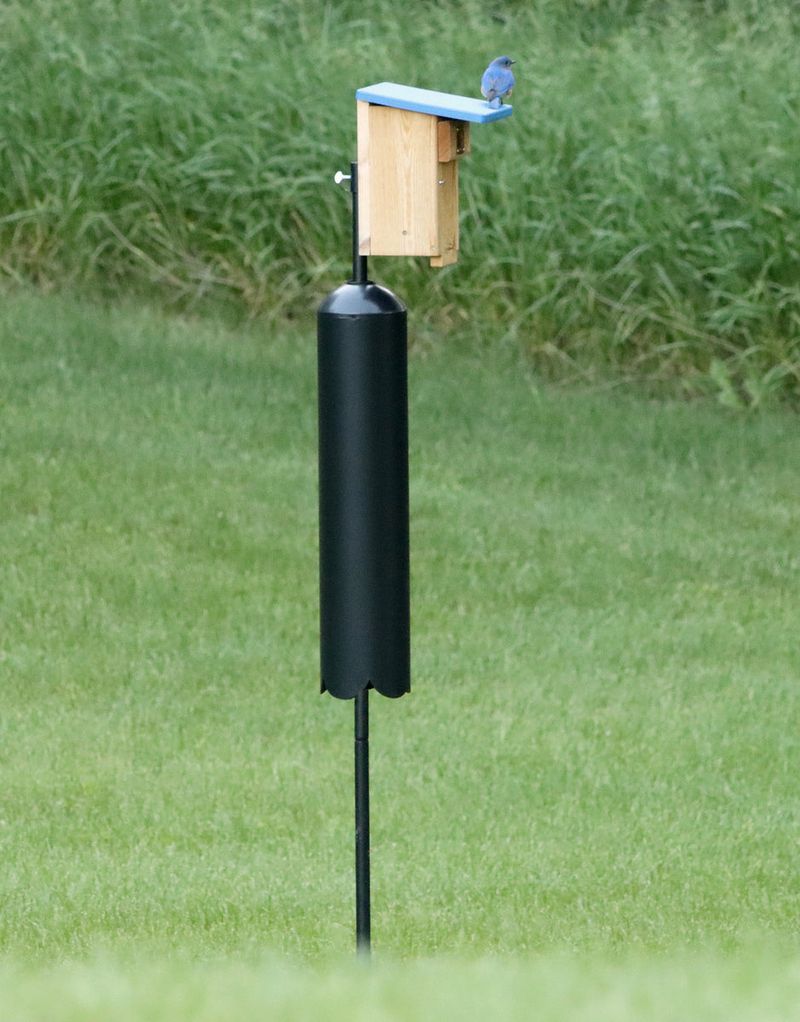
Getting the box off the ground and onto the right kind of support is where many well-intentioned setups fall short. NestWatch recommends mounting an Eastern Bluebird box roughly 4 to 6 feet above the ground on a freestanding pole, with the entrance facing toward open habitat. That height keeps the box accessible for monitoring while placing it above the easy reach of most ground-level threats.
Pole choice matters. A smooth metal or PVC pipe is harder for raccoons, snakes, and squirrels to grip than a rough wooden post. Keep the pole away from tree trunks, fences, buildings, and overhanging branches, because any of those structures can serve as a launch point for a determined predator. NestWatch’s FAQ and the USDA NRCS Eastern Bluebird guide both stress isolation from climbable structures as a basic predator-reduction step.
Add a predator guard or stovepipe baffle below the box on the pole. A national NestWatch analysis found that boxes with predator guards had, on average, 6.7% higher nesting success than unguarded boxes, a meaningful difference over a full season. Guards reduce risk, though they do not eliminate it entirely: large snakes can occasionally work around barriers, and cats remain a real threat to fledglings on the ground even when the box itself is well protected. Keeping pet cats indoors is a practical complement to any hardware solution.
On direction: NestWatch’s placement guide recommends an east-facing entrance for Eastern Bluebirds, while USDA guidance prioritizes protection from prevailing wind and rain alongside reasonable morning sun. Treat east-facing as a useful starting point, not an absolute rule. If your open habitat lies to the south or southeast, or if an east-facing position would expose the box to driving afternoon storms, adjust accordingly. Open habitat, weather protection, and predator resistance are the non-negotiable priorities.
Give territorial birds enough room
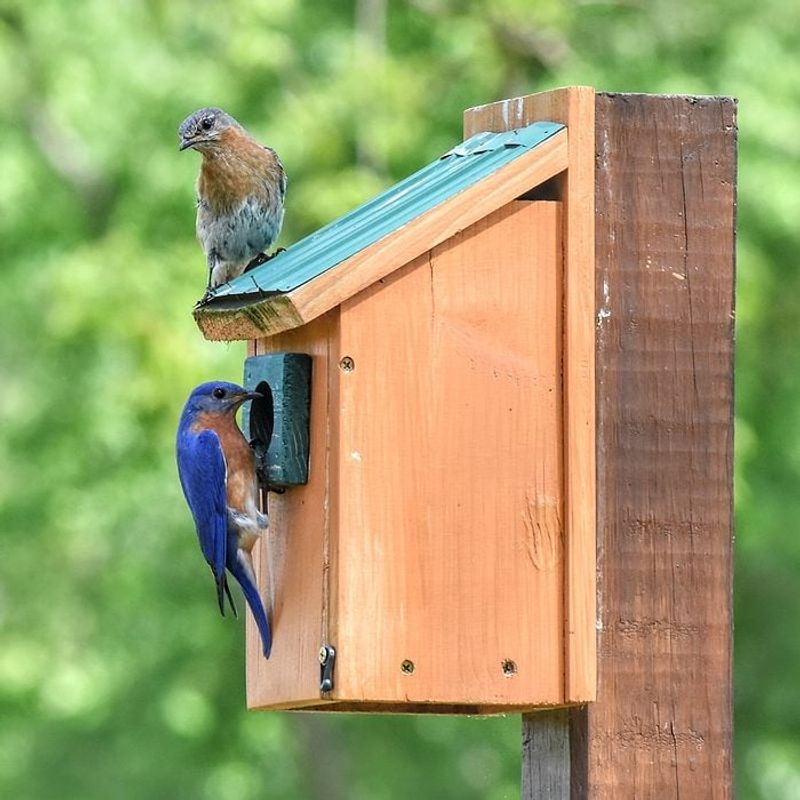
Eastern Bluebirds are territorial during the breeding season, and a male will defend the area around his nest box from rival bluebirds. Crowding boxes together does not attract more bluebirds; it tends to produce conflict, abandoned attempts, and wasted effort on your part.
The practical spacing rule is straightforward: keep individual bluebird boxes at least 300 feet apart. NestWatch’s Eastern Bluebird guidance supports this minimum distance to reduce territorial overlap between pairs. For most residential yards, that means one box is the right number unless the property is large and open enough to offer genuinely separate territories.
You may come across advice to install two boxes close together, roughly 15 to 20 feet apart. That setup is a real technique, but it addresses a specific problem: direct competition between bluebirds and Tree Swallows. NestWatch’s “A Tale of Two Boxes” research summary explains that paired boxes can allow both species to nest simultaneously by giving each a cavity to claim, reducing the back-and-forth fighting that sometimes drives one species away entirely. This is a targeted management strategy for sites where Tree Swallows are already present and competing, not a reason to double up boxes across a typical backyard.
If you are not dealing with an established Tree Swallow competition problem, the paired arrangement adds complexity without a clear benefit.
Start with one well-sited box at the correct spacing, evaluate whether bluebirds or other cavity nesters use it over a season or two, and expand only if your property genuinely has the open territory to support separate pairs.
Build food and cover into the surrounding yard
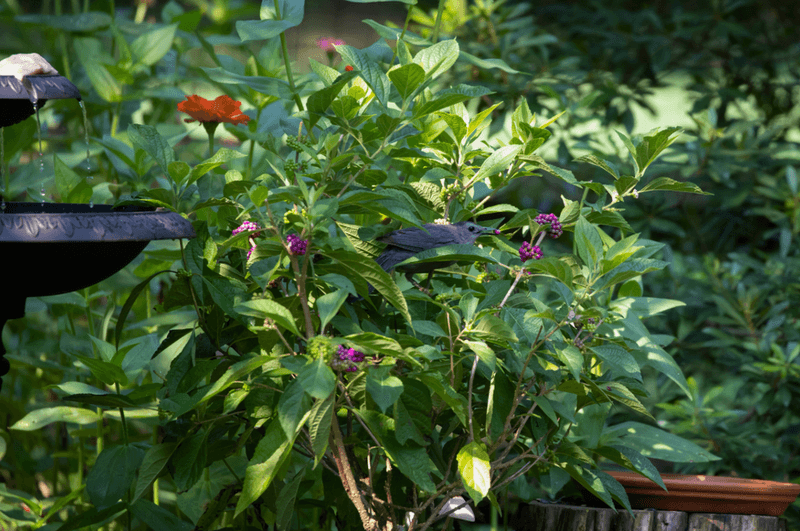
A nest box sitting in a sterile lawn surrounded by non-native shrubs is a harder sell for bluebirds than one set in a yard with diverse native plants nearby. Bluebirds depend heavily on insects during the breeding season, feeding caterpillars, beetles, grasshoppers, and other invertebrates to their growing nestlings. Later in the year, berries become an important part of the diet.
NC State Extension’s bird habitat guide recommends diverse native vegetation as the foundation of a yard that supports birds broadly. The North Carolina Wildlife Resources Commission notes that Eastern Bluebirds eat fruits from plants such as viburnums, dogwoods, and black cherry. Other useful native options for North Carolina yards include blueberry, blackberry, serviceberry, eastern redcedar, and American holly, along with native grasses and flowering forbs that support the insect community bluebirds rely on.
None of these plants is a guaranteed bluebird magnet. NC State’s native plant landscaping guidance frames the benefit as broader habitat diversity and food availability, not a direct cause-and-effect relationship with any single species. Think of native planting as improving the overall quality of the yard rather than sending a specific invitation.
Reducing unnecessary pesticide use is at least as important as adding plants. Broad-spectrum insecticides applied to a lawn or garden can remove the very invertebrates that bluebird parents need to feed their young. A yard with thriving insect life, a mix of native berry-producing shrubs, and some open ground for foraging gives bluebirds a reason to stay and nest, not just pass through. Bluebirds eat insects as part of their natural foraging behavior; they should not be marketed as a yard-wide tick or mosquito control system, and no evidence supports that framing.
Monitor carefully and clean only an empty box
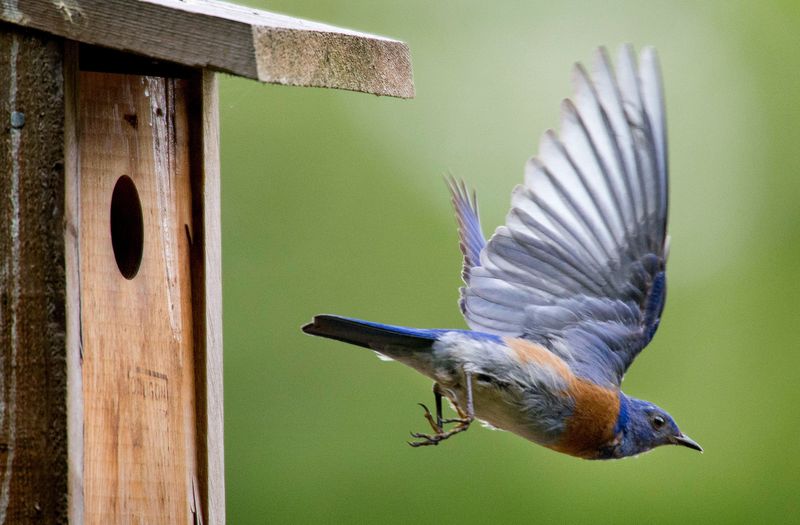
Once the box is up and birds begin showing interest, the instinct to check frequently and help out is understandable. Resist it. Frequent disturbance near an active nest can cause adults to abandon the site, and handling eggs or nestlings without proper authorization is not only harmful to the birds but is also generally prohibited under federal and state law protecting native bird species.
The NestWatch Code of Conduct outlines a careful monitoring approach: brief, infrequent checks, no lingering near the box, and no removal of nesting material or interference with an active clutch. If a nest appears abandoned, do not attempt to assist the eggs or move the brood. A brood that looks abandoned may still have adults returning on a schedule that does not match your observation window.
Keep in mind that the box may attract birds other than bluebirds. Carolina Chickadees, Brown-headed Nuthatches, Tree Swallows, and House Wrens all use similar cavities and are welcome tenants. Cornell Lab’s Eastern Bluebird life history notes that bluebirds can also compete with smaller native cavity nesters, so the dynamics of who uses the box may shift from year to year.
Cleaning is straightforward once a brood has fledged and the box is empty. Cornell Lab’s guidance on cleaning nest boxes recommends removing old nesting material after each brood leaves, since a fresh box is more likely to be used for a second nesting attempt. Eastern Bluebirds in North Carolina can raise two or even three broods in a season, so timely cleaning between attempts can matter. Use gloves and dispose of the old nest material away from the box.
If insects appear inside the box, do not apply insecticides, diatomaceous earth, grease, or any other chemical treatment. NestWatch specifically warns that chemicals inside a nest box can harm nestlings and advises against adding them under any circumstances. Remove insects manually if needed, or simply clean the box after fledging and allow natural conditions to reset.
Make the yard ready when bluebirds choose
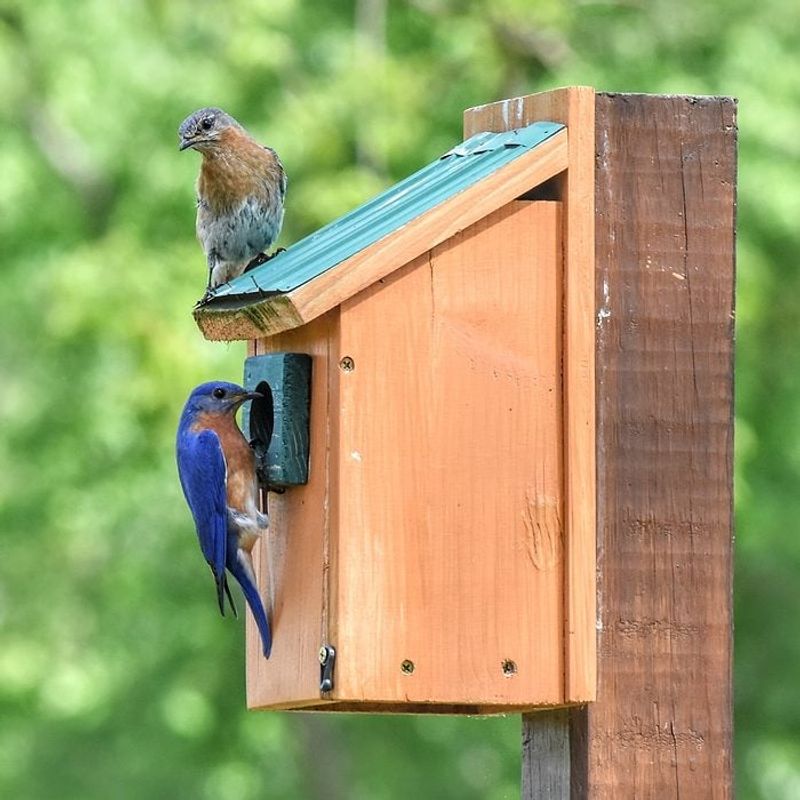
The steps that give a yard the best shot at bluebird nesting are concrete and manageable. Choose a box with a 1.5-inch round entrance hole and proper ventilation, drainage, and access for cleaning. Mount it 4 to 6 feet high on a smooth pole with a predator baffle, positioned over open or semi-open ground with scattered trees or shrubs nearby, and oriented to limit exposure to prevailing wind and rain.
Keep any additional boxes at least 300 feet apart, add native berry-producing and insect-supporting plants where possible, and reduce pesticide use in the areas around the box. Clean the box after each brood fledges to keep conditions fresh for a potential second nesting attempt. North Carolina’s Eastern Bluebirds are likely already present somewhere in your area year-round, so the goal is to offer a suitable option when a pair is ready to claim a territory, not to lure distant migrants back from a long journey.
NestWatch and NC State Extension both frame nest boxes as opportunities rather than guarantees, and that honest framing is the right one. Do the habitat work, get the box up before spring nesting activity begins, and then let the birds decide. A yard that earns a bluebird pair’s approval is one that was ready before they came looking.