
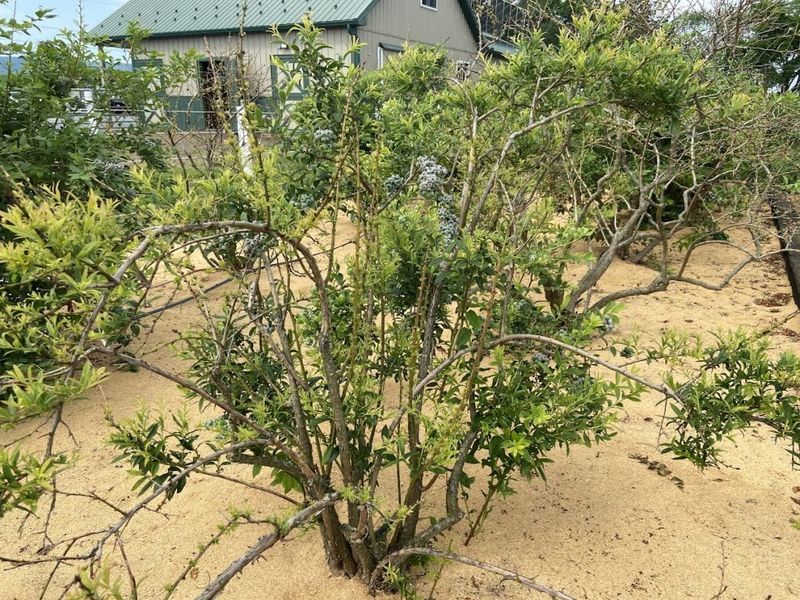
Blueberries grow across North Carolina, but getting a reliable harvest from your backyard takes more than dropping a plant in the ground. Many homeowners run into the same early problems – wrong cultivar, wrong soil, wrong timing – and the bush either limps along or never really produces. The good news is that most of these setbacks happen before the first berry ever forms, which means they are preventable with a little planning upfront.
North Carolina is not one blueberry-growing climate
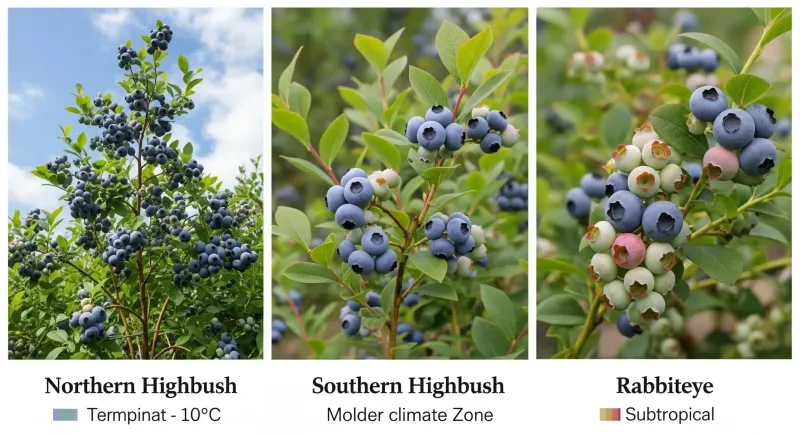
Blueberries can grow in every corner of North Carolina, but the state spans a wide range of growing conditions that make a single universal recommendation impossible. Elevation, winter temperatures, chilling hours, soil texture, and spring-freeze exposure all shift considerably between the mountains, Piedmont, Sandhills, and Coastal Plain. A cultivar that thrives in Hendersonville can fail to produce well in Raleigh, and a rabbiteye variety planted near Asheville above 2,500 feet may suffer serious winter injury.
Rabbiteye blueberries are generally the most practical choice for most Piedmont, foothill, and lower-elevation Coastal Plain home gardens. They tolerate summer heat, brief drought, and a wider range of soils than highbush types do. Highbush blueberries, by contrast, are better matched to western mountain sites, particularly at higher elevations where winters are cold enough to meet their chilling requirements. Southern highbush cultivars can work in suitable Coastal Plain soils and carefully prepared sites elsewhere, but their early flowering raises the risk of spring-freeze damage.
An important distinction worth keeping in mind: a plant that survives is not the same as a plant that fruits well. NC State Extension’s home-garden blueberry guide identifies different best-fit types for each region precisely because some cultivars merely persist while others produce dependably. Commercial blueberry production in North Carolina is concentrated mainly in the southeastern Coastal Plain, where naturally acidic, high-organic soils provide ideal conditions. That regional success does not transfer automatically to a residential lot that has been graded, limed, or compacted during construction.
Choosing the right cultivar for your specific region is the first decision in the planting sequence, and getting it wrong early creates problems that are difficult to correct later. Before buying a plant, identify your region and check current NC State Extension guidance for cultivar recommendations matched to your county or elevation zone.
Test the soil before you prepare the planting hole
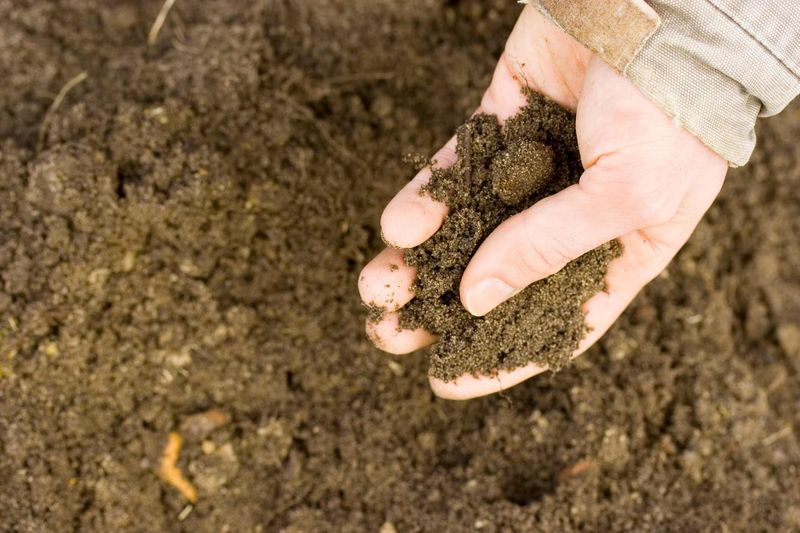
Soil pH is the single most important factor in blueberry establishment, and it is invisible to the eye. A bush planted in soil that is too alkaline may leaf out and even grow for a season or two before the signs of trouble become obvious – yellowing leaves, stunted shoots, and fruit that never amounts to much. By that point, correcting the problem is far harder than preventing it.
Blueberries need substantially more acidic soil than most garden plants. The NC State Extension Gardener Handbook identifies an optimum around pH 4.5, and notes that poor growth and leaf chlorosis can appear above pH 5.0 for highbush types and above pH 5.3 for rabbiteyes. If your soil tests above pH 6.0, planting is not recommended until corrections have been made and confirmed by a follow-up test. These are not minor distinctions – a pH reading of 6.5 or 7.0 is common in lawns that have been limed for turfgrass, and that same pH can make blueberry roots unable to absorb iron and other nutrients even when those nutrients are present in the soil.
Elemental sulfur is the standard tool for lowering soil pH in North Carolina, but the rate depends on your soil’s texture and organic matter content. Applying too little accomplishes nothing; applying too much can over-acidify the soil and create a different set of problems. NC State’s guide on calculating acidifier rates explains how texture affects the required application, and it reinforces why a blanket sulfur recommendation is unsafe without test results in hand.
The practical sequence is straightforward: take a soil test before you prepare the planting site, ideally in the fall before the spring you plan to plant. If corrections are needed, apply only what the test recommends, wait the necessary time – potentially close to a year for sulfur to fully react – and retest before planting. Coffee grounds, pine needles, and peat moss are not reliable pH-correction tools and should not substitute for a measured approach.
Give shallow roots both air and consistent moisture
Blueberry roots are unusually shallow. According to NC State Extension’s Small Fruits chapter, roughly 90 percent of the root system stays in the top 6 inches of soil. Those roots also lack the fine root hairs that most plants use to pull water and nutrients from the surrounding soil, which makes them especially sensitive to both waterlogged conditions and extended dry spells.
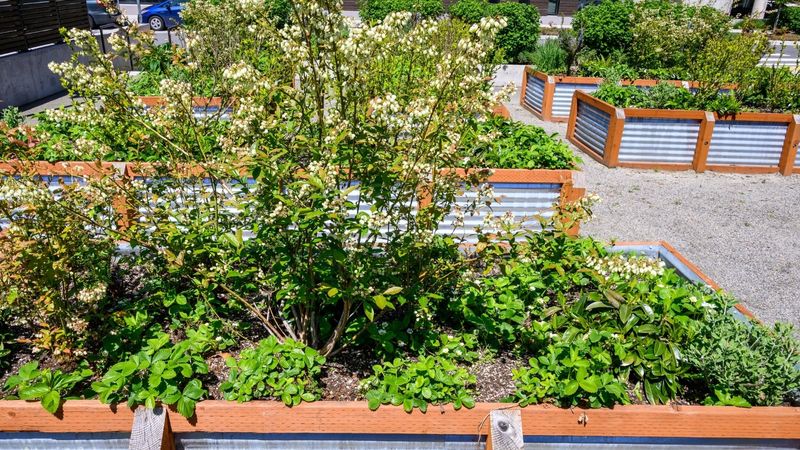
A low-lying spot, heavy clay subsoil, or compacted ground can hold water against those shallow roots long enough to cause serious damage. A simple way to check your site before planting is to dig a hole 6 to 8 inches deep and observe it after a heavy rain. If water is still pooling in the hole 24 hours later, that site carries real drainage risk. Moving the planting to higher ground or building a raised bed roughly 4 feet wide are the two options NC State recommends when drainage is poor.
Raised beds allow you to control soil composition more precisely, but they still require appropriate pH, organic matter, irrigation, and compatible cultivars – they are not a complete fix on their own.
When preparing the planting area, adding suitable organic matter improves both drainage and moisture retention. NC State’s blueberry production guide points to peat moss, composted pine bark, or decomposed softwood sawdust as appropriate preplant materials. Undecomposed wood chips or fresh sawdust should not be mixed into the soil because they can tie up nitrogen as they break down. Filling the entire planting hole with loose organic material is also a mistake – NC State cautions that water and nutrient management become difficult in a pure organic medium.
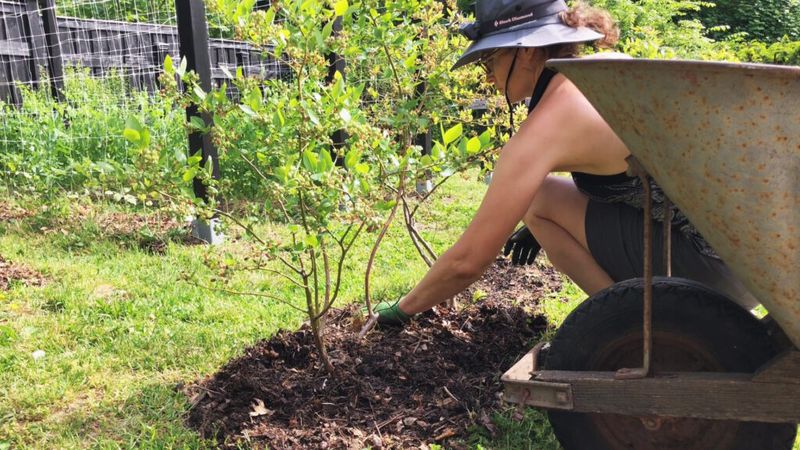
NC State’s childcare garden blueberry guide recommends applying surface mulch about 3 to 4 inches deep to moderate soil temperature and reduce moisture loss. Keep mulch a few inches away from the trunk and never pile it against the crown. Mulch helps manage moisture uniformity, but it does not replace drainage or correct soil pH – those problems need to be solved before the plant goes in the ground.
Plant compatible cultivars that bloom together
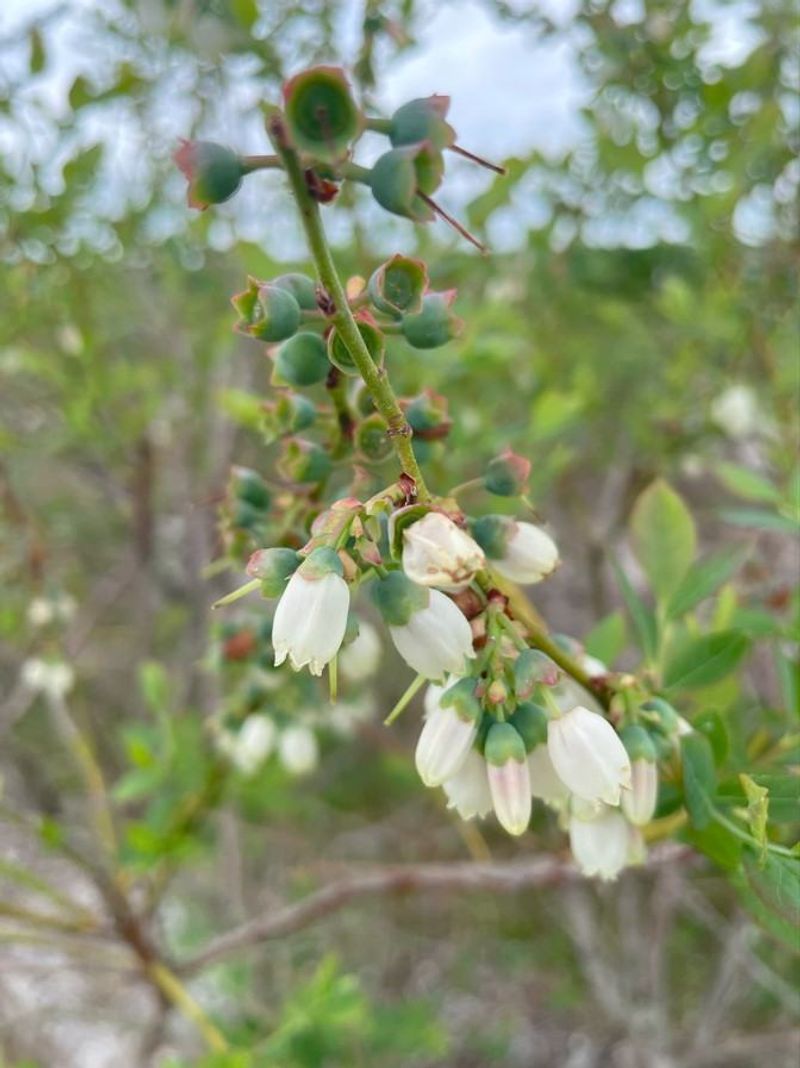
Pollination is not automatic, and treating it as an afterthought is one of the more common reasons a blueberry planting produces disappointing fruit set. Blueberries depend on insects – native bees, bumblebees, solitary bees, and honey bees – to transfer pollen between flowers. Most cultivars cannot set a reliable crop without that insect activity, and even partially self-fertile types tend to produce better yields when a compatible second cultivar is nearby.
NC State Extension recommends planting at least two different cultivars to support fruit set, and this is especially important for rabbiteyes, which benefit strongly from cross-pollination. The critical detail that many gardeners miss is that the two cultivars must bloom at the same time. Pairing an early-season variety with a late-season variety may leave both plants blooming without a compatible partner nearby when each is at its peak. Check bloom-period information for any cultivar before purchasing and confirm that the two selections overlap adequately.
NC State’s childcare garden resource reinforces that compatible bloom timing is as important as choosing the right species for your region. Selecting two mid-season rabbiteyes for a Piedmont yard, for example, gives those plants a much better chance of setting fruit than a mid-season and a late-season pair that only partially overlap. Think of cultivar pairing as a deliberate planting decision rather than a secondary consideration – it shapes the harvest before the first flower ever opens.
Use the first season to build the bush
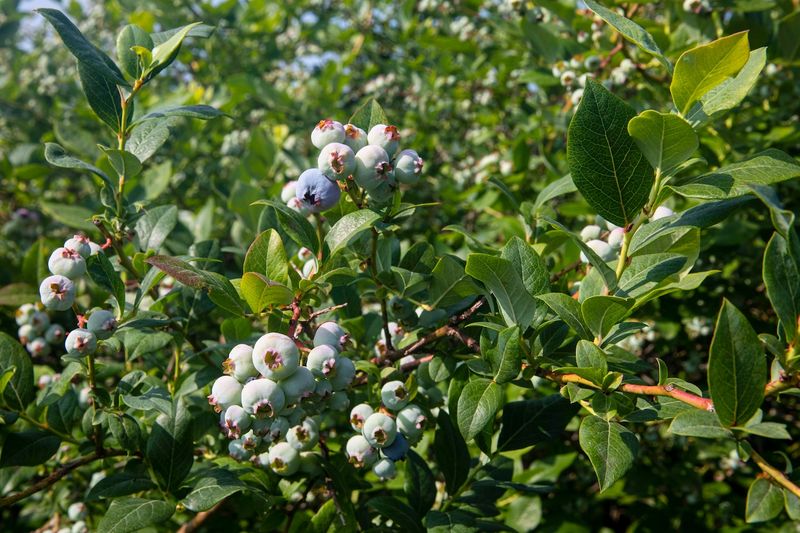
Planting season matters more than many homeowners realize. Dormant plants go in the ground most successfully in late winter, when the bush is not yet pushing new growth and root disturbance causes the least stress. Containerized plants have more flexibility and can be planted at other times of year, but they require more attentive watering to compensate for the warmer conditions.
When preparing the planting hole, keep the depth roughly equal to the root ball and make the width about twice as wide. Setting the plant deeper than it grew in the nursery is a common error that can interfere with establishment. After planting, NC State’s home-garden guide recommends removing all but the strongest three or four shoots and, perhaps more surprisingly, removing all flower buds entirely.
That last step frustrates many first-year gardeners who were hoping for a few berries to taste. The reasoning is straightforward: a young bush that puts energy into flowering and fruiting has less to invest in root expansion and cane development. NC State’s childcare garden blueberry resource frames the first-year objective clearly as vegetative establishment, not harvest. A bush that roots deeply in year one is far more likely to produce well in years three, four, and five than one that was pushed to fruit too early.
In the second year, a limited crop may be reasonable if the bush grew vigorously, but flower-bud thinning remains important in all subsequent years. NC State Extension notes that failure to prune and thin can lead to overcropping, smaller berries, weakened vegetative growth, and reduced long-term productivity. Annual pruning to remove dead, diseased, crossing, or unproductive wood is part of managing an established planting, not just a first-year task.
Irrigate young bushes without creating standing water
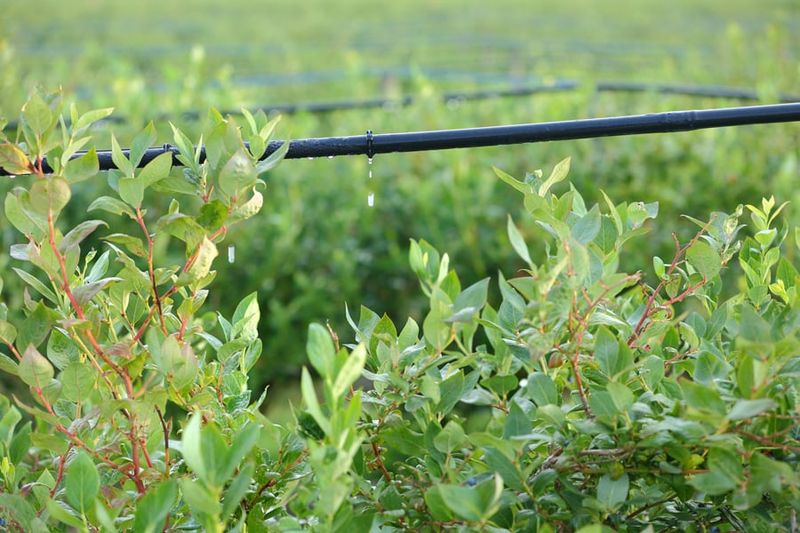
Supplemental irrigation during the first and second years is not optional for most North Carolina sites. Those shallow, hair-free roots that make blueberries sensitive to standing water also make them vulnerable to drying out between rain events, especially during warm summers in the Piedmont and Coastal Plain. NC State Extension describes reliable irrigation as essential during establishment, and drought stress during this window can reduce growth in ways that affect future productivity, not just current-season appearance.
A drip system or soaker hose delivers water more uniformly than occasional hand watering and keeps moisture at the root zone rather than wetting foliage. How often you water depends on weather, your soil’s texture and drainage, the size of the plant, how much mulch is in place, and whether recent rain has been adequate. There is no universal schedule that works across all NC conditions. The goal is consistent soil moisture – not saturated, not bone dry – throughout the growing season.
Mulch works alongside irrigation by slowing evaporation and moderating soil temperature, which is why the surface mulch layer described in the drainage section matters here too. Consistent moisture and good drainage are not competing goals; they are complementary conditions that a well-prepared site can support at the same time. Letting a newly planted bush dry out for even a few days during a hot stretch can set back root development in ways that take the rest of the season to recover from.
Delay fertilizer and measure every amendment
Fertilizing right after planting feels like a supportive move, but it can actually work against a newly planted blueberry. NC State advises waiting until growth begins before applying any fertilizer, and the reasoning is practical: fertilizer salts near freshly disturbed roots can cause injury rather than encourage establishment. Patience at this stage protects the plant while it is most vulnerable.
Fertility needs also vary considerably across North Carolina. The naturally high-organic soils of the southeastern Coastal Plain, where commercial production is concentrated, behave very differently from the mineral-heavy Piedmont soils common in residential neighborhoods. NC State’s Agricultural Chemicals Manual fertilizer guidance notes that many noncommercial sites may need only nitrogen based on soil-test results, rather than the broader fertility programs used in commercial operations. Copying a commercial fertilizer schedule into a backyard planting is a common misstep that can lead to over-application.
NC State’s childcare garden resource reinforces the test-first approach: make amendments only when test results show a specific need, and follow the rates the test recommends. Adding compost, manure, or other organic materials without knowing your baseline can raise pH or add excess salts, which creates new problems in soil that may already be marginal for blueberries.
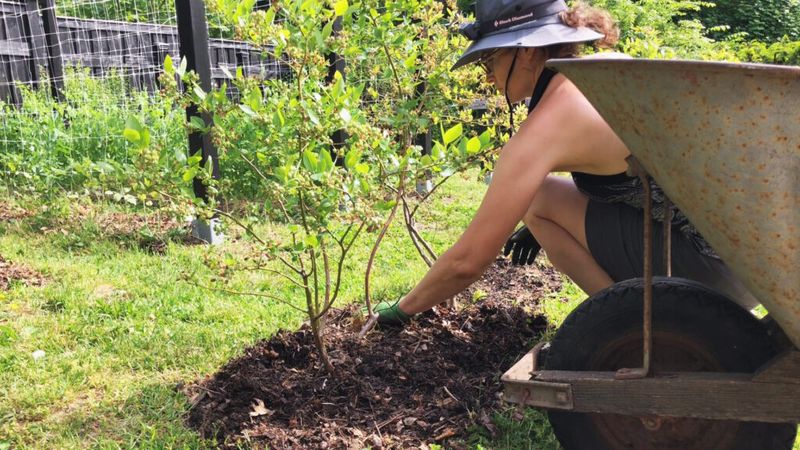
Surface mulch is one amendment that generally helps without complicating soil chemistry, provided it is applied correctly. Keep the layer at roughly 3 to 4 inches deep, leave several inches of clearance around the trunk, and make sure the crown of the plant stays exposed. NC State Extension’s Small Fruits guidance supports mulch as a moisture and temperature management tool, not as a substitute for measured fertility decisions. When fertilizer is eventually appropriate, use rates and timing from current NC State guidance rather than guessing or borrowing from a neighbor’s program.
Build the planting plan before buying the bush
Every section of this guide points to the same underlying principle: the decisions made before planting matter more than most of the care applied afterward. Working through a practical sequence upfront gives a backyard blueberry planting a far better foundation than trying to fix a mismatched site after the bush is already in the ground.
Start by identifying your North Carolina region and selecting a cultivar type suited to your elevation and climate zone. Test the soil before preparing the bed, and make only the corrections that test results call for, allowing enough time for amendments like sulfur to work before planting. Evaluate drainage honestly, and either relocate the planting or build a raised bed if the site holds water. Prepare the soil with suitable organic matter, choose at least two compatible cultivars with overlapping bloom periods, plant at the correct depth, remove first-year flower buds, and maintain steady moisture through the first two growing seasons.
Hold off on fertilizer until the plant shows active growth, then follow current NC State home-garden guidance for rates and timing.
Blueberries are genuinely feasible across North Carolina, but productive bushes are a conditional outcome, not an automatic one. NC State Extension makes clear that matching the plant to the site is the foundation of everything that follows. A planting built on that match, with realistic expectations and measured care, gives you a much better chance of harvesting well than any amount of remediation applied to a bush that was set up to struggle from day one.