
Watching a cucumber vine explode with blossoms while the produce drawer stays empty is one of the more frustrating moments in a summer garden. Many gardeners reach straight for fertilizer, convinced a feeding fix will flip the switch. The real story is more layered, and understanding it can save you from making the problem worse. Working through a short checklist of flower type, heat, pollination, moisture, and soil health will point you toward the right response far more reliably than any single bag of nutrients.
Those flowers may not be the ones that make cucumbers
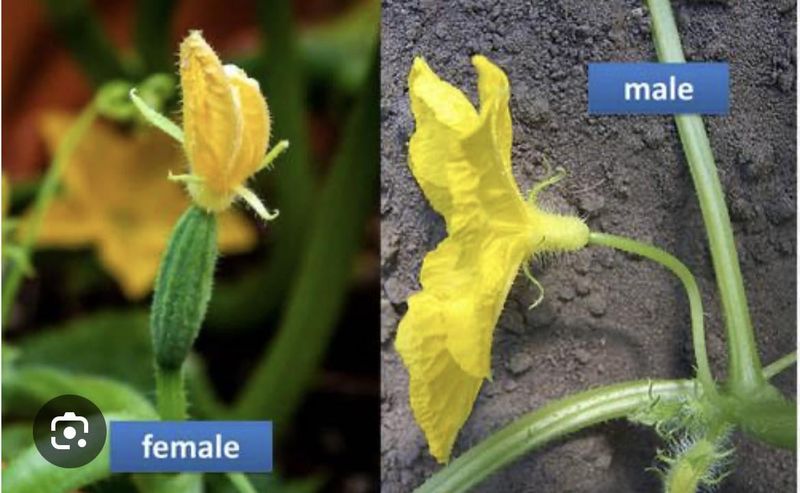
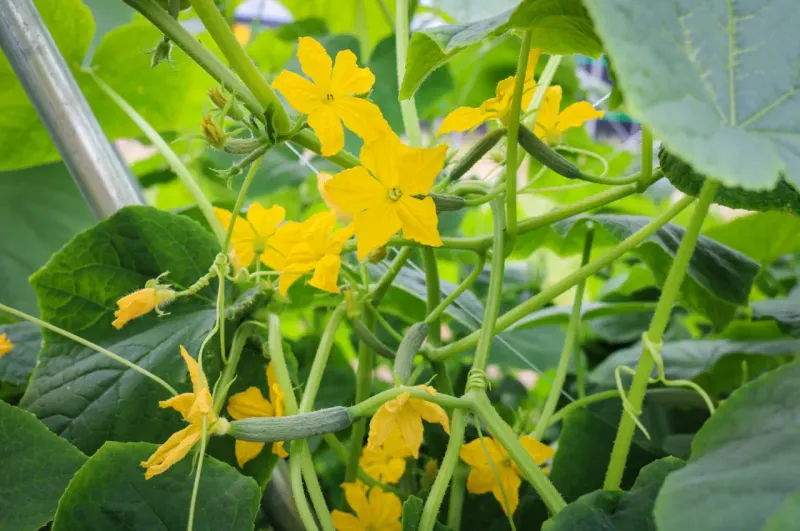
Before counting blossoms and concluding something is nutritionally wrong, take a closer look at what those flowers actually are. Cucumber plants produce two completely different flower types on the same vine, and only one of them can ever become a cucumber. University of Minnesota Extension guidance on growing cucumbers explains that male flowers appear on a plain, thin stem with no swelling behind the petals, while female flowers carry a small, cucumber-shaped ovary right at the base of the blossom.
A vine absolutely loaded with blossoms may still have almost no fruit-producing flowers if the majority are male. This is especially common in the early weeks of the season, when plants naturally push out a flush of male flowers well before the first female appears. Those early male flowers drop cleanly from the vine without leaving any fruit behind, which looks alarming but is entirely normal.
Heat stress can push this male-to-female imbalance further, shifting the ratio even more heavily toward non-fruiting flowers. Excess nitrogen in the soil can do the same, producing a lush, leafy vine that delays the arrival of female flowers. Neither situation calls for more fertilizer. The first real diagnostic step is simply to crouch down, look at the base of each open flower, and ask whether a tiny cucumber is already forming there.
Heat is one contributor to poor fruit set, not a complete diagnosis
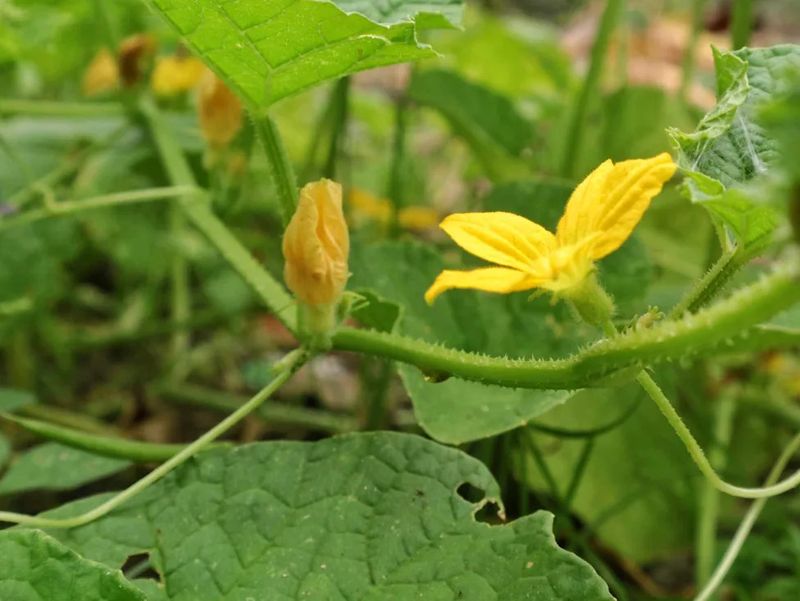
Persistent heat during flowering and fruiting is genuinely hard on cucumbers, but it is one piece of a larger picture rather than the whole story. University of Minnesota Extension’s resource on heat and the vegetable garden notes that heat can increase the proportion of male flowers, trigger flower or young-fruit abortion, reduce bee activity, and impair pollen viability, but emphasizes that there is no single temperature at which cucumber pollination simply stops. The response is gradual and varies by cultivar, duration of heat, nighttime temperatures, humidity, soil moisture, and how many pollinators are still working the garden.
Several extension sources associate reduced fruit set with daytime temperatures near or above 90 degrees F combined with nighttime temperatures above 70 degrees F, and University of Georgia Cooperative Extension identifies 75 to 85 degrees F as a favorable growing range. Treating those warm-weather thresholds as a hard cutoff misses the nuance: a brief heat spike during otherwise moderate weather is different from two weeks of unbroken triple-digit afternoons.
The practical takeaway is that heat can explain a lot, but it cannot explain everything. Pollination quality, moisture consistency, variety genetics, light, pests, and disease all belong in the same conversation. Adding fertilizer cannot reverse a flower imbalance caused by heat, restore bee activity, or rescue pollen that has already been damaged by extreme temperatures.
The female flowers reveal whether pollination failed
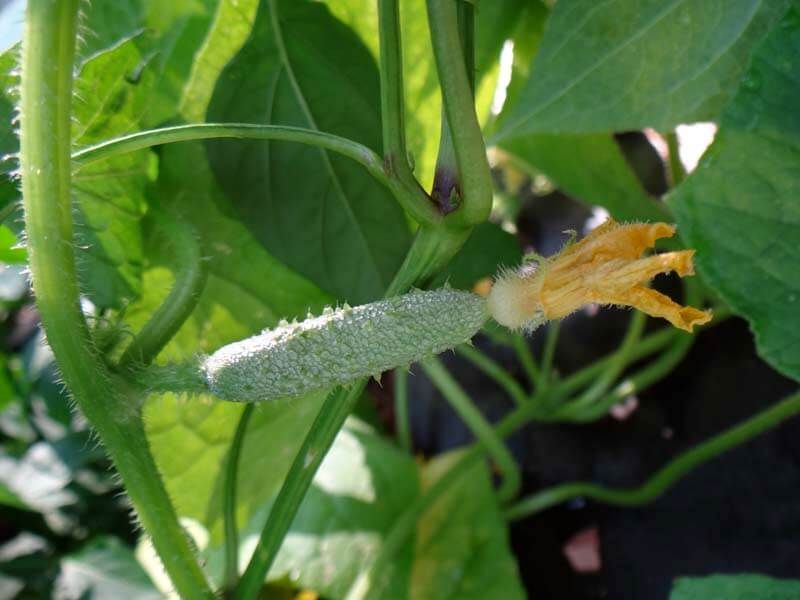
Once you have confirmed that female flowers are actually present, they become your next diagnostic tool. A female flower that opens, receives pollen, and develops successfully will swell into a cucumber within days. One that shrivels, drops, or produces a misshapen or very lightweight fruit is telling you that something interrupted the process, and incomplete pollen transfer is often the leading suspect.
University of Minnesota Extension’s pollination requirements resource explains that most cucumber varieties depend on insect visits to move pollen from a male flower to the stigma of a female flower. Hot, rainy, or windy conditions can sharply reduce the number of bees visiting the garden, and insecticide applications during bloom can reduce pollinator activity even further. When those visits become infrequent, female flowers may open and close without receiving enough pollen to set fruit.
University of New Hampshire Extension’s post on cucurbit flowering problems describes morning hand-pollination as a practical, low-risk way to test whether pollination is the limiting factor. Use a small, clean brush or remove a freshly opened male flower and gently transfer pollen from its center to the stigma inside a newly opened female flower. If hand-pollinated flowers go on to produce cucumbers while unpollinated ones continue to drop, you have strong evidence that pollinator activity is the bottleneck, not your soil fertility.
Even moisture and protected pollinators support fruit development
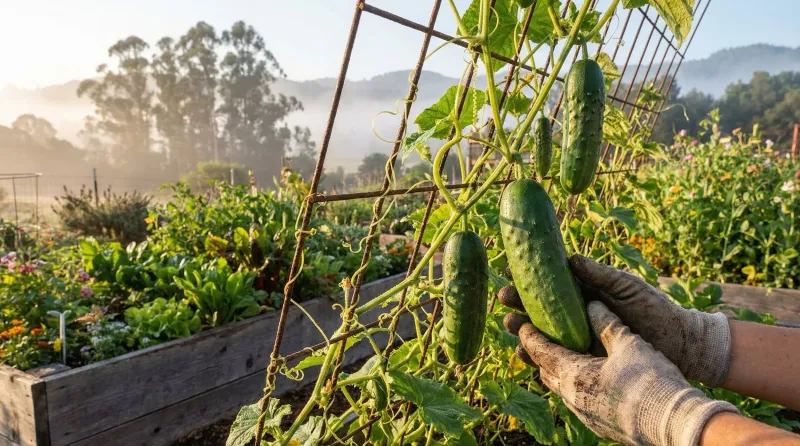
Soil moisture is one of the most controllable variables in the fruit-set equation, and it matters more than many gardeners expect. University of Minnesota Extension’s cucurbit growing guide notes that both drought stress and excessive water can contribute to flower or fruit abortion, and that drought in particular can shift the vine toward producing more male flowers relative to female ones. The goal is reasonably even soil moisture, not perfectly constant wetness.
Deep, infrequent watering that encourages roots to reach down rather than stay near the surface tends to buffer plants against short dry spells. A layer of organic mulch – straw, shredded leaves, or wood chips – slows evaporation, keeps the root zone cooler during hot afternoons, and reduces the dramatic wet-dry cycles that stress flowers off the vine. Avoid letting the plant wilt severely and then saturating it; that kind of oscillation is harder on fruit set than a slight, steady moisture deficit.
Protecting pollinators belongs in the same conversation as watering. EPA guidance on reading pesticide labels reinforces that product labels govern when and how any pesticide may be applied near flowering crops. Avoid applying any insecticide directly onto open flowers, and follow the label’s crop, timing, and harvest restrictions carefully. Even products marketed as relatively bee-safe can reduce pollinator visits when applied during the hours bees are most active.
Use fertilizer only when soil evidence supports it
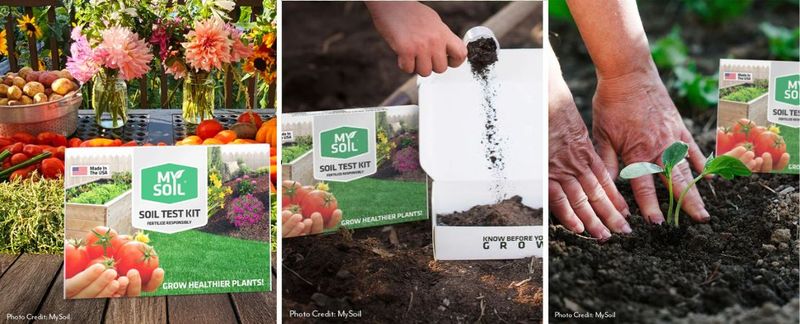
Fertilizer is a legitimate tool in the cucumber garden, but the decision to use it should follow evidence rather than frustration. Oklahoma State University Extension’s cucumber production guide and Utah State University Extension’s cucumber growing resource both tie phosphorus and potassium applications to soil-test results and crop-specific recommendations rather than to the appearance of flowers or the absence of fruit. A vine covered in blossoms but producing no cucumbers is not, by itself, a diagnosis of nutrient deficiency.
Excess nitrogen is a particular trap. When a plant is very leafy, vigorous, and dark green but slow to fruit, high nitrogen is often part of the problem, not the solution. Excess nitrogen pushes vegetative growth and can delay or reduce flowering and fruit set. Adding more of it will not help and may actively make things worse.
Oregon State University Extension’s nutrient management guide points out that excess phosphorus in already adequate soil provides no production benefit and can contribute to runoff pollution in waterways.
The practical path forward starts with a soil test. Oregon State University Extension’s guide to testing garden soil walks through how to collect and submit a sample to a lab. If the results show a genuine deficiency, apply the recommended nutrient at the recommended rate and follow the product label exactly. Routine bloom boosters, bone meal, potassium supplements, and foliar fertilizer sprays are not reliable fixes for failed fruit set, and EPA guidance on yard nutrient management cautions that unnecessary fertilizer applications contribute to water quality problems.
More is not better.
Your cucumber variety may change the pollination answer
Variety choice quietly shapes how a cucumber plant behaves in ways that can look identical to a pollination failure or a nutrient problem. Parthenocarpic cucumbers, which are common in greenhouse and high-tunnel production, can develop fruit without any pollination at all. Penn State Extension’s high-tunnel cucumber guide notes that these varieties are specifically suited to environments where bee activity is limited. If you are growing a parthenocarpic type outdoors and still getting poor fruit set, the cause almost certainly lies elsewhere, such as heat, moisture, or disease, rather than pollinator shortage.
Gynoecious varieties present a different situation. These plants produce mostly female flowers, which sounds ideal until you realize that without male flowers nearby to supply pollen, those female flowers may still fail to set fruit. Many gynoecious seed packets include a small number of seeds from a standard pollinizer variety, and University of Minnesota Extension points out that whether a pollinizer is needed depends on the specific cultivar. Check the seed packet or plant tag before assuming bees or fertilizer are to blame.
When extreme heat has been the main driver of poor fruit set, production may improve once temperatures moderate, though recovery is possible rather than guaranteed. Oklahoma State University Extension suggests that temporary shade cloth can reduce heat load on plants during the hottest part of the day, but any shade protection should preserve adequate ventilation and enough light for the plant to continue growing and reproducing. Heavy, permanent shade trades one stress for another.
Follow a diagnosis-first rescue sequence
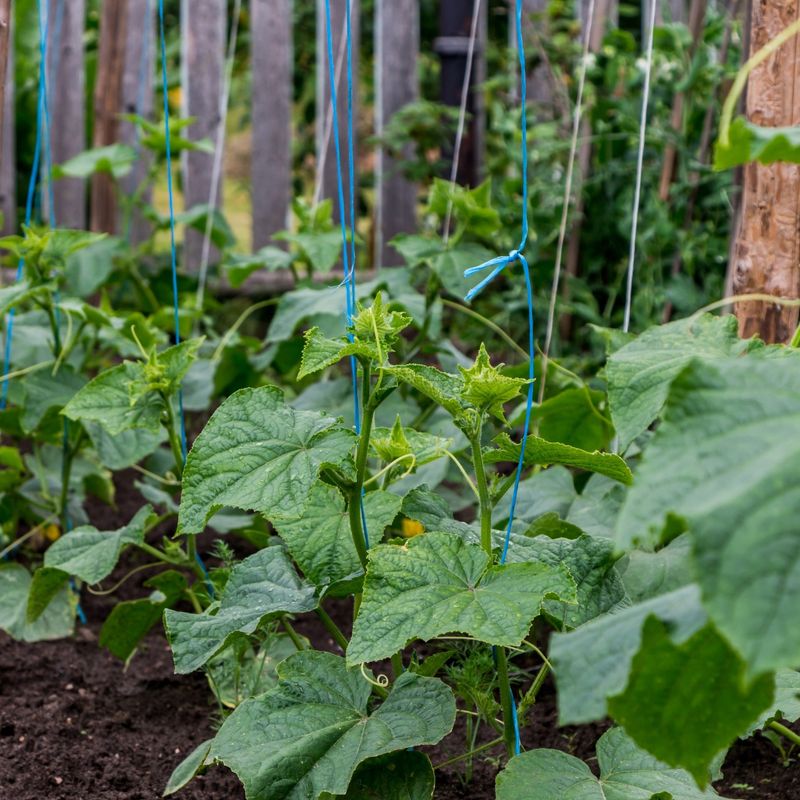
Putting the steps in order makes the whole process less overwhelming. Start by checking flower sex: are female flowers actually present, or is the vine still mostly producing males? Then look at any female flowers that have opened and ask whether small cucumbers are forming, shriveling, or dropping. Review the past two weeks of weather for prolonged heat and the past few days of watering for dramatic wet-dry swings.
Check your variety on the seed packet, protect pollinators by keeping sprays off open flowers, and try morning hand-pollination for a few days if bee activity seems low. University of Minnesota Extension’s pollination guidance and its heat-stress resource both support working through these non-nutrient causes before reaching for a fertilizer product. If the vine looks lush and vigorous rather than pale or stunted, a nutrient deficiency is less likely than heat, moisture, or pollination stress.
Order a soil test if you want to address fertility with confidence, and apply only what the results recommend. Abundant flowers are a sign of a plant with energy and ambition; turning those flowers into cucumbers is mostly a matter of giving them the right conditions rather than the right bag of fertilizer.