
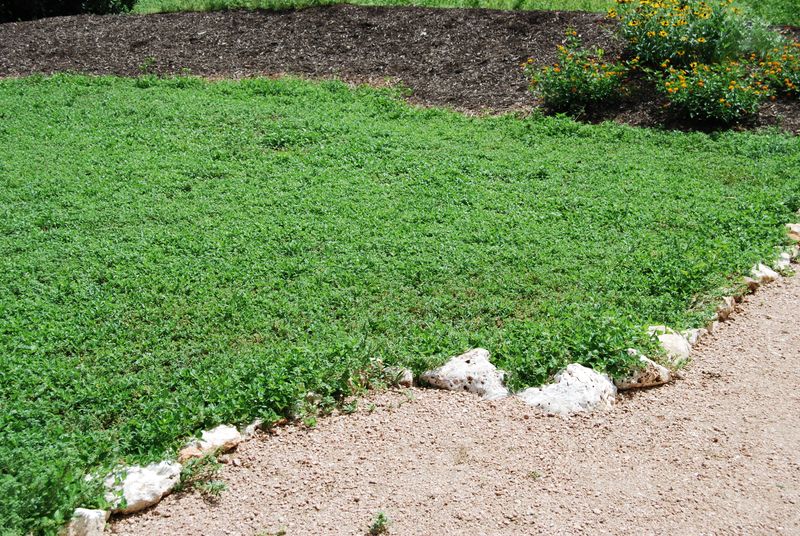
Walk barefoot across a gravel yard on a July afternoon in Texas and you will know exactly why homeowners are looking for something better. Texas frogfruit, a low-spreading native plant, offers a living alternative to exposed rock mulch that can cool its own surface while it actively grows. Whether it truly outperforms every type of gravel in every condition is a more complicated question, and the answer matters if you want to make a smart choice for your yard.
Meet the Texas-native groundcover behind the claim
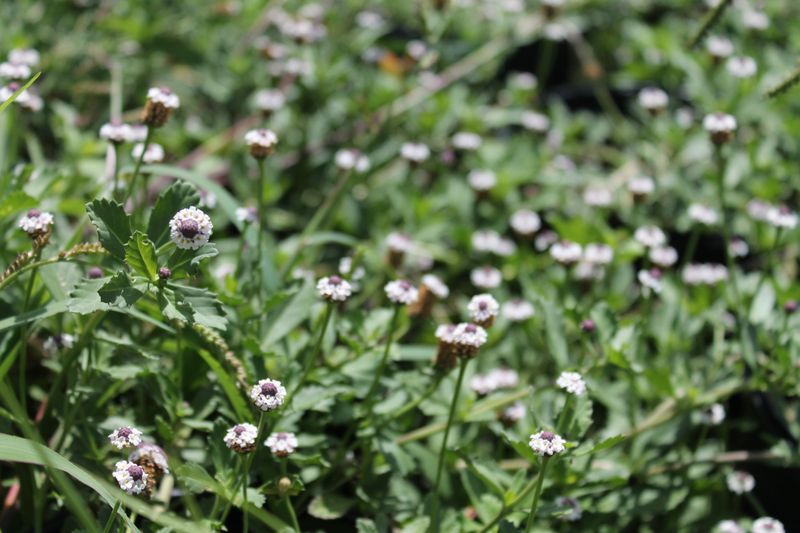
Texas frogfruit, known botanically as Phyla nodiflora and sometimes called turkey-tangle frogfruit, is a prostrate, spreading perennial that hugs the ground and roots as it goes. Austin’s native and adapted landscape plant guide lists it at roughly 6 to 8 inches tall and 1.5 to 2 feet wide at maturity, with sun-to-part-shade tolerance and low-to-medium water needs. Those dimensions make it genuinely low-profile, which is part of what puts it in the same conversation as rock mulch.
The plant spreads vigorously by rooting wherever its stems contact the ground, and USDA NRCS describes it as suited to hot, dry soil while noting that it can also tolerate periodic flooding. That combination of drought resilience and moisture flexibility gives it range across Texas landscapes that would challenge many other groundcovers. It can be propagated by seed or stem cuttings, making it relatively easy to source and multiply.
Texas SmartScape recommends it for lawn substitution and erosion control, two roles where exposed gravel often ends up by default. Because it spreads rapidly, edge management is part of the deal wherever it meets a bed, walkway, or neighbor’s property. Think of frogfruit as a strong candidate for replacing some rock-mulched areas, not as a plant that has been scientifically proven to win a heat-wave temperature contest against every gravel type under every Texas sky.
What the cooling research actually shows
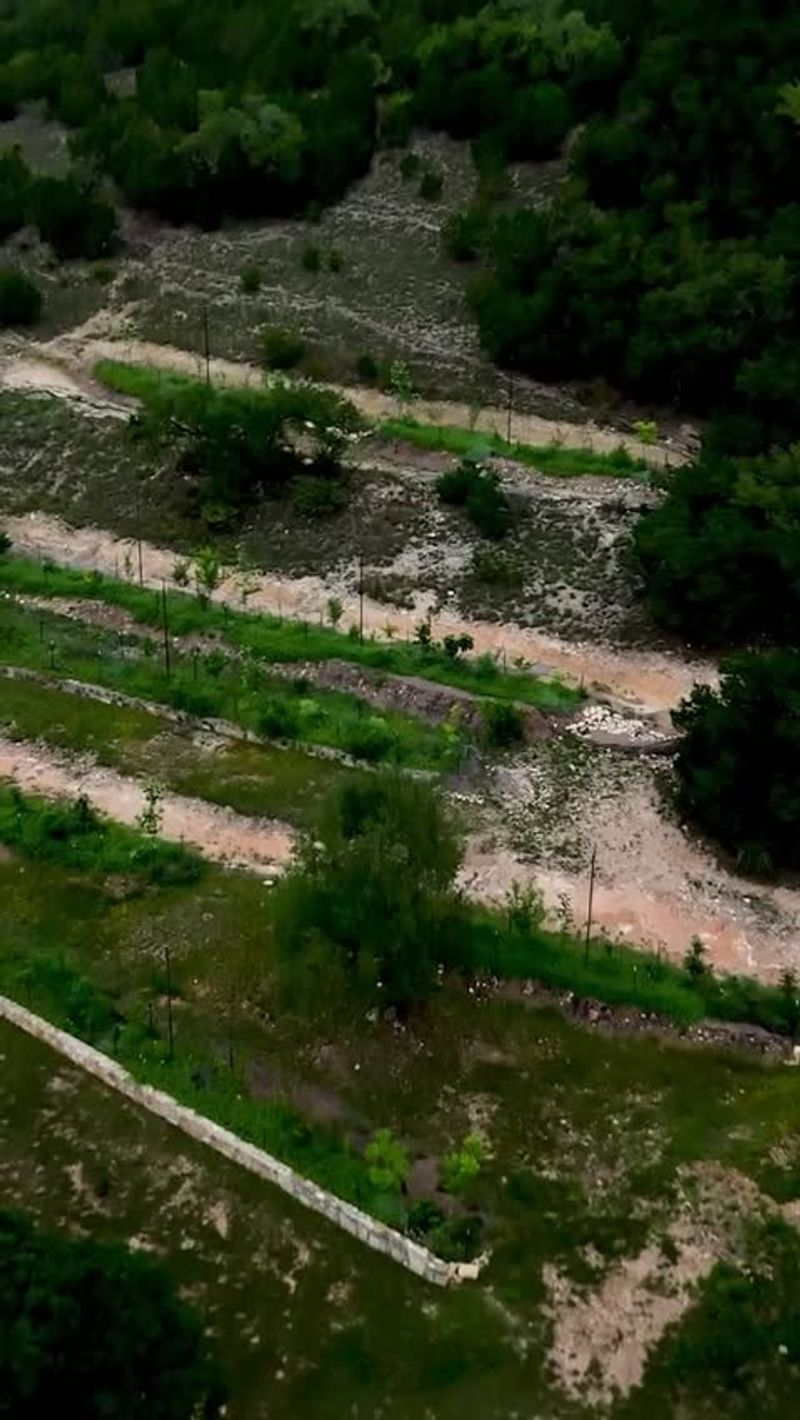
Living plants cool themselves through transpiration, the process of moving water from roots up through leaves and releasing it as vapor. That continuous moisture release carries heat away from the leaf surface, much like sweat cools skin. When a dense mat of actively growing vegetation covers the ground, the surface it presents to the sun can register measurably lower temperatures than an adjacent nonliving material.
Texas A&M turfgrass research measured infrared surface temperatures across several broad landscape treatments during the growing season, including St. Augustinegrass, sand-capped turf, xeriscaping, conventional mulch, and artificial turf. Living turf surfaces recorded the lowest temperatures in those comparisons, and the researchers attributed the difference partly to reflected solar radiation and, for actively growing plants, transpiration. The measurements were taken weekly around midday, not at the daily peak, and the study did not compare Texas frogfruit directly against a named gravel product such as decomposed granite, pea gravel, or river rock.
A separate three-year landscape surface study conducted in Utah found that vegetated surfaces showed lower surface temperatures than nonvegetative surfaces, including gravel rock mulch, because vegetation can provide evaporative cooling. That study was conducted in Utah, not Texas, and it did not test frogfruit either, so it supports the underlying mechanism rather than a species-specific Texas result.
Taken together, the evidence points toward a real cooling effect tied to active growth and water availability. Surface temperature is also not the same as soil temperature, root-zone temperature, air temperature, or how a surface feels underfoot. Frogfruit may offer a cooler surface than exposed gravel when it is actively growing and well-watered, but that advantage shrinks or disappears during drought stress, dormancy, or hard freezes.
Frogfruit adds habitat and living-root activity
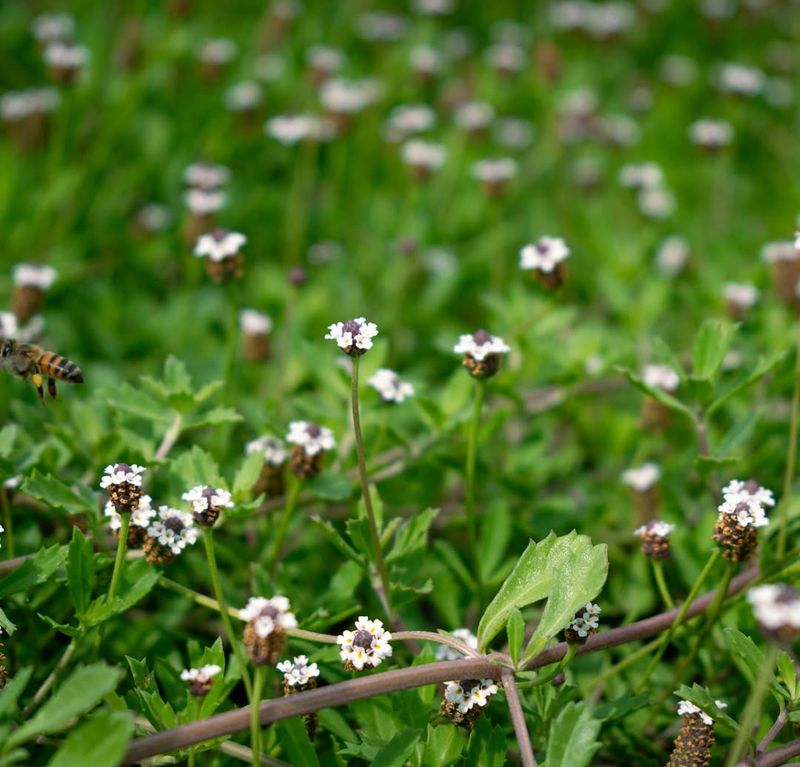
Beyond any temperature argument, frogfruit earns its place in a Texas yard through what it feeds. USDA NRCS identifies frogfruit as a nectar plant for butterflies and a larval food plant for the Phaon Crescent, Buckeye, and White Peacock, three species that show up regularly across Texas. Gravel mulch provides none of that. A yard section covered in frogfruit is, in effect, a low-maintenance pollinator patch that also happens to cover bare ground.
The living-root side of the story is equally practical. USDA NRCS soil health guidance explains that living roots continuously release compounds that feed soil microbes, and that living cover can improve soil structure, nutrient cycling, water infiltration, and wildlife habitat over time. Those are general principles that apply to any actively rooted groundcover, not measurements specific to frogfruit, but the plant qualifies as a living cover in exactly the way gravel does not.
One clarification matters here: frogfruit is not a legume and has not been identified in the reviewed sources as a nitrogen-fixing plant. NRCS guidance on organic matter points to root exudates and decomposing organic material as the primary pathways for soil biology support. Frogfruit contributes through those pathways, not through nitrogen fixation. Think of it as a soil-biology supporter and a wildlife resource, rather than a fertilizer replacement.
Match the plant to the right Texas site
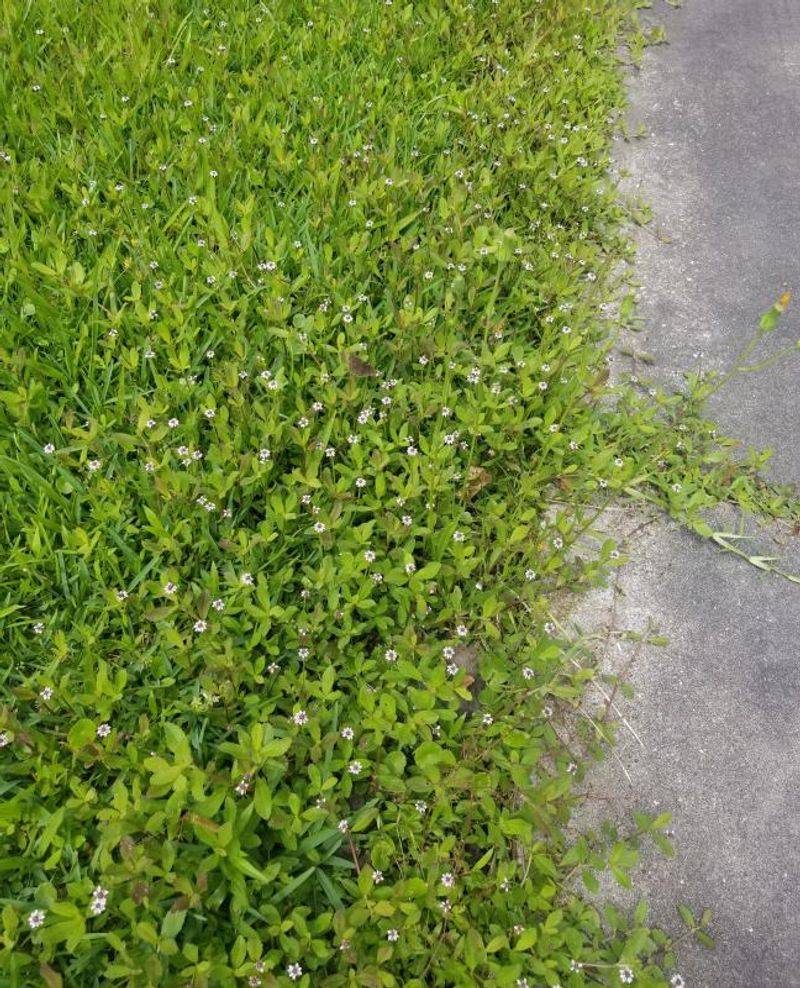
Placement decisions start with sun and drainage. Texas SmartScape rates frogfruit as extremely drought tolerant and suited to full sun or partial shade, which covers a wide range of Texas yard conditions. It also tolerates periodic flooding, making it a reasonable choice for low spots that drain slowly after rain, as long as water does not stand for extended periods.
Texas is not one climate. A gardener in Houston deals with Gulf Coast humidity, clay soils, and mild winters, while someone in Lubbock faces alkaline caliche, lower rainfall, and harder freezes. North Texas winters can push frogfruit into dormancy or cause dieback, and the plant may re-emerge more slowly in spring than it would in San Antonio or along the coast. Far West Texas brings intense sun, low humidity, and limited irrigation water, conditions where establishment watering becomes even more critical.
Austin’s landscape guide presents frogfruit as a Central Texas performer, and that regional framing matters when you are gardening somewhere else.
The Texas A&M AgriLife Earth-Kind Plant Selector is a practical tool for checking which adapted plants perform in your specific Texas ecoregion before you buy. Frogfruit works well between stepping stones, along path edges, and on gentle slopes where erosion is a concern. It is not a guaranteed year-round green carpet statewide, and calling it “Texas native” does not mean it thrives identically from Texarkana to El Paso. Match it to your local soil, rainfall, and freeze pattern first.
Establish the planting before asking it to handle heat
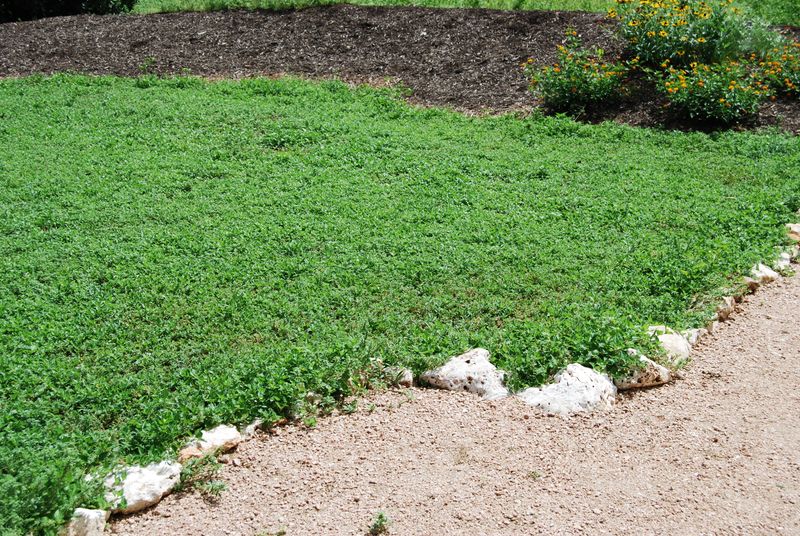
A plant’s mature toughness and its first-summer survival are two different things. Frogfruit earns its drought-tolerant reputation after it has rooted into the soil, built a spreading mat, and established connections between the plant and the microbial community below. Before that point, a new planting is just as vulnerable as any other transplant in a Texas summer.
Start by clearing the area thoroughly. Extension guidance on pre-plant soil preparation consistently identifies pre-plant weed control as one of the most important factors in successful groundcover establishment, because weeds that sprout through a new planting can outcompete young plants before they spread. Loosen compacted soil where necessary to encourage root penetration, but avoid burying the crown or stems when you set plants in place. Set plugs or rooted cuttings at the soil surface and press them in firmly.
Water based on soil moisture and local conditions rather than on a fixed schedule. Water-wise landscape maintenance guidance recommends checking soil moisture before irrigating and adjusting frequency as weather changes, which aligns with Texas municipal water restrictions that often limit irrigation days. The Austin landscape guide describes frogfruit as rapid-spreading, but rapid spreading does not mean instant weed suppression. Gaps between new plugs are open ground until stems knit together, and weeds will exploit those gaps aggressively in the first growing season.
Pull or smother competing growth early and consistently, because the weed control you do in month one protects the habitat and coverage benefits you are working toward in year two.
Compare frogfruit with gravel by the job, not by a slogan
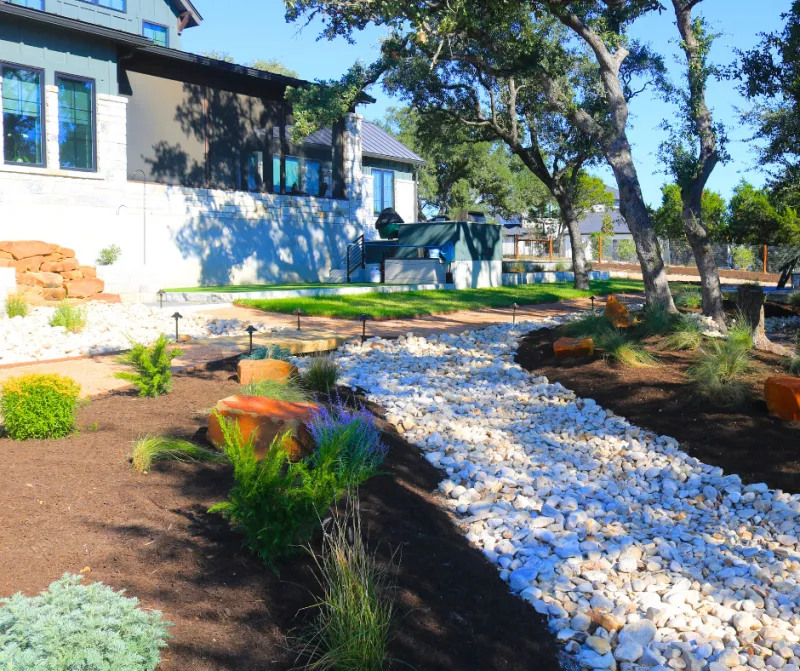
Gravel is not the enemy of a good yard, and a fair comparison requires giving it credit. Water-wise landscaping research on mulch types shows that gravel can reduce soil evaporation, moderate soil temperature, and provide drainage in ways that organic mulches and bare soil cannot. It requires no replacement, does not decompose, and holds up under heavy foot traffic, vehicle loads, and years of Texas sun without losing its function.
Thermal behavior in gravel is more variable than the simple “gravel gets hot” story suggests. Research on gravel mulch and soil evaporation shows that gravel size, thickness, color, and moisture all affect how a rock surface performs. Light-colored limestone or caliche gravel can reflect more solar radiation than dark river rock, and shaded gravel behaves differently than gravel baking in open sun. The Utah landscape surface energy study found that vegetated surfaces ran cooler than nonvegetative ones, but that comparison covered broad surface categories, not a controlled frogfruit-versus-specific-gravel test.
Where frogfruit clearly wins is in ecological function. A gravel bed supports no pollinators, feeds no butterfly larvae, and contributes nothing to soil biology. Texas SmartScape’s frogfruit profile highlights its value for erosion control, lawn substitution, and wildlife support, none of which gravel can replicate. The practical rule is to keep driveways, heavy dog routes, play areas, and regular walkways in gravel or hardscape unless local testing shows otherwise, and to use frogfruit where living cover, habitat, and soil biology are the priority.
Each material does a real job; pick the one whose job matches the spot.
Choose frogfruit for its living benefits, with cooling as a possibility
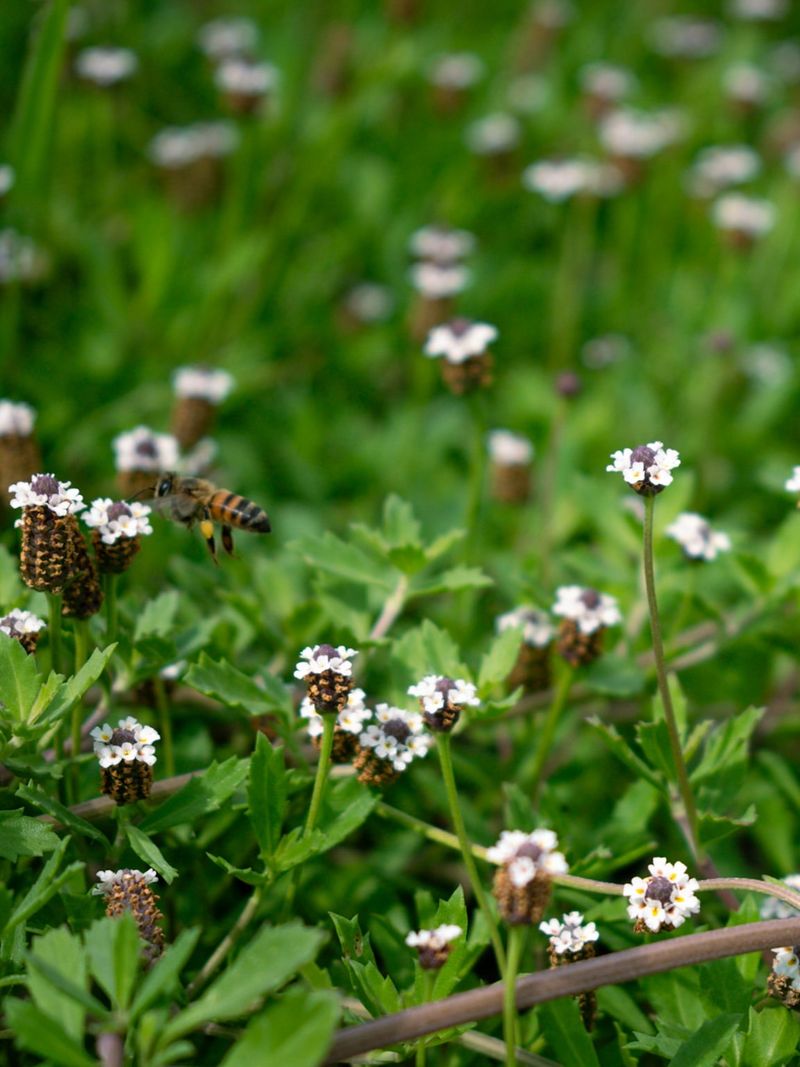
Texas frogfruit can replace selected areas of exposed rock mulch when the goal is a low, native, habitat-supporting groundcover that may also cool its own surface while actively growing and transpiring. The Texas A&M surface temperature research and the broader vegetation science behind it support a real cooling mechanism tied to evapotranspiration, but neither source directly proves that this specific USDA-profiled species beats every gravel product at every hour of a Texas heat wave.
The stronger case for frogfruit is the one gravel can never make: butterfly larvae, pollinator nectar, living roots, and improving soil biology over time. Start with a well-prepared, contained area matched to your local Texas ecoregion, manage edges as the plant spreads, and give it the establishment watering it needs before asking it to handle drought on its own. Texas SmartScape’s profile is a solid starting reference for regional fit and placement options.
A yard that feeds the food web while potentially running cooler than the rock beside it is a better yard by most Texas measures. The cooling is a bonus worth having; the habitat is the reason to plant it.