
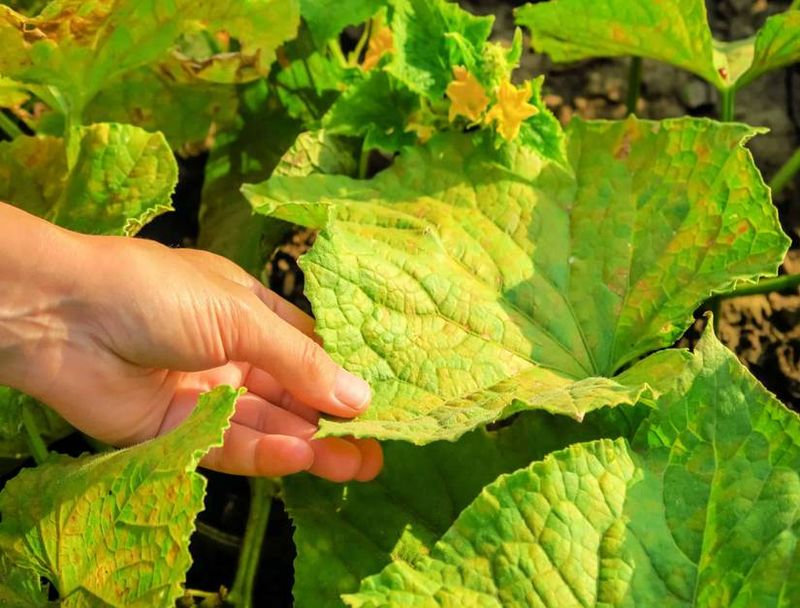
Watching your cucumber vines turn yellow during the hottest weeks of summer is genuinely worrying, especially when the plants looked fine just days ago. The instinct is to blame the heat or reach for the hose, but yellow leaves have a long list of possible causes, and watering more is not always the answer. Getting to the bottom of it means starting at the root zone, reading the pattern of yellowing across the vine, and ruling out pests and disease before you treat anything.
Start with the root zone—but do not assume it caused the yellowing
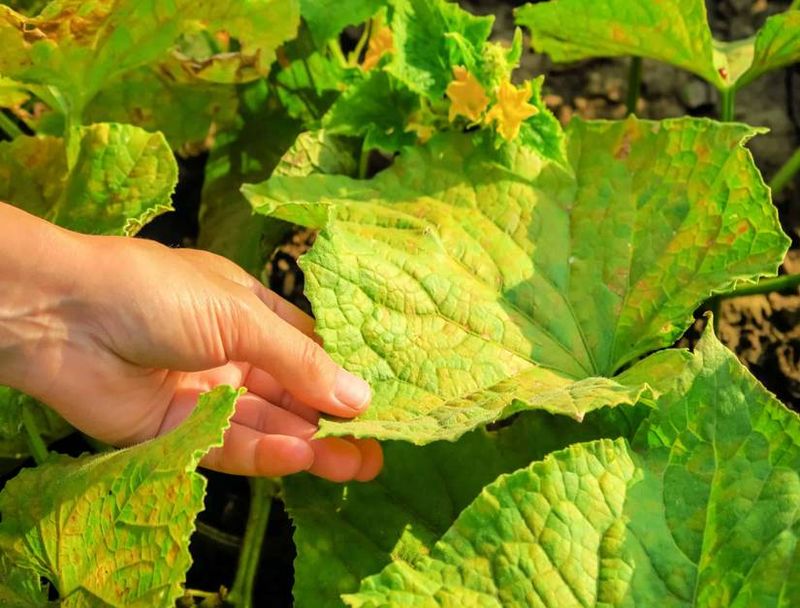
Hot, windy summer days pull moisture out of cucumber leaves faster than the roots can replace it, so checking the root zone first is a sensible move. That said, yellow cucumber leaves are not proof that the roots caused the problem. University of Minnesota Extension’s cucumber leaf discoloration guide lists natural aging, nutrient deficiency, spider mites, aphids, cucumber beetle-associated bacterial wilt, downy mildew, powdery mildew, and viruses as common causes alongside moisture stress. Any of these can produce yellow leaves without the roots being the original problem.
Before adjusting irrigation, push a finger or a trowel into the soil several inches deep, near the plant but not pressed against the stem. What you find there matters more than how hot the air temperature is. Dry, crumbly soil means the root zone is short on water. Soggy, heavy soil that smells off is a warning sign of waterlogging, which can be just as damaging as drought.
Colorado State University Extension explains that waterlogged roots lose the ability to absorb water efficiently, which can make a plant look thirsty even when the soil is wet.
Compacted soil, restricted root spread, and physical root damage can also interrupt water delivery and produce similar symptoms. The soil check gives you a starting point, but the symptom alone cannot tell you what caused it. Hold off on any treatment until you have more information from the plant itself.
Match watering to what the soil actually needs
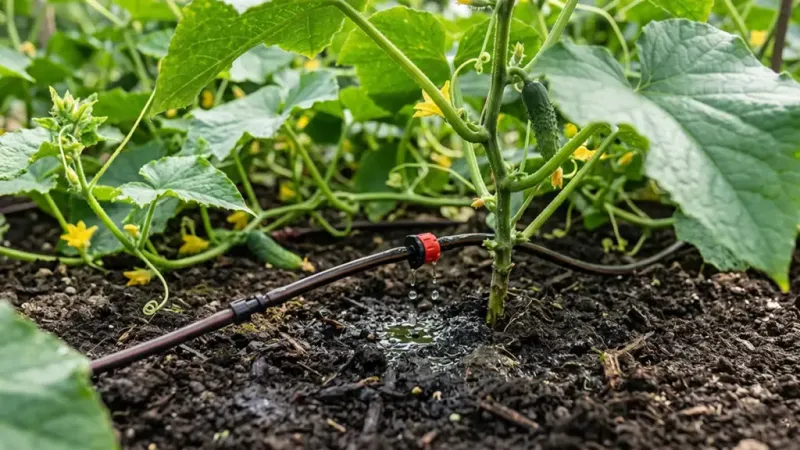
When the root zone turns out to be genuinely dry, the right response is a thorough, slow soak delivered at the soil line, not a quick splash on the leaves. Oregon State University Extension’s watering basics guide recommends deep, infrequent watering over shallow, frequent applications because it encourages roots to grow deeper and access a larger reservoir of moisture. A drip system or soaker hose placed along the row does this job well, keeps the foliage dry, and reduces the risk of foliar disease spreading through prolonged leaf wetness.
Mulch is worth adding if you have not already used it. A two- to three-inch layer of straw, wood chips, or shredded leaves slows evaporation from the soil surface and moderates temperature swings at the root zone. Keep it an inch or two away from the stem to avoid trapping moisture against the crown, which can encourage rot.
General extension guidance suggests cucumbers need roughly one to two inches of water per week, and Oklahoma State University Extension recommends about 1.5 inches every seven to ten days during the hottest months when rainfall falls short. Treat both figures as flexible starting points, not a fixed schedule. Sandy soil drains fast and may need more frequent attention. Containers and raised beds dry out faster than in-ground plots.
Trellised plants and those exposed to strong wind lose moisture more quickly. Count any rainfall toward your weekly total before reaching for the hose, and if the soil check still shows adequate moisture, do not add more water.
Read the yellowing pattern before treating the leaves
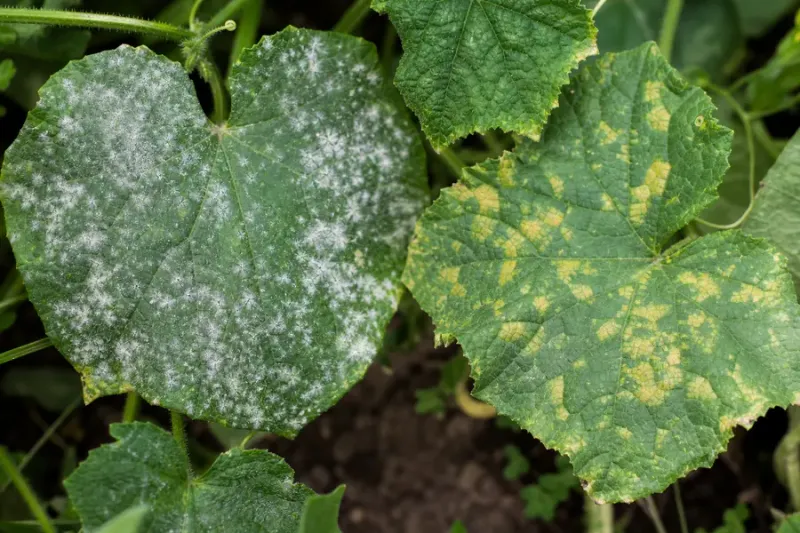
Where the yellowing appears on the plant, and what it looks like up close, tells you far more than the color alone. Penn State Extension’s plant health diagnosis resource emphasizes matching symptom patterns to likely causes rather than guessing from a single observation. Take a few minutes to walk the vine from base to tip and look at several affected leaves before forming any conclusion.
Older, lower leaves that turn uniformly yellow and drop off can fit natural aging as the plant directs energy toward fruiting. The same pattern also shows up with nitrogen deficiency, overwatering, or root problems, so it is a clue rather than a verdict. Flip those lower leaves over and look at the undersides. Fine pale stippling, a bronze or dusty cast, or delicate webbing are classic signs of spider mites.
UC Statewide IPM Program notes that spider mites thrive and reproduce rapidly in hot, dry conditions, and cucurbit crops are among their preferred hosts. Mite damage can look a lot like heat or drought stress from a distance.
Angular yellow patches bounded by the leaf veins, rather than spreading in smooth circles, point toward downy mildew or possibly angular leaf spot, a bacterial disease documented by Utah State University Extension. Mottled or mosaic coloring across leaves of all ages raises concern about a virus. Each pattern narrows the field of possibilities, but none of them is a definitive diagnosis on its own. Use what you observe to decide which direction to investigate next.
Treat whole-vine warning signs as a separate problem
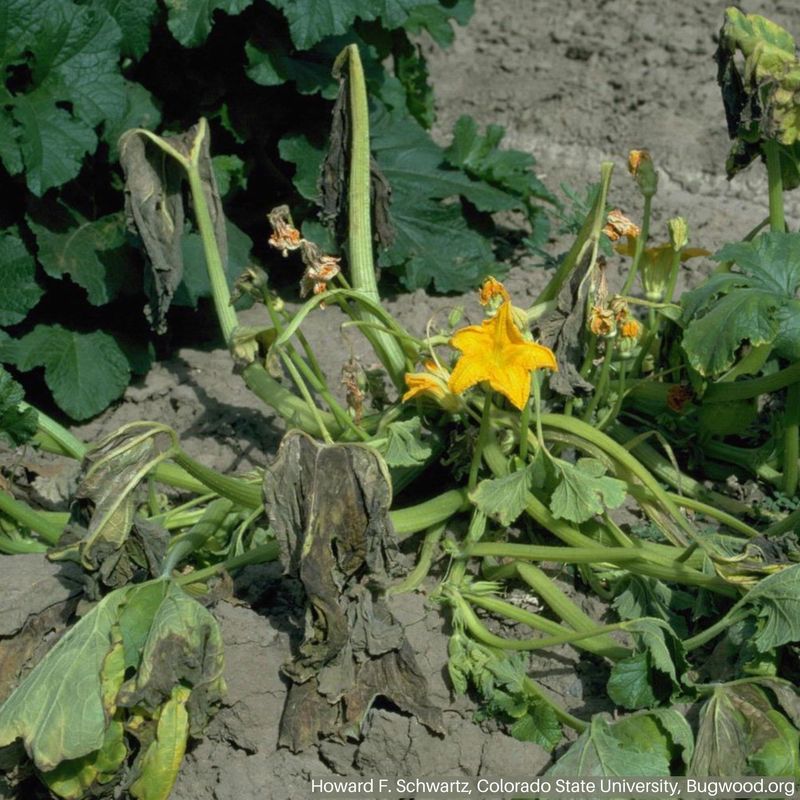
A few yellow leaves on an otherwise vigorous vine is a different situation from a plant that is collapsing vine by vine. Certain warning signs push the problem beyond a simple watering adjustment and call for a closer look at disease or root health. Learning to tell them apart can save the rest of your planting.
Daytime wilting that partially recovers overnight, then gets progressively worse over several days until the vine collapses entirely, is a recognized warning pattern for bacterial wilt. University of Minnesota Extension’s cucumber diagnosis tool flags this pattern as particularly associated with the presence of cucumber beetles, which spread the bacterial pathogen as they feed. Bacterial wilt is a systemic disease, and correcting soil moisture will not stop it.
Brown or decaying roots, a darkened or water-soaked area on the lower stem just above the soil line, persistent wilt that does not ease at night, and progressive yellowing spreading up the vine are signs that raise concern about Fusarium crown and root rot. Utah State University Extension’s Fusarium crown rot resource explains that this soilborne disease can kill plants outright, particularly in poorly drained soils. Adding more water to already saturated or diseased roots makes the situation worse, not better. University of Minnesota Extension’s disease management guidance underscores that systemic and established root diseases require a different response than ordinary moisture stress, and severe cases may not be recoverable.
When you see these signs, focus on protecting nearby healthy plants rather than expecting the affected vine to bounce back.
Do not fertilize until the evidence supports it
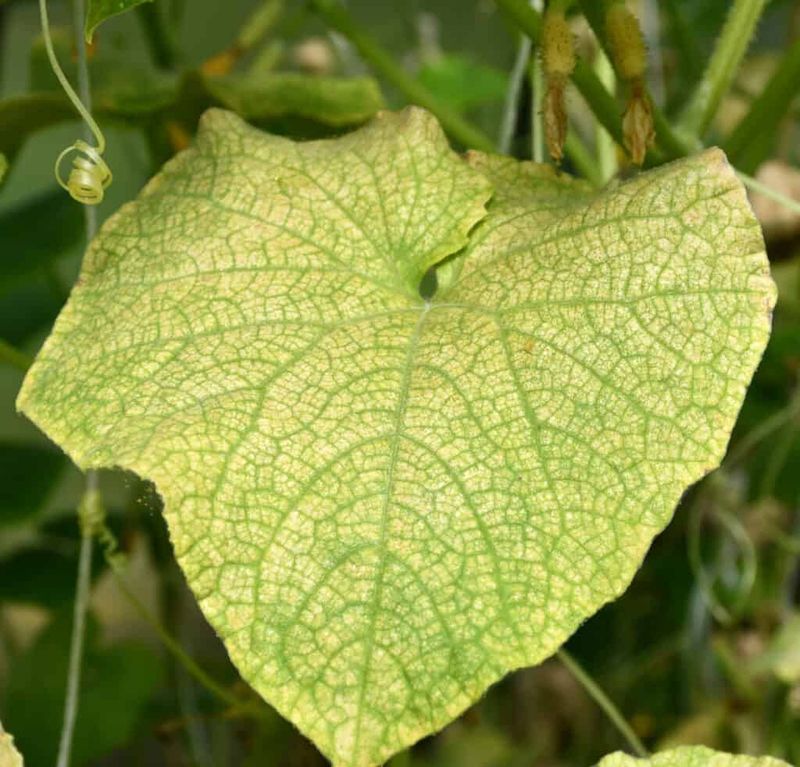
Yellow cucumber leaves almost always trigger the impulse to add nitrogen, and that impulse is understandable. Nitrogen deficiency does produce uniform yellowing that starts on older lower leaves and moves upward. But overwatering, root damage, natural aging, spider mites, and disease can produce leaves that look nearly identical. Applying nitrogen to a plant with waterlogged or diseased roots is unlikely to help and may push excessive leafy growth at the expense of fruit.
University of Minnesota Extension’s fertilizing guide recommends soil testing as the more reliable basis for fertilizer decisions rather than diagnosing by leaf color alone. A basic soil test, available through most state extension services, tells you what nutrients are actually present and at what levels. That information prevents you from adding what the soil already has in excess and helps you target a real deficiency when one exists.
One more thing to keep in mind about yellow leaves: they may not recover even after you correct the underlying problem. Colorado State University Extension notes that already damaged or scorched leaf tissue often stays discolored rather than returning to green. That is normal and not a sign that your correction failed. Watch the new growth emerging from the growing tips instead.
Healthy, green new leaves are the clearest signal that the plant is recovering and that conditions at the root zone have improved.
Follow a measured rescue sequence and use treatments carefully
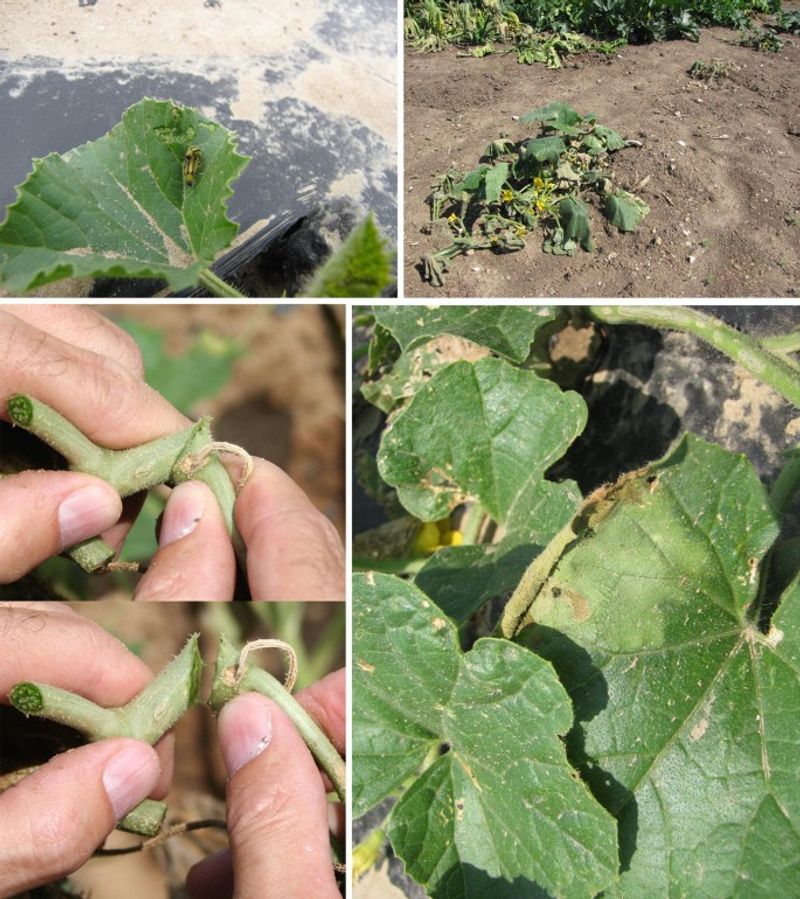
Once you have checked the soil, read the yellowing pattern, and ruled out whole-vine disease, you have enough information to act in a logical order. Start by correcting whatever the soil check revealed: water thoroughly at the root zone if the soil was dry, or hold off and improve drainage if it was saturated. Utah State University Extension’s cucumber irrigation guidance recommends moisture-retentive but well-drained soil, and raised beds as a practical fix where drainage is poor.
For foliar diseases such as angular leaf spot or cucurbit scab, Utah State University Extension and their cucurbit scab resource both suggest removing heavily affected leaves or plants when practical, improving air circulation around the vines, and avoiding working among wet plants to limit spread. University of Minnesota Extension’s disease management page reinforces that these cultural steps reduce spread of some diseases but cannot cure systemic infections such as bacterial wilt or viruses.
Spider mites are one situation where directing water at the foliage can sometimes help knock populations down, but UC IPM advises against applying insecticidal soaps or oils to water-stressed plants or during extreme heat, because the products can injure foliage under those conditions. Do not generalize the mite exception into a routine practice of overhead watering, which raises foliar disease risk across the rest of the garden.
Any pesticide use requires identifying the target pest or disease first. EPA guidance makes clear that you must use a product labeled for cucumbers and for the specific pest or disease you have identified, follow the rate and application directions exactly, and observe the preharvest interval printed on the label. Using a pesticide inconsistently with its label is a violation of federal law. Getting water to the root zone is the right first correction for moisture stress, but it is only one piece of the puzzle – healthy new growth at the vine tips is the real sign that your cucumbers are finding their footing again.