
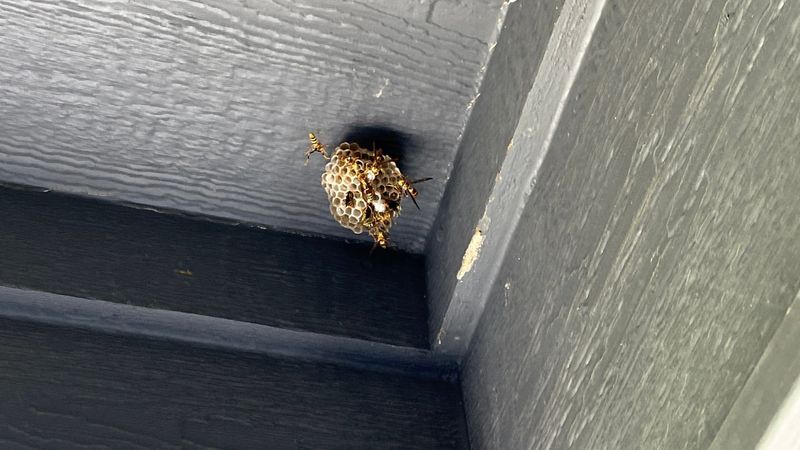
That gray, honeycomb-looking nest tucked under your porch eave is not a random accident. Paper wasps are deliberate about where they build, and a North Carolina porch gives them exactly what they need. Understanding why they chose your home, and what they do all day, can change how you think about the shrubs getting chewed up just a few feet away.
A sheltered porch explains the nest better than its compass direction
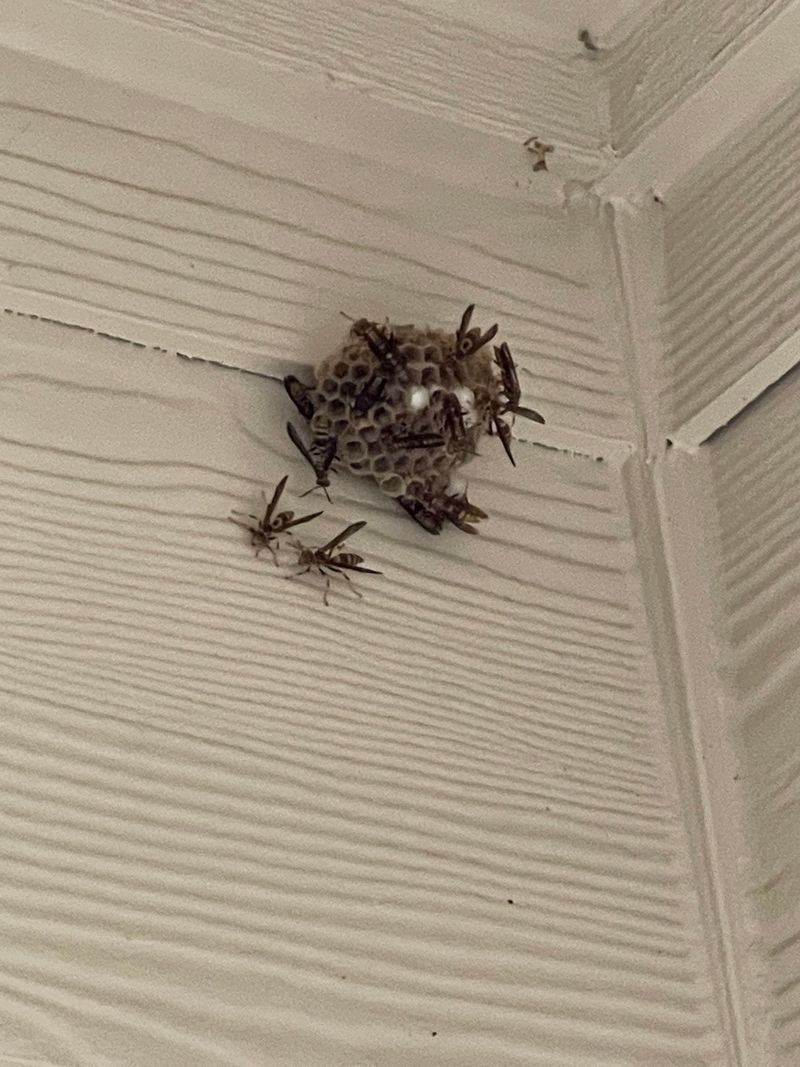
Plenty of homeowners assume a paper-wasp nest showed up because of which way their porch faces. A north-facing porch does not carry any special biological meaning for these insects. What actually draws them is shelter, specifically the kind of protected overhang that blocks rain, reduces wind, and keeps the nest hidden from birds and other threats.
NC State Extension guidance on stinging insects in North Carolina confirms that paper wasps routinely attach their nests under eaves, porch roofs, window sills, awnings, and deck railings. The compass direction of your porch is incidental. A shaded overhang on any side of the house can serve the same purpose if it offers enough protection from the elements.
Paper wasps belong to the genus Polistes and build the open, umbrella-shaped nests that look like a cluster of gray paper tubes bundled together. Unlike yellowjackets, they do not enclose the nest in a papery shell, so the cells are visible from below. Each cell holds an egg, a larva, or a developing pupa.
A colony on your porch is a social group, not a lone insect squatter. Workers leave and return throughout the day, foraging for food and nest-building material. That activity near a door or seating area is what makes location so important when you decide whether to leave the nest alone.
The ecological value of a paper-wasp colony is real but conditional. Workers hunt caterpillars and other soft-bodied insects to feed their young, so a nearby nest may offer some natural pest control benefit in the surrounding garden. Whether that benefit outweighs the sting risk depends entirely on where the nest sits relative to people, pets, and daily foot traffic, and that is the central question this article works through.
What workers generally carry back to the larvae
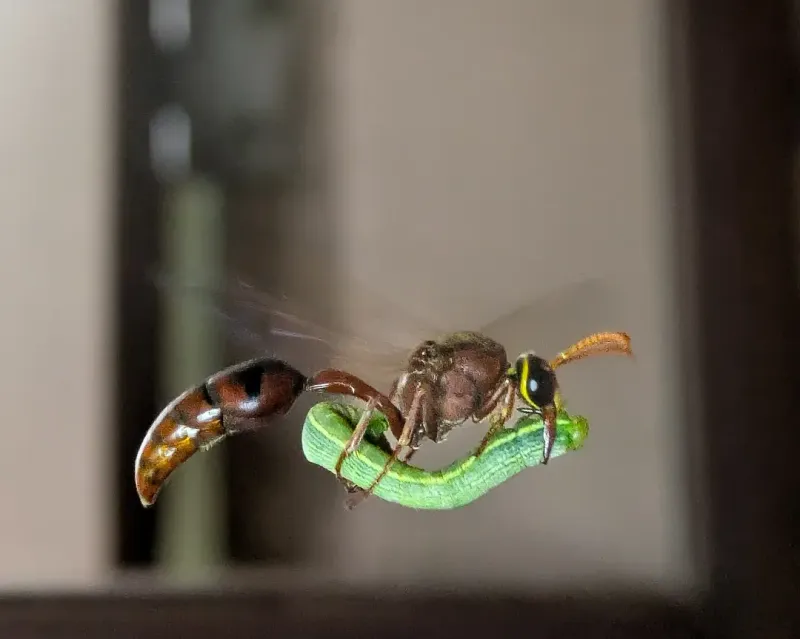
Watching a paper wasp land on a shrub and then fly back toward the porch can look purposeful, and it often is. Adult paper wasps do not eat solid prey themselves. They feed on nectar and other liquid food sources. The caterpillars and other soft-bodied insects they capture are processed into food for the larvae waiting in the nest cells.
The process works like this: a worker finds a caterpillar on a leaf, subdues it, and chews it into a protein-rich paste. She then carries that paste back to the nest and deposits it directly into a cell where a larva feeds on it. NC State’s beneficial predators resource on paper wasps describes workers as voracious caterpillar hunters whose prey-provisioning behavior makes the colony a documented predator of garden caterpillars.
Research published in a peer-reviewed journal reinforces the picture. A study on Polistes metricus larval nourishment documents that the quality and quantity of prey provisions workers carry back directly affect larval development, which means colonies have a built-in incentive to keep hunting as long as larvae are present in the nest.
Caterpillars are not the only prey. Workers also take flies, small beetles, and other soft-bodied arthropods when available. Utah State Extension’s caterpillar pest management notes list paper wasps among the predatory insects that can reduce caterpillar pressure in enclosed growing spaces, which reflects the broader documented hunting behavior rather than a North Carolina-specific study.
One caution worth keeping in mind: seeing a wasp fly from a garden plant toward the porch does not prove that particular insect is carrying prey. Workers also make defensive flights, inspection trips, and nest-material runs. The provisioning behavior is well documented at the colony level, but an individual flight path does not confirm what any one wasp is doing.
The colony is not one uniform kind of paper wasp
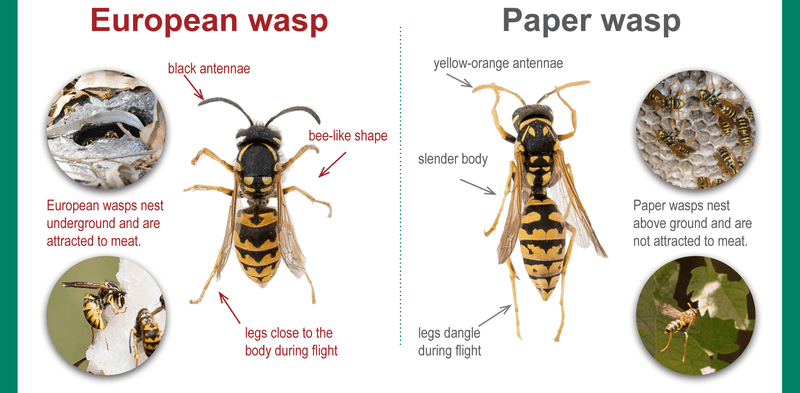
Before treating any paper-wasp nest as a garden ally, it helps to know that “paper wasp” covers more than one species. North Carolina is home to several native Polistes species, and the introduced European paper wasp, Polistes dominula, has also established itself across much of North America. They can look similar at a glance, but their behavior and ecological effects are not identical.
NC State’s paper wasp profile describes the group broadly as beneficial caterpillar predators, which is accurate for native Polistes species as a general statement. The nuance comes in when you look at the introduced European species.
Penn State Extension’s European paper wasp guide notes that Polistes dominula has a more varied diet than many native paper wasps and that research has raised concerns about its effects on some caterpillars, including monarch larvae, in certain urban settings. That detail matters if you are also trying to support native butterflies in your yard.
Identifying which species you have requires a close look at color patterns. Native species such as Polistes exclamans tend toward reddish-brown and yellow banding, while the European paper wasp often shows brighter yellow and black markings that can superficially resemble a yellowjacket. If you are uncertain, your local NC Cooperative Extension office can help with identification.
The practical takeaway is that a paper-wasp colony on your porch is not automatically a net positive for every native insect in the yard. Native Polistes species offer well-documented caterpillar predation benefits. The European paper wasp brings some of the same hunting behavior but also some ecological trade-offs that are still being studied. Knowing which one you have gives you a more honest picture of what the nest is contributing.
Fall webworms may be part of the story—but not the whole story
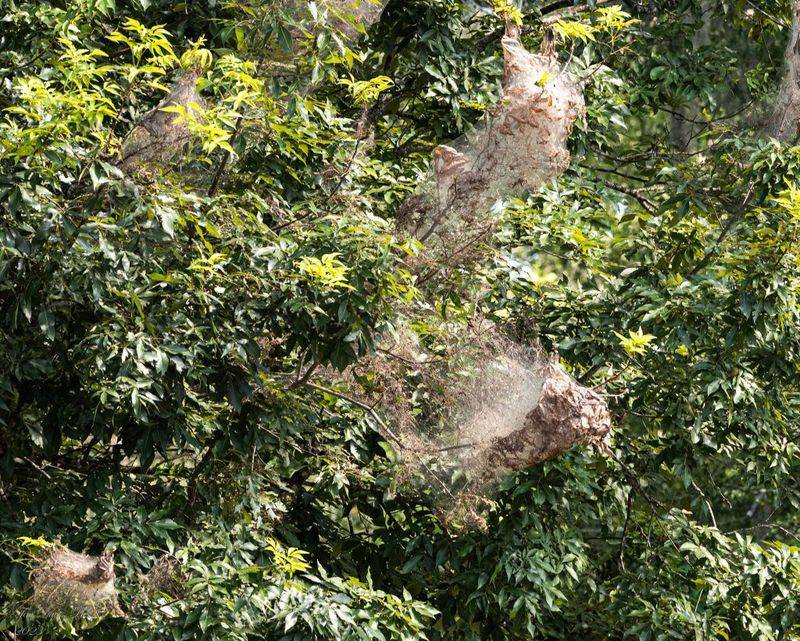
Fall webworms are one of the most visible caterpillar pests in North Carolina landscapes. They spin large silk webs over branch tips and feed inside them in groups, leaving behind skeletonized leaves and that unmistakable white tent that shows up on pecans, sweetgums, and dozens of other trees from late summer into fall. They are not the same pest as tent caterpillars, which appear in spring and build webs in branch crotches rather than over branch tips, and they are not bagworms either. Getting the identification right matters before choosing any management approach.
University of Georgia Extension’s fall webworm management guide explains that the pest has many natural enemies, including insect predators, parasitoid wasps and flies, spiders, birds, and lizards. Paper wasps fit into that broader natural-enemy community as documented caterpillar hunters, and a nearby colony may take some caterpillars when workers are foraging in the right area at the right time.
The important word there is “may.” NC State identifies paper wasps as beneficial caterpillar predators, but there is no published North Carolina field study showing that a single porch colony removes a meaningful number of fall webworm larvae or prevents defoliation on a specific tree. The UGA fall webworm fact sheet focuses on monitoring, biological control as part of a broader system, and targeted treatment rather than relying on any one predator.
Integrated pest management gives a clearer path forward. NC State’s IPM handbook chapter recommends identifying the pest, monitoring plant damage, and choosing controls based on the pest’s life stage and the severity of the problem. For fall webworms, that might mean pruning out accessible webs, applying Bacillus thuringiensis to young caterpillars before the web grows large, or simply monitoring a mature tree that can tolerate late-season defoliation without lasting harm.
A paper-wasp colony is a reasonable part of the natural-enemy picture, not a substitute for that kind of targeted thinking. Preserving the nest when it is safely located is a sensible stewardship choice. Treating it as a guaranteed fall-webworm solution is not.
Japanese beetles require a different diagnosis
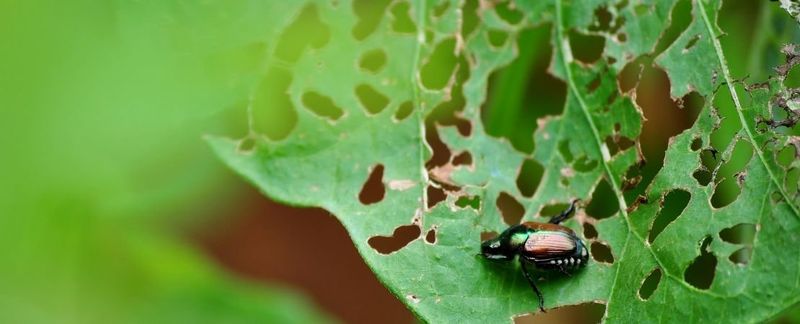
Japanese beetles are a real and frustrating pest for many North Carolina gardeners, chewing roses, crape myrtles, grapes, and dozens of other plants into lacy skeletons during summer. The temptation to connect them to the paper-wasp nest on the porch is understandable, especially if you have read that wasps eat garden pests. The connection does not hold up, though, and acting on it could lead to misplaced confidence in the nest and delayed action on the beetles.
Paper wasps are documented hunters of caterpillars and other soft-bodied insects. Adult Japanese beetles are hard-shelled, leaf-chewing beetles. They are a fundamentally different type of prey, and the porch-nesting Polistes wasps on your eave are not a reliable control for the adult beetles damaging your plants. NC State Extension’s Japanese beetle guide focuses management on the adult stage, recommending monitoring, hand-picking, targeted insecticide applications timed to adult feeding, and plant selection to reduce attractiveness.
The wasp species associated with Japanese beetles are a different group entirely. Tiphiid and scoliid parasitoid wasps attack Japanese beetle grubs in the soil, not the adults on leaves. University of Maryland Extension’s white grub resource and the UMD guide to natural enemies of Japanese beetles both identify tachinid flies, spring tiphiid wasps, and other organisms as the natural enemies relevant to the beetle’s life cycle. None of these are the open-nest Polistes wasps building under your porch railing.
The practical step is to treat Japanese beetle damage as its own separate problem requiring its own diagnosis and response. Monitor when adults appear, typically June through August in most of North Carolina, assess the level of damage, and choose a management approach matched to that specific pest and life stage. The paper-wasp nest nearby may help with caterpillar pressure in a general way, but it is not part of the Japanese beetle equation.
Leave the nest only when the location is genuinely low-risk
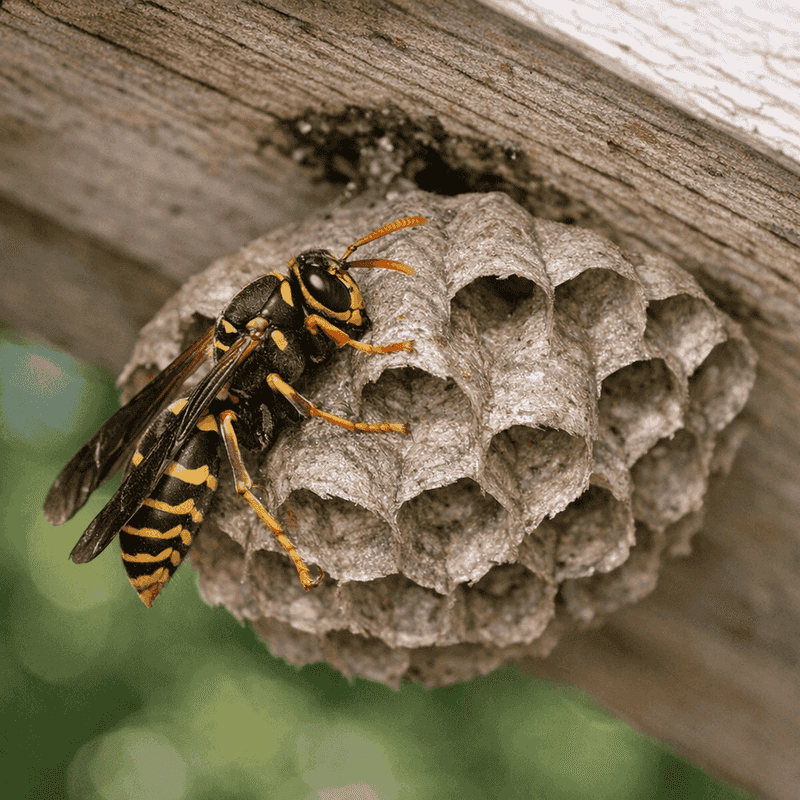
Leaving a paper-wasp nest alone is a reasonable stewardship choice, but only when the location actually supports it. The nest’s ecological role does not change the sting risk, and that risk depends almost entirely on where the nest sits relative to the people and animals who use the space every day.
A nest tucked under an eave at the far end of a porch, away from doors, seating, and foot traffic, presents a different situation than a nest directly above a frequently used entry or beside a child’s play area. University of Maryland Extension’s social wasp guide notes that paper wasps are generally less aggressive than yellowjackets when foraging away from the nest, but nest disturbance triggers defensive behavior, and they can sting repeatedly. That changes the calculus quickly when the nest is in a high-traffic spot.
Several behaviors reliably provoke a defensive response and should be avoided around any active nest. Striking or swatting at the nest, mowing directly beneath it, using a broom or hose to knock it down, or reaching into concealed spaces where a nest may be hidden all carry real risk of triggering a group defense. Even vibrations from a lawnmower passing close by can be enough.
Certain household situations make removal the safer default rather than the last resort. A nest near a frequently used door, a walkway, outdoor seating, a pet’s run, or a child’s play structure warrants serious consideration of removal regardless of the nest’s potential garden benefit. Anyone in the household with a known severe sting allergy, or a history of anaphylaxis, should not treat an active nest as a wildlife feature to preserve.
When removal is the right call, NC State Extension’s stinging insect guidance recommends using a product labeled for wasps, treating at night when the colony is less active, and wearing protective clothing. For nests that are elevated, concealed inside a wall void or soffit, unusually large, or otherwise difficult to reach safely, Penn State Extension’s stinging insect removal guide recommends calling a licensed pest management professional rather than attempting removal from an unsafe ladder position or without proper protective gear.
Peaceful coexistence with a paper-wasp colony is a genuinely good option when the conditions support it. The key word is “when.” The location assessment comes before the stewardship decision, not after.
A seasonal colony changes the long-term decision
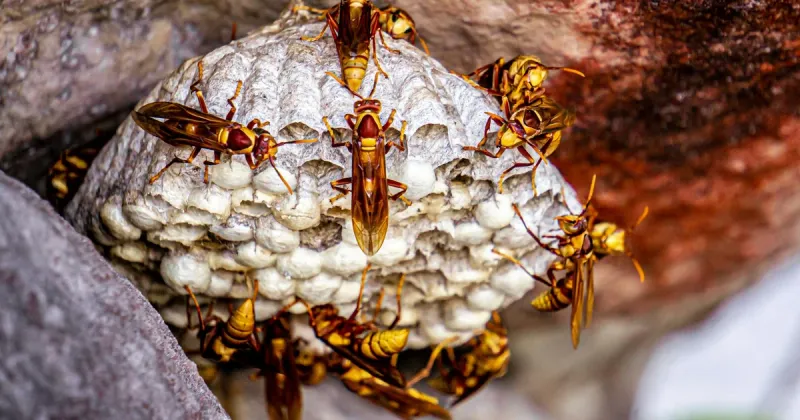
Paper-wasp colonies in North Carolina follow a predictable annual pattern, and knowing that pattern helps homeowners think through the long-term picture without misreading what is happening at any given point in the season.
A single mated queen starts the nest in spring, building the first few cells and raising the initial worker brood on her own. Workers emerge and take over foraging, nest expansion, and larval care through late spring and summer, which is when the colony is largest and most active. NC State Extension’s stinging insect resource explains that in early fall, the colony shifts its energy toward producing reproductive males and new queens. Those reproductives mate, the original workers eventually die, and the nest is abandoned rather than reused the following year.
That seasonal endpoint does not mean an active fall nest is less risky. A colony producing reproductives in September or October still has workers capable of defending the nest, and the increased activity around mating can make the area feel more congested with wasps than it did in midsummer. Waiting out an unsafe nest because “it will be gone soon” is not a sound safety strategy.
What the seasonal pattern does offer is perspective for the following spring. An abandoned nest from the previous year poses no sting risk and can be removed at any time. New queens will scout for fresh nest sites in spring rather than returning to the old one, so leaving an empty nest in place does not guarantee a new colony will appear in the same spot, though a sheltered structure that worked once may attract a new founder.
Preserving a colony through the active season, when the location is genuinely safe, supports the natural predation that works alongside good garden monitoring. That monitoring, including identifying pests, tracking plant damage, and choosing targeted treatments when needed, remains part of the picture regardless of whether a wasp colony is present. NC State’s integrated pest management framework treats natural enemies as one tool among several, not as a replacement for informed observation.
The useful lesson is coexistence with limits
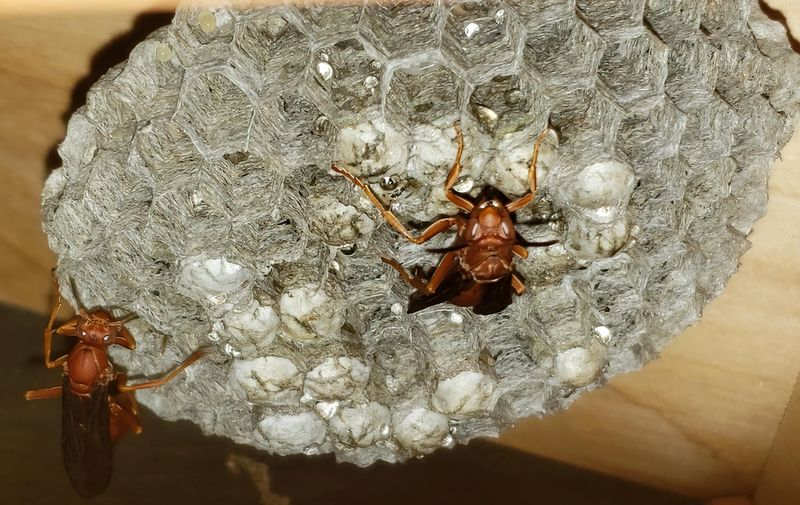
Pull the pieces together and a clear, practical picture emerges. The porch detail in the title points to shelter, not compass direction. Paper wasps chose your eave, railing, or overhang because it offers protection from weather and disturbance, the same reason they nest under any suitable human-made structure across North Carolina.
Workers do carry caterpillar prey back to the larvae, and that behavior is well documented. A colony near your garden may take some caterpillars as part of its normal provisioning activity. What that contribution looks like in practice depends on nest size, prey availability, and timing, and NC State’s paper wasp resource describes the benefit in general terms rather than as a guaranteed outcome for any specific yard. It is not a fall-webworm cure, and it has nothing to do with the adult Japanese beetles NC State advises managing directly through targeted adult-stage controls.
The homeowner’s decision comes down to three steps: identify the pest causing plant damage, assess the nest’s location against the realistic daily movement of people and pets, and preserve the colony when doing so is genuinely safe. NC State’s IPM guidance supports natural enemies as one part of a broader management system, not as a reason to skip monitoring or delay a targeted response when damage is escalating. A paper-wasp nest in the right spot is a quiet, low-effort ally worth keeping. The job of the homeowner is simply to confirm that the spot actually qualifies.