
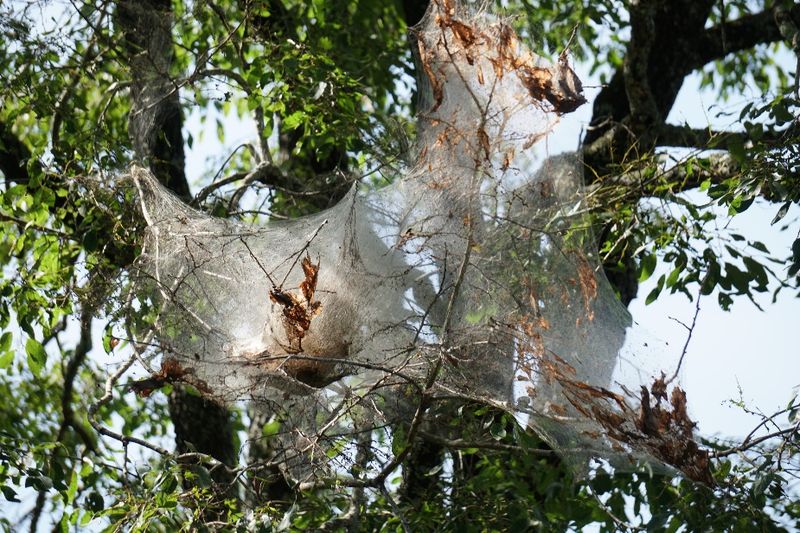
Every late summer, North Carolina homeowners start noticing white silky webs draped over the tips of tree branches, and the instinct to grab a saw or a spray can is hard to resist. Those webs belong to fall webworms, and while they look alarming, the story they tell is usually less urgent than the appearance suggests. Understanding what these nests actually mean, and which responses help versus which ones hurt, can save your trees and spare you a lot of unnecessary effort.
North Carolina’s late-season webs usually signal a cosmetic problem
Around late summer each year, white webs start appearing at the outer tips of tree branches across North Carolina yards, and the sight of them can feel urgent. NCDA&CS guidance on fall webworm describes the resulting damage as primarily aesthetic and usually not a threat to tree health, largely because the feeding happens toward the end of the growing season when trees have already done most of their photosynthetic work for the year.
The NC Forest Service 2024 forest health report documented conspicuous webs and activity in eastern North Carolina during late summer, with populations active across the Piedmont and Coastal Plain. That regional context is useful, but it does not mean every corner of the state is experiencing the same level of activity or that any one yard is necessarily at risk.
Part of why these nests feel alarming is pure optics. A single web can drape over a large section of branch, making a tree look far more damaged than it actually is. The caterpillars inside are consuming leaves, but healthy established trees typically handle ordinary late-season defoliation without lasting harm.
The exceptions matter, though. University of Massachusetts Extension notes that young trees, weakened trees, and those already stressed by drought, disease, flooding, or repeated defoliation face a higher risk from heavy infestations. For a mature, well-established oak or sweetgum with a handful of webs, monitoring is often the most reasonable first response. For a newly planted tree or one that has had a difficult growing season, a closer look is warranted before deciding to do nothing.
The web’s location separates fall webworm from look-alikes
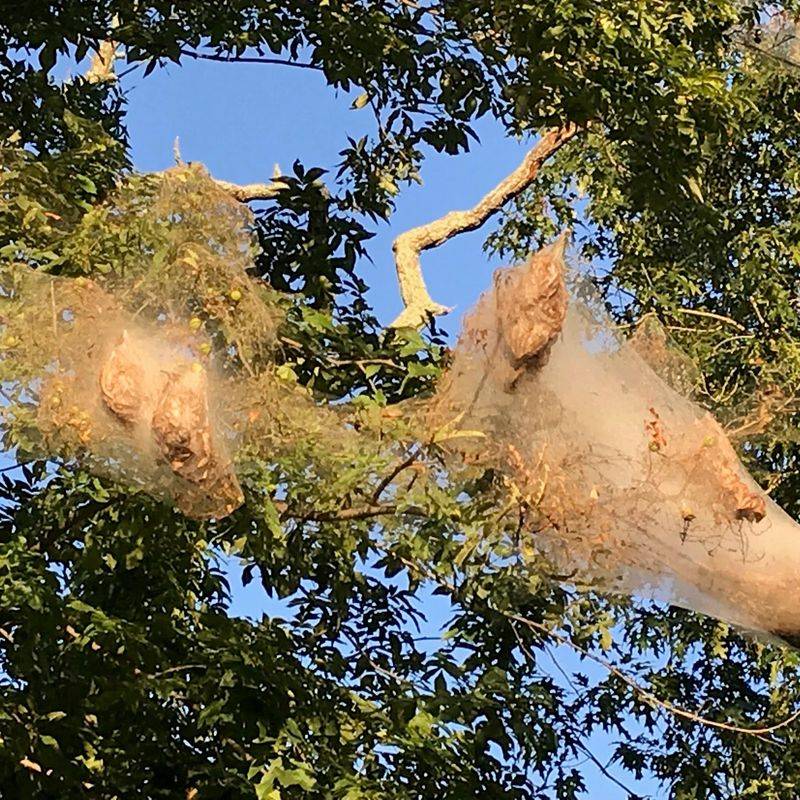
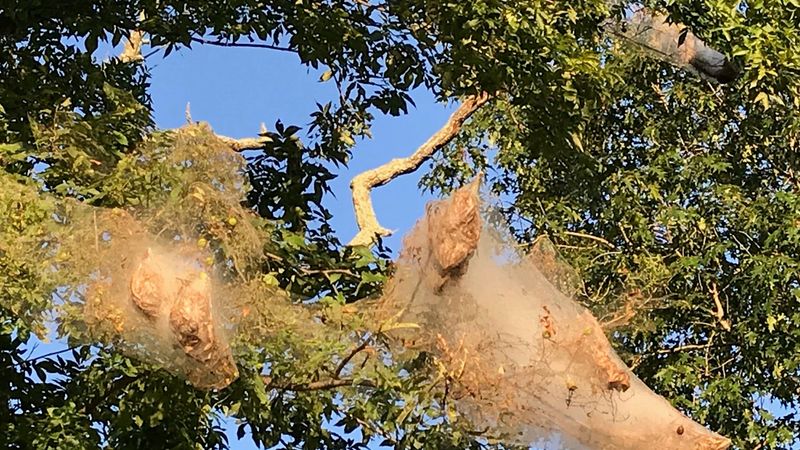
Before deciding how to respond to a web in your tree, confirming what you are actually looking at saves a lot of second-guessing. UC IPM’s fall webworm profile identifies the key visual clue: fall webworm webs are built over the ends or terminals of branches, enclosing leaves that the caterpillars consume from inside the silk. That branch-tip location is the single fastest way to separate fall webworm from its most common look-alike.
Eastern tent caterpillars build their webs in branch crotches rather than at branch ends, and they are primarily a spring pest. If you are seeing silky webs in the forks of branches during March or April, eastern tent caterpillar is the much more likely culprit. Fall webworm, by contrast, becomes noticeable in late summer and continues into fall, which matches the timing of what most North Carolina homeowners are encountering right now.
Fall cankerworm is a third insect worth keeping separate. NC Forest Service forest health records and NCDA&CS reporting on fall cankerworm make clear that despite a similar common name, fall cankerworm is a different insect entirely. Cankerworm larvae feed in spring rather than late summer, and repeated severe infestations in North Carolina have caused growth loss, decline, and in some cases tree mortality, making it a more serious concern than the typical fall webworm situation.
One more point worth noting: a web’s presence alone does not prove an active infestation. Mature caterpillars eventually leave the web to pupate, and old abandoned webs can persist on branches for weeks. Before treating anything, check whether the web actually contains live, small caterpillars, because a chemical application aimed at an empty or mature-colony web accomplishes nothing useful.
Fall webworm itself is Hyphantria cunea, a native North American moth whose caterpillars feed on many deciduous trees, including hickory, walnut, birch, cherry, crabapple, oak, sweetgum, maple, mulberry, and willow. NCDA&CS confirms this wide host range, which explains why webs can show up on so many different tree species across a single neighborhood.
What the caterpillars do—and why established trees usually cope
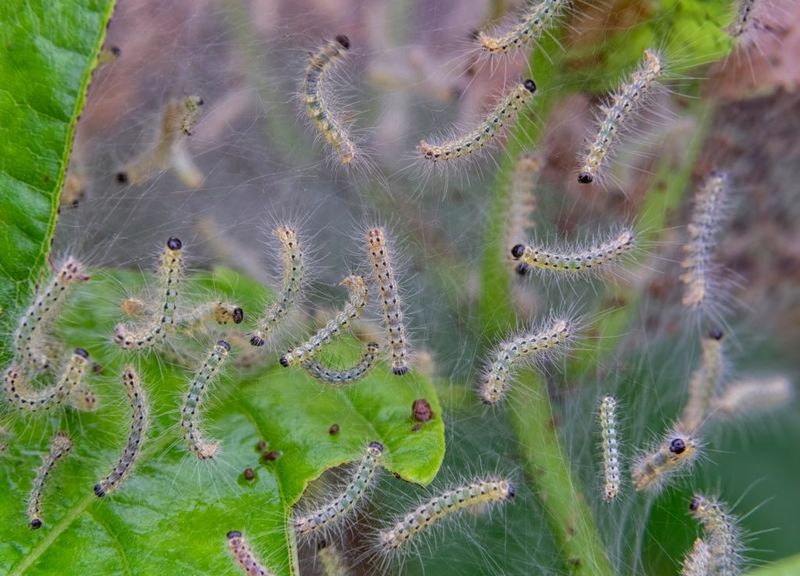
Watching a web grow larger over a few weeks can make the feeding inside feel more destructive than it typically is. Penn State Extension’s fall webworm guide explains that caterpillars begin by skeletonizing leaves, consuming the softer tissue while leaving veins behind, then progress to more complete leaf consumption as they grow. The web itself expands to enclose fresh foliage as the colony moves outward along the branch.
Large webs covering substantial portions of a branch can look severe, but Missouri Department of Conservation’s field guide notes that established trees are rarely killed by ordinary infestations. The timing explains a lot of that resilience. By late summer, most deciduous trees have already completed the bulk of their photosynthesis for the year, stored carbohydrates in their roots, and set next year’s buds. Losing some foliage at that point is inconvenient but rarely catastrophic for a healthy, mature tree.
The calculation shifts for trees that are already under stress. UMass Extension and UC IPM both note that heavy defoliation, repeated infestations across multiple seasons, or infestations on trees already weakened by drought, flooding, disease, advanced age, or recent transplanting can compound stress in ways that matter more than a single late-season event on a healthy tree.
A practical way to think about severity is to look at how much of the tree’s canopy is actually affected. A few webs on the outer branch tips of a large oak represent a very small fraction of the total leaf area. Many webs covering a significant portion of a small or young tree’s canopy is a different situation and deserves closer attention. Late-season timing reduces the usual consequence of defoliation, but it does not make every infestation equally harmless across all trees and all circumstances.
A nest belongs to the food web, not a yard-health scorecard
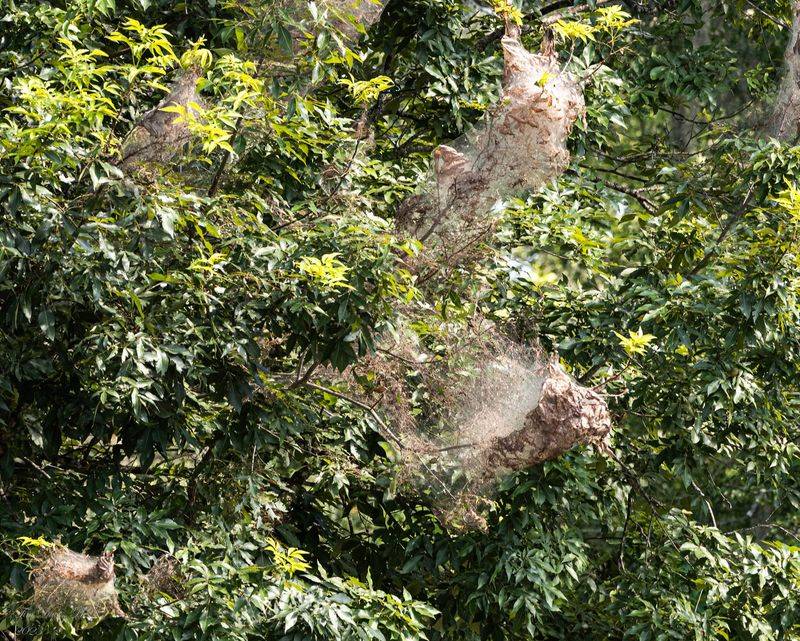
Fall webworms do not live in ecological isolation. USDA Forest Service research on fall webworm natural enemies documents an extensive list of predators and parasitoids that attack the caterpillars, including birds, spiders, predatory insects, lizards, and various parasitic wasps and flies. That web hanging from your tree branch is, among other things, a food source that multiple species in your yard interact with.
Published research in the Journal of Integrated Pest Management further describes the range of natural enemies associated with fall webworm populations. Knowing that these relationships exist is genuinely useful context for a homeowner deciding whether an automatic pesticide application makes sense on a healthy tree with a light infestation, because a broad spray can reach far more than the target caterpillars.
At the same time, the presence of a fall webworm nest is not a reliable signal that a yard is especially healthy, biodiverse, native-plant-rich, or wildlife-friendly. That interpretation goes further than the evidence supports. Fall webworm is a widespread native insect with a broad host range, and its appearance in a yard reflects the insect’s own biology and seasonal timing more than it reflects the quality of the surrounding habitat.
The more defensible framing is narrower: choosing not to apply an unnecessary pesticide avoids needless exposure of non-target organisms, including pollinators, beneficial insects, and the predators that do interact with webworm colonies. That is a reasonable argument for restraint when a tree is healthy and the infestation is minor. North Carolina pesticide guidance reinforces the principle that pesticide use should be deliberate and label-compliant rather than reflexive, which aligns with taking a measured look before reaching for a spray can.
When cutting helps—and when pruning creates the real problem
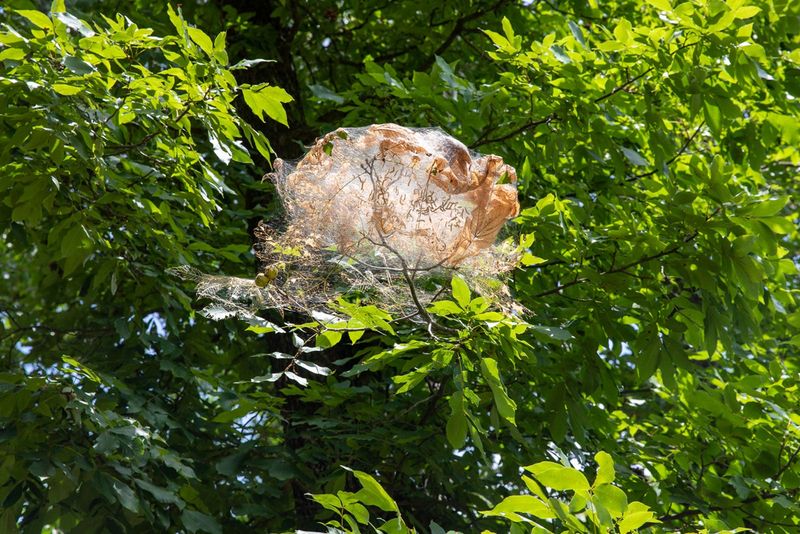
The article’s title suggests that cutting fall webworm nests down usually backfires, but that framing needs some precision before it becomes useful advice. Removing a small infested twig and destroying it is an accepted, extension-recommended control method, particularly on a small tree where the web is reachable without climbing. Penn State Extension explicitly recommends pruning out infested branches and disposing of the material as a mechanical control option.
What can genuinely backfire is a different kind of cutting: repeatedly shearing branch tips across a tree to erase every web, removing large structural limbs to reach a nest, or pruning an ornamental tree so aggressively that its natural shape is permanently altered. UGA Extension’s pest management guidance notes that indiscriminate pruning can disfigure ornamental trees, reduce productivity on fruit trees, and create unnecessary wounds that invite other problems. The issue is not removal itself but removal that exceeds what the situation actually calls for.
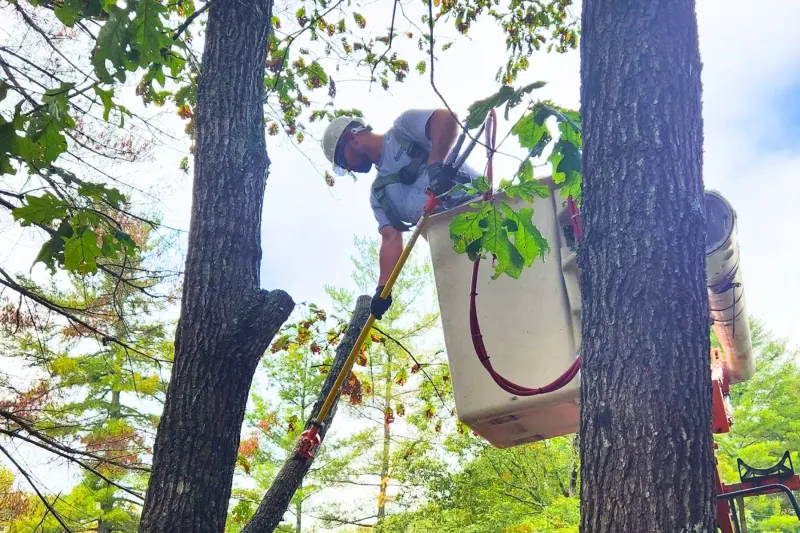
A useful alternative to pruning, particularly for webs that are reachable but not on twigs that need to come off, is web disruption with a pole-mounted tool. UGA Extension’s ornamental pest management resource describes tearing open the web to expose caterpillars to birds and other predators as a practical control step that can kill many caterpillars without any cutting at all. UC IPM similarly recommends web disruption as a mechanical option.
The guiding principle is proportionate, tree-conscious removal. Ask whether the twig being removed is small enough that the cut will not disfigure the tree or create a large wound. Ask whether the web is actually active and contains small caterpillars, since cutting out an abandoned web accomplishes nothing for tree health. And ask whether the same result could be achieved by opening the web rather than removing the branch.
A targeted snip on a reachable twig, or a firm poke with a pole to tear the silk open, handles most accessible infestations without the downsides of aggressive pruning.
The lowest-effort response is often to monitor first
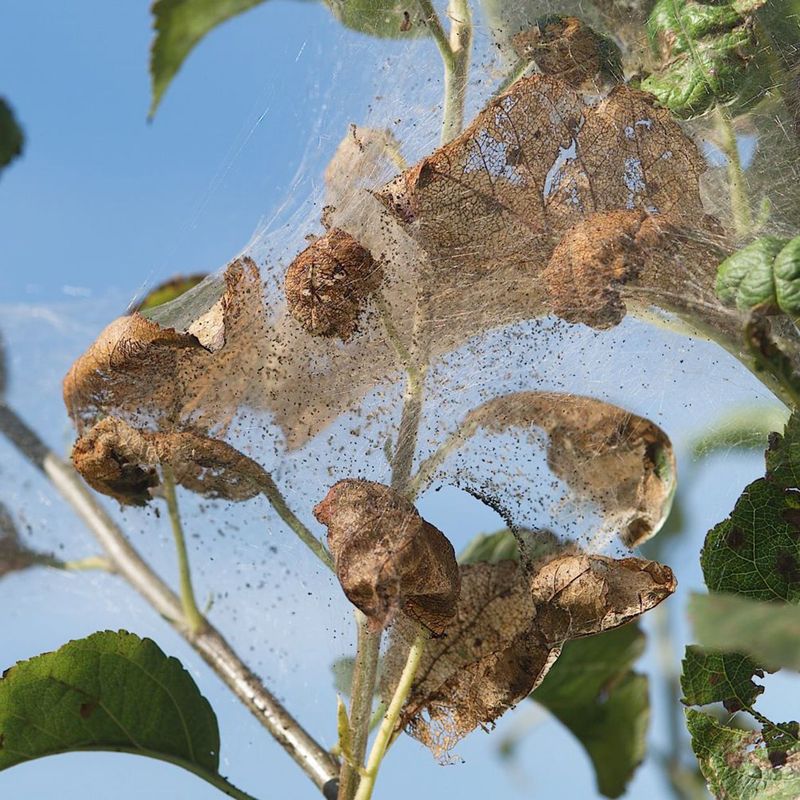
Monitoring sounds passive, but it is actually a deliberate choice that requires knowing what to look for. NCDA&CS and UMass Extension both support leaving infestations alone when the tree is healthy, only a few webs are present, and feeding appears limited and late-season. Natural enemies commonly attack fall webworm populations, and many infestations resolve without any intervention at all.
A practical decision sequence helps avoid both under-reaction and over-reaction. Start by confirming the web contains live, small caterpillars rather than an abandoned silk structure. Then look at the overall tree: how much of the canopy is affected, whether the tree shows any other signs of stress, and whether this is a first-time event or a recurring pattern across multiple seasons.
If the tree is healthy and the infestation is light, monitoring through the rest of the season is a reasonable call. If one or two webs are reachable, web disruption with a pole or selective twig pruning can handle them without escalating to a chemical response. Penn State Extension places mechanical control before chemical control in its recommended sequence for exactly this reason.
Chemical treatment becomes more relevant when larvae are small, the infestation is heavy, the tree is already stressed, or mechanical methods are not practical given the tree’s size or the number of webs. UGA Extension advises that treatment should target the web and nearby foliage rather than automatically covering the entire tree. Bacillus thuringiensis var. kurstaki is one option listed by extension sources when treatment is warranted and larvae are small, but it is not a universal prescription, and timing, label compliance, and protective equipment requirements all apply before any product is used in North Carolina.
The key mental shift is moving from a reflex response to a size-up-then-act approach. Most late-season webs on healthy trees in North Carolina do not require anything beyond a watchful eye and a willingness to revisit the situation if conditions change.
Pesticides and tall trees require more caution than the web does
A common mistake is treating a fall webworm infestation as though the web is the most dangerous thing in the yard, when the greater hazard can come from the response itself. Spraying an entire tree with a household insecticide is not a recommended approach under any extension guidance reviewed here, and North Carolina’s pesticide guidance for consumers is clear that pesticide use must follow the product label, including requirements for protective equipment, application rates, and precautions for people, pets, pollinators, and wildlife.
Broad applications aimed at high webs in large trees carry particular risks. UGA Extension warns that spraying trees of any significant size can be problematic and recommends that large-tree insecticide applications generally be handled by trained professionals rather than homeowners attempting to reach high canopy with equipment they are not accustomed to using.
The same caution applies to physical access. Homeowners should not climb trees or use ladders and other equipment in ways that exceed their comfort and safety experience to reach webs that are high in the canopy. A web that is genuinely out of reach from the ground or from a standard step ladder is a web that should either be left alone or evaluated by a professional arborist who can also assess whether the tree itself needs attention.
When a tree shows substantial stress, significant defoliation across multiple seasons, or signs of disease or structural problems alongside a webworm infestation, that combination warrants a professional evaluation. The webworm may be a secondary issue on a tree already in decline, and treating the caterpillars while missing the underlying problem does not protect the tree. Proportionate action means matching the response to the actual situation rather than to the visual alarm of a white web in an otherwise healthy tree.
Protect the tree without demanding eradication
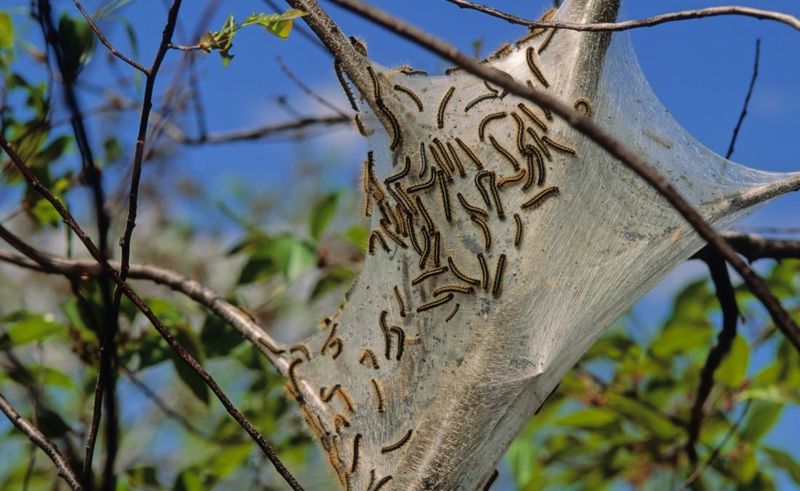
A reasonable response to fall webworms follows a short, repeatable sequence: confirm the web is active and contains small caterpillars, look at how much of the tree’s canopy is actually affected, and let the tree’s overall health guide the next step. NCDA&CS supports monitoring as a first response for healthy trees with limited late-season activity, and Penn State Extension places mechanical control before any chemical option in its recommended sequence.
For reachable webs, disrupting the silk with a pole or pruning out a small infested twig and disposing of it can handle the situation without escalating further. Reserve targeted treatment, or a call to a professional, for trees that are young, stressed, repeatedly defoliated, or simply too large to manage safely from the ground.
USDA Forest Service research confirms that fall webworms are part of local food webs with many natural enemies, which is a real reason for measured rather than automatic responses. Their presence, though, is not a diagnosis of yard health or biodiversity, and treating a nest as a nature-richness badge misreads what the evidence actually shows.
The corrected premise is straightforward: limited, targeted removal of reachable material can help when it is warranted. Unnecessary or aggressive pruning is what risks backfiring, by disfiguring the tree, opening wounds, or reducing fruit production without meaningfully reducing the infestation. Most fall webworm situations in North Carolina resolve on their own schedule, and the homeowner who takes a moment to size up the tree before acting usually ends up doing less work, not more.