
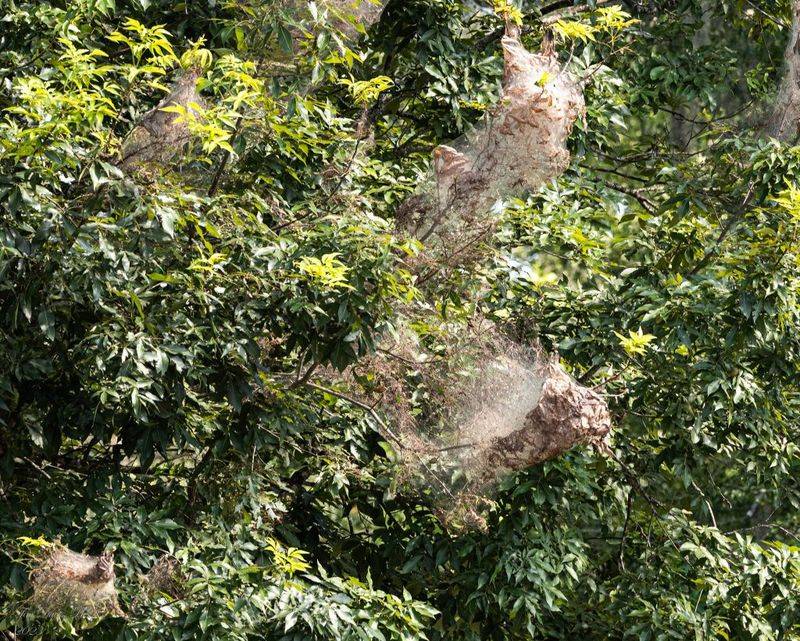
Silky white webs draped over tree branches are one of summer’s most startling sights in a North Carolina yard. Many homeowners assume the worst, picturing a diseased or dying tree, but the reality is usually far less dramatic. Fall webworms are native insects with a long history in this region, and knowing what their webs actually signal can save you from unnecessary worry, wasted money, and hasty decisions about your trees.
Seeing a Web Does Not Mean the Tree Is Failing
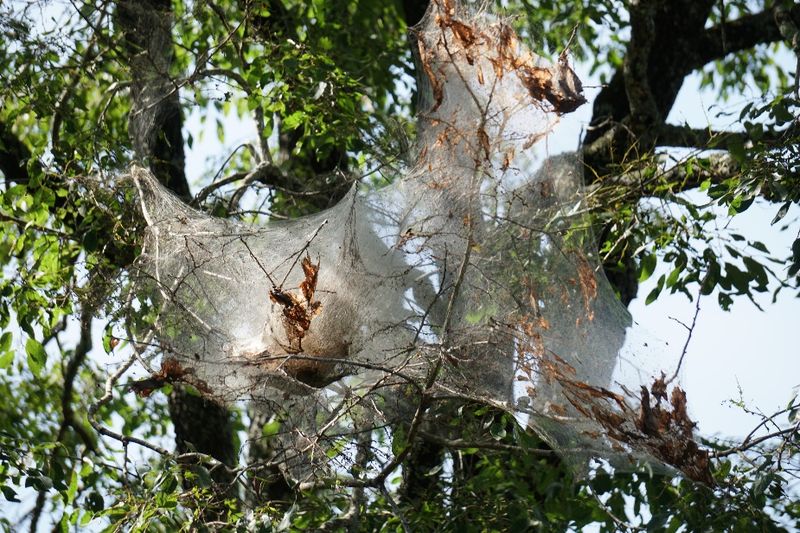
A loose web draped over a branch tip in your yard is not a distress flare from a sick tree. NC State Extension guidance on fall webworms confirms that fall webworm (Hyphantria cunea) is a native insect, active throughout the North Carolina summer, and capable of producing at least two generations in the state each year. Seeing one of these webs during summer is a seasonally normal event, not evidence that something has gone wrong with your tree.
The web itself is a signal about food and location, not tree health. It tells you the tree is a suitable host plant and that webworm moths found it and laid eggs there. That is an observation about local insect activity, not a diagnosis of disease, nutrient deficiency, dead wood, or structural decline.
A web does not rule out separate tree problems, either. If your tree also shows wilting, unusual bark damage, branch dieback, or discolored leaves well away from the web, those symptoms deserve their own assessment. The web and the separate symptom may be unrelated, so look at each independently rather than blaming one on the other.
Summer sightings of fall-webworm webs on North Carolina hardwoods are plausible based on the insect’s documented seasonal activity in the state. The available evidence does not confirm a statewide outbreak or that webs are currently widespread in every part of North Carolina. What the evidence does support is that NC Cooperative Extension reporting on webs in trees consistently frames fall-webworm activity as a routine seasonal occurrence rather than an alarm.
Treating a web as a crisis can lead to unnecessary pruning, premature removal decisions, or pesticide applications that cost money and harm beneficial insects without improving the tree’s long-term health. A measured first response, starting with correct identification, puts you in a much better position than reacting to the web’s appearance alone.
Identify the Loose Web at the Branch Tip
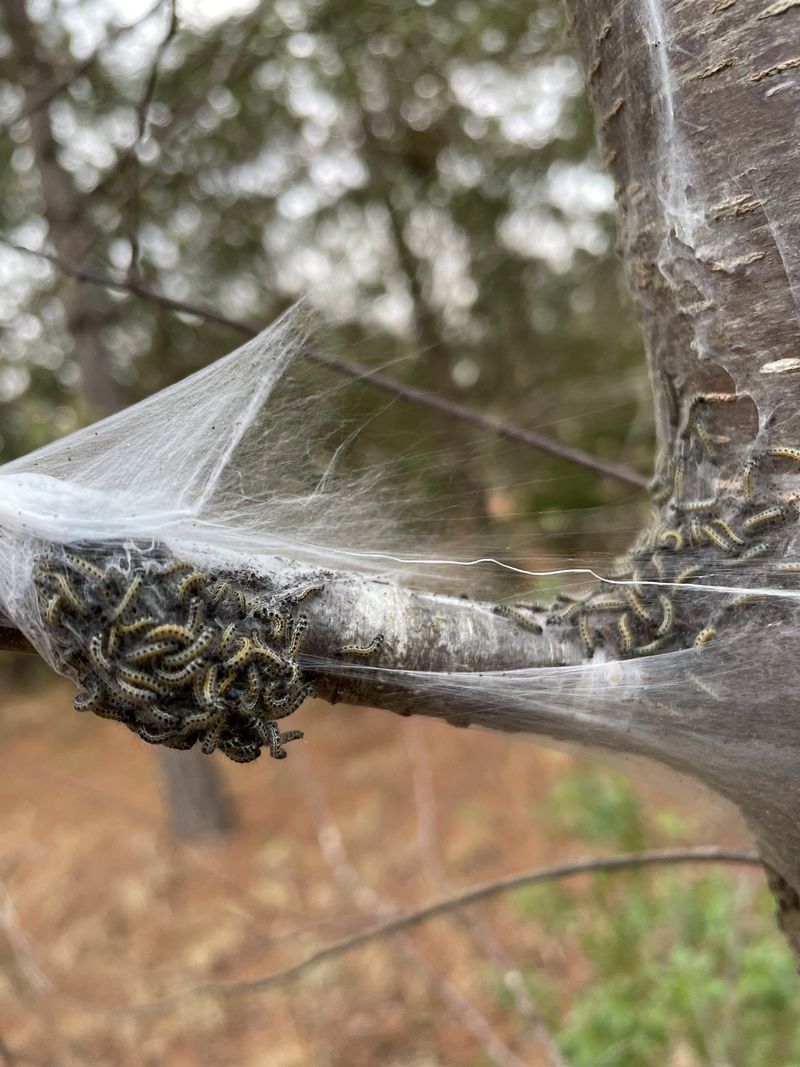
Fall-webworm webs have a distinctive look once you know what to seek. NC Cooperative Extension’s description of webs in trees characterizes them as loose silk enclosures wrapped around the ends of branches, with the caterpillars feeding on the foliage inside. As the caterpillars eat through the leaves within reach, they expand the web outward to enclose fresh foliage, so a web that looked small one week may be noticeably larger the next.
Location matters for identification. Fall-webworm webs sit at branch tips, surrounding the terminal leaves. The caterpillars stay inside the web while they feed, which is why the enclosed foliage turns brown and skeletal. You may see dozens of small caterpillars moving within the silky material if you look closely.
Eastern tent caterpillars are a common source of confusion, but the differences are clear once you know them. NC Extension reporting on eastern tent caterpillars explains that their tents appear in spring, not summer, and form in the crotches where branches fork rather than at the tips. Eastern tent caterpillars leave the tent to feed and return to it for shelter, while fall webworms stay inside their web throughout feeding.
Bagworms are a third look-alike worth ruling out. Wayne County Extension guidance on bagworms and fall webworms notes that bagworms construct individual portable cases, often decorated with bits of plant material, that hang from branches like small ornaments. They do not build large communal webs. If you see separate spindle-shaped cases rather than a shared silky enclosure at a branch tip, you are looking at bagworms, which require a different response.
Getting the identification right before acting prevents misapplied treatments and unnecessary alarm. A summer branch-tip web with caterpillars feeding inside is a fall webworm, and that distinction shapes every decision that follows.
Many North Carolina Trees Can Host Fall Webworms
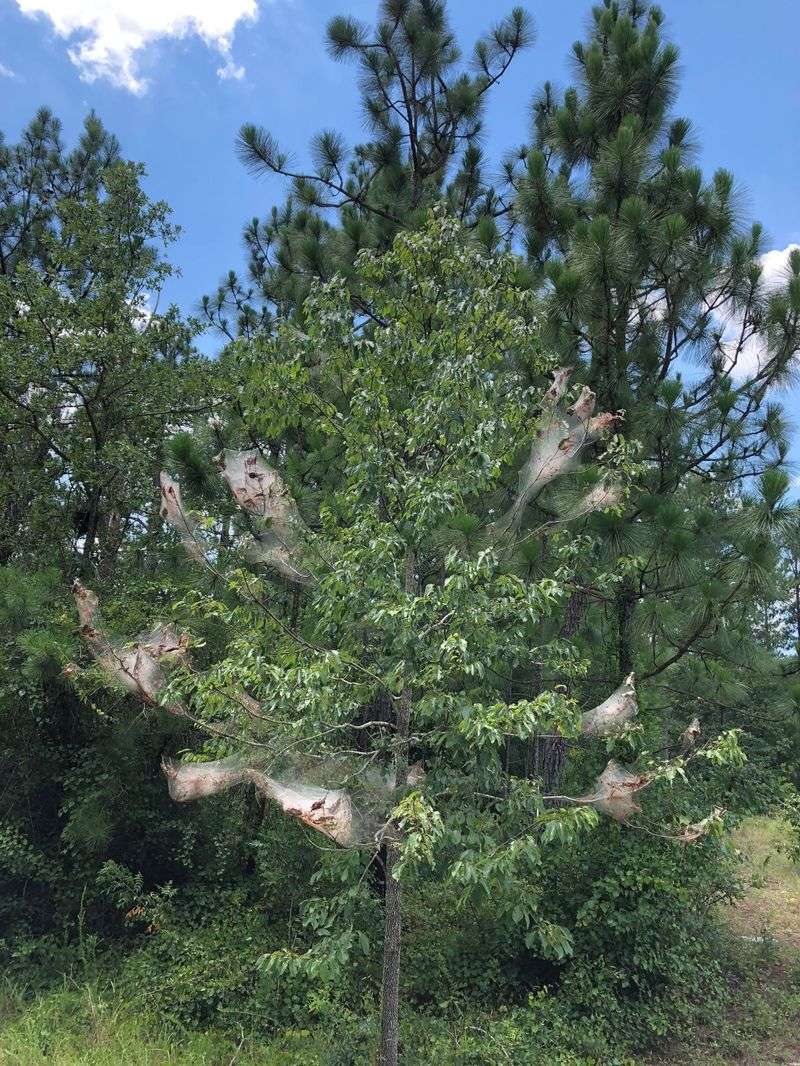
One reason fall webworms show up reliably every summer is that they are not picky. NC State Extension’s overview of fall webworms lists sourwood, persimmon, pecan, sweet gum, and cherry among the trees commonly affected in North Carolina, and the insect’s actual host range extends to redbud, crape myrtle, hickory, and many other deciduous species.
Seeing webs on a pecan or persimmon year after year is not a sign that those trees are chronically weak or poorly sited. It reflects the fact that fall webworm moths are searching for available foliage, and those particular trees offer it. NC Parks moth host records for Hyphantria cunea document the insect’s broad host range across many hardwood species, reinforcing that host selection is driven by availability rather than tree vulnerability.
The practical meaning for a homeowner is straightforward. If webs keep appearing on your sourwood or sweet gum, the tree has not developed a weakness that attracts insects. The tree is simply one of many acceptable food plants in the neighborhood, and local webworm populations are using it. Lee County Extension’s explanation of fall webworms on trees supports this framing, noting that the presence of webs reflects the insect’s wide appetite rather than a problem specific to the host tree.
Replacing the tree with a different species would not guarantee a web-free yard, since the insect’s range of acceptable hosts is extensive. The more useful response is to understand what the webs mean for that specific tree’s health and decide on a proportionate action from there.
Healthy Established Trees Often Need Only Monitoring
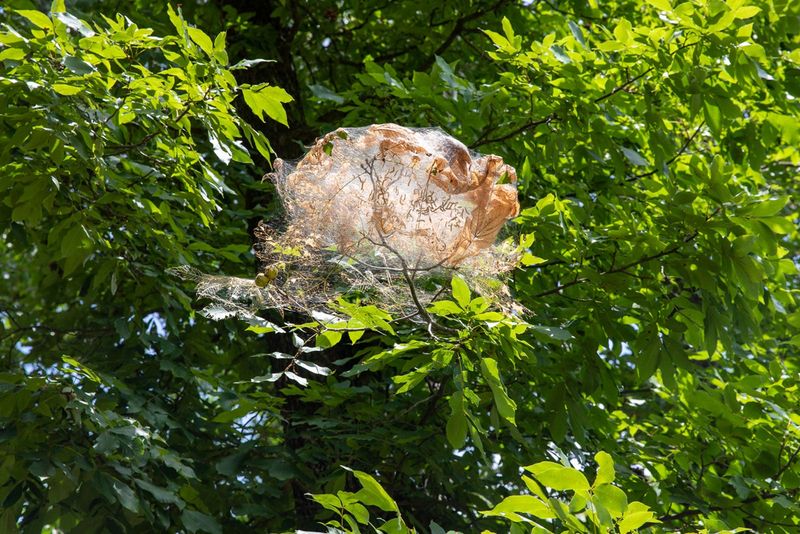
For a mature, otherwise healthy shade tree with a web or two, the most practical first move is often to watch and wait. Late-season leaf feeding by fall webworms is usually cosmetic and temporary on established trees, because the insects consume foliage near the end of the growing season when the tree has already done most of its photosynthetic work for the year. NC Cooperative Extension’s guidance on webs in trees states that treatment is generally unnecessary because the injury is cosmetic and the webs eventually disappear on their own.
If a web is within safe, ground-level reach, you have a low-effort option beyond pure observation. Opening the web with a long stick or pole exposes the caterpillars inside to birds, spiders, predatory insects, and parasitoid wasps that naturally prey on or parasitize them. NC State Extension’s fall-webworm resource mentions this approach as a practical, low-chemical way to address accessible webs. Natural enemies can suppress populations, though they should not be counted on to eliminate every caterpillar in every web.
Two responses to rule out immediately are burning and automatic spraying. University of Maryland Extension’s fall-webworm guidance explicitly warns against burning webs out of trees, because open flames near living wood and dry foliage create a real fire hazard with no benefit to the tree. Spraying every visible web as a reflex is equally unnecessary: for an established tree with limited webbing, the cosmetic damage does not justify the cost, the labor, or the risk to non-target beneficial insects.
Lee County Extension reinforces the same measured approach, noting that healthy, established trees typically recover without intervention. Monitoring means checking the web periodically to see whether it is growing rapidly or whether the tree has other symptoms that need separate attention. For most mature shade trees in a North Carolina yard, that is the full extent of what the situation requires.
Vulnerable Trees Deserve Closer Attention
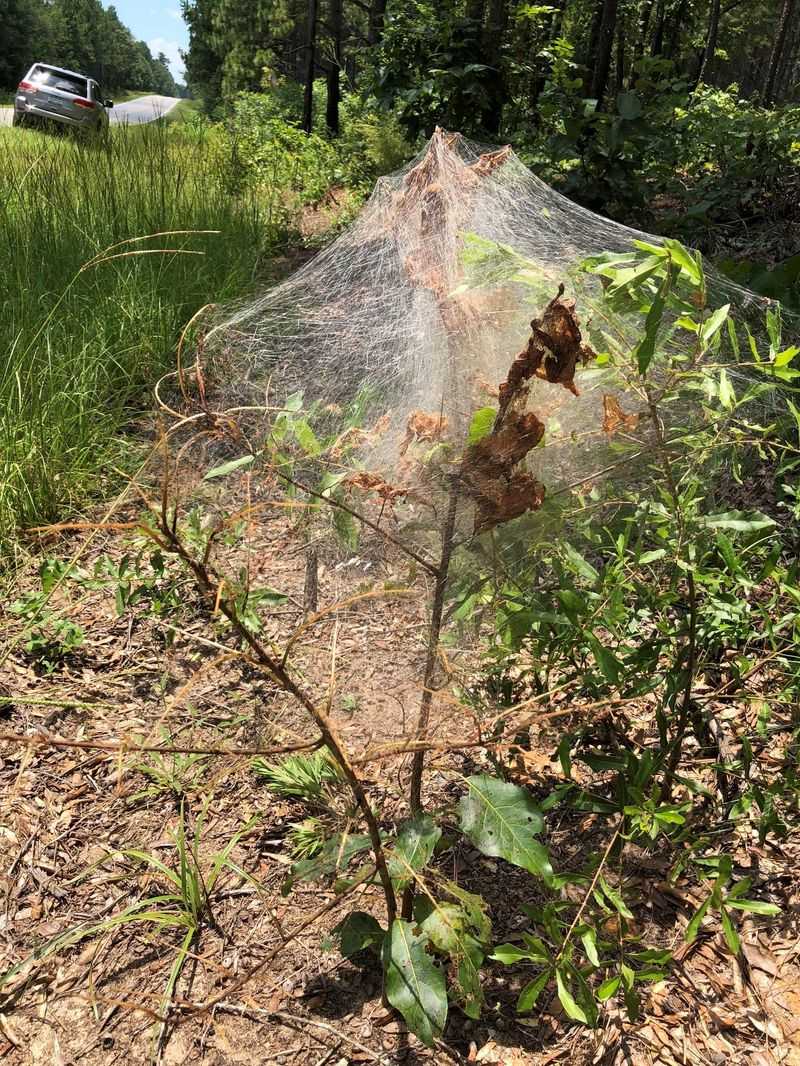
Young trees, recently transplanted trees, and drought-stressed trees sit in a different category from mature, well-established shade trees. A small tree with limited leaf area can lose a meaningful share of its canopy to a single active web, and repeated defoliation across multiple seasons can add cumulative stress even when any single event looks minor. NC Cooperative Extension specifically identifies young trees at risk of complete defoliation as the primary situation in which physical removal or treatment may be justified rather than optional.
Fruit and nut trees warrant extra consideration as well. Extensive defoliation on a pecan, cherry, or persimmon during the growing season can reduce the tree’s energy reserves and, in a heavy year, affect nut or fruit production. The web itself does not guarantee production loss, but a tree that loses most of its foliage repeatedly has less capacity to recover and produce than one that retains a full canopy.
Selective pruning of an infested twig is a reasonable option for a small tree when the cut will not disfigure the plant. Remove the branch tip that holds the web, seal it in a bag, and dispose of it rather than leaving it on the ground beneath the tree. UC IPM guidance on fall webworms and University of Georgia Extension’s fall-webworm fact sheet both note pruning as a practical physical option when webs are accessible and limited in number.
Aggressive pruning, however, can injure the tree more than the webworms would have. Removing large, structurally important branches to eliminate a web trades a cosmetic problem for a real wound. Pruning is not required purely for appearance or as a routine tree-health measure. Penn State Extension’s fall-webworm guidance reinforces this point, recommending that pruning be limited to small, accessible, infested twigs rather than used as a broad response to any visible web.
Drought stress is worth checking independently. If your tree is showing wilting or leaf scorch unrelated to the web, address the water deficit as a separate issue rather than attributing it to the caterpillars. A stressed tree that also hosts webworms needs both problems acknowledged on their own terms.
Use Chemical Control Only When the Situation Justifies It
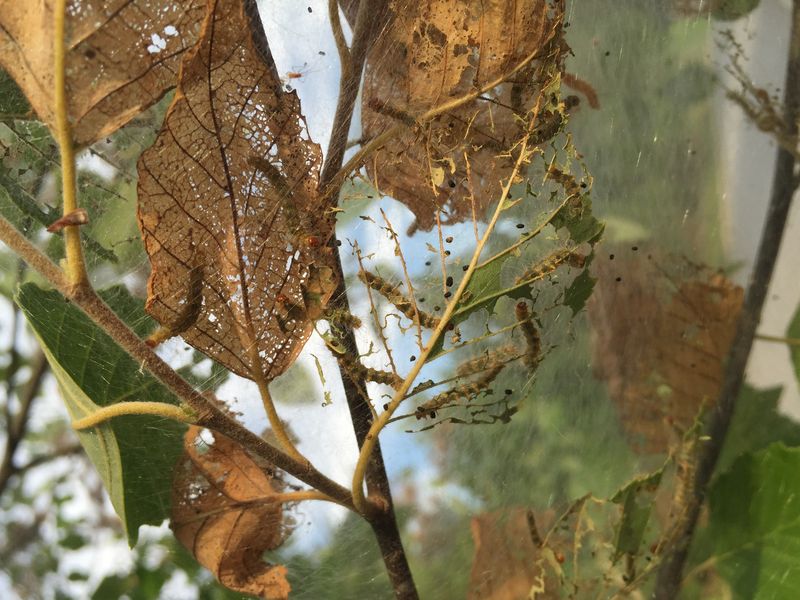
Chemical treatment is not a default response to fall-webworm webs, and for many established trees it is never needed at all. The situations where treatment warrants genuine consideration are narrower than the sight of a web might suggest: a young or recently planted tree facing extensive, active defoliation, a fruit or nut tree where repeated leaf loss threatens production, or a tree already under significant drought or disease stress where additional defoliation would compound the problem.
Timing and targeting matter more than product selection. Penn State Extension’s fall-webworm guidance explains that small, actively feeding caterpillars are more vulnerable to treatment than large ones, and that applications directed at the foliage associated with the web are more practical than trying to saturate mature webbing. Mature silk can physically block a spray from reaching the caterpillars inside, reducing effectiveness and wasting product.
Opening the web with a stick before any application, if the web is within safe reach, improves contact between the spray and the insects. UC IPM’s fall-webworm resource and University of Georgia Extension’s fall-webworm management publication both note that disrupting the web before applying any product increases the likelihood that the material reaches the target insects.
Before using any pesticide, read the current product label completely. The label is a legal document, and it specifies which sites and crops or ornamentals the product is registered for, the correct application rate, and the protective equipment required. EPA pesticide label guidance makes clear that using a product inconsistently with its label is both illegal and potentially unsafe. Avoid applying any insecticide when bees or other pollinators are actively foraging on nearby flowers; EPA pollinator-protection labeling requirements reflect the real risk that pesticide applications pose to non-target beneficial insects.
For tall trees, webs that are out of safe reach from the ground, or any situation that requires climbing or overhead spray applications, contact a licensed arborist or pest management professional. Attempting to spray or prune high branches without proper equipment and training creates fall and chemical-exposure risks that outweigh any benefit from treating the web yourself.
Match the Response to the Tree, Not the Web Alone
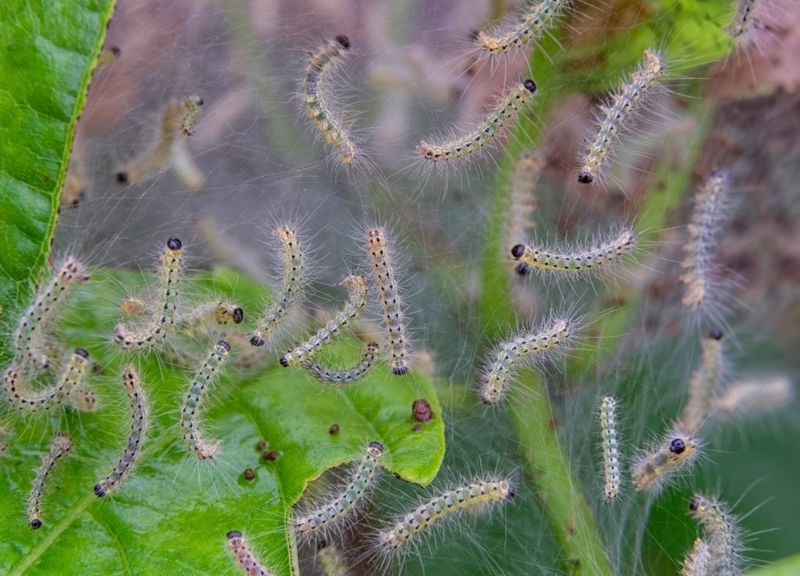
Before deciding what to do, run through a short checklist. Confirm that what you are seeing is actually a fall-webworm web at a branch tip and not an eastern tent caterpillar tent in a branch crotch or a bagworm case hanging from a twig. Getting the insect right is the foundation of any sensible response. NC Cooperative Extension’s guidance on webs in trees walks through this identification step clearly.
Next, assess the tree itself. Is it a mature, established shade tree with a full canopy and no other visible problems, or is it a young, recently planted, drought-stressed, or fruit-bearing tree where leaf loss carries more consequence? Estimate whether the webbing is limited to one or two branch tips or covers a substantial portion of the canopy. Consider whether this is the first time you have noticed webs on this tree or whether it has been defoliated repeatedly over several seasons.
Those answers point toward a proportionate response. A healthy mature tree with one accessible web can be monitored, left alone, or have the web gently opened with a pole to expose caterpillars to natural predators. UC IPM’s fall-webworm resource supports this graduated approach, reserving more active intervention for trees where defoliation is genuinely extensive or repeated. A young or stressed tree with heavy webbing warrants closer attention and possibly selective pruning or, in clear-cut cases, a targeted treatment following label directions.
Three things to skip regardless of tree type: burning the webs, which University of Maryland Extension explicitly warns against as a fire hazard, removing large amounts of healthy wood for cosmetic reasons, and attempting to treat or prune branches that are out of safe reach without professional equipment. A summer branch-tip web usually means a caterpillar found a good meal, not that your tree is in trouble. The tree, not the web, is what deserves the closer look.