
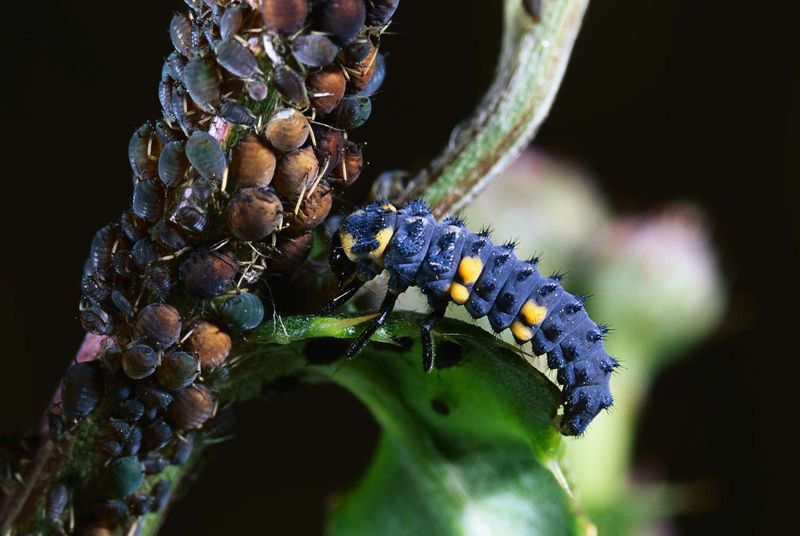
A small, dark, spiny creature crawling through the aphids on your rose bush may look alarming, but squashing it could be one of the worst things you do for your garden this season. That insect may be a lady beetle larva, an immature stage of the familiar spotted beetle that hunts soft-bodied pests on California roses and citrus. Learning to tell it apart from plant-eating lookalikes takes just a few minutes of observation, and it can save you from accidentally wiping out your best natural pest control. This guide walks you through what to look for, what it means, and how to respond without making the problem worse.
That spiky insect may be a lady beetle larva
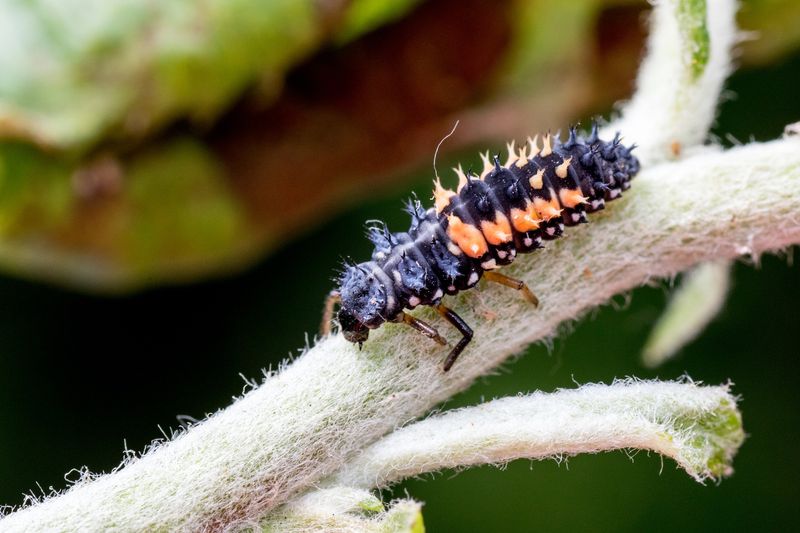
Spotting something dark, spiny, and unfamiliar crawling across your rose canes is understandably unsettling. Before you reach for a spray bottle or your thumb, take a closer look, because that insect may be a lady beetle larva doing exactly what you want it to do: hunting the aphids that have been clustering on your new growth.
Lady beetles go through four life stages: egg, larva, pupa, and adult. The larva looks nothing like the small, round, spotted beetle most people recognize. Instead, UC IPM’s guide to lady beetles describes the larvae as elongated, often black or blue-black, sometimes carrying orange or reddish markings, and bearing short spines or tubercles along their bodies. The comparison to a tiny alligator is a useful one: the larva moves on six legs, has a flattened profile, and can reach about a quarter inch in length depending on the species and how far along it is in development.
The convergent lady beetle, one of the most commonly encountered species in California yards, fits that description closely. UC IPM’s profile of the convergent lady beetle notes that its larvae have blackish bodies with orange blotches and long legs, growing to roughly 6 millimeters before they pupate. After the pupal stage, the adult emerges with the familiar domed, spotted shell.
That said, appearance alone is not enough to confirm what you are looking at. Several other insects found on California roses, including rose sawfly larvae and certain predatory fly larvae, can share a roughly spiny or segmented look. Identifying an insect as a lady beetle larva requires more than noting that it is dark and has bumps. The next section explains what additional clues to gather before you decide whether to leave it alone or intervene.
Inspect the prey and the damage before you intervene
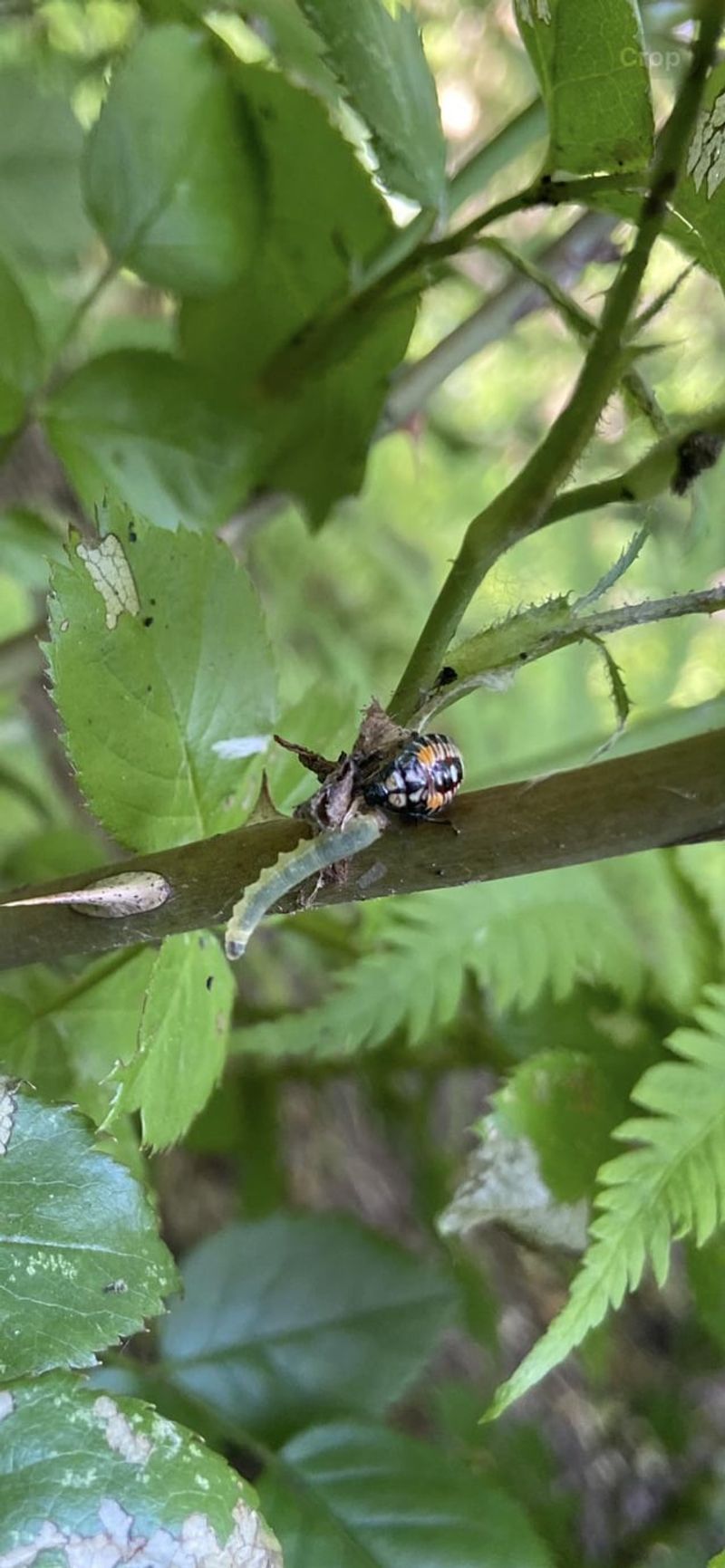
The single most useful thing you can do when you find an unfamiliar larva on your roses is to stop and watch it for sixty seconds. Where is it moving? What is it touching? Are the surrounding leaves intact, scraped, or full of holes?
A larva that is actively moving through a cluster of aphids and pausing to feed on them is behaving like a predator. Lady beetle larvae hunt soft-bodied insects and do not chew rose tissue. If the insect you are watching is sitting in the middle of an aphid colony and the rose foliage around it looks undamaged, that behavior supports a predatory identification, though it does not confirm species.
Contrast that with a rose sawfly larva. UC IPM’s rose sawfly page explains that these larvae feed on rose leaf tissue, leaving behind skeletonized, scraped, or windowed patches of foliage. Finding a larva near that kind of damage, on the leaf surface rather than in an aphid cluster, is a meaningful diagnostic difference. Rose sawfly larvae can look greenish, yellowish, or slimy rather than black and spiny, but the damage pattern is often more reliable than color alone.
Other beneficial insects can also be present. Syrphid fly larvae, which are legless and often pale or greenish, occur in aphid colonies and feed on them without chewing the plant. Lacewing larvae are another predatory option in California gardens, and Penn State Extension’s guide to recognizing natural enemies emphasizes that many beneficial larvae are mistaken for pests because they look unfamiliar.
UC IPM’s rose insects and mites page recommends inspecting roses regularly so you can tell the difference between what is helping and what is hurting. A spiny or alligator-like shape is a starting point, not a conclusion. Prey association, location on the plant, and the condition of nearby foliage together give you a much more reliable picture.
Rose aphids can bring helpful predators with them
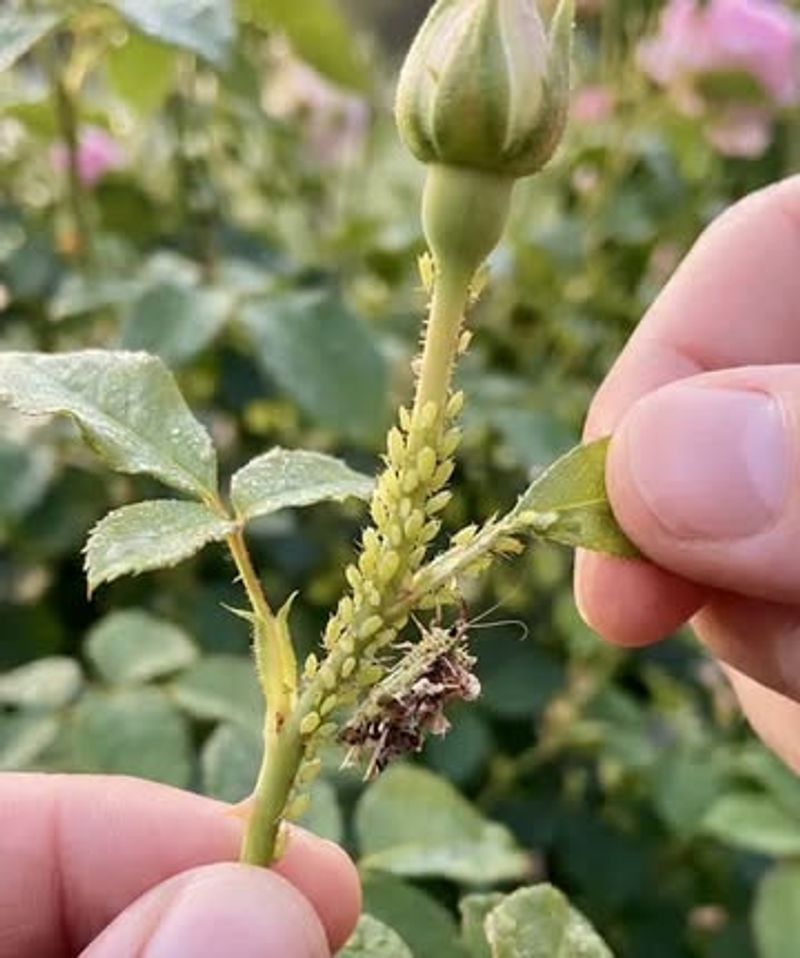
Aphids are one of the most predictable problems on California roses, and they follow a reliable seasonal pattern. Tender new growth in spring draws colonies of rose aphids to shoots and buds, and those same colonies signal to natural enemies that a meal is waiting.
According to UC IPM’s rose pest management guidance, rose aphid populations are typically most significant during roughly six weeks in spring and early summer in many California areas, and then decline as summer temperatures climb. During that window, lady beetles, parasitic wasps, soldier beetles, and syrphid fly larvae can arrive in numbers and begin reducing aphid populations noticeably.
The relationship works in your favor when you let it run. An aphid colony that appears overnight may look alarming, but the predators often follow within days. Treating immediately interrupts that cycle before natural enemies have had a chance to respond.
A low to moderate aphid infestation on an established rose does limited lasting damage to the plant. Established shrub roses and many hybrid teas can tolerate some aphid feeding without significant setback. The bigger risk is acting too fast and removing the predators along with the pests.
UC IPM’s biological control overview frames natural enemies as a community rather than a single fix: lady beetles, lacewings, parasitoid wasps, syrphid larvae, soldier beetles, and fungal pathogens all play roles that vary by season, location, and pest pressure. Observing your roses for a few days before treating gives that community time to respond, and it often means you need to do far less work yourself.
Aphid control and mealybug control require different predators
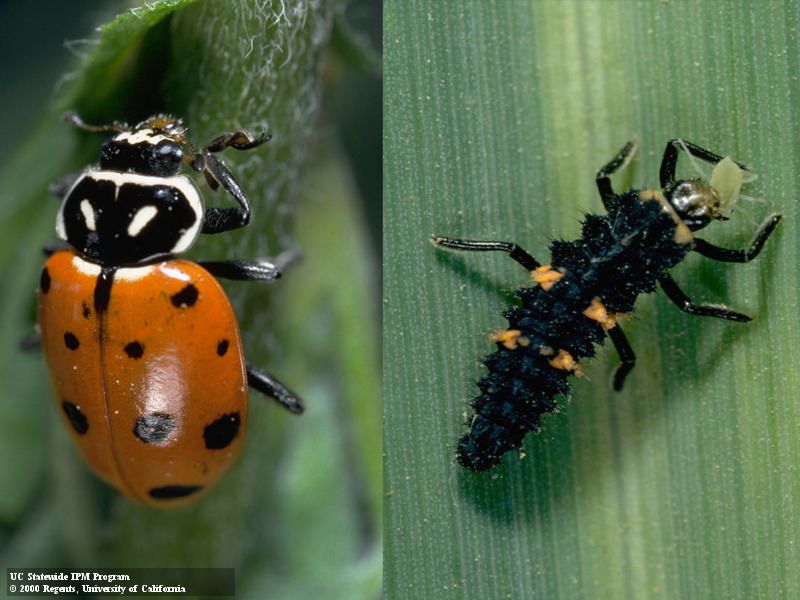
One of the most common mistakes California gardeners make is treating all lady beetles as interchangeable. The species that shows up on your roses and the one that protects your citrus are not doing the same job, and they are not the same insect.
The convergent lady beetle is the species most California homeowners encounter on roses. UC IPM’s convergent lady beetle profile confirms that this species is primarily an aphid predator. Its larvae and adults hunt soft-bodied insects and are well-suited to rose and vegetable garden pest control. This is a native California species, and it is the one most likely behind the spiky larva on your rose cane.
Citrus mealybugs are a different story. The predator best supported by research for controlling citrus mealybugs is the mealybug destroyer, Cryptolaemus montrouzieri. UC IPM’s mealybug destroyer page explains that this beetle was introduced from Australia specifically to control mealybugs and has been used in California since the late 1800s. Its larva is covered in white waxy filaments and can resemble a large mealybug, which creates its own identification challenge for gardeners who do not know what to look for.
On citrus, UC IPM’s citrus aphid guidance notes that naturally occurring predators and parasites, including lady beetles, lacewings, and fungal pathogens, usually keep citrus aphids below damaging levels without intervention. For citrus mealybugs specifically, UC IPM’s citrus mealybug management page and the general mealybug page both emphasize the role of the mealybug destroyer and parasitoid wasps rather than convergent lady beetles.
The vedalia beetle is another introduced species worth knowing. UC IPM’s vedalia page describes it as the biological control agent credited with saving California’s citrus industry from cottony cushion scale in the 1880s. Calling any of these insects simply “native” overlooks a history of intentional introductions that shaped California’s current beneficial insect community.
Ants can protect the pests you want predators to eat
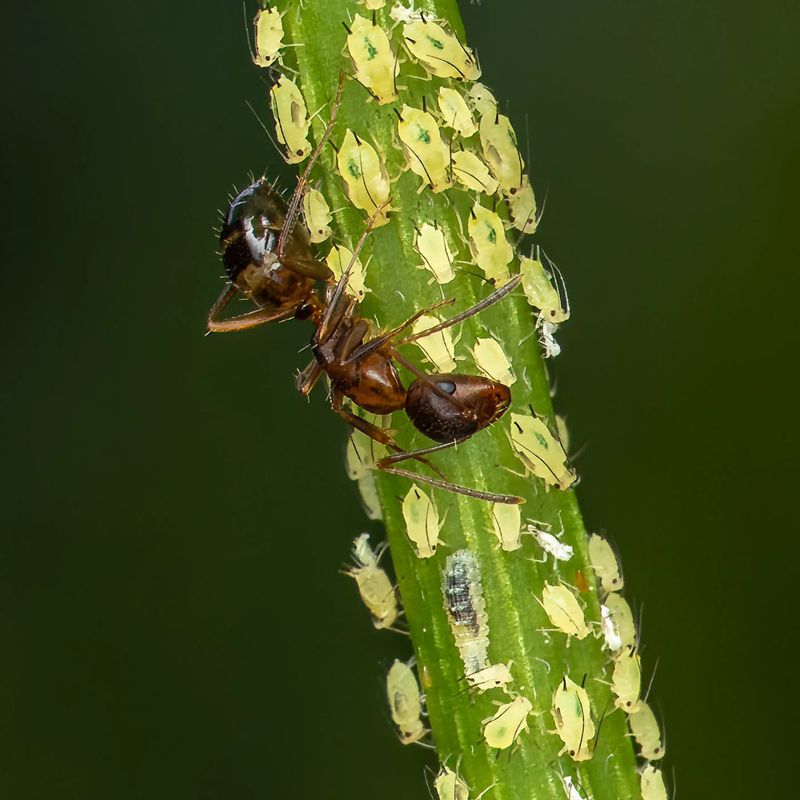
Finding lady beetle larvae on your roses is encouraging, but if a trail of ants is also running up the same canes, those larvae may be fighting an uphill battle. Ants and aphids have a well-documented partnership, and it works directly against the natural enemies you are trying to protect.
Aphids and mealybugs produce honeydew, a sticky, sugary waste product that ants actively seek. In exchange, UC IPM’s aphid management page explains that ants physically guard aphid colonies, chasing away or attacking predators and parasitoids that approach. That behavior can significantly reduce the effectiveness of lady beetles, lacewings, and parasitic wasps that would otherwise keep aphid numbers in check.
UC IPM’s ant management page recommends checking whether ants are climbing onto infested plants and, if so, managing their access as part of your response. Wrapping the trunk or main stem with a sticky barrier product designed for that purpose can interrupt the ant-aphid relationship without requiring any spray on the plant itself. This approach supports natural enemies rather than replacing them.
Managing ants is not a guarantee that aphids or mealybugs will disappear. Pest levels, weather, plant stress, and the local predator community all affect outcomes. Treating ants is one supportive step that removes a specific obstacle to biological control, and it is often more effective than spraying the aphids directly when predators are already present.
Use the least disruptive response that fits the plant and pest
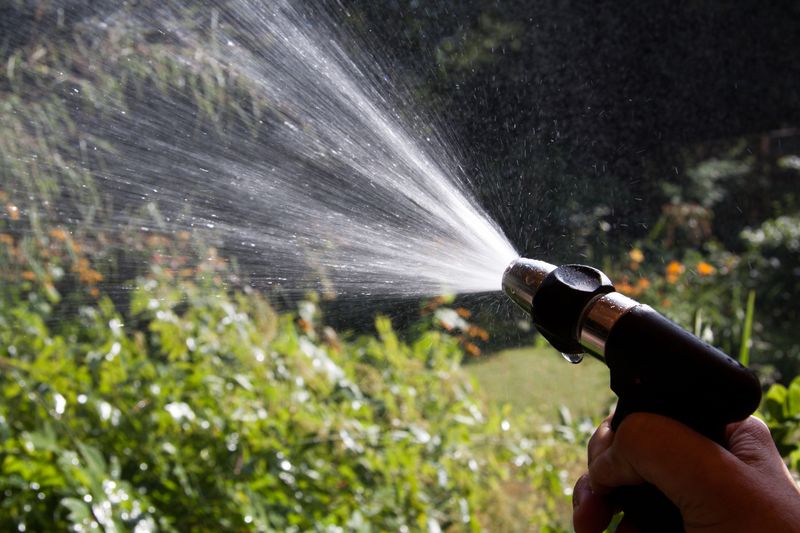
When aphid numbers on your roses climb high enough that you want to act, starting with the least disruptive option protects the predators already working on the problem. For sturdy, established roses, a forceful stream of water from a garden hose is a reasonable first step.
UC IPM’s rose pest management page supports using water sprays to knock aphids from rose foliage, and the general aphid page notes that dislodged aphids rarely find their way back to the plant. This works best on roses with firm, established growth that can tolerate the pressure. Avoid directing strong water streams at tender new buds or newly grafted canes where tissue damage is more likely.
Water sprays are not the right default for citrus. Citrus trees have different growth habits, bark, and pest dynamics, and the aphid species involved differ from rose aphids. For citrus pests, UC IPM’s citrus aphid guidance recommends following crop- and pest-specific guidance rather than applying rose aphid controls to a different plant type.
If water sprays are not enough and you decide a product is necessary, insecticidal soap or horticultural oil are the options UC IPM generally favors for aphids because they break down relatively quickly and leave less residue. Both products require full label compliance, including checking for plant sensitivity at the temperatures you plan to spray. Critically, both can kill beneficial insects they directly contact, so timing the application to early morning or evening when predators are less active, and avoiding open flowers, reduces that risk. Applying only to the heavily infested areas rather than the entire plant also limits collateral harm.
Broad-spectrum sprays can remove the help already on the plant
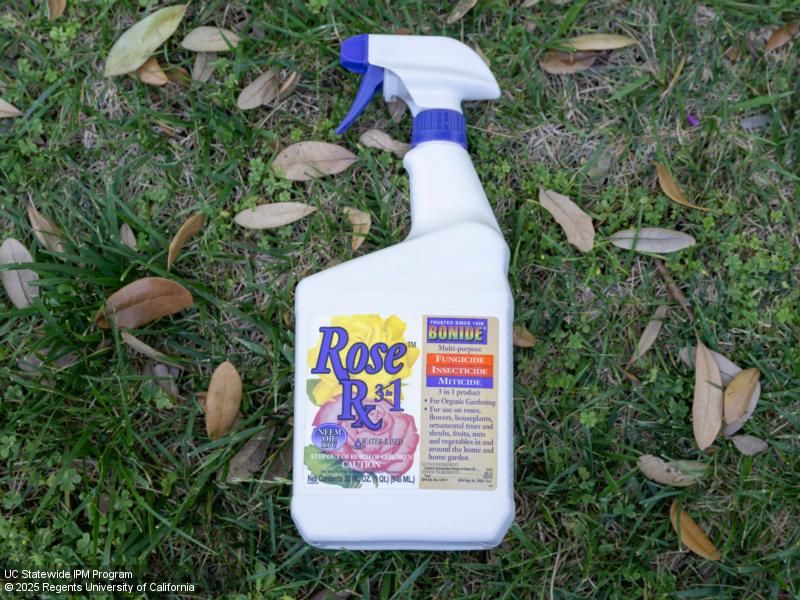
Reaching for a spray when you spot an unfamiliar insect is a natural reaction, but it carries a real cost when the insect turns out to be a predator. Spraying an unidentified larva can eliminate the very control you were counting on, and it may leave the pest population to rebound without competition.
The risk is greater with broad-spectrum and persistent insecticides. UC IPM’s guidance on protecting natural enemies and pollinators specifically warns that pyrethroids, carbamates, organophosphates, and some systemic insecticides can harm beneficial insects, including predators and pollinators, not just the target pest. Some of these products persist in plant tissue or on leaf surfaces long enough to affect insects that arrive days after the application.
Systemic insecticides present an additional concern on flowering plants. When taken up by the plant and expressed in pollen or nectar, they can reach bees and other beneficial visitors that never touched the spray. UC IPM’s rose pest page cautions against applying insecticides to roses that are in bloom for exactly this reason.
Every pesticide application carries a legal and practical requirement: read and follow the product label, which is a binding legal document in California. The label specifies the plants the product is registered for, the pests it targets, the application rates, the reapplication intervals, and any restrictions on use near water or flowering plants. Applying a product in a way that contradicts the label is a violation of California law, not just a gardening misstep. When in doubt, checking UC IPM’s pest-specific pages before purchasing any product will help you match the treatment to the actual pest and plant rather than guessing.
Protect local predators instead of buying a guaranteed fix
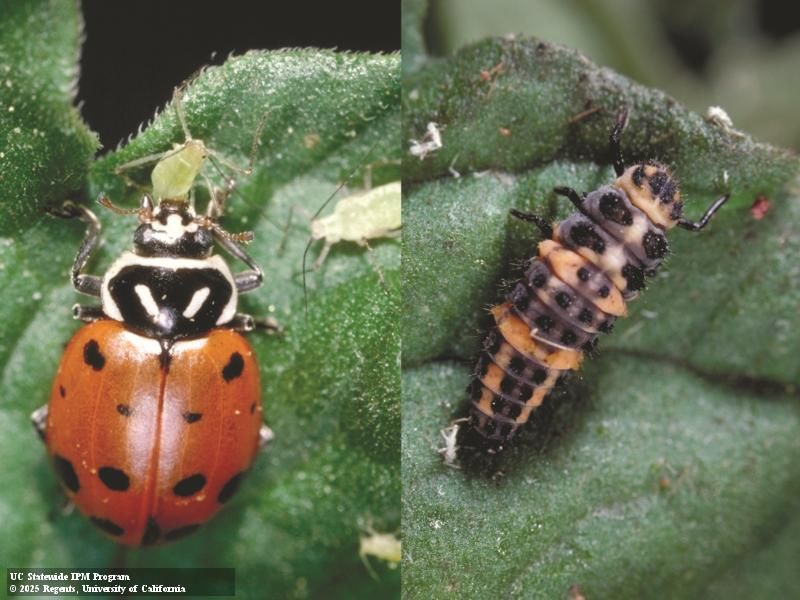
When a spiky larva appears on your roses, the most productive first move is to pause. Watch what the insect is feeding on, check the surrounding foliage for damage, look for ant trails, and give yourself a few days before treating anything. That short window of observation is often enough to let natural enemies tip the balance.
Buying a bag of lady beetles at a garden center may seem like a shortcut, but the results are unreliable in a home garden setting. UC IPM’s convergent lady beetle profile notes that most released beetles disperse rapidly after release. A published trial on aphid control with released convergent lady beetles found that effective suppression on landscape roses required releases of roughly 1,400 to 1,750 beetles per shrub under experimental conditions. Those numbers and that context do not translate reliably to every California yard, pest situation, or plant type, and the research does not address mealybugs or citrus pests.
A more durable approach builds on what UC IPM’s biological control overview describes as conservation: reducing pesticide use, managing ants, tolerating low pest levels, and choosing the least disruptive treatment matched to the specific crop and pest when action is genuinely needed. The predators already living in your yard, including lady beetles, lacewings, parasitoid wasps, and syrphid larvae, are the most reliable resource you have. Keeping them alive costs nothing and starts with learning to recognize what they look like before you decide they are a threat.