
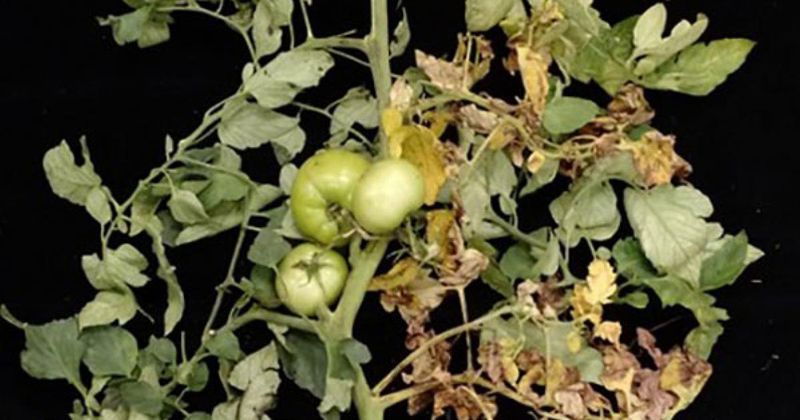
Walking out to your garden in August and finding a tomato plant with drooping, yellowing lower leaves is one of the more unsettling sights of the growing season. The decline can look fast and mysterious, and the fear of losing the whole plant is real. Progressive wilting that works its way up from older, lower foliage during hot weather often points toward Fusarium wilt, a soilborne fungal disease, but that pattern alone is not a diagnosis. Several other problems look nearly identical, and sorting them out before you act can save you from the wrong response.
Fusarium wilt leads the list—but bottom-up wilt is not a diagnosis
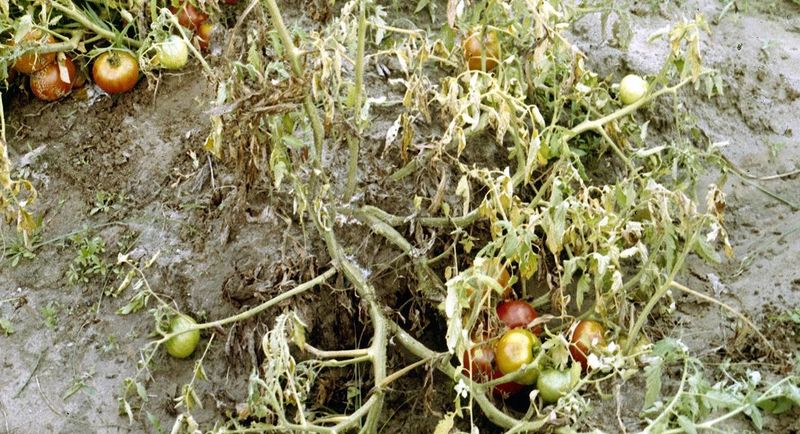
Progressive yellowing and wilting that begins in a tomato plant’s older, lower leaves during the heat of August fits a recognizable profile. The leading candidate for that pattern is Fusarium wilt, caused by the soilborne fungus Fusarium oxysporum f. sp. lycopersici. According to UC IPM’s Fusarium wilt guidance, the pathogen enters through the roots, colonizes the water-conducting tissue inside the stem, and can cause one branch or one side of the plant to decline before the entire plant collapses.
Warm soil temperatures and the energy demands of fruit development commonly coincide with the moment symptoms become visible, which is exactly why August is the month many gardeners first notice the problem. The wilting can look sudden, but the infection typically has been progressing underground for some time before leaves show the damage.
Fusarium wilt is a strong suspect for this symptom pattern, but it is not the only one. Verticillium wilt, Fusarium crown and root rot, bacterial wilt, root-knot nematode injury, heat or drought stress, root damage, southern blight, and excess soil moisture can all produce overlapping symptoms. Treating Fusarium as the confirmed cause before ruling out those alternatives risks the wrong response, so hold the diagnosis loosely until you have worked through the clues.
Read the pattern before you diagnose the plant
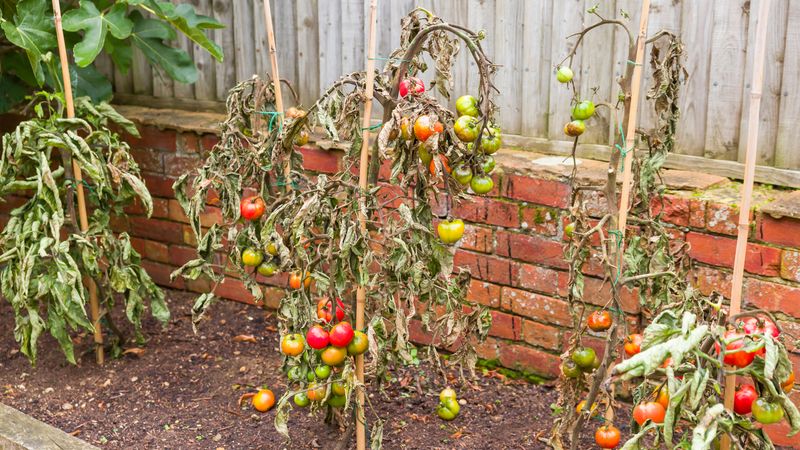
Reacting to a single wilted leaf is rarely the right move. The more useful question is whether the symptoms are progressing, and in what direction. University of Minnesota Extension’s Fusarium wilt page describes the classic pattern: older, lower leaves turn yellow and wilt first, and symptoms may appear on only one side of the plant or on a single branch before spreading further. One early clue that makes Fusarium a stronger candidate than plain heat stress is asymmetry – when only one shoot droops while the rest of the plant looks fine, a vascular problem is more likely than a watering issue.
Another telling sign is what happens overnight. A plant with Fusarium wilt may partially recover after sundown and then wilt again the following day as temperatures climb. Over time, that partial overnight recovery stops, and the wilt becomes permanent. That cycle of temporary improvement followed by progressive decline is worth tracking over two or three days before drawing conclusions.
August timing adds context but does not confirm the diagnosis. Warm soil can favor Fusarium symptom development, but heat also intensifies ordinary water stress and can worsen symptoms from several root and vascular problems. The pattern across multiple days, not a single afternoon’s observation, is what matters most when you are trying to separate disease from a rough week of weather.
A stem check can reveal vascular damage, not the exact fungus
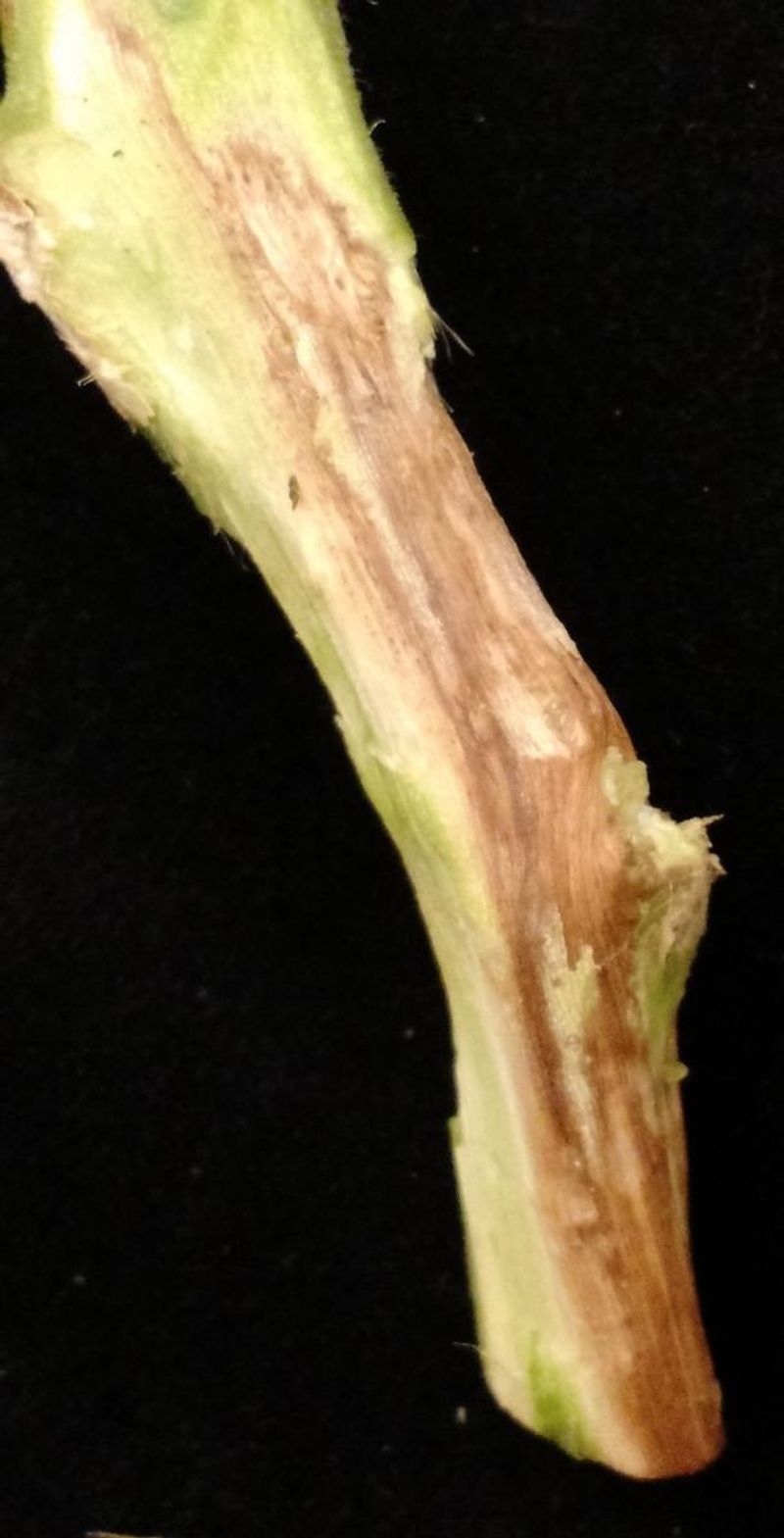
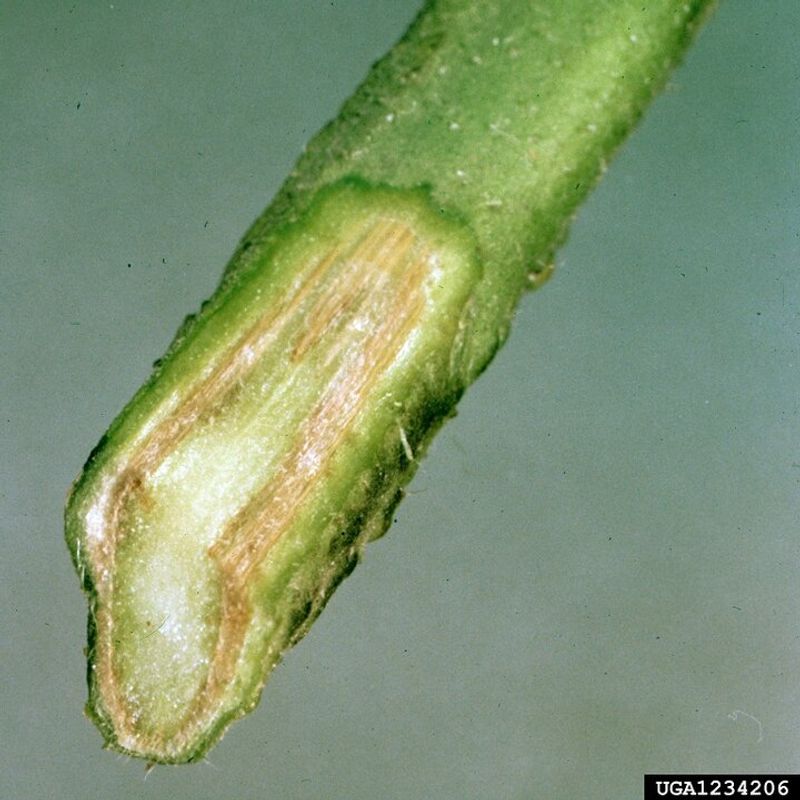
Once you have watched the plant for a day or two and suspect a vascular problem, a simple stem inspection can give you more information. Use a clean knife to cut or scrape the lower stem an inch or two above the soil line and look at the tissue just beneath the outer skin. Darkened or brown streaking in the vascular ring supports a vascular wilt diagnosis. Utah State University Extension’s comparison of Fusarium and Verticillium wilts notes that this discoloration cannot reliably distinguish one from the other – both diseases can produce similar browning, and laboratory testing is required for a definitive identification.
Fusarium wilt is also not the same disease as Fusarium crown and root rot, and the two are worth separating. Crown and root rot is caused by a different organism, Fusarium oxysporum f. sp. radicis-lycopersici, and according to UMN Extension’s crown and root rot resource, it is associated with root decay and a chocolate-brown lesion that girdles the stem right at or just below the soil line. If that lesion is present along with root decay, crown and root rot is a more likely explanation than classic Fusarium wilt.
When the diagnosis will shape next year’s planting decisions, a home stem inspection is not enough. Submitting a fresh symptomatic sample to a university plant diagnostic clinic or your state’s cooperative extension service is the most reliable path to a confirmed answer. The cost is usually modest, and knowing the exact pathogen can prevent years of repeated losses.
Check soil moisture before blaming a fungus
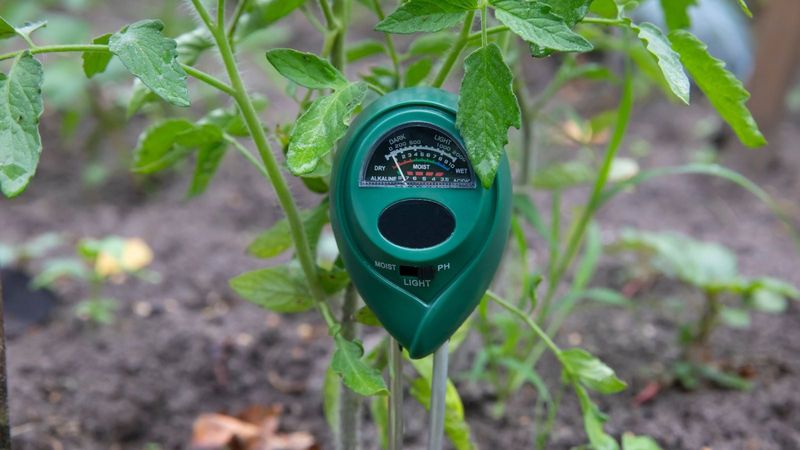
Before settling on a disease explanation, rule out the simpler one. Tomato plants wilt in heat, and they wilt harder when the soil is dry. Stick your finger or a trowel several inches into the soil near the root zone – not just at the surface, which can feel dry even when moisture is adequate below. If the soil is genuinely dry several inches down and the plant perks up fully by evening or after a thorough watering, heat or drought stress is the likely explanation rather than a soilborne pathogen.
UMN Extension’s tomato growing guide offers roughly 1 inch of water per week as a general starting point, but that figure needs adjustment for your soil type, local temperatures, and recent rainfall. The more important habit is consistency and depth: deep, infrequent watering encourages roots to grow downward and access moisture reserves, while frequent shallow watering keeps roots near the surface where they are most vulnerable to heat and dry spells.
Two important limits apply here. First, watering cannot cure a plant that is already infected with Fusarium, Verticillium, or bacterial wilt – the wilt in those cases comes from blocked vascular tissue, not from dry soil, and adding water will not reopen blocked vessels. Second, if your soil drains poorly and the root zone already feels wet, adding more water will worsen the problem and can encourage additional root diseases. Check the moisture level first, then decide whether water is actually what the plant needs.
Green leaves and rapid collapse raise bacterial wilt concerns
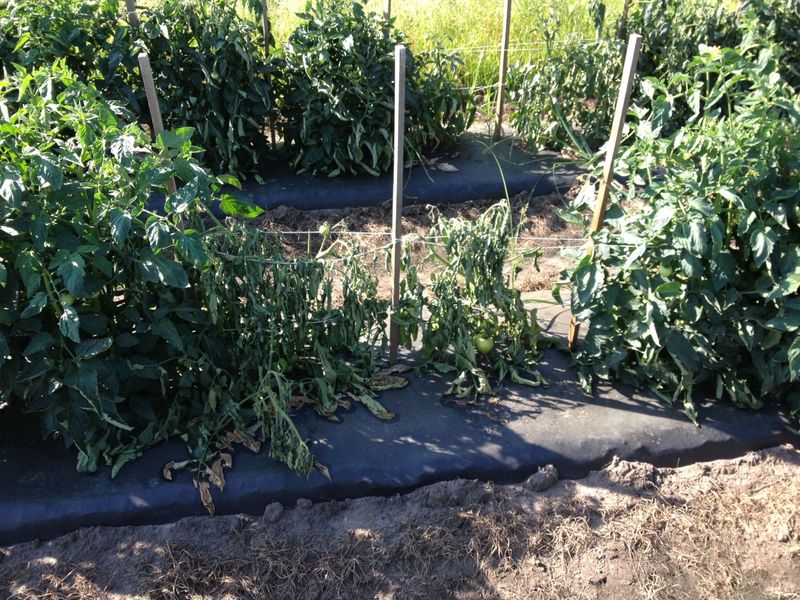
Not every wilt that appears in August follows the slow, yellowing pattern associated with Fusarium. If a tomato plant collapses quickly – within a day or two – while its leaves remain green and the soil moisture is adequate, bacterial wilt moves up the list of likely causes. According to the University of Georgia Extension’s vegetable disease guide, bacterial wilt is caused by Ralstonia solanacearum, not a fungus, and it can kill a plant far faster than Fusarium typically does. The bacteria invade and block the same water-conducting tissue, but the timeline and the appearance of the foliage can differ noticeably.
Bacterial wilt is especially worth considering in warm, humid regions of the southeastern and mid-Atlantic United States, where the pathogen thrives. The fact that leaves stay green while the plant wilts permanently is one of the more reliable visual clues that separates it from Fusarium. That said, no visual symptom is a guaranteed identifier on its own.
Several other problems deserve a place on the differential list as well. UMN Extension’s tomato wilt diagnostic tool and University of Illinois Extension’s plant problem resource both identify Verticillium wilt, root-knot nematode injury, root damage from cultivation or pests, southern blight, and waterlogged soil as causes that can mimic Fusarium’s appearance. Visual symptoms alone cannot settle which of these is responsible, and the appropriate response may differ significantly depending on the actual cause.
Remove a strongly suspected plant instead of trying to cure it
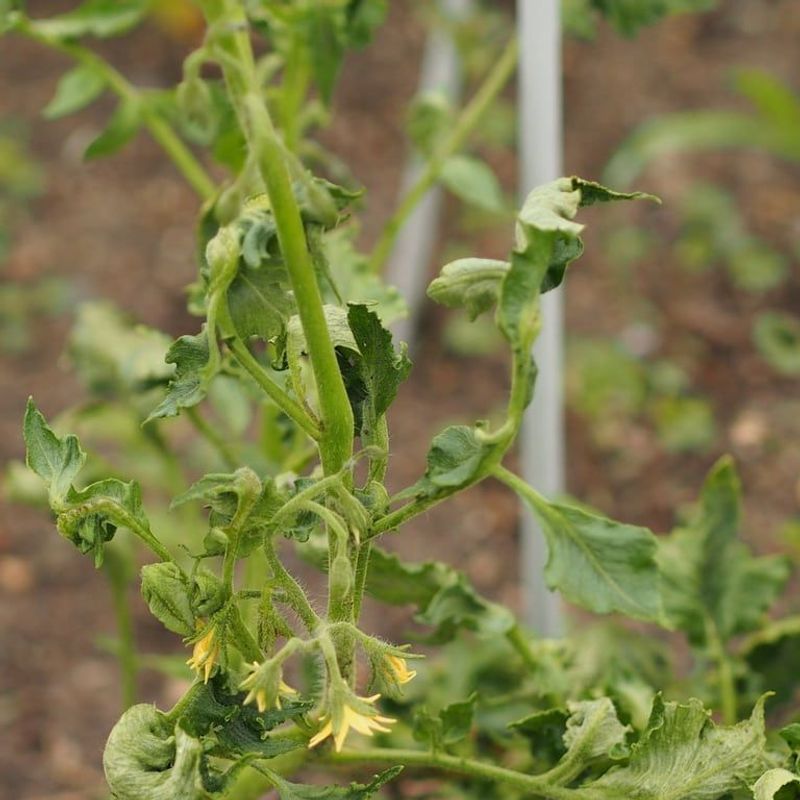
Once you have checked soil moisture, watched the progression over a couple of days, and inspected the stem, a plant showing convincing progressive wilt from the bottom up with vascular discoloration present deserves a clear response. University of Maryland Extension’s Fusarium wilt resource is direct on this point: there is no curative treatment available for an already infected tomato plant. Applying a fungicide to a plant with an established vascular infection will not reverse the damage or clear the pathogen from the tissue.
The practical response is removal. Pull the entire plant and dig out as much of the root system as you can manage – leaving roots behind leaves infested material in the soil. UMN Extension’s Fusarium wilt management guidance recommends cleaning soil from tools, shoes, cages, stakes, and any other equipment that contacted the infected plant before moving to another part of the garden. Fusarium spreads through infested soil particles, so a shovel or boot that carries soil from one bed to another can extend the contamination.
Disposal requires a judgment call on composting. UMN Extension’s guidance on managing plant diseases in the home garden explains that composting diseased material is only appropriate when the pile reliably reaches temperatures high enough to break down pathogens. Most backyard compost piles do not consistently reach those temperatures throughout the mass. If you cannot be confident your pile gets hot enough, bagging the infected plant and disposing of it with household waste is the safer choice.
Protect next season with resistant, clean planting material
After removing an infected plant, the natural next question is how to avoid a repeat. Choosing tomato varieties with resistance codes on the seed label is one of the most practical steps available to home gardeners. The letters F or FF on a tomato variety label indicate resistance to one or two races of Fusarium oxysporumlycopersici f. sp. . UC IPM’s Fusarium wilt on tomatoes page and UGA Extension’s tomato variety guide both note that these codes are race-specific – a variety rated F may resist Race 1 but remain susceptible to Race 3, for example.
Resistance lowers risk and can reduce symptom severity, but it is not immunity, and it can be undermined by high disease pressure or root damage from root-knot nematodes.
Starting with clean planting material matters as much as variety selection. Certified disease-free seed and transplants from reputable sources reduce the chance of introducing the pathogen on new plants. After harvest, remove all infected plant residue from the bed rather than tilling it back into the soil, since the fungus can persist in decomposing plant material.
Rotation is commonly recommended, but the guidance varies. UC IPM’s commercial tomato Fusarium wilt page and UGA Extension’s vegetable disease management bulletin suggest rotating away from susceptible crops for several years, with specific recommendations ranging from three to five or more years depending on the source and local conditions. Fusarium can survive in soil for many years without a host, so rotation reduces pressure but does not guarantee a clean bed. For gardeners with a confirmed or strongly suspected infestation in a specific raised bed or container, switching to fresh, uncontaminated growing medium or starting a new container with clean soil offers more reliable protection than rotating within the same infested ground.
Use the pattern as a warning, not a verdict
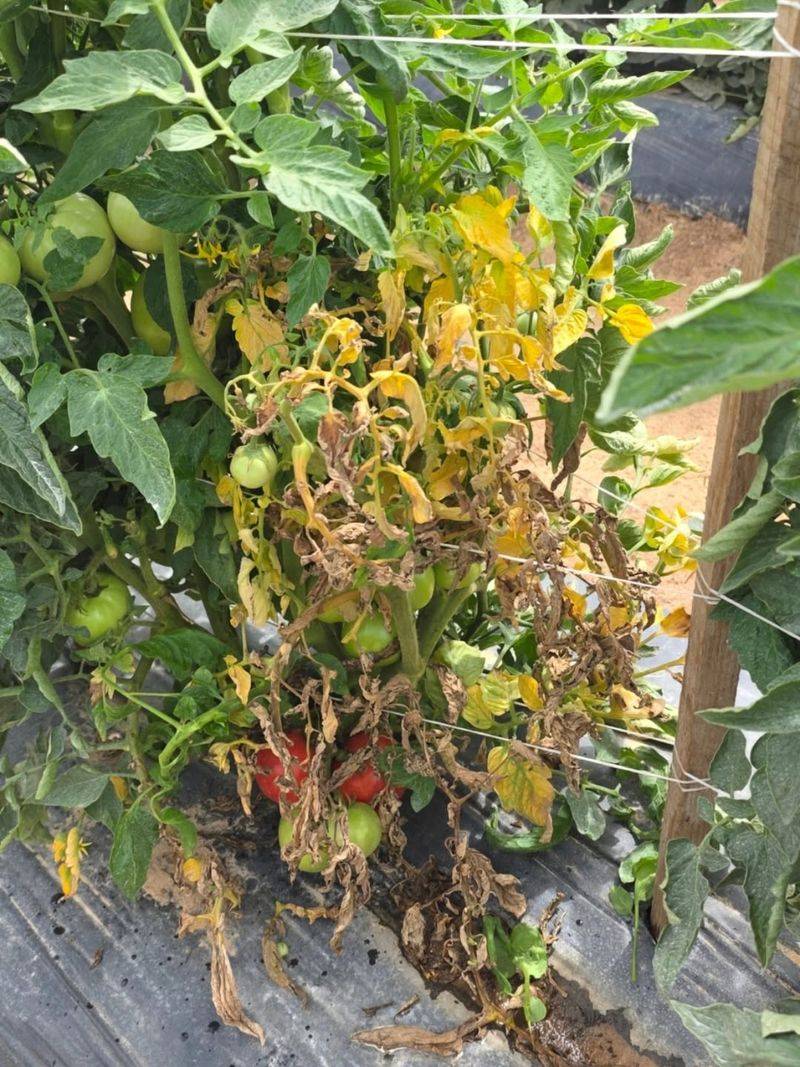
When a tomato plant starts declining from the bottom up in August, the pattern deserves a methodical response rather than an immediate assumption. Start by checking soil moisture several inches below the surface. If the soil is dry and the plant recovers fully by evening, address the watering before anything else. If the plant does not recover, or if it improves overnight and then wilts again the following day, watch the progression and inspect the lower stem for vascular discoloration.
Brown streaking in the vascular tissue, combined with progressive lower-to-upper decline and one-sided symptoms, makes Fusarium wilt the strongest suspect for an August collapse. Utah State University Extension’s wilt comparison resource reinforces that visual inspection cannot separate Fusarium from Verticillium with certainty, and when the answer will shape next year’s planting, a diagnostic lab submission is worth the effort. Remove and sanitize around a plant you strongly suspect is infected, even without a confirmed pathogen name.
Managing a probable soilborne infection without claiming certainty about the exact cause is a reasonable and responsible position. The pattern is a warning worth acting on – not a verdict that requires a lab report before you respond.