
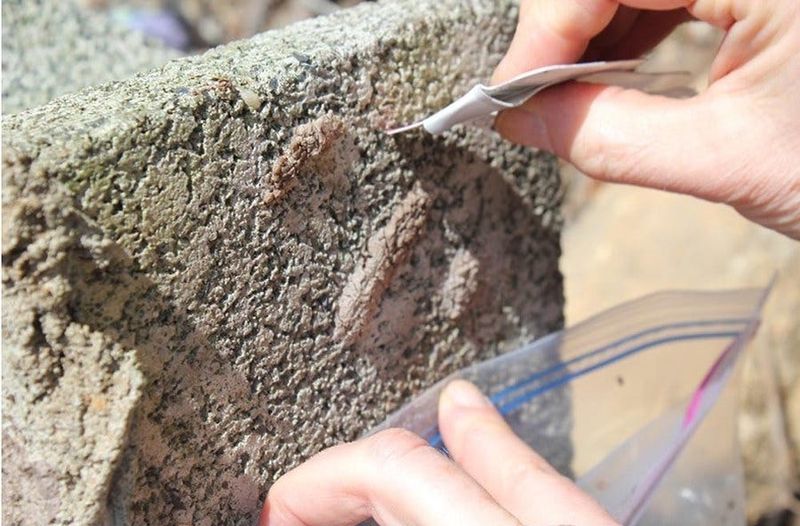
Spotted lanternflies have been showing up in more North Carolina yards, and the egg masses they leave behind are what fuel next spring’s population. Finding and removing those masses from surfaces around your property is one of the most direct steps a homeowner can take. It will not wipe out every lanternfly in the neighborhood, but scraping confirmed, reachable masses now and continuing through spring can reduce the number of eggs that hatch on your property.
Begin checking in late summer and keep checking through spring
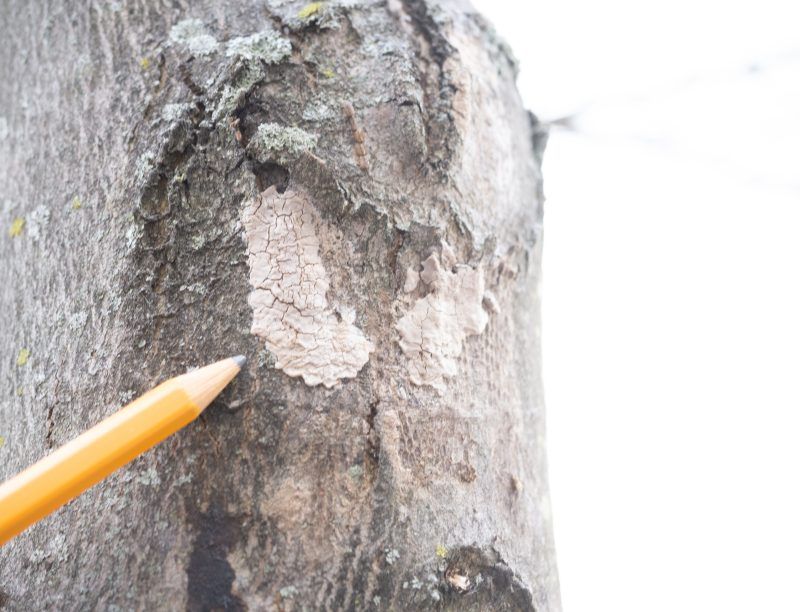
Spotted lanternfly egg masses do not disappear with the first frost. North Carolina’s agriculture department places the egg-mass stage from approximately September through May, meaning the masses are present through the entire dormant season and into early spring. Adults can begin laying as early as late summer, so that is a practical time to start looking, even if the bulk of laying has not yet occurred.
October tends to be the main deposition period, according to Penn State Extension’s egg-mass guidance. That means a single late-summer check is not enough. Homeowners who walk the yard once in August and then stop will miss the majority of masses laid later in the season. Plan to check again in October, again in November or December, and once more in late winter before the spring hatch.
Each mass that overwinters successfully can hatch into roughly 30 to 50 nymphs in spring. Removing a confirmed mass whenever you find it during this long window is a concrete, additive step toward reducing the number of eggs that hatch on your property. Penn State Extension is direct about the limits: scraping can reduce future numbers but will probably not eliminate an established local population. Treat each removed mass as a useful local gain, not as a complete solution, and keep inspecting through the full egg-mass season.
Search the yard’s outdoor surfaces and movable equipment
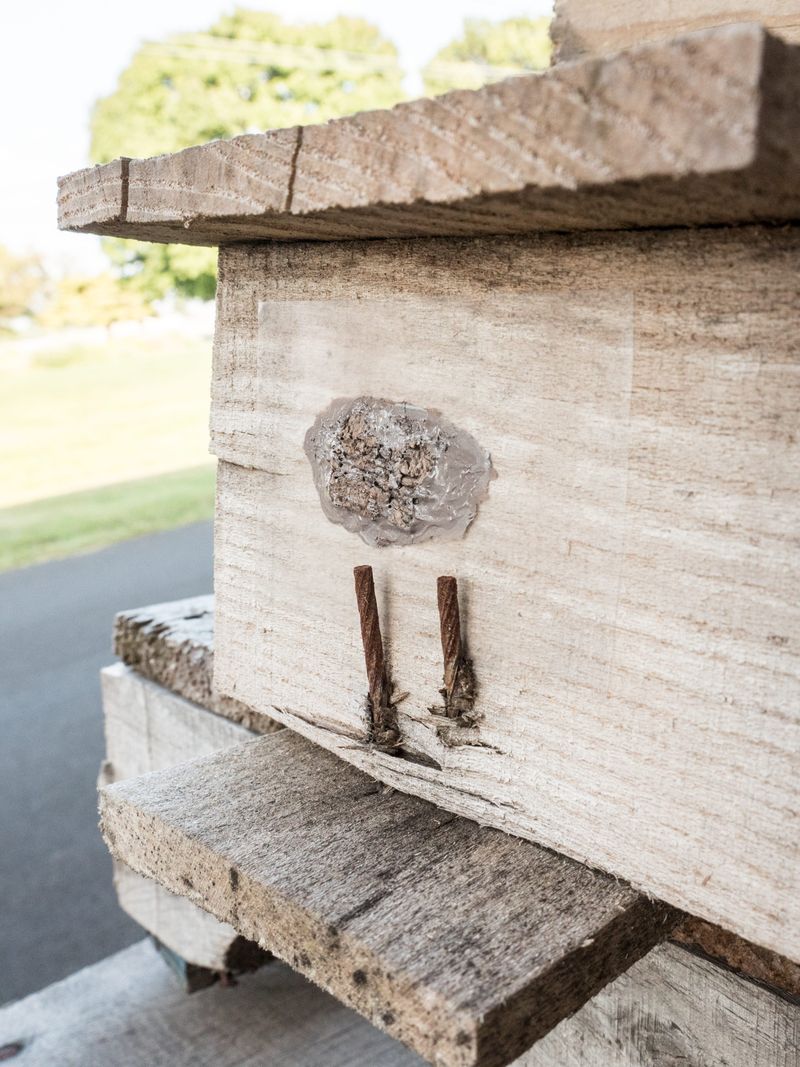
Egg masses turn up in more places than most homeowners expect. USDA APHIS confirms that spotted lanternflies lay on tree bark, bricks, stones, fences, grills, vehicles, firewood, lawn furniture and other hard outdoor surfaces. Both rough and smooth surfaces can host a mass, so skipping the stone wall or the brick chimney base because they look too rough is a mistake.
Work through a mental checklist when you walk the yard. Check the lower trunks and branches of trees, especially within the first few feet from the ground. Move along fence lines, deck boards and railings, stacked firewood and any retaining walls. Then shift to movable objects: the grill, outdoor chairs and tables, storage bins, garden tools, children’s toys, trailers and vehicles parked near the yard.
Movable equipment deserves extra attention because egg masses can hitchhike. USDA guidance on cleaning items before moving them specifically highlights this risk: a mass on a trailer hitch, a kayak rack or a camper can travel to a county that has not yet detected lanternflies. Before you haul anything out of the yard for a trip, spend a few minutes checking every flat surface on the object. That habit protects not just your property but also areas where the pest has not yet established.
Keep the search practical and stay on the ground. You do not need to cover the entire tree canopy; focus on what you can see and reach safely from a standing position. A thorough ground-level sweep of the surfaces listed above will cover the spots most likely to produce a mass you can actually remove.
Confirm the egg mass before scraping it
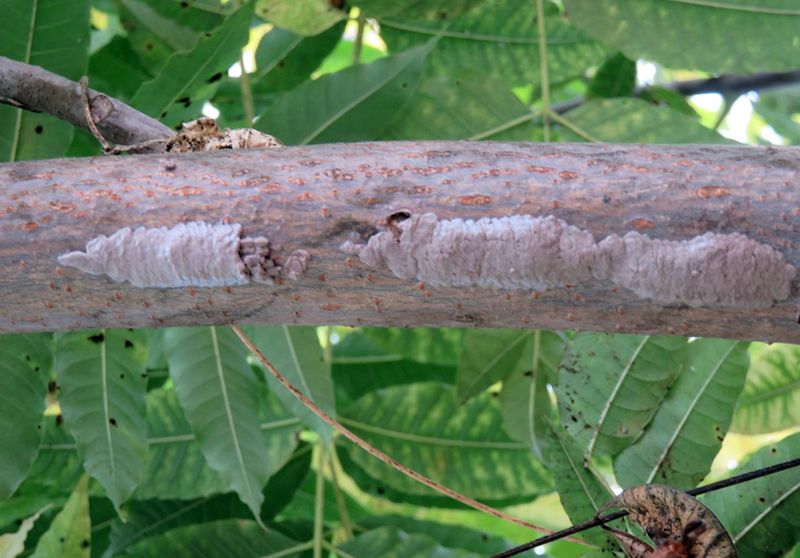
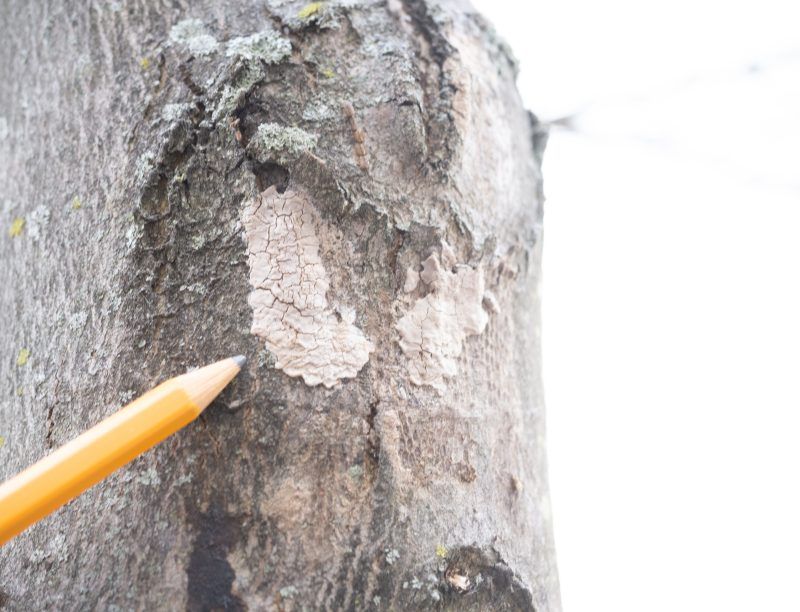
A spotted lanternfly egg mass looks like a smear of dried or cracked mud. Fresh masses are covered with a waxy gray or tan coating that can resemble putty or weathered paint. As that coating breaks down over fall and winter, it flakes away and rows of individual brown seeds or beads become visible underneath. USDA APHIS describes the mass as roughly an inch long and containing about 30 to 50 eggs arranged in columns.
Other insects also lay egg masses on bark and hard outdoor surfaces, including species that are beneficial to gardens and local wildlife. University of Maryland Extension warns that scraping an unconfirmed mass risks destroying something you want to keep. If you are uncertain whether what you found is a spotted lanternfly mass, photograph it from a few angles and compare it with verified images on the North Carolina Department of Agriculture’s spotted lanternfly page before touching it.
An adult lanternfly sighting is a different trigger than a confirmed egg mass. Seeing the insect itself is a reason to report and watch for masses, not a reason to scrape the nearest surface. The removal instructions in this article apply specifically to a confirmed, safely reachable egg mass. If you spot an adult and are outside a known infestation area, photograph it and submit the report through state guidance rather than treating the yard broadly.
Scrape, mix and discard a confirmed reachable mass
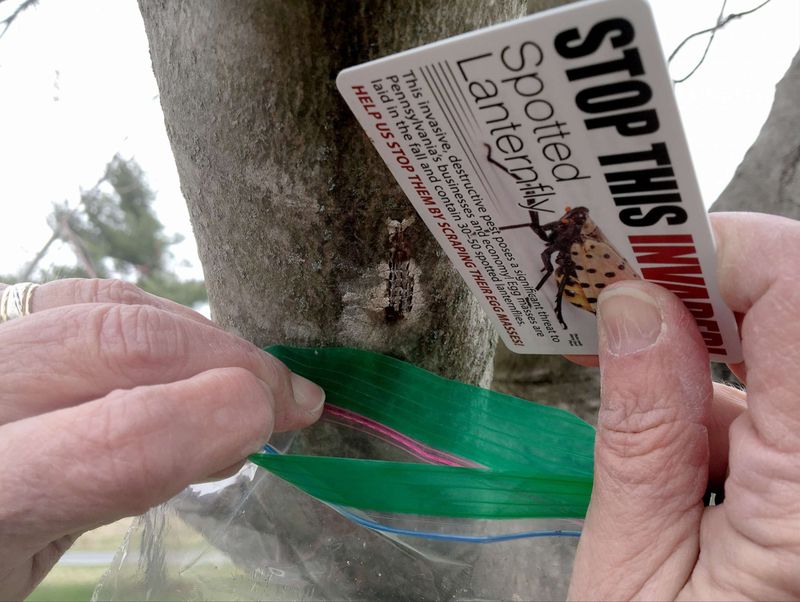
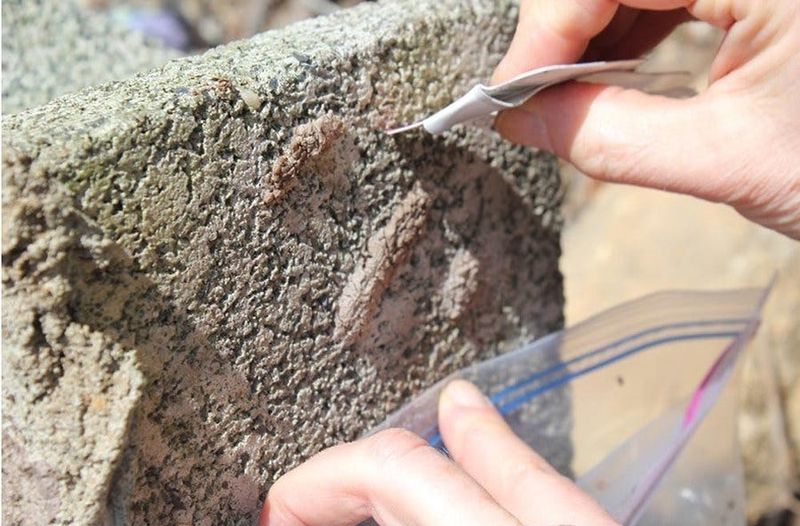
Once you have confirmed a mass and confirmed you can reach it safely from the ground, gather two things before you start: a stiff plastic card or putty knife and a sealable plastic bag with a small amount of hand sanitizer or rubbing alcohol already inside. Hold the open bag close to the surface so the scraped material falls directly into the liquid. That sequence matters because it prevents eggs from scattering on the ground or catching on clothing.
Work the scraper under the edge of the mass and push firmly along the surface. University of Maryland Extension’s removal guide and USDA APHIS both recommend the same sequence: scrape into the bag, crush or thoroughly mix the eggs in the sanitizer or alcohol, seal the bag completely and place it in the trash. Do not pour the contents into a drain or compost pile, and do not leave a partially scraped mass on the surface.
Crushing or mixing the eggs inside the bag is the step that actually destroys them. The alcohol or hand sanitizer helps, but physical disruption is what you are counting on. Squeeze the outside of the sealed bag firmly to make sure the eggs are broken, then seal it and set it aside for the regular trash pickup.
According to North Carolina’s agriculture department, an average mass contains roughly 35 eggs. Each one you remove and destroy is a local reduction in the next generation. That is a meaningful action even though it will not account for masses hidden higher in the canopy, on neighboring properties or on objects that have already left the yard.
Choose safety over a perfect cleanup
High egg masses are a real limitation, and accepting that limitation keeps you safe. Penn State Extension studied egg-mass distribution on 30- to 40-foot maple trees and found that fewer than 2% of masses were within 10 feet of the ground. That figure comes from a specific tree species and study site, so the percentage on your property may differ, but the broader point holds: a large share of masses in mature trees will be out of safe homeowner reach.
Do not climb trees or use a ladder casually to chase upper-canopy masses. The risk of a fall outweighs the benefit of reaching a single egg mass, and the masses you cannot reach will remain regardless. Focus your effort on what you can confirm and touch safely while standing on level ground, including lower trunks, fence lines, equipment and outdoor furniture. That is where your removal will be most practical and most consistent across the full inspection season.
Movable objects are worth a second mention here because they represent a category where your reach is complete. Before loading a camper, moving a trailer, transporting firewood or hauling outdoor equipment to another location, check every flat surface. USDA’s guidance on cleaning items before moving makes clear that a thorough check of vehicles and gear is one of the most direct ways a homeowner can limit the pest’s spread to new areas. A mass you cannot see on a tree 35 feet up is beyond your control; a mass on the trailer hitch is not.
Use reporting and broader management when one mass is not the whole problem
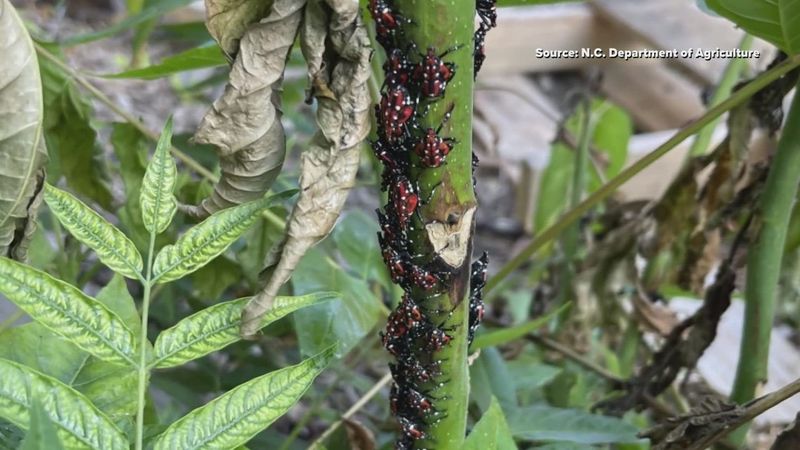
Removing a single egg mass is useful, but an established spotted lanternfly population involves far more than what any one homeowner can scrape. Masses can be hidden in bark crevices, positioned high in the canopy, present on neighboring properties or already transported on moving objects. Penn State Extension is clear that egg destruction is an additive local measure, not a population-control program, and that it will probably not eliminate a local population on its own.
When an infestation is more widespread, monitoring, trapping, targeted treatment or coordination with extension agents and agriculture officials may be needed. Penn State’s management guide supplement outlines options beyond physical removal for situations where egg scraping alone is insufficient. North Carolina homeowners facing a heavy infestation should contact their local Cooperative Extension office rather than defaulting to broad yard sprays, which can harm beneficial insects and offer limited lasting benefit.
If you are outside a known infestation area and find something that looks like a spotted lanternfly or its egg mass, photograph it and report it through the state’s current reporting system before taking any other action. As of February 10, 2026, NCDACS had confirmed established populations in seven counties: Forsyth, Guilford, Rockingham, Caldwell, Caswell, Davidson and Rowan. That list should be treated as a dated snapshot, not a permanent boundary. Check the NCDACS spotted lanternfly page directly for the most current county status before drawing conclusions about your area.
The pest is actively spreading, and the distribution as of early 2026 may have changed by the time you read this.
Repeat the inspection and avoid untested shortcuts
The practical routine is straightforward: start checking outdoor surfaces in late summer, confirm any suspected mass against verified images, remove only confirmed masses you can reach safely using the sealable bag method, and repeat those checks through fall, winter and into early spring. No single pass will catch everything, because adults continue laying into early winter and masses persist through May.
Broad sprays, lawn insecticides and homemade mixtures are not reliable substitutes for targeted removal. University of Maryland Extension advises against lawn insecticide applications because spotted lanternflies do not live in lawns, and whole-yard sprays typically offer only a small, temporary reduction while posing real risk to pollinators, beneficial predators and other parts of the landscape. Vinegar, dish soap and similar homemade mixtures are untested and can harm plants, pets and wildlife. If you want to do something beyond physical removal, consult current extension guidance on registered, targeted products rather than reaching for whatever is in the garage.
For persistent or widespread problems, professional management resources and your local NCDACS guidance are the right next step. Consistent seasonal inspection is unglamorous work, but a scraper and a sealable bag remain the most direct tools a homeowner has.