
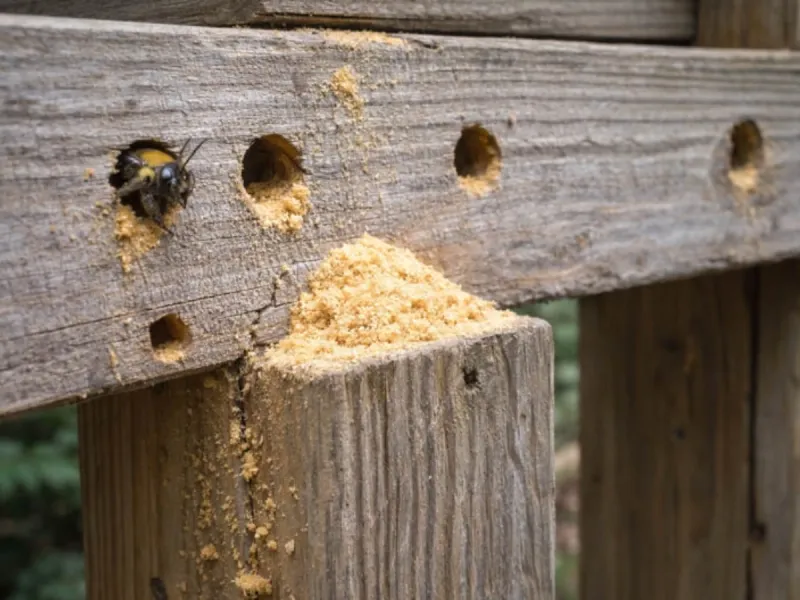
Spotting a nearly round hole in your deck rail or fence post can stop you mid-step, especially when you notice a large, hovering bee nearby. Those openings are a signal worth reading carefully, because they reveal something specific about the condition and finish of your outdoor wood. Understanding what drew the bees there in the first place puts you in a much better position to protect the wood before the damage spreads.
The hole’s shape points to a carpenter-bee gallery
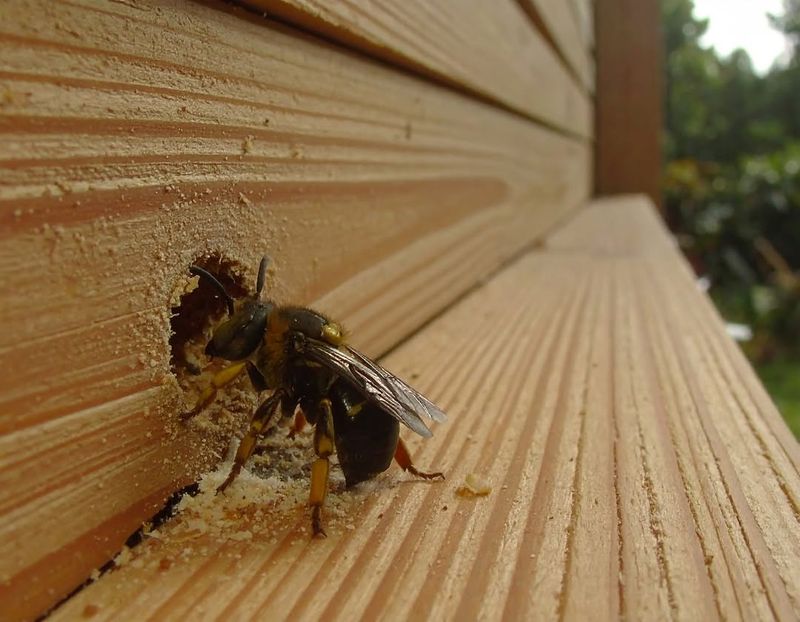
A nearly round opening about one-half inch across in a deck rail, fence post, or eave board is one of the more recognizable signs of a large carpenter bee at work. According to NC State Extension’s guide to non-honey bee stinging insects, exposed decks, rails, eaves, and other outdoor wood are common nesting sites for these bees, and the entrance hole is typically smooth-edged, nearly perfectly circular, and about the diameter of your finger.
Two additional clues help confirm the identification. Fine sawdust, sometimes called frass, often collects directly below the entrance, and yellowish-brown staining or waste may streak the wood beneath the opening. Both signs point toward active or recent nesting activity rather than a simple crack or mechanical damage.
The casual description “quarter-sized” circulates widely, but Penn State Extension’s carpenter bee resource more precisely describes the entrance as roughly one-half inch in diameter. Diameter alone is not a definitive diagnosis; shape, location, sawdust, staining, and the bee’s appearance together build a stronger case.
The bee itself offers another layer of confirmation. Eastern carpenter bees have a largely hairless, shiny black abdomen, which sets them apart from bumble bees, whose abdomen is densely covered with yellow and black hair. If a large, glossy-bodied bee is hovering near the hole or disappearing into it, you are most likely looking at a carpenter-bee gallery rather than damage from another insect or a weather crack. That starting identification matters before you decide how to respond.
Which wood are the bees choosing?
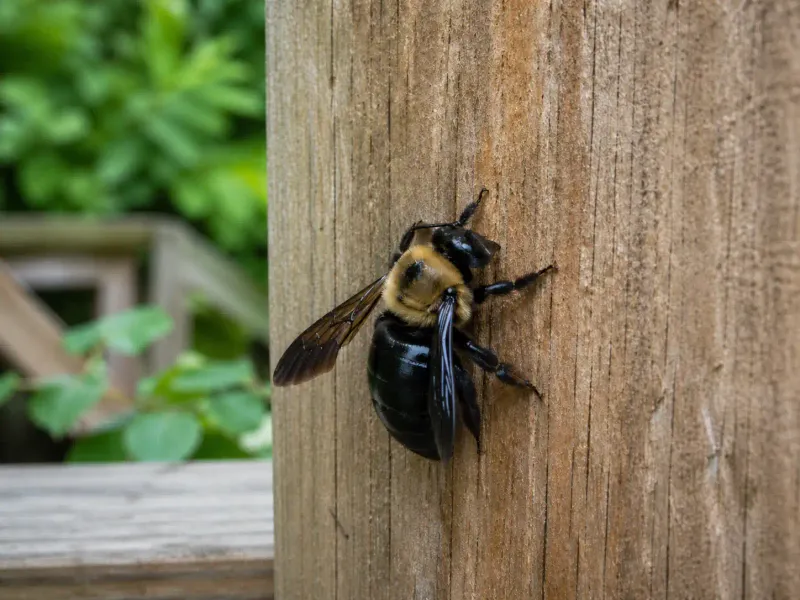
Carpenter bees are not drilling randomly. The pattern of where holes appear reflects a combination of wood species, surface finish, grain orientation, sun exposure, and local nesting pressure. Ohio State Extension’s carpenter bee factsheet notes that these bees show a strong preference for bare or weathered, relatively soft, straight-grained lumber. Pine, cedar, cypress, redwood, and fir are frequently targeted because their grain is easy to excavate and their surfaces are often left exposed on decks and fences.
Weathered wood is not automatically rotten wood. Research on Xylocopa virginica nesting biology confirms that eastern carpenter bees can excavate sound, undecayed dead wood. What matters more than decay is the loss of a protective surface finish and the softness of the grain. A board that looks solid but has shed its paint or stain is still an attractive candidate.
Painted, stained, or pressure-treated wood can also be attacked, particularly where coverage has worn thin, where end grain is exposed, or where old galleries already exist. University of Illinois Extension’s carpenter bee overview points out that a maintained finish makes wood less attractive but does not make it immune. Pressure treatment may slow initial attack, but resistance tends to decline as the surface weathers over seasons.
The most vulnerable spots on a typical North Carolina deck or fence are the tops of rails and fence boards, cut ends and end grain, fascia boards facing south or west, cracks and checks in older lumber, and any surface where the finish has peeled or faded. Addressing those specific locations, rather than treating all wood as equally at risk, is where a targeted prevention plan starts.
A small entrance can hide a longer tunnel
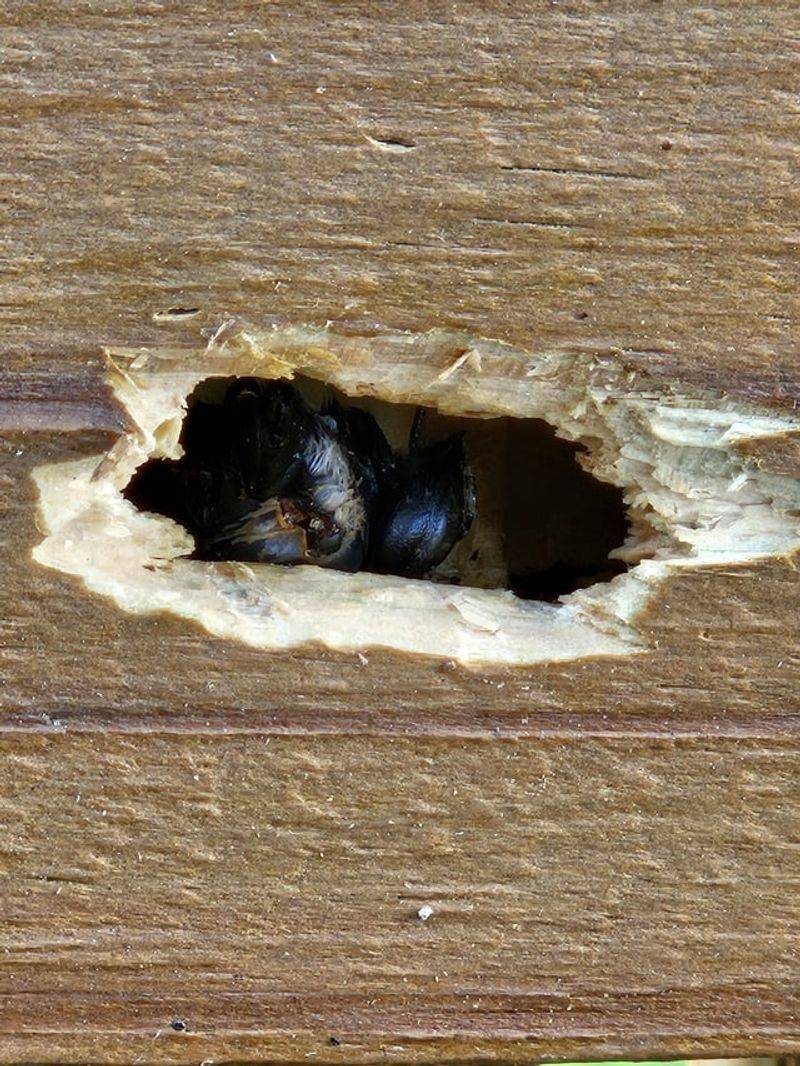
What you see at the surface is only part of the story. Penn State Extension explains that after a female carpenter bee bores an entry hole, she typically excavates across the grain for about an inch before turning and tunneling along the grain to create a series of brood chambers. A half-inch opening on the outside of a rail can therefore conceal a gallery that runs several inches or more into the wood, packed with pollen provisions and developing larvae.
That internal geometry is why a quick glance at the entrance does not tell you how much wood has been removed. Still, isolated holes from a single season are usually a localized concern rather than a structural emergency. NC State Extension notes that serious structural damage is uncommon unless large numbers of bees drill many tunnels over successive years.
Cumulative reuse is where the risk grows. When bees return to the same board spring after spring, enlarging existing galleries and adding new branches, the wood loses meaningful cross-section. Thin lumber, such as a two-by-four rail, has less material to spare than a thicker post, so repeated nesting in the same piece carries more consequence. Decay setting into old, open galleries speeds that process further.
Ohio State Extension and UC IPM’s carpenter bee guidance both note that woodpeckers compound the damage by hammering into galleries to reach larvae, sometimes splitting or splintering the surrounding wood far beyond the original tunnel. Signs that justify a closer look include multiple holes clustered in the same board, soft or spongy wood around an entrance, visible staining that suggests moisture has entered a gallery, and fresh woodpecker damage on the same surface. A few scattered holes on an otherwise sound deck do not call for immediate replacement.
North Carolina’s spring activity reveals when to inspect
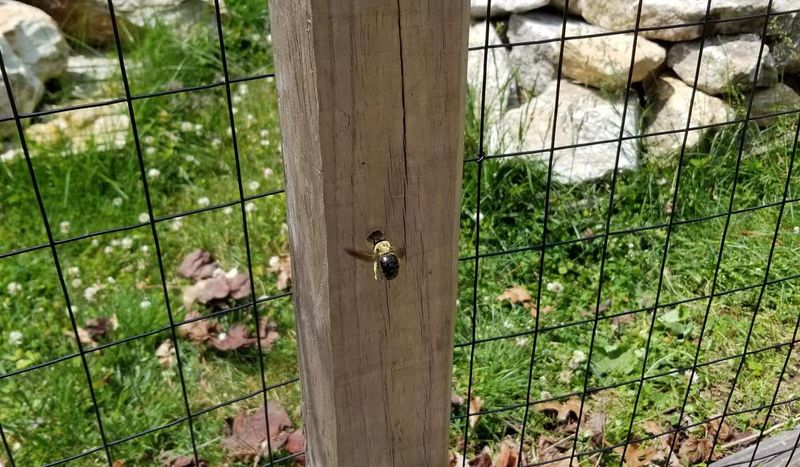
Timing matters when you are trying to get ahead of carpenter-bee nesting. NC State Extension reports that carpenter bees in North Carolina typically emerge in April and May to mate and begin excavating new galleries or reoccupying old ones. A second group of adults, which developed inside nests earlier in the year, emerges later in summer. Both windows are worth knowing about, but the spring emergence is when most new drilling happens.
Activity timing is not uniform across the state. Weather and elevation shift the schedule across the Coastal Plain, Piedmont, and mountains, so a homeowner in the western highlands may see bees a few weeks later than someone near the coast. State natural heritage records document eastern carpenter bees in North Carolina, and the species commonly nests in residential wood structures across the region, though the exact distribution and density vary by location.
Before you approach any holes for inspection, the sting risk is worth a brief note. Male carpenter bees often hover assertively near nest sites, which can feel threatening, but males have no stinger. Females can sting if handled or pressed against skin, though they are not generally aggressive toward people who are simply walking nearby. UC IPM’s carpenter bee guidance reinforces that females typically sting only when trapped or directly handled.
The practical takeaway is to schedule a thorough inspection of your deck and fence rails in late winter or very early spring, before the April emergence begins. Check rail tops, cut ends, fascia, and any boards that showed holes the previous year. Catching worn finishes and old galleries before bees return gives you the best chance to address vulnerabilities on your schedule rather than theirs.
A durable finish protects the wood they keep finding
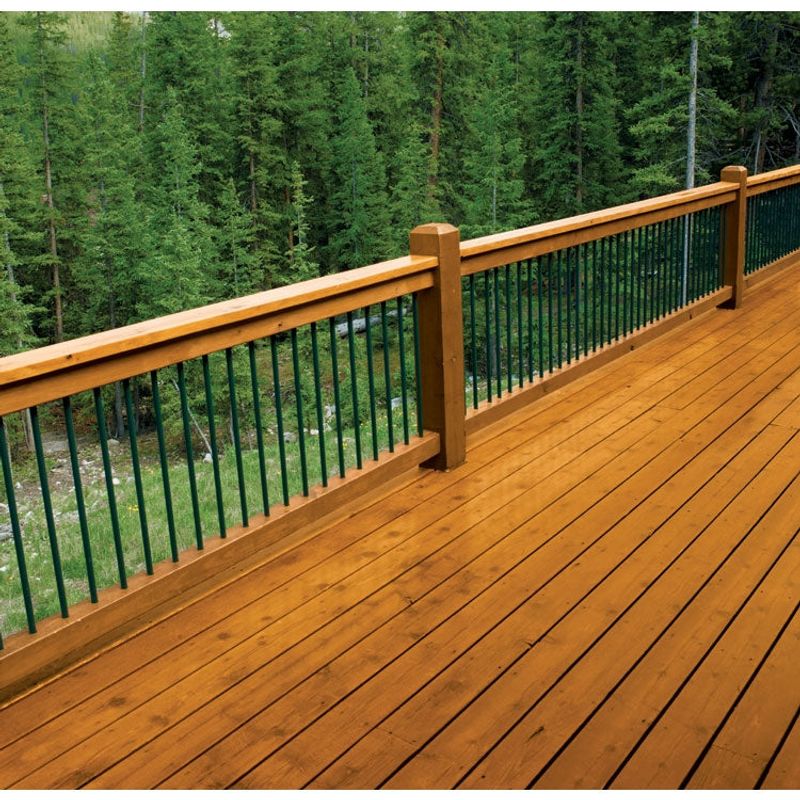
The most accessible step a North Carolina homeowner can take is also the most preventive: keep a durable finish on exposed wood surfaces before bees return each spring. Ohio State Extension recommends painting or thoroughly varnishing bare wood, with special attention to the surfaces bees find most attractive. Rail tops, cut ends and end grain, fence board tops, fascia edges, and any sunny south- or west-facing surfaces are the highest-priority spots.
End grain deserves particular care because it absorbs finish poorly and dries out faster than face grain. A board that looks well-painted on its broad face may have completely bare, checked end grain at the cut, which is exactly where bees probe first. Two coats of a quality exterior paint or varnish on those ends, reapplied whenever the finish shows wear, closes one of the easiest entry points.
University of Illinois Extension notes that a maintained finish makes wood less attractive to carpenter bees but does not make it bee-proof, especially where old galleries remain or coverage thins over time. For boards that have been drilled repeatedly over multiple seasons, replacement with a painted lumber alternative or a non-wood component is worth considering. Composite decking, vinyl fence rails, and aluminum fascia trim simply do not offer the soft, straight grain that carpenter bees prefer.
Build the finish check into an annual routine. Walking the deck and fence line in late winter, looking for peeling paint, bare end grain, cracks, and old holes, takes less than an hour and sets up the whole season. NC State Extension consistently points to maintaining a durable surface as a primary deterrent, paired with sealing old galleries before bees reoccupy them. Address the finish before April, and you have shifted the odds in your favor.
What should you do about an active hole?
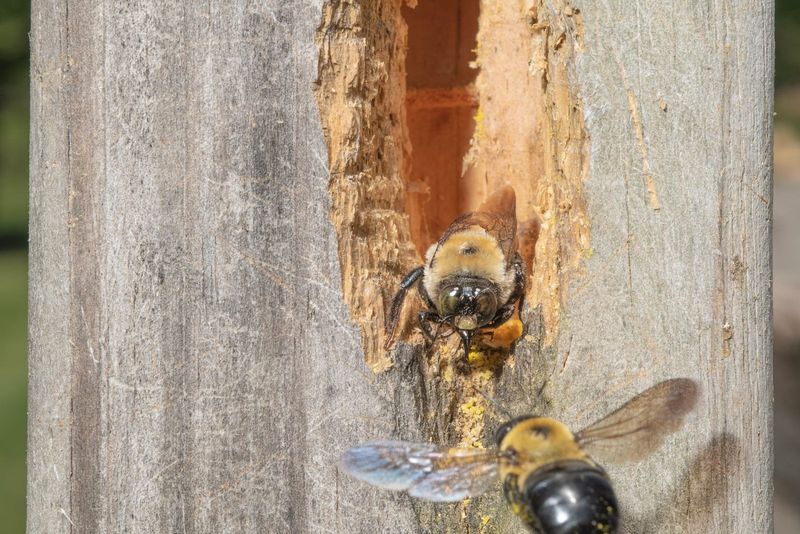
Finding an active gallery calls for a measured response, not a quick fix. The first rule is to avoid plugging a hole that bees are still using. NC State Extension warns that stuffing an active entrance with mesh or a plug can trap bees inside, which may prompt them to chew a new exit hole elsewhere in the same board. You end up with more damage and no resolved problem.
Any pesticide treatment must follow the current product label exactly. North Carolina’s 2026 Agricultural Chemicals Manual lists active ingredients and products used for carpenter-bee gallery treatment, but product availability, formulation, and homeowner-use permissions vary. The label on the specific product you purchase controls legal use, required protective equipment, application timing, and any restrictions intended to protect pollinators. EPA guidance on pollinator protection makes clear that pesticide labels are legally binding and must be followed precisely.
Targeted treatment directed into the gallery entrance is the appropriate approach when a label-compliant product is used. Spraying bees that are hovering in the air or broadly treating the entire deck surface is not recommended. NC State Extension specifically describes spraying hovering bees as neither a sensible nor a particularly safe use of pesticides, and EPA’s pesticide product and label system provides a way to verify current label requirements for any registered product.
After bee activity has stopped and the product label permits sealing, fill the entrance with wood filler, caulk, or a snug wooden dowel. Sand the repair flush, then paint or varnish the patched area so the surface matches the surrounding finish and offers no bare wood for future probing. Penn State Extension recommends this sequence consistently: treat, wait for the appropriate interval, seal, and refinish.
For holes that are high on a structure, tucked under eaves, clustered in large numbers, or simply in places that would require unsafe climbing or injecting pesticide into unknown wood, a licensed pest-control professional is the safer choice. Attempting to treat inaccessible galleries without proper equipment raises both personal safety and label-compliance concerns. A professional can assess the full extent of gallery use and apply treatment correctly. The goal throughout is protecting the specific wood that is vulnerable, not treating every bee in the yard as a target.
Reviewing a current EPA-registered label example before purchasing any product helps confirm that what you plan to do matches what the label actually permits.
Protect the rail without treating every bee as a threat
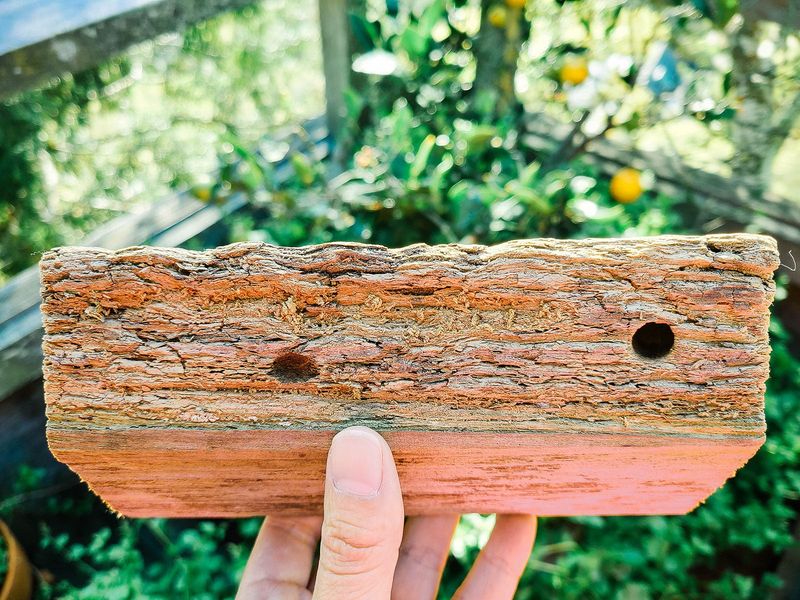
A proportionate response to carpenter bees starts with accurate identification and an honest look at the wood. Spot a likely gallery, check whether it shows signs of active use, assess how many holes are present and how much the finish has degraded, then decide on the level of response the situation actually warrants. A single hole in a well-maintained rail calls for finish repair and monitoring. Repeated tunneling in the same thin board over several seasons, especially with woodpecker damage added in, calls for more deliberate action.
University of Illinois Extension frames carpenter bees as both wood-damaging and ecologically valuable, a combination that rewards targeted wood protection over indiscriminate spraying. NC State Extension reinforces that the male bees hovering near your railing cannot sting, and that females are not inclined to sting people who are simply passing by.
University of Georgia Extension notes that carpenter bees are native pollinators that visit a wide range of flowering plants, making broad pesticide applications a trade-off that affects far more than the bees drilling your fence. Keeping finishes intact, sealing old galleries at the right time, and replacing chronically attacked boards with non-wood alternatives protects your structure without turning every bee in the yard into a problem to eliminate. The holes signal a specific, protectable wood condition, and addressing that condition is a more durable solution than chasing the bees themselves.