
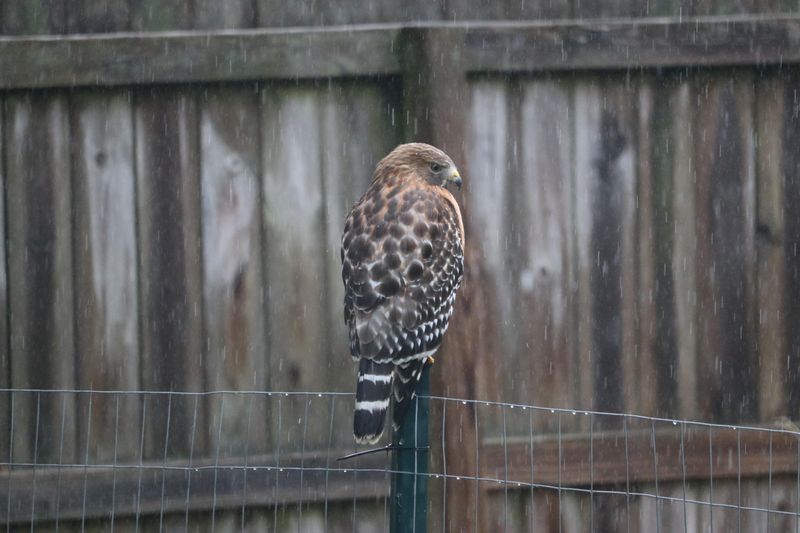
Spotting a hawk once is exciting, but seeing the same bird swoop through your backyard again and again can leave you wondering what it is after. For North Carolina homeowners, those repeat visits are worth paying attention to, because they usually mean something nearby is drawing the hawk in. Understanding what that something is can help you protect your feeder birds, keep your yard healthy, and share the landscape with one of the state’s most capable predators.
Repeated visits signal opportunity, not ownership
Seeing a hawk cross your yard two or three times in the same week feels significant, and it is, just not in the way most people assume. A returning hawk does not mean your property has become its permanent hunting territory. What those repeat appearances more reliably suggest is that the surrounding landscape, including neighboring yards, tree lines, open patches, and rooftop perches, offers something the hawk finds useful: prey it can reach, cover to hunt through, a good vantage point, or air conditions that make flying easier.
The more accurate question to ask is not “has this hawk claimed my yard?” but rather “what opportunity is it finding here or nearby?” That shift in thinking matters because it moves you from alarm toward observation. A hawk using your airspace is responding to what the whole neighborhood offers, not necessarily declaring your specific lawn its private dining room.
Research supports the idea that prey availability shapes where hawks show up in populated areas. A peer-reviewed study of urban Cooper’s and Sharp-shinned Hawks in metropolitan Chicago found that prey abundance strongly influenced which areas hawks colonized and continued to use. That finding offers useful context, but it describes patterns across an entire metropolitan landscape, not a diagnosis of one property in Raleigh or Wilmington. Your yard may be part of a broader set of conditions the hawk is responding to, rather than the single source of its interest.
Cornell Lab’s Cooper’s Hawk profile notes that these birds are woodland and suburban hawks that move through varied habitat in search of prey. A sighting alone cannot confirm that your yard holds a rodent problem, a nest nearby, or a reliable food source. Repeated visits are a clue worth reading, not a verdict.
The flight pattern tells a different story
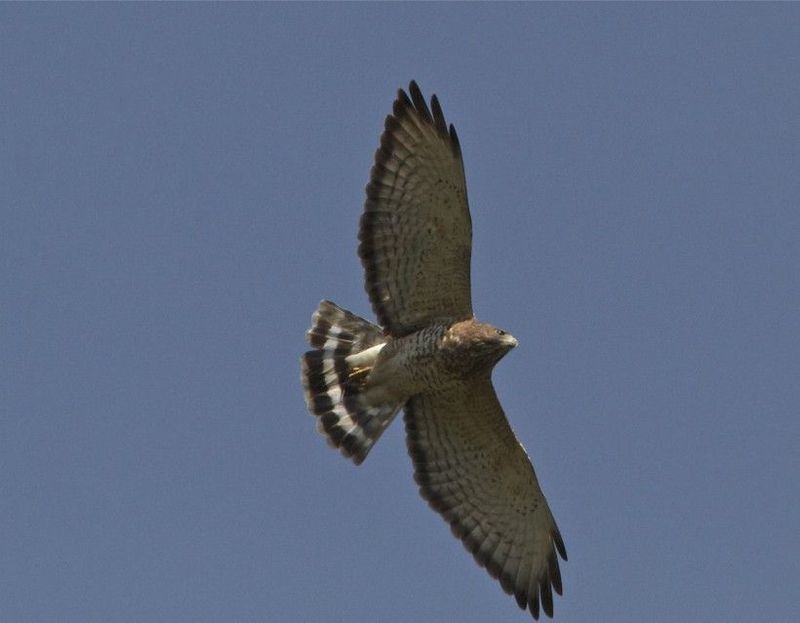
Not every hawk you see circling overhead is hunting your yard. The way a hawk moves through the air carries real information, and reading that movement can save you a lot of unnecessary worry. High, lazy circles on a warm afternoon usually mean the bird is riding a thermal, a column of rising warm air, to gain altitude or travel efficiently across the landscape. Broad-winged Hawks and Red-tailed Hawks use this technique regularly, and Cornell Lab explains that hawks often circle above forest canopies or open terrain simply to gain height before moving on.
Lower, tighter circling over an open lawn or field is a different behavior. That pattern is more consistent with a hawk actively scanning the ground for prey, watching for movement in the grass below. Even then, the hawk may be assessing rather than actively pursuing anything specific in your yard.
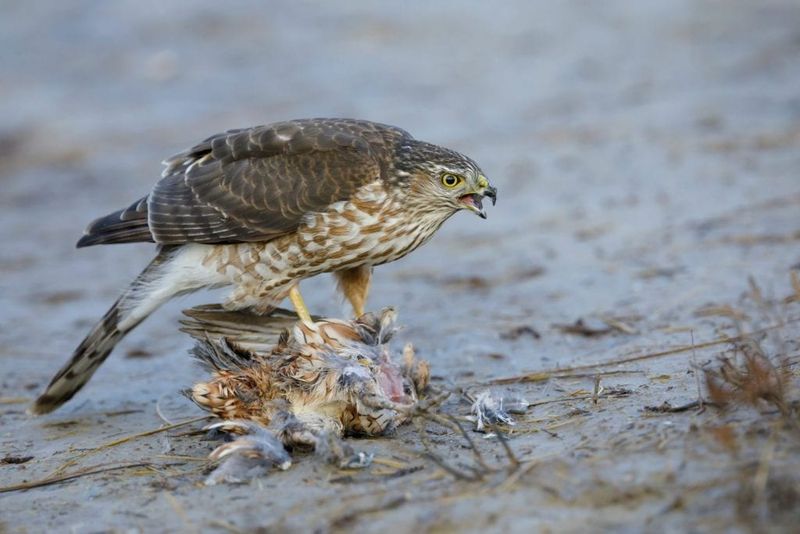
The most unmistakable hunting behavior looks nothing like circling at all. A Cooper’s Hawk or Sharp-shinned Hawk pursuing a songbird moves fast and low, threading through shrubs, around tree trunks, and under canopy cover with quick, powered wingbeats followed by short glides. That kind of flight is a pursuit, not a patrol. Audubon’s field guidance describes this as the accipiter style, built for agility in dense vegetation rather than soaring efficiency.
Other explanations for repeated passes include territorial display over a nesting area, a parent commuting between a nest and a hunting area, or a young hawk from this summer’s brood practicing its range. A casual backyard view from a deck or window often does not give you enough angle or detail to identify the species with confidence, let alone diagnose the reason for the visit. Noting the flight height, wing shape, and whether the bird is powered or gliding gives you much more to work with than simply counting how many times it appears.
Species changes what the yard may be offering
Knowing which hawk you are looking at changes everything about what that visit might mean. You do not need to be an expert birder to pick up on the basics, and even rough observations can point you in a useful direction.
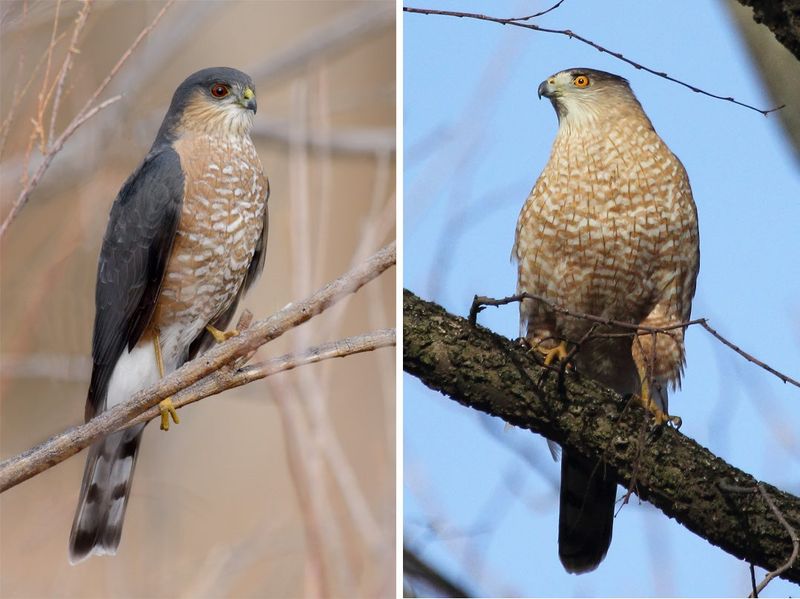
A hawk with a long, banded tail, rounded wings, and the kind of quick, agile flight that carries it through tree branches and around shrubs is most likely a Cooper’s Hawk or a Sharp-shinned Hawk. Both are accipiters, a group built for hunting in wooded and suburban settings. Cornell Lab describes the Cooper’s Hawk as a bird that mainly eats other birds, and it is well known for visiting yards where feeders concentrate songbirds. The Sharp-shinned Hawk is smaller, with a squarish tail, and specializes even more strongly in small birds.
Seeing either of these near your feeders suggests the concentration of songbirds at that station may be the draw.
A larger, broad-winged hawk sitting on a utility pole or fence post at the edge of an open lawn tells a different story. Red-tailed Hawks hunt primarily from perches or while circling over open ground, and their diet runs heavily toward mice, voles, rabbits, and other small mammals, along with some birds, snakes, and carrion. A Red-tailed Hawk scanning your lawn is more likely responding to open ground that gives it a clear view of potential prey movement than to your bird feeders.
The catch is that hawk diets overlap, and a single backyard sighting rarely gives you enough detail for confident identification. Cooper’s and Sharp-shinned Hawks are notoriously similar in appearance, and even experienced observers sometimes cannot tell them apart without a clear, close look. Using behavior and habitat context alongside shape and size gives you the best chance of reading the visit accurately, even if you cannot put a firm name on the bird.
Feeders can concentrate the prey without feeding the hawk
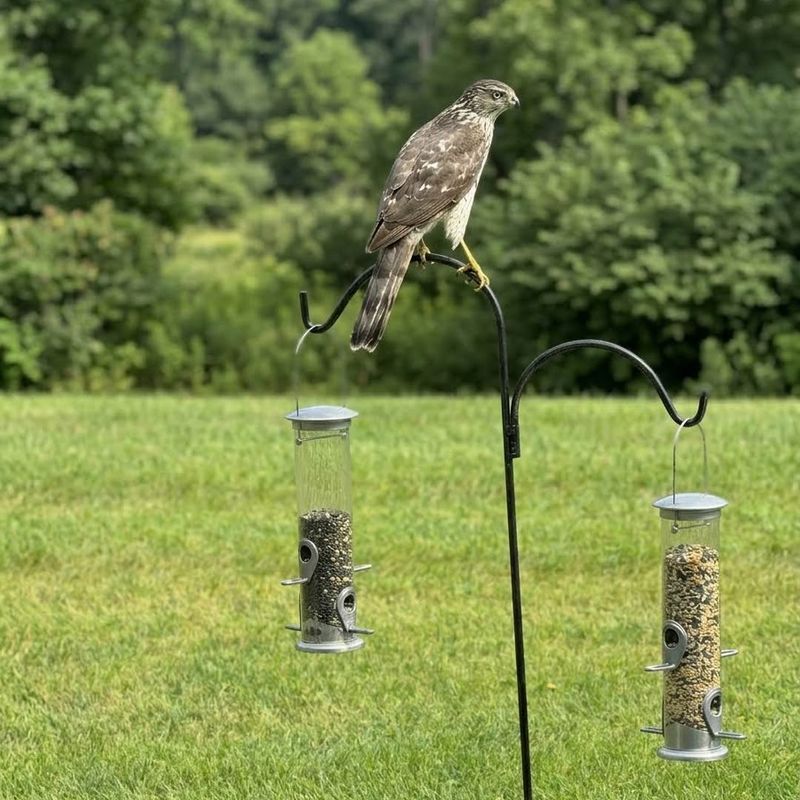
Hawks do not eat birdseed. That point sounds obvious, but it clears up a confusion that catches a lot of homeowners off guard. When a hawk shows up near a feeder, the seed itself is not the attraction. What feeders do is pull songbirds into a predictable, concentrated spot, and that concentration is what can catch the attention of a bird-hunting hawk like a Cooper’s or Sharp-shinned.
Cornell Lab notes that Cooper’s Hawks are known to visit yards and feeders because feeders can concentrate prey birds, not because the hawks are interested in what the feeder holds. The Sharp-shinned Hawk follows the same logic, sometimes hunting at backyard feeders where songbirds gather in predictable numbers. Seed draws sparrows, finches, and chickadees; those birds draw the hawk.
Spilled seed on the ground introduces a second possible pathway. Seed that falls under a feeder and sits there can attract mice and other small rodents, which are prey for Red-tailed Hawks and, to a lesser extent, Cooper’s Hawks. This is a plausible secondary connection between a messy feeder and a hawk visit, but it is worth treating as a possibility rather than a certainty. A hawk’s presence near your feeder does not confirm that rodents are living under it.
Cornell Lab’s broader reporting on hawk sightings in yards makes clear that feeders can increase the visibility of predator-prey interactions without necessarily causing a serious population-level decline in native birds. The relationship is complicated, and individual yards vary widely. What a feeder reliably does is make prey easier to find in one spot, and that is the detail worth keeping in mind when a hawk keeps returning.
What does summer change in North Carolina?
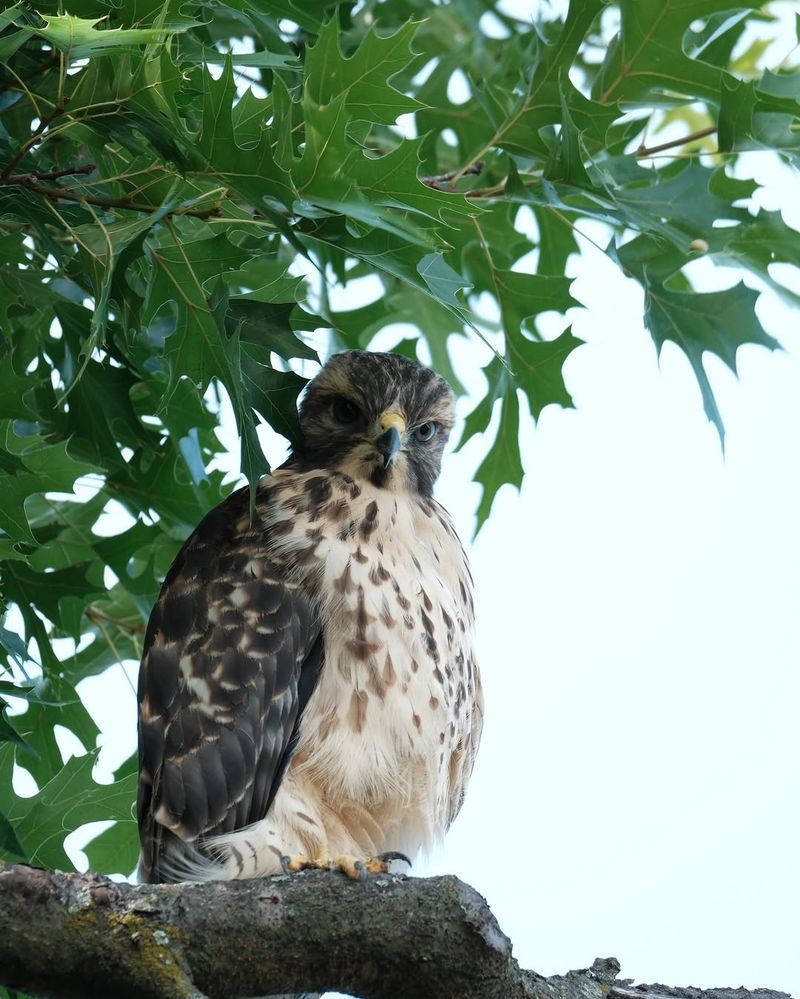
Summer does not automatically mean hawk activity peaks in every North Carolina backyard, but the season does bring a set of conditions that can make sightings more likely or more noticeable depending on where you live and which species are present.
Local breeding is one factor. Hawks that nest in the area spend the summer raising young, and adults make repeated trips between a nest site and nearby hunting areas to bring food back. Once fledglings leave the nest, they begin exploring their own range, and young hawks practicing their hunting skills are often less efficient and more visible than experienced adults. This can produce a stretch of weeks in summer when a hawk appears regularly in the same general area simply because that is where it grew up.
Soaring conditions also shift in summer. Warm afternoons generate stronger thermals over open ground and rooftops, which can bring hawks overhead more often, especially broad-winged species. Broad-winged Hawks are woodland nesters that may circle above forest canopy during summer months before their dramatic fall migration. Sharp-shinned Hawks, by contrast, are more closely associated with migration and nonbreeding-season feeder activity than with summer residency near feeders.
Use the season as context rather than a fixed explanation. A hawk you see in July may be a local breeder, a wandering fledgling, or a bird simply taking advantage of good soaring weather. Matching the behavior and species to the season gives you a more accurate read than assuming summer alone explains the visit.
A short feeder pause is the practical response to repeated attacks
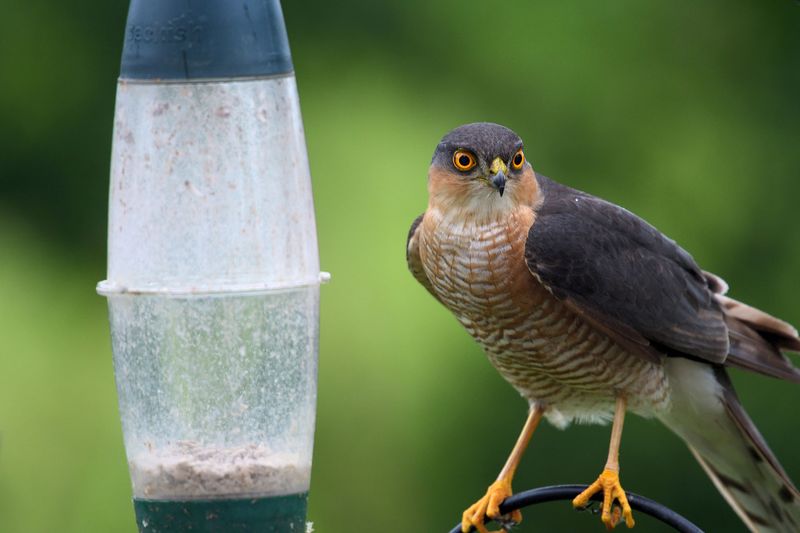
When a hawk begins hitting your feeders repeatedly, the most practical and low-effort response is to take the feeders down for a few days. This is not a permanent fix or a guarantee, but it removes the concentrated gathering of songbirds that made the location predictable for the hawk. Cornell Lab recommends taking feeders down for a couple of weeks if a Sharp-shinned Hawk begins hunting regularly in the yard, and the same logic applies to Cooper’s Hawks.
A useful approach is to start with several days and watch what happens when you bring the feeders back. If attacks resume quickly, extend the pause toward two weeks. The goal is to break the pattern of concentrated prey at one predictable spot, not to eliminate feeding permanently. Cornell’s Cooper’s Hawk guidance frames this as a temporary measure to reduce concentrated encounters, not a reason to stop feeding birds altogether.
Feeder hygiene is a separate matter worth handling on its own schedule. Cleaning feeders and removing spilled seed from the ground supports bird health by reducing the spread of disease, which can move quickly through crowded feeding stations during North Carolina’s humid summers. Audubon’s backyard mishap guidance notes that pausing feeding can also help disperse birds when illness is suspected at a station. Removing spilled seed may also reduce the chance of attracting rodents under the feeder, though neither of these sanitation steps should be counted on to stop hawk visits on their own.
Vegetation placement is another layer of risk reduction. UGA Cooperative Extension guidance on feeder management and Audubon both note that dense shrubs within roughly 15 to 20 feet of a feeder can give small birds a place to escape quickly. That cover helps, but it is not a hawk-proof setup. An accipiter is built to hunt through vegetation, so nearby shrubs reduce risk without eliminating it.
Think of feeder placement and escape cover as reasonable precautions, not a formula that makes the yard safe from every approach.
Hawks belong in the yard’s food web, not on a pest-control promise
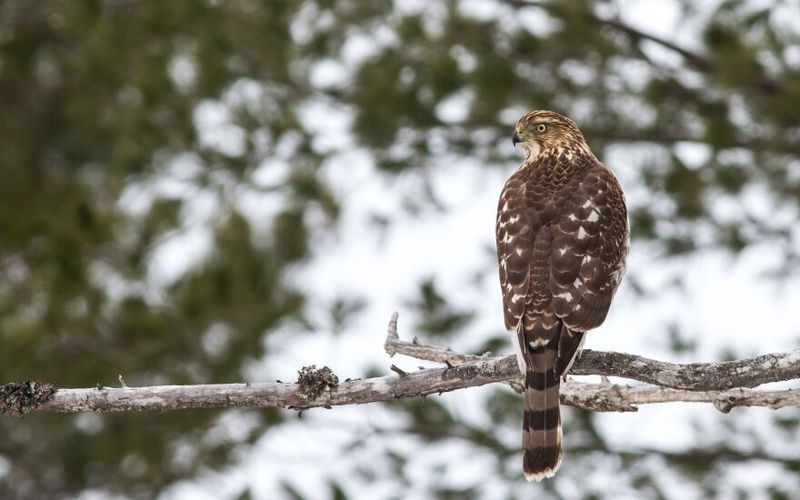
Hawks are a natural part of the food web in North Carolina yards, and their presence is generally a sign of a functioning local ecosystem rather than a problem to solve. That said, it is worth being clear about what they do and do not offer the homeowner who wants a safer yard.
Hawks are predators that eat what they can catch, and ordinary predation on songbirds or small mammals is not a routine danger to people. Cornell Lab raptor expert Brian Sullivan characterizes hawk behavior as natural predation on prey, not aggression toward humans. Keeping children and small pets away from active nest sites, injured raptors, and fledglings on the ground is a sensible precaution, but hawks circling overhead or perching nearby are not a family threat in normal circumstances. Never attempt to handle a hawk, remove a nest, or disturb eggs or young birds.
Native hawks are federally protected under the Migratory Bird Treaty Act. U.S. Fish and Wildlife Service documentation makes clear that trapping, harassing, or harming a protected raptor is not a legal option for homeowners. If hawk activity creates a persistent conflict that passive measures cannot address, the right step is to contact your state wildlife agency or a licensed wildlife rehabilitator rather than attempting removal yourself.
On tick prevention, hawks may occasionally consume rodents that carry ticks, but there is no reliable basis for treating a backyard hawk as a meaningful tick-control service. CDC guidance on preventing tick bites centers on habitat modification and personal protection: removing leaf litter, clearing tall grass and brush near the house, mowing regularly, placing a wood-chip or gravel barrier at wooded edges, and storing firewood neatly to discourage rodents. Those steps have direct evidence behind them. The hawk in your yard is a welcome part of the landscape, but tick management belongs in your hands, not on its talons.
Read the return as a clue, then watch the yard
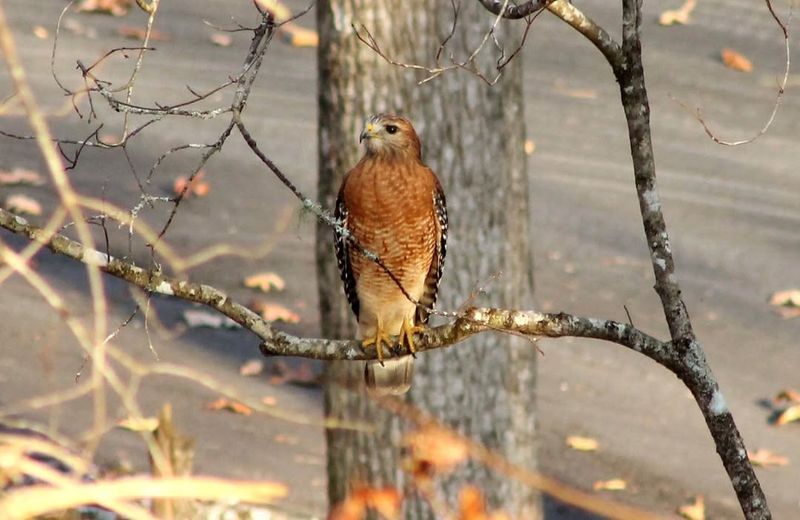
A hawk that keeps returning is worth paying attention to, but the number of visits matters less than what the bird is actually doing. Species and behavior together tell you far more than a simple count of appearances. Cornell Lab notes that hawk sightings in yards have become more common as some species have adapted to suburban landscapes, so a returning hawk may reflect broader landscape trends as much as anything specific about your property.
The practical path forward is straightforward. Observe first, then act if needed. Pause feeders for several days if a hawk begins repeatedly targeting songbirds at your station, and extend that pause toward two weeks if attacks continue. Keep feeders clean and clear spilled seed for bird health and basic sanitation, separate from any hope of deterring the hawk.
Avoid any direct interference with the bird, its nest, or its young. For tick prevention, rely on the yard-management steps that actually have evidence behind them rather than assigning that job to a passing raptor.
A hawk returning to your North Carolina yard is reading the landscape and finding something worth coming back for. Your job is simply to read it back.