

If you have ever stepped onto your porch on a warm Texas evening and spotted a small lizard darting toward the light, you have already met one of the most common uninvited helpers around Central Texas homes. Those quick little wall-climbers eat insects, including cockroaches, and a lot of homeowners want more of them.
But before you run out and plant a specific shrub expecting a gecko army to show up and clean house, there is a more honest and more useful story to know.
Cenizo offers habitat value, not a proven gecko shortcut

Cenizo, sometimes called Texas sage or purple sage, is one of those plants that keeps showing up in conversations about Central Texas gardening, and for good reason. Texas A&M horticulture materials describe cenizo as a drought-tolerant evergreen shrub that provides wildlife cover and functions as a host plant for certain insects.
Those are real benefits, and they belong in any honest discussion of wildlife-friendly gardening in this region.
What cenizo does not do, at least according to any source that can be pointed to, is reliably draw house geckos to a porch. The headline premise that one specific native shrub summons roach-hunting geckos every summer is not backed by research.
No study or extension document reviewed for this article establishes cenizo, or any other single Central Texas shrub, as a documented gecko attractant. Calling it a gecko lure would be selling the plant credit it has not earned.
That correction does not make cenizo a bad choice. General wildlife cover and host-plant value are worth having in a yard, especially in a region where water-conscious planting matters.
The more important point is that cenizo’s usefulness depends heavily on where you are trying to grow it. Texas Parks and Wildlife wildscape guidance recommends selecting plants suited to local conditions and ecoregions, and cenizo is not the right fit for every Central Texas yard.
Before planting it along a foundation, check whether it is native to your specific area, not just to Texas broadly, and confirm that your soil, drainage, and sun exposure actually match what the plant needs.
The shrub’s regional native status also requires a second look. TPWD’s South Texas wildscapes tips remind gardeners that a plant’s performance and ecological role can shift significantly across ecoregions.
Cenizo suits parts of the Trans-Pecos, the South Texas Plains, and some drier areas of the Edwards Plateau, but it is not automatically a native or a reliable performer in every Austin-area backyard. Verify before you plant.
The porch geckos are usually introduced house geckos
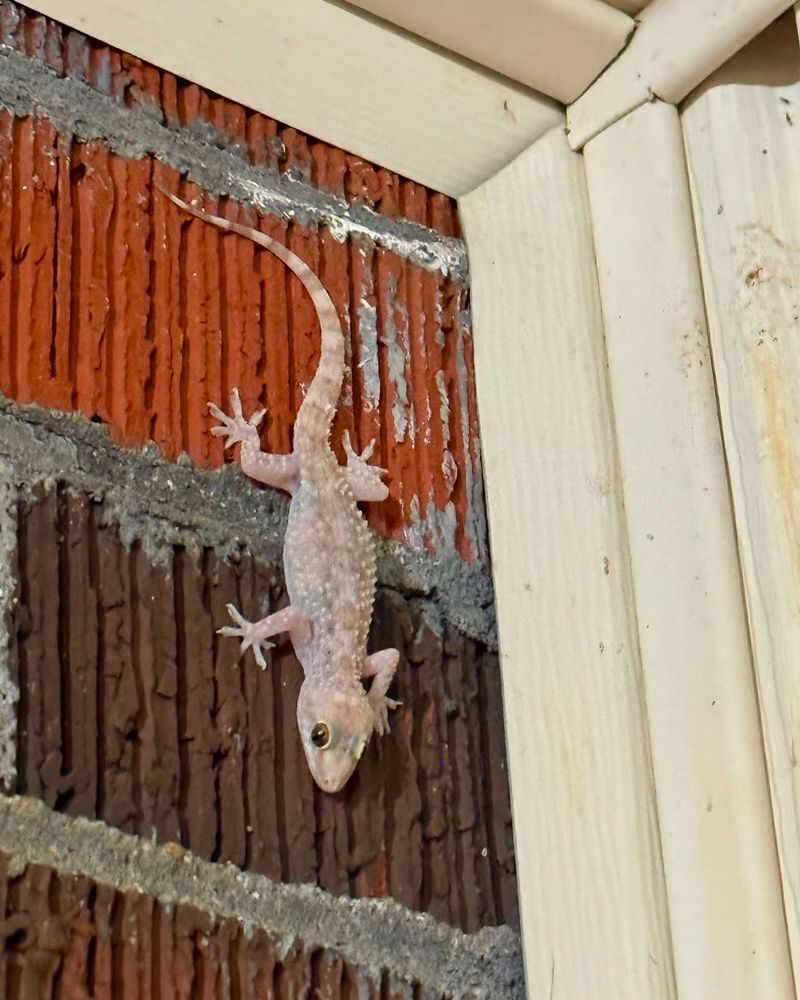
Most Texans who spot a gecko on their porch wall at night are looking at an introduced species, not a native one. Texas A&M’s urban entomology factsheet identifies the Mediterranean house gecko (Hemidactylus turcicus) and the common house gecko (Hemidactylus frenatus) as the species most commonly found around Texas homes, particularly in urban and suburban areas.
Both are nocturnal, both are active mainly from spring through fall, and both are frequently found clinging to walls and ceilings near porch lights.
Mediterranean house geckos have been documented around Austin and throughout much of southern Texas. UT Austin’s biodiversity reporting confirms their presence in city neighborhoods and notes that they have become a familiar part of the urban wildlife landscape.
Their large eyes, pale or pinkish skin, and the chirping sounds they sometimes make at night are reliable identification clues. If you see a small lizard racing up your porch column after dark, the odds are strong that it is one of these two introduced species.
Knowing this distinction matters for a practical reason. Introduced house geckos are not protected native wildlife, and management decisions, whether you want more of them or fewer, should start from an accurate identification.
Native Texas geckos do exist, but the best-known example, the Texas banded gecko, is a different animal. National Park Service information on the Texas banded gecko describes it as a terrestrial species associated with rocky desert habitat, not a wall-climbing porch visitor.
If you find a small, spotted, ground-level gecko in rocky or sandy terrain, that is a different encounter entirely. The animals most people see near porch lights are the introduced Hemidactylus species, and the rest of this article focuses on them.
Lights and structures explain more than one shrub does
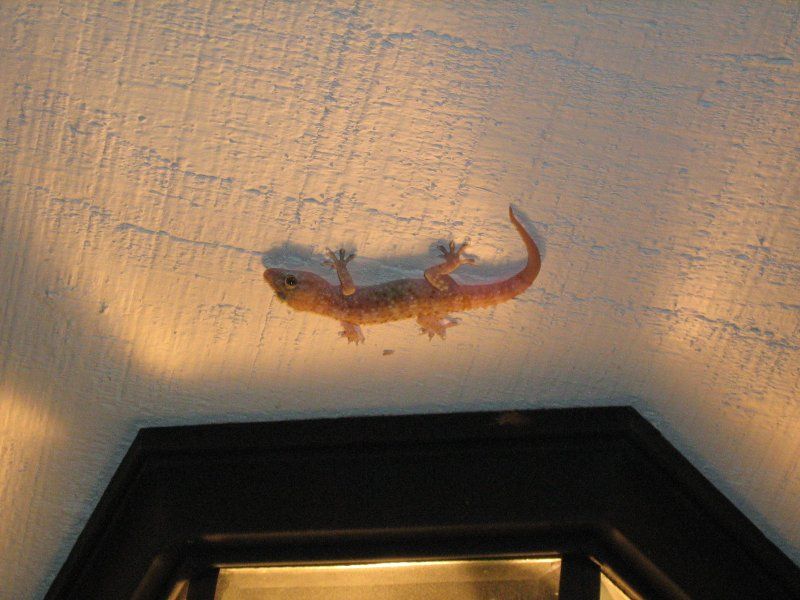
Walk outside after dark on a Central Texas summer night and look at what is happening around your porch light. Moths, midges, beetles, and other flying insects orbit the bulb, and somewhere close by, a gecko is almost certainly waiting.
That pattern has a straightforward explanation that has nothing to do with which shrub you planted beside the foundation.
House geckos are hunters that position themselves where prey concentrates. Texas A&M’s house gecko factsheet explains that these animals commonly station themselves near porch lights, illuminated windows, and other lit areas on walls and ceilings precisely because nocturnal flying insects gather there.
The light does the initial work of concentrating insects, and the gecko simply shows up where the food is. Structures also matter: cracks, crevices, gaps around utility penetrations, and the space behind shutters or trim give geckos the daytime shelter they need to keep returning at night.
Texas A&M’s Galveston County Master Gardener gecko page lists cockroaches among the primary prey items Mediterranean geckos take around homes and gardens. Geckos do encounter cockroaches near structures, but the mechanism is not that a shrub lures the gecko, which then chases roaches.
The more accurate sequence is that lights draw flying insects, geckos hunt near those concentrations, and cockroaches and other ground-level prey may also be encountered near the building’s exterior. These are related but separate parts of the picture.
A shrub beside the foundation can contribute cover, but the sources reviewed for this article consistently point to lighting, prey availability, structural access, and shelter as the primary factors explaining gecko presence near Texas porches. Framing a single plant as the decisive attractant skips over the stronger, better-documented parts of the explanation.
If you want to understand why geckos appear on your porch each spring, start with the bulb in your porch light fixture and the gaps around your door frames, not the plant bed beside the steps.
A native shrub can support the food web indirectly
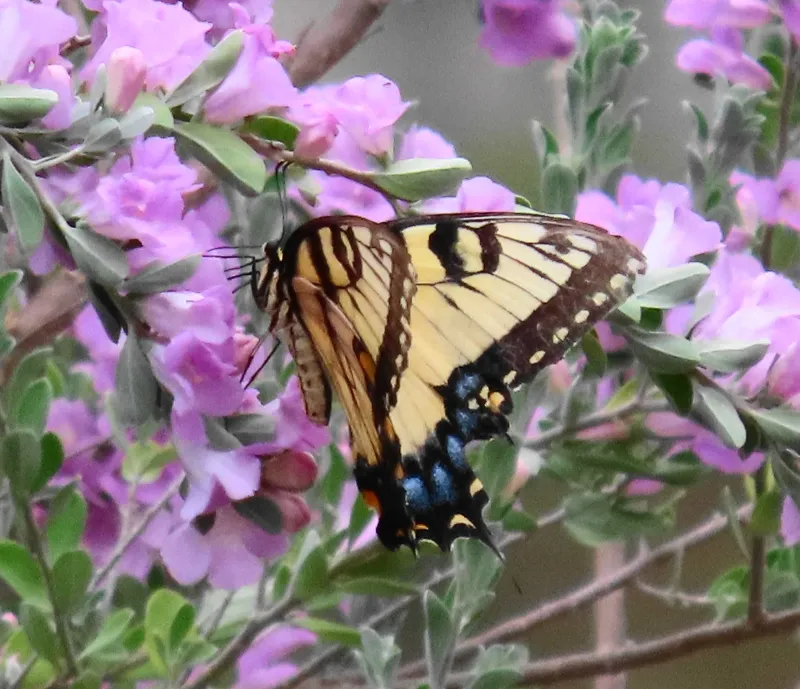
Cenizo and other regionally appropriate native plants can do something genuinely useful in a yard, just not in the specific, direct way the headline suggests. Texas Parks and Wildlife’s wildscapes guidance explains that native plants provide food or shelter for local wildlife and that retaining insects helps sustain insect-eating animals higher up the food chain.
Cenizo fits that description: it provides cover, supports certain insects, and adds structural diversity to a planting bed.
What that food-web connection cannot promise is a gecko-specific result. A plant that increases insect abundance or provides dense shelter will attract many kinds of wildlife, not just geckos.
Birds, spiders, small mammals, and other lizard species may all respond to the same habitat improvements. TPWD’s bird city habitat resources make the same point in a different context: habitat features support a community of animals, and predicting which species will show up in what numbers requires more than one plant variable.
A denser insect population near the foundation might also mean more insects visible around the house, which is worth considering before treating habitat gardening as an unambiguous win.
Shelter features matter alongside the plants themselves. A TPWD wildscapes publication specifically identifies leaf-litter mulch as shelter for lizards and skinks, and other TPWD design guidance notes that rock walls and logs can provide homes for lizards and small wildlife.
Combining cenizo or a similar native shrub with a few retained rocks or a small log pile near the planting bed creates more complete habitat than the plant alone.
The honest summary is that cenizo’s documented value is as a drought-tolerant shrub with wildlife cover and host-plant function, not as a proven gecko lure. Plant it for the right reasons at the right site, and it can be a genuinely useful part of a wildlife-friendly yard.
Just do not expect it to deliver a specific gecko-and-roach outcome on a predictable schedule.
Choose and place cenizo for the site you actually have

Cenizo has a reputation as a tough, low-water shrub, and in the right spot that reputation holds up. But “right spot” is doing a lot of work in that sentence.
Central Texas Gardener’s reporting on native plant performance notes that cenizo performs poorly in persistently wet conditions. Clay soils that hold moisture after rain, shaded beds on the north side of a house, or low spots that collect runoff are not good locations for this plant.
Placing it in the wrong drainage situation will not produce a thriving habitat shrub; it will produce a dead one.
Before buying, check your specific ecoregion, not just your general region. TPWD’s wildscape design tips emphasize selecting plants appropriate to local conditions, including soil type, sun exposure, and drainage.
Cenizo suits drier parts of the Edwards Plateau, the Trans-Pecos, and the South Texas Plains better than it suits the wetter eastern edges of the Hill Country or Austin neighborhoods with heavy clay and afternoon shade. Confirm the plant’s native range for your specific county or ecoregion before treating it as the obvious choice.
Placement near a foundation also requires attention to spacing and structure. TPWD’s wildscapes publication recommends retained rocks, logs, and leaf-litter mulch as habitat features, but those same materials can create moisture problems or pest access points if piled against siding, rooflines, or foundation vents.
Keep plants trimmed so they do not contact the house, preserve drainage around the bed, and avoid deep mulch layers directly against the foundation.
TPWD’s South Texas wildscapes tips add a useful reminder: mature plant size matters at installation time. Cenizo can reach six to eight feet in height and spread, so a small plant purchased at a nursery may eventually crowd a bed, block windows, or press against the structure if placed too close.
Plan for mature size, not nursery-pot size, and give the plant room to grow without becoming a maintenance problem or a bridge to the roofline.
Geckos may eat roaches, but they do not manage infestations
Mediterranean house geckos do eat cockroaches. Texas A&M’s Galveston Master Gardener gecko resource lists cockroaches among the primary prey items these animals take around homes and gardens.
That is a real and welcome behavior. The problem comes when homeowners treat gecko presence as a substitute for actual cockroach management, because the math does not work out in their favor.
A gecko hunting near a porch light will catch some roaches on some nights. It will not find the ones hiding in your wall voids, living under the refrigerator, or moving through sewer connections into the house.
Texas A&M’s cockroach biology and management guide puts the emphasis squarely on sanitation, moisture reduction, entry-point elimination, and monitoring. Removing food sources, fixing leaky pipes, clearing clutter from cabinets and garages, and sealing gaps around plumbing penetrations do more to reduce cockroach populations than any number of geckos patrolling the porch.
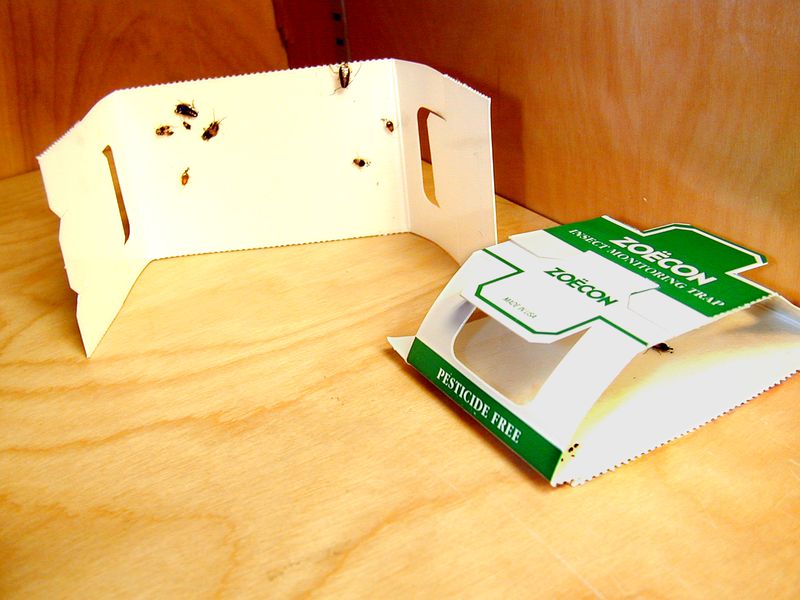
Monitoring is a step many homeowners skip. Glue boards placed near doors, under appliances, behind toilets, and along baseboards in active areas will tell you where cockroaches are traveling before the population grows large enough to become obvious.
That information lets you target the actual problem rather than hoping a gecko handles it.
When geckos get inside the house, the right response is exclusion, not pesticide. Texas A&M’s house gecko factsheet recommends repairing or replacing worn weather stripping, sealing cracks and crevices around windows and door frames, closing soffit gaps, and sealing utility penetrations where pipes and wires enter the building.
Those same repairs also reduce cockroach entry points, so the work serves double duty. Geckos belong in the yard; exclusion keeps them there while also closing the routes roaches use to get inside.
Protect the habitat without spraying for a guaranteed result

Reaching for a can of broad-spectrum insecticide to manage cockroaches around a planting bed intended to support wildlife is a fast way to undo the habitat work. Pesticides that kill cockroaches and other insects also remove the food supply geckos depend on.
Texas A&M Master Gardener guidance warns that improper pesticide use can eliminate lizards, both through prey reduction and through direct exposure. A gecko that hunts in a treated area can pick up pesticide residue from the insects it eats or from contact with treated surfaces.
EPA pest control guidance recommends using nonchemical methods where possible and following every label restriction precisely when chemical control is necessary. That applies especially around foundation plantings where runoff, soil absorption, and wildlife contact are all real concerns.
Spot treatments targeting confirmed cockroach entry points are a different calculation than blanket spraying around a garden bed.
Mothballs, essential oils, and products advertised as reptile repellents are not the answer either. Extension pest guidance specifically warns against mothballs as wildlife repellents because fumes at deterrent concentrations can be hazardous to people, and it notes that advertised reptile repellents have not been demonstrated effective.
These products do not belong in a habitat garden or near a foundation planting.
The corrected version of the original headline’s promise looks like this: plant cenizo or another regionally appropriate native shrub where the site actually suits it, for the genuine cover and food-web value it provides. Let porch lighting, prey availability, building access, and shelter do the explaining when geckos show up from spring through fall.
And when cockroaches are the real problem, use integrated pest management – sanitation, exclusion, monitoring, and targeted treatment – rather than counting on any plant or predator to do that job. Texas A&M’s gecko factsheet closes with the same logic: appreciate the gecko for what it genuinely does, and handle pest management through methods that actually work.
A yard that supports both is possible; it just requires honesty about what each piece contributes.