
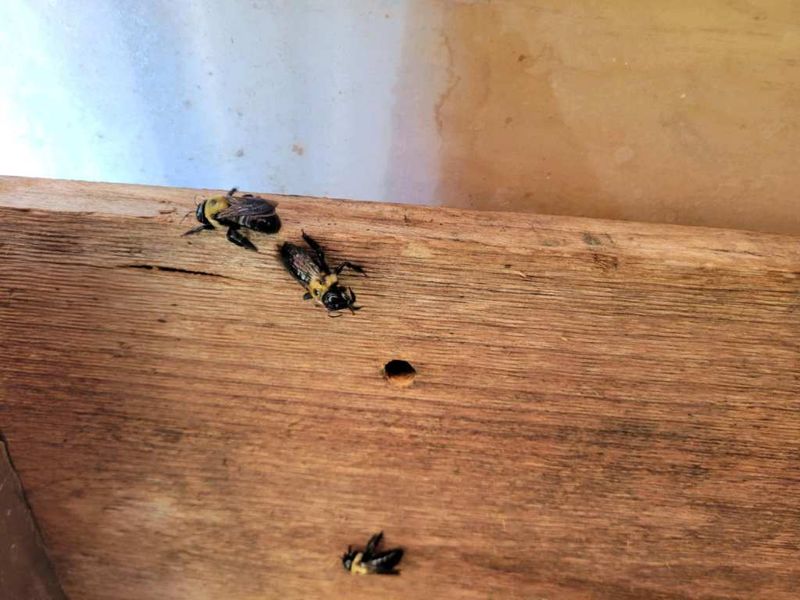
Spotting a large bee hovering near your porch railing and then disappearing into a hole in the wood is enough to make any homeowner stop and wonder what is happening. Carpenter bees are native to North Carolina, and their activity on a porch can reveal something specific about the wood they have chosen, not just that bees are present.
Understanding what you are actually seeing, and when it most likely started, helps you decide whether to monitor, treat, or repair before more damage builds up.
What summer carpenter-bee activity really means for your porch
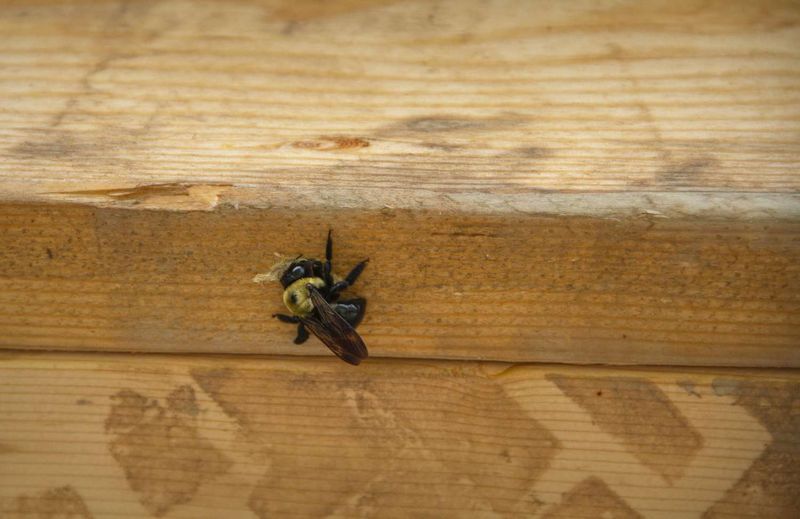
Seeing a carpenter bee enter a hole in your porch wood during July or August does not necessarily mean the drilling just started. NC State Extension guidance on stinging insects in North Carolina identifies April and May as the main period for large carpenter bee emergence and new nest construction in the state.
By summer, what you observe may be a newly emerged adult using an existing tunnel, a bee cleaning out an old gallery, or a bee preparing a tunnel for overwintering rather than starting fresh excavation.
The central fact worth holding onto is that carpenter bees excavate wood to create brood chambers, not to eat it. Unlike termites, which consume wood as a food source, carpenter bees remove wood material to hollow out a shelter.
Penn State Extension’s carpenter bee resource explains that these bees tunnel into wood to lay eggs and provision cells with pollen and nectar for developing larvae.
The wood your porch offers matters more than its age or condition. Utah State University Extension’s carpenter bee fact sheet notes that carpenter bees can excavate sound wood and tend to favor surfaces that are exposed, bare, weathered, or otherwise accessible.
Unpainted rails, exposed end grain, saw cuts, and sections where a previous finish has worn away are particularly attractive. A summer sighting does not mean the porch is rotting or that structural failure is coming.
It means the porch offered wood that was accessible enough for a bee to begin or continue a nest.
A characteristic hole plus active entry supports the diagnosis
A bee hovering near the porch is not enough on its own to confirm a carpenter bee nest. Bumblebees, which are also large and common in North Carolina, can look similar at a glance.
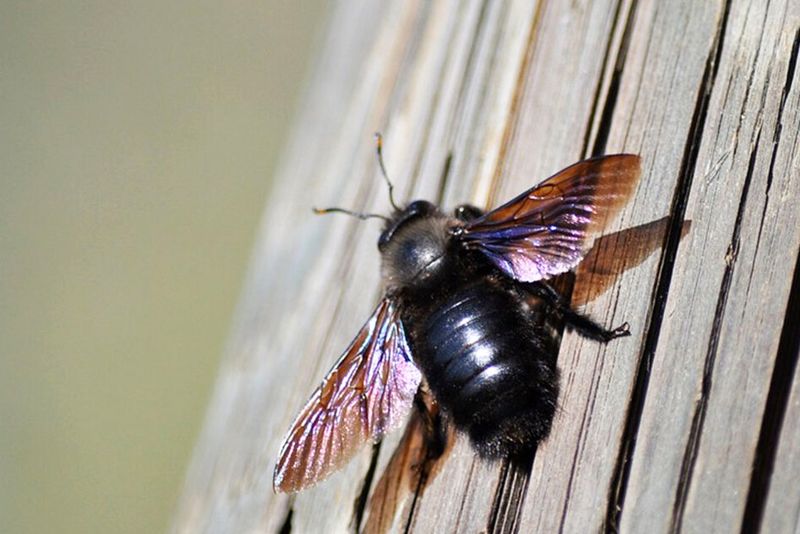
The key physical difference is the abdomen: the NC State guide to North Carolina bees describes large carpenter bees as having a relatively hairless, shiny abdomen, while bumblebees have a noticeably fuzzy one. Body appearance narrows the identification, but the real confirmation comes from what you find at the wood.
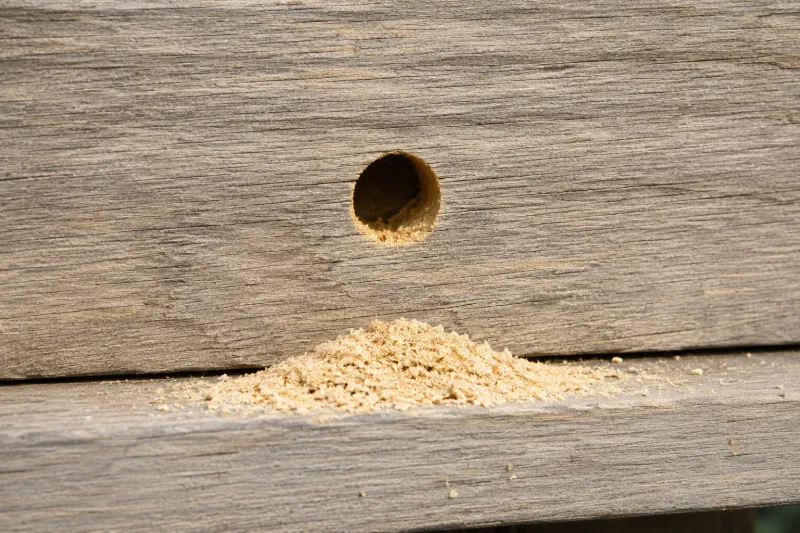
Look for a clean, nearly circular entrance hole about one-half inch wide. Fresh sawdust or wood particles directly below the hole and yellowish-brown fecal staining on the wood surface are strong supporting signs.
Penn State Extension notes that the tunnel typically turns to run with the grain of the wood after the initial vertical or angled entrance, so probing gently with a thin wire can reveal the direction of the gallery inside. The combination of active entry, the round hole, and fresh residue is much stronger evidence than any single clue alone.
Expand the search beyond the first hole you spot. Check nearby rails, fascia boards, eave soffits, deck edges, and any section of wood with exposed end grain or a worn finish.
University of Georgia Extension points out that a bee seen near the porch may simply be foraging for pollen or nectar on nearby flowers rather than nesting. Hovering males, which cannot sting, often patrol a territory near a nest without entering it.
Females can sting but generally do so only when handled or directly threatened, so observing from a comfortable distance is safe and gives you better information than trying to shoo the bees away.
Summer sightings may reveal an older nest rather than new drilling
Timing matters when you are trying to understand what you are dealing with. Large carpenter bees in North Carolina generally emerge and begin constructing new nests in April and May.
NC State Extension notes that the period of new tunnel construction is centered in spring, and that later in the season, newly emerged adults become visible but are not typically building fresh galleries.
When you notice a carpenter bee entering porch wood in midsummer or late summer, the most straightforward explanation is usually that the nest was established earlier and the bee is continuing to use it. Newly emerged adults, which hatch from eggs laid in spring, may be seen cleaning out the tunnel, foraging from the same area, or beginning to prepare the gallery for overwintering.
The tunnel serves multiple purposes across the season, so activity does not stop just because new excavation has slowed.
This timing distinction changes how you interpret a summer discovery. Rather than assuming a fresh infestation has just begun, consider whether the hole looks worn or stained in ways that suggest prior use.
A well-established tunnel may have darkened edges and older staining alongside newer sawdust from recent cleaning activity. Recognizing that an older nest is likely already in place helps you skip straight to the inspection and decision steps rather than treating the situation as brand-new damage requiring immediate emergency action.
Inspect the porch before deciding how serious the problem is
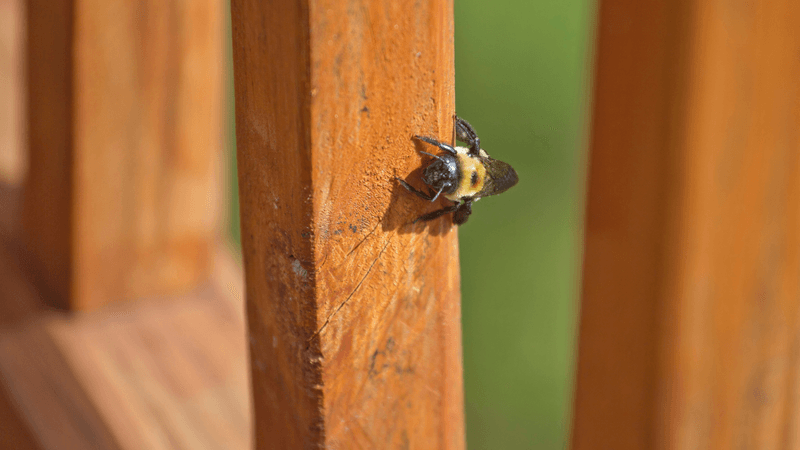
Before settling on a response, walk the entire porch rather than focusing only on the first hole you found. Rails, fascia boards, eave soffits, deck edges, exposed end grain on cut lumber, old nail holes, and any section with bare or weathered wood are all worth checking.
Utah State University Extension notes that carpenter bees favor exposed, accessible surfaces, so a single visible hole often has company nearby.
One bee or one isolated tunnel is generally not an emergency. NC State Extension and Penn State Extension both indicate that a single gallery causes limited structural damage, while repeated nesting over successive years can produce branching tunnels that weaken wood more substantially.
The concern grows with the number of holes, the number of seasons the same porch has been used, and how thin or lightweight the affected boards are.
Thin siding and decorative trim are more vulnerable than heavy framing lumber. A half-inch tunnel through a two-inch rail cap matters less structurally than the same tunnel through a narrow fascia board that is already showing wear.
Holes also create entry points for moisture, which can feed decay fungi over time. Woodpeckers sometimes find carpenter bee larvae attractive enough to enlarge the damaged areas significantly, turning a modest nest into a larger repair project.
Reasons to escalate from monitoring to treatment or professional help include activity in structural framing members, nests located in eaves or soffits that are difficult to reach safely, visible wood deterioration around existing tunnels, or evidence that bees have returned to the same locations for multiple seasons. If the inspection turns up only one or two holes in nonstructural wood with no sign of branching damage, a measured response is appropriate.
Coexistence can suit a sound, nonstructural porch area
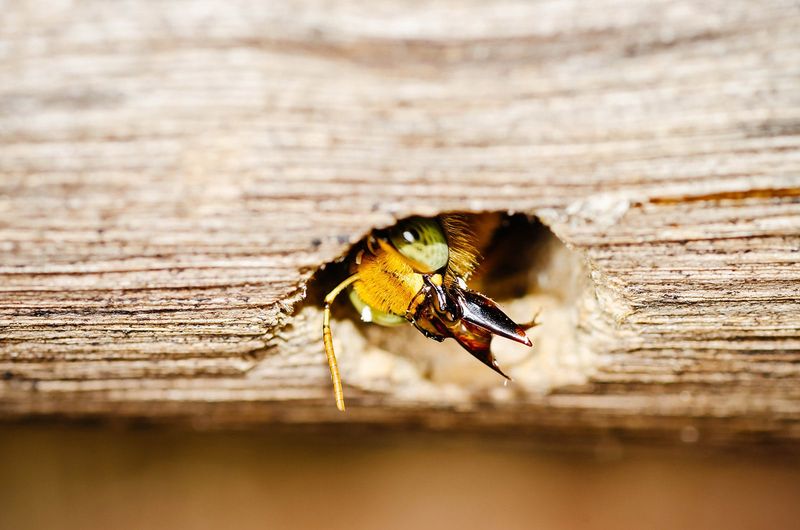
Not every carpenter bee nest demands immediate removal. When the affected wood is nonstructural, the porch remains fully functional, and the bees are not creating a safety problem, leaving the nest in place is a reasonable option worth considering.
Penn State Extension’s eastern carpenter bee resource recommends weighing coexistence or alternative nesting sites where the damage is limited, particularly because carpenter bees are native pollinators that contribute to local plant reproduction.
The practical decision rule comes down to three questions: Where is the nest located? How important is that wood to the porch’s structure or appearance?
Has damage recurred in the same spot over multiple seasons? A single tunnel in a decorative rail post that shows no sign of branching or moisture damage sits at the low end of concern.
Repeated excavation in the same thin fascia board, or activity spreading to new sections each year, shifts the balance toward intervention.
A separate nesting board made from untreated pine or cedar, positioned away from the porch, can give bees an alternative site. That option is worth trying, but it should not be described as a guaranteed way to draw bees away from an established porch nest.
Bees that have already committed to a tunnel location are unlikely to abandon it for a new board nearby. University of Georgia Extension discusses carpenter bee traps as another option, noting that success varies and that traps may capture many males without necessarily reducing nest activity in the wood.
Traps can be part of a broader management approach but should not be treated as a complete solution on their own.
Active nests need targeted, careful control
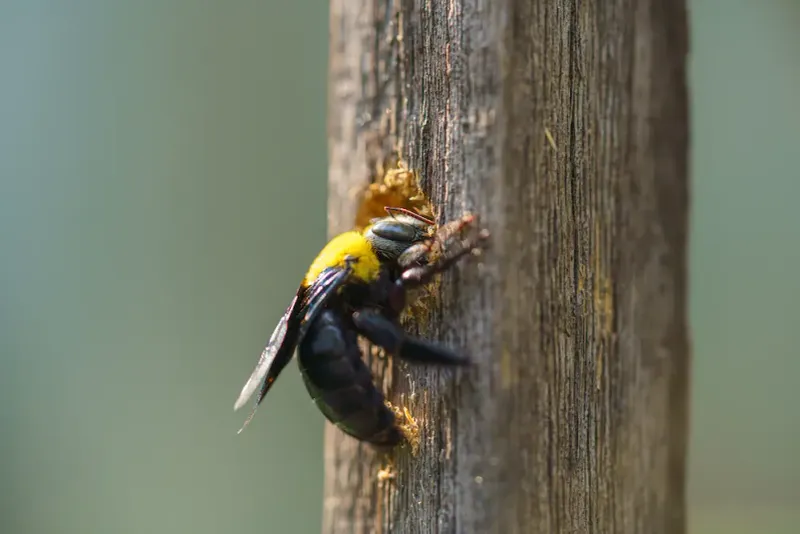
Homeowners who decide treatment is necessary face a few important constraints before acting. Swatting or handling the bees is not a safe starting point: females can sting when threatened, and disturbing an active nest increases the chance of a direct encounter.
NC State Extension specifically advises against spraying hovering bees, noting that it is neither a sensible nor particularly safe use of pesticides. Broad application around the porch, especially near flowering plants, can expose other pollinators to unnecessary harm.
Plugging an active hole immediately is another step to avoid. An active tunnel may contain adults or developing larvae, and sealing them inside can cause bees to chew through the plug or through nearby wood to escape.
Penn State Extension recommends allowing adequate treatment time before sealing, so that adults and any developing bees have either exited or been addressed. NC State similarly advises treating individual tunnels and then sealing them only after the interval specified on the product label.
For nests in eaves, soffits, high railings, or structural wood, a licensed pest professional is the safer choice. Reaching those locations safely, applying an appropriate product correctly, and protecting family members, pets, and nearby flowers from exposure all become more difficult when access is limited or the nest is large.
The 2026 North Carolina Agricultural Chemicals Manual lists carpenter bee treatments, and some products or application methods carry professional licensing or training requirements in the state.
Any pesticide application must follow the current product label exactly. EPA guidance on protecting pollinators from pesticides advises minimizing pesticide use, treating only the specific nest or wood area covered by the label, and following all bee-hazard directions.
EPA tools for pollinator protection also address avoiding application during pollinator foraging periods, which matters on a porch near a garden. Apply only to the labeled area, never to hovering bees or flowering plants.
Seal an inactive tunnel and protect the surrounding wood
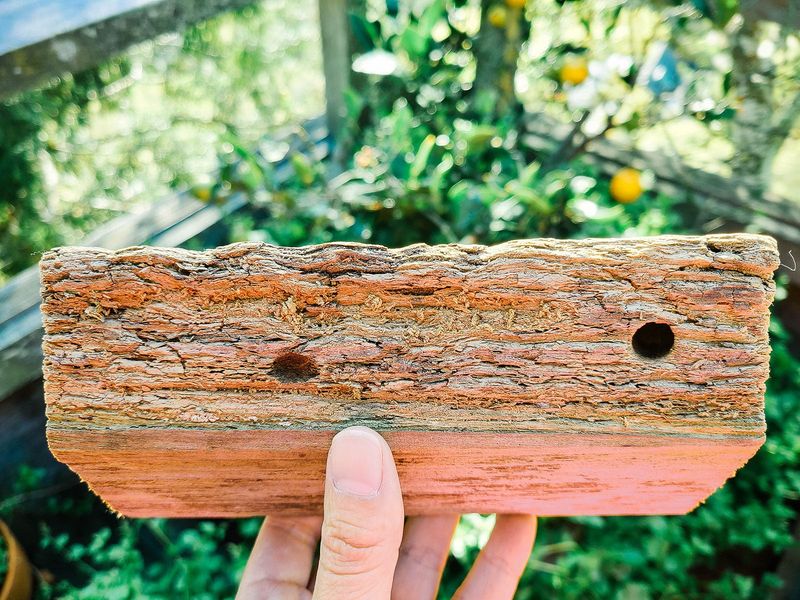
Once a tunnel is no longer active, either after treatment or after natural abandonment, filling the entrance properly is the next step. A snug wood plug, a wooden dowel cut to fit, or an exterior-grade wood filler all work well for closing the hole.
After filling, apply paint or a suitable exterior finish over the repaired area to seal the surface and reduce the chances of re-entry at the same spot. NC State Extension and Penn State Extension both recommend this sequence: treat or wait, fill, then finish the surface.
Sealing only the hole while leaving nearby bare or weathered wood exposed is a limited fix. Saw cuts, cracks, exposed end grain, worn finish areas, and old nail holes on the same board or adjacent boards remain attractive to new bees.
Penn State Extension’s eastern carpenter bee piece consistently identifies paint or a suitable exterior finish on sound, exposed wood as a preventive measure that can make new excavation less appealing. Painting is not a cure for an established tunnel, but it does reduce the likelihood that bare wood nearby becomes the next nesting site.
For porch sections that have suffered repeated excavation across multiple seasons, consider whether a material change makes more sense than another round of fill-and-paint. Composite decking, PVC trim boards, or other nonwood components do not provide the accessible grain that carpenter bees need to begin a tunnel.
Replacing a repeatedly damaged rail cap or fascia board with a composite alternative can break the cycle without requiring ongoing seasonal treatment. The investment is higher upfront, but it removes the vulnerability that keeps drawing bees back to the same location.
Treat the situation as manageable wood damage, not a bee emergency
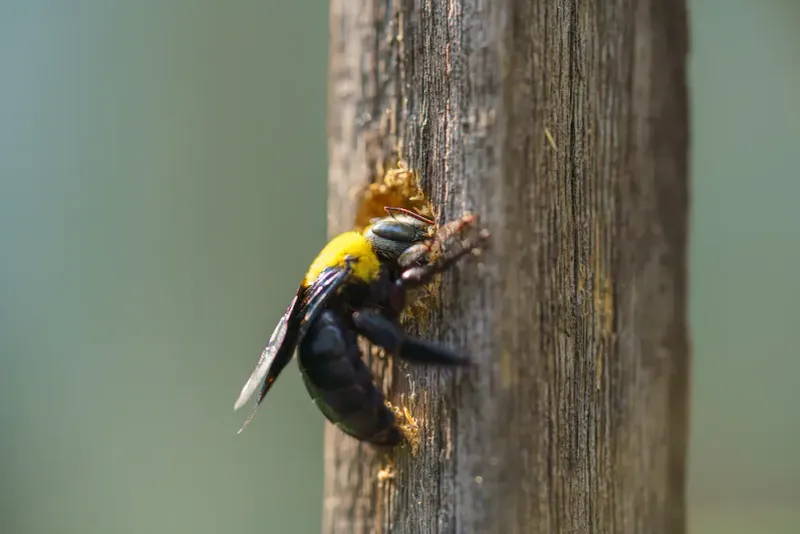
A carpenter bee on your porch railing is a wood-maintenance issue with a clear decision path, not a crisis. Start by confirming the signs: active entry into wood, a round half-inch entrance hole, and fresh sawdust or staining.
Account for the spring-centered nesting cycle in North Carolina before assuming new drilling is underway. Then inspect the full porch for the number of holes, the type of wood affected, and any signs of repeated or structural damage.
From there, three paths are available. Monitoring and coexistence work when the nest is isolated, the wood is nonstructural, and no damage is recurring.
Targeted professional treatment fits active nests in hard-to-reach locations, structural wood, or situations where repeated nesting has already caused visible deterioration. Repair and prevention, including filling inactive tunnels and finishing exposed wood, are the steps that reduce future vulnerability regardless of which path you took first.
NC State Extension and Penn State Extension both support this measured, sequential approach.
Avoid handling the bees, applying pesticides broadly, or plugging an active hole before the nest has been addressed. A single tunnel in sound, nonstructural wood may be manageable without any treatment at all.
Recurring excavation in the same vulnerable boards, on the other hand, deserves a durable material solution rather than another season of monitoring. Most North Carolina porches that see carpenter bee activity come through it fine with a targeted response and some preventive finishing work.