
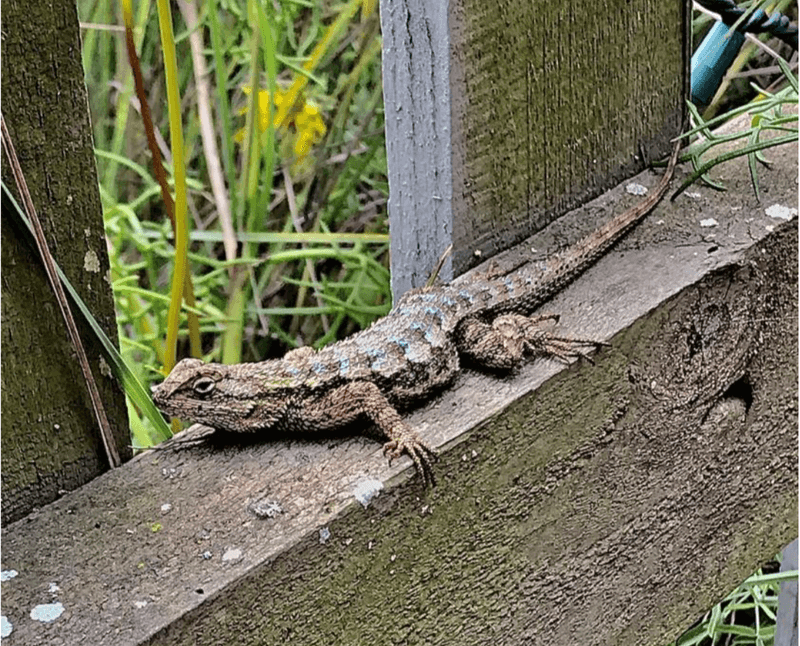
Spotting a big, thick-bodied lizard draped across your garden wall on a warm California afternoon can stop you in your tracks. Many homeowners wonder whether the animal is a sign of something wrong in the yard, or whether it means a spider problem is brewing nearby.
The truth is more straightforward and more reassuring than most people expect. Understanding what that lizard is actually doing, and what its presence can and cannot tell you, makes it much easier to share your yard with one of California’s most useful native reptiles.
A Sunny Wall Is Not a Pest Diagnosis
Reptiles cannot generate their own body heat, so a lizard stretched across a warm wall is doing exactly what its biology requires. The wall absorbs heat from the sun and radiates it back, giving the animal a reliable platform to raise its body temperature quickly.
Once warm enough, the lizard can digest food, move faster, and react to threats more effectively. That is the most straightforward explanation for what you are seeing.
According to California Herps’ species account for southern alligator lizards, these animals are generally secretive and spend much of their time under vegetation, rocks, boards, and other cover, but they do bask and are regularly observed in suburban yards, garages, and sheltered outdoor areas. A wall simply offers a clean, sun-warmed surface that works well for thermoregulation.
The lizard may also be resting between foraging bouts, scanning the surrounding area, or using the wall as a travel corridor between patches of cover on your property.
Warm weather can make lizards more active and more visible overall. A UCLA study on Los Angeles lizards found that some species are well adapted to urban and suburban environments, using human-made structures as thermal resources.
That adaptability means a wall sighting is very much a normal occurrence rather than an alarm signal.
What the sighting does not tell you is equally important. A lizard sunning itself is not necessarily hunting at that moment, and its presence does not confirm that black widows or any specific pest are present in your yard.
The UC IPM lizard resource notes that lizards cause no measurable plant damage and may provide some pest-management benefit, but the agency stops well short of calling any lizard a reliable pest indicator. Seeing one on your wall most reliably means your yard offers something the animal needs, whether that is warmth, cover, or proximity to food.
Confirm the Lizard Before Drawing Conclusions
Before connecting a wall-sunning lizard to black widow predation or any other specific ecological role, it helps to know what species you are actually looking at. Not every large or rough-scaled lizard on a California fence, rock, or ledge is a southern alligator lizard, and the evidence for venom tolerance and widow predation is tied to specific species rather than lizards in general.
The Butte County lizard guide and other regional field references point out that California walls and fences host several species. Western fence lizards are among the most common, recognized by their blue belly patches, rougher dorsal scales, and typically smaller, more compact build.
Side-blotched lizards are smaller still, with a distinctive dark spot behind each foreleg. In some Southern California neighborhoods, introduced European wall lizards have also established populations and use the same sunny surfaces that native lizards prefer.
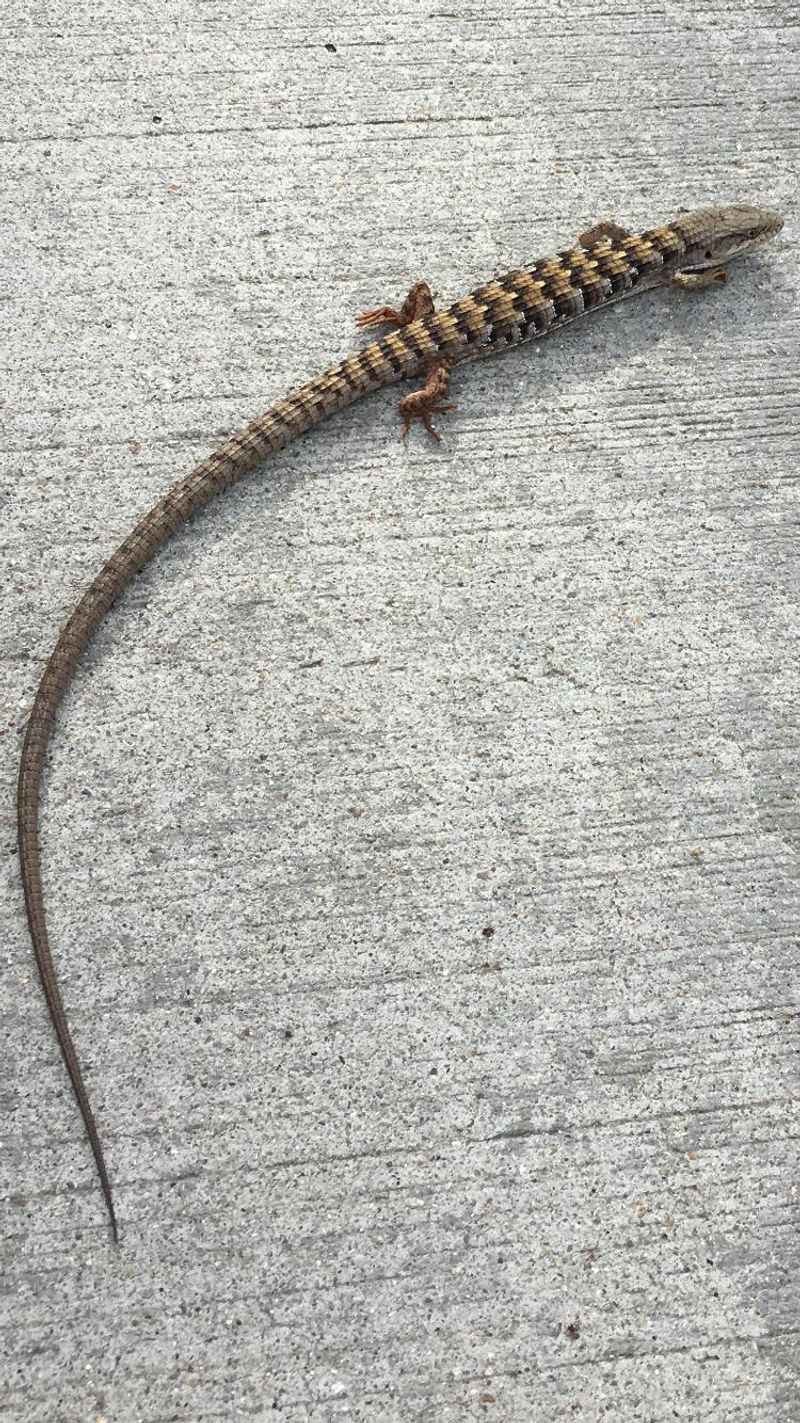
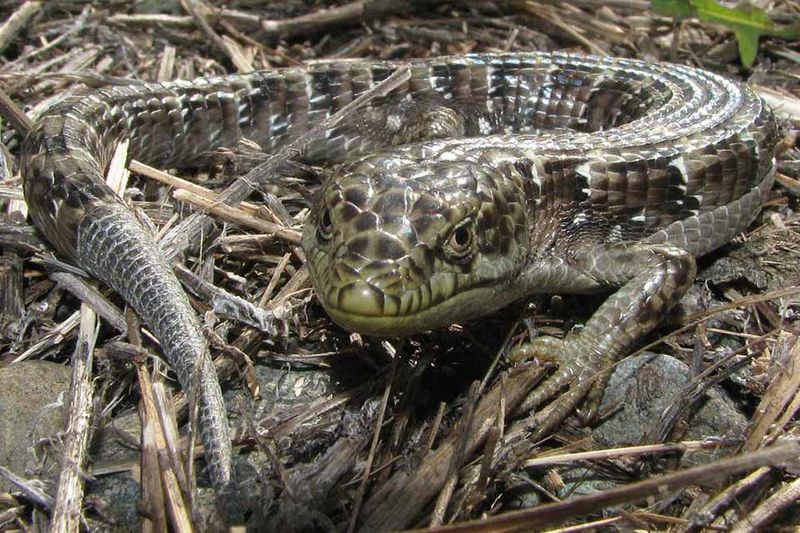
Southern alligator lizards have a distinctive look once you know what to check. According to the National Park Service species page for Channel Islands, they have a noticeably long tail, a relatively narrow head that widens at the jaw, stiff keeled scales along the back, and a soft, folded skin fold running along each side.
Adults can reach 7 inches or more in body length, not counting the tail. Their coloring tends toward brownish or grayish tones with banding or mottling.
Range matters too. California Herps documents southern alligator lizards across most of California below the high Sierra and outside the driest desert areas, while the CDFW range data for northern alligator lizards shows that the northern species occupies cooler, moister portions of the state.
Knowing which part of California you are in helps narrow the identification. A 2024 SDSU urban lizard feature notes that multiple species share city and suburban habitats, so observation from a comfortable distance, rather than catching or restraining the animal, is the safest and most accurate way to compare traits.
The Evidence Behind the Black-Widow Connection
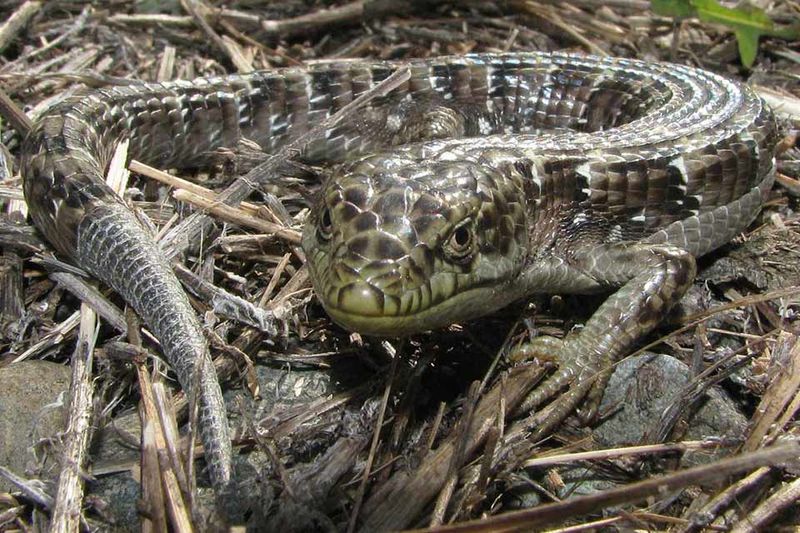
The claim that alligator lizards eat black widows is not folklore. It rests on documented field observations and a peer-reviewed laboratory study that examined the relationship in detail.
A 2022 study published in Toxins confirmed that southern alligator lizards consume western black widow spiders and their egg sacs, and found that the lizards tolerated experimentally administered black widow venom at doses that would be dangerous to many other animals. That combination of documented predation and measurable venom resistance makes the food-web connection real and worth understanding.
The Royal Society’s overview of the research explains that the lizards’ tolerance appears to involve physiological resistance rather than simple avoidance behavior, meaning the animals can engage with prey that would incapacitate less resistant predators. Researchers noted that this kind of venom resistance likely evolved alongside the predator-prey relationship over time.
The finding puts southern alligator lizards in a small group of vertebrates known to interact with medically significant spiders with a meaningful degree of tolerance.
Understanding the limits of that evidence is just as useful as knowing what it shows. The study tested venom tolerance under controlled laboratory conditions, not in a residential yard.
It does not establish that a single lizard will find and consume every black widow on a property, reduce the local population to a measurable degree, or that a lizard sighting is evidence that black widows are present. UC IPM’s guidance on lizards supports their general role as arthropod predators in gardens while stopping short of positioning them as a reliable spider-control tool.
The practical takeaway is that a southern alligator lizard in your yard participates in a real food web that includes western black widows. That is a genuine ecological benefit, and it is worth knowing.
Framing it as a food-web relationship rather than a pest-control guarantee keeps expectations honest and avoids decisions, like removing the lizard or over-treating for spiders, that would work against the yard’s own natural balance.
What the Sighting Can—and Cannot—Tell You
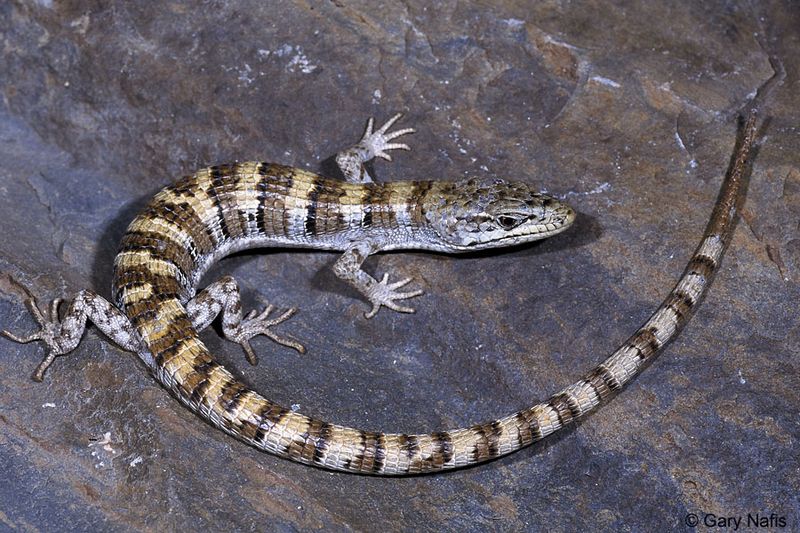
Reasonable inferences about why a lizard uses your yard are grounded in what these animals actually need: warm surfaces, cover, and accessible prey. A garden wall offers heat.
Leaf litter, rocks, low shrubs, stacked boards, or a gap under a raised structure provide cover and hunting ground. If your yard has a combination of sun-exposed hardscape and sheltered spots at ground level, it offers the basic resources a southern alligator lizard looks for.
The National Park Service’s profile of the southern alligator lizard describes the species as adaptable to a wide range of habitats, including suburban edges, chaparral, oak woodlands, and grasslands. California Herps adds that the lizard is commonly found under boards, in woodpiles, in dense shrubs, and around buildings.
A sunning lizard on your wall is using the property the way the species has always used available terrain.
What a single sighting cannot do is diagnose anything specific about your yard’s pest situation. The lizard’s presence does not confirm that black widows are nesting nearby, that an arthropod population has increased, or that an irrigation problem has created new habitat.
Lizards move through yards on their own schedule, following thermal gradients and prey opportunities that shift through the day and across seasons.
Their diet is also broader than the black-widow angle might suggest. UC IPM notes that California lizards eat beetles, ants, wasps, aphids, grasshoppers, and spiders, among other arthropods.
The UCR Botanic Gardens wildlife resource echoes that lizards contribute to arthropod management across a range of prey types, not only species homeowners consider harmful. Treating the sighting as a single-cause signal, whether for pests or for a habitat problem, overstates what one observation can reasonably show.
Support Native Wildlife With Modest Habitat
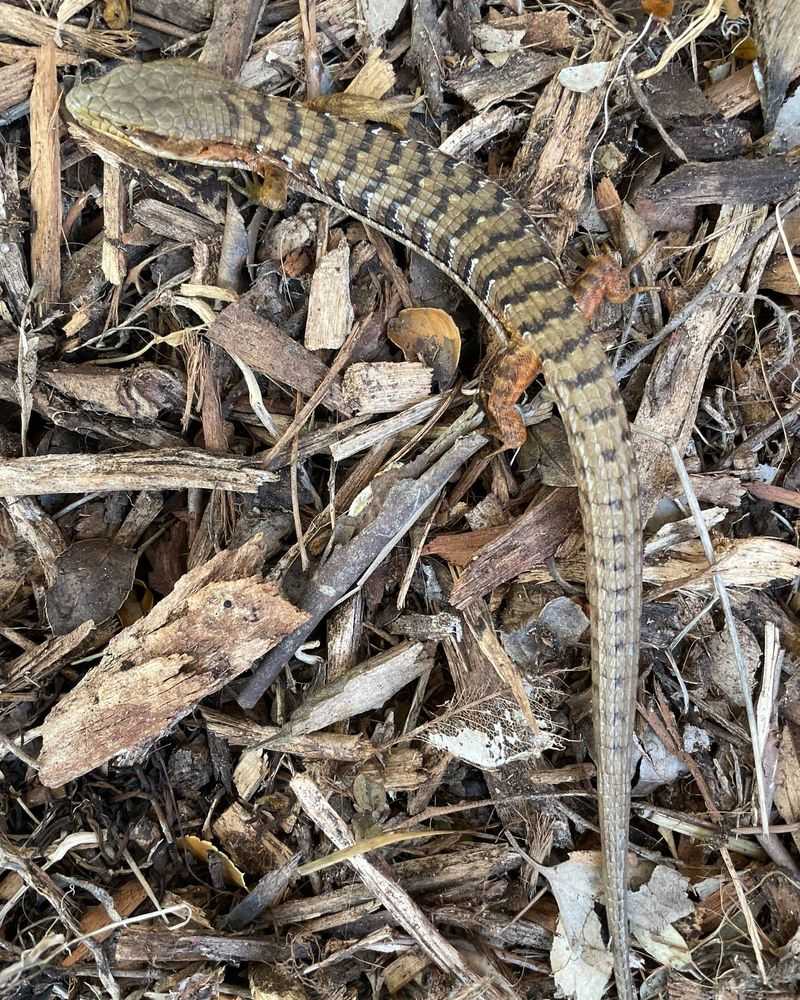
Creating conditions that support southern alligator lizards and other native wildlife does not require a yard overhaul. The changes that matter most are small, structural, and compatible with California’s water-wise and fire-safe gardening priorities.
Retaining some leaf litter under shrubs, leaving a few flat rocks in a sunny spot, or keeping a short section of log at the edge of a bed gives lizards and other ground-level wildlife the cover and microhabitat they use regularly.
UC ANR’s wildlife-friendly garden guidance recommends combining sheltered ground cover with diverse plantings that support insects at multiple levels of the food web. When lizards have access to prey-rich areas and places to hide, they are more likely to stay and forage.
The UC ANR naturescaping resource extends that advice to include native plants, reduced mowing at edges, and the retention of natural debris that would otherwise be cleared away as tidying.
These habitat features work because they support the broader food web, not just lizards. UC IPM’s biological control resource explains that natural enemies of garden pests, including predatory insects, spiders, and lizards, depend on undisturbed shelter and a prey base to persist in residential landscapes.
Clearing every surface and removing all organic debris tends to eliminate the cover those animals need.
A few practical boundaries are worth keeping in mind. Habitat features should be placed where they do not create fire risk or block defensible-space clearance in fire-prone areas.
Leaf litter and wood debris near structures can create ignition risk in wildland-interface neighborhoods, so place them away from walls and eaves. UC IPM also advises against hand-feeding, trapping, introducing, or relocating wild lizards.
Letting the animal find and use your yard on its own terms is both safer for the lizard and more ecologically sound than trying to manage its movements directly.
Avoid Spraying or Handling the Lizard
Two of the most common homeowner responses to finding a large lizard, reaching for a pesticide sprayer or grabbing the animal, are also the two most likely to cause harm. Broad-spectrum pesticides applied routinely around a yard do not distinguish between target pests and the beneficial arthropods and vertebrates that keep a garden in balance.
UC IPM’s guidance on protecting natural enemies and pollinators is direct on this point: routine applications can kill the insects, spiders, and other invertebrates that natural predators, including lizards, depend on for food.
Reducing the prey base through broad-spectrum treatment works against the ecological benefit you are hoping the lizard provides. UC IPM’s biological control resource recommends integrated pest management as the practical alternative: confirm that a pest problem actually warrants treatment, then choose the least disruptive effective option rather than applying preventively.
That approach preserves natural enemies and keeps the food web intact.
Handling the lizard directly carries its own risks. UC IPM notes that alligator lizards may bite when roughly handled, and the bite, while not venomous, can be surprisingly firm and may break skin.
Tail loss is another stress response: the tail detaches as a defense mechanism, and while it regrows, the process costs the animal significant energy reserves.
If one enters a garage, shed, or living space, the right move is patience rather than pursuit. A UCLA report on urban lizard behavior reinforces that these animals are alert and responsive to movement.
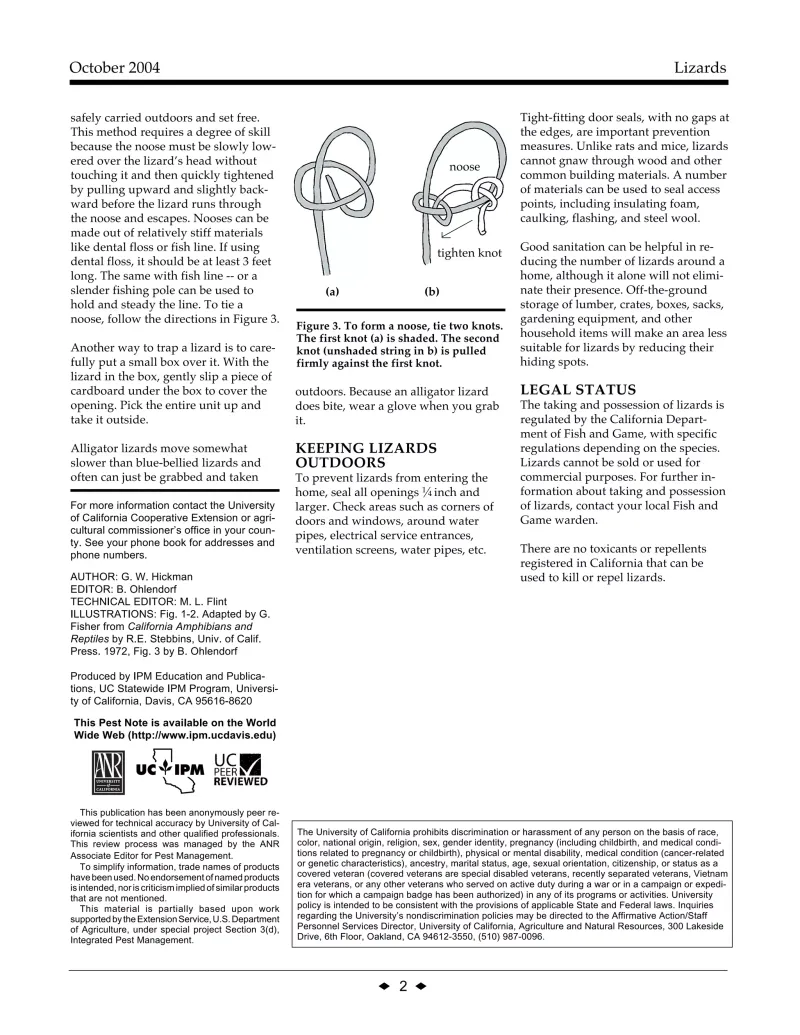
Opening a door or window and using a piece of cardboard to gently guide the lizard toward the exit works far better than cornering or grabbing it. A container placed over the lizard and slid onto a piece of cardboard is another low-stress option that avoids direct contact for both the animal and the homeowner.
Keep Black-Widow Precautions in Place
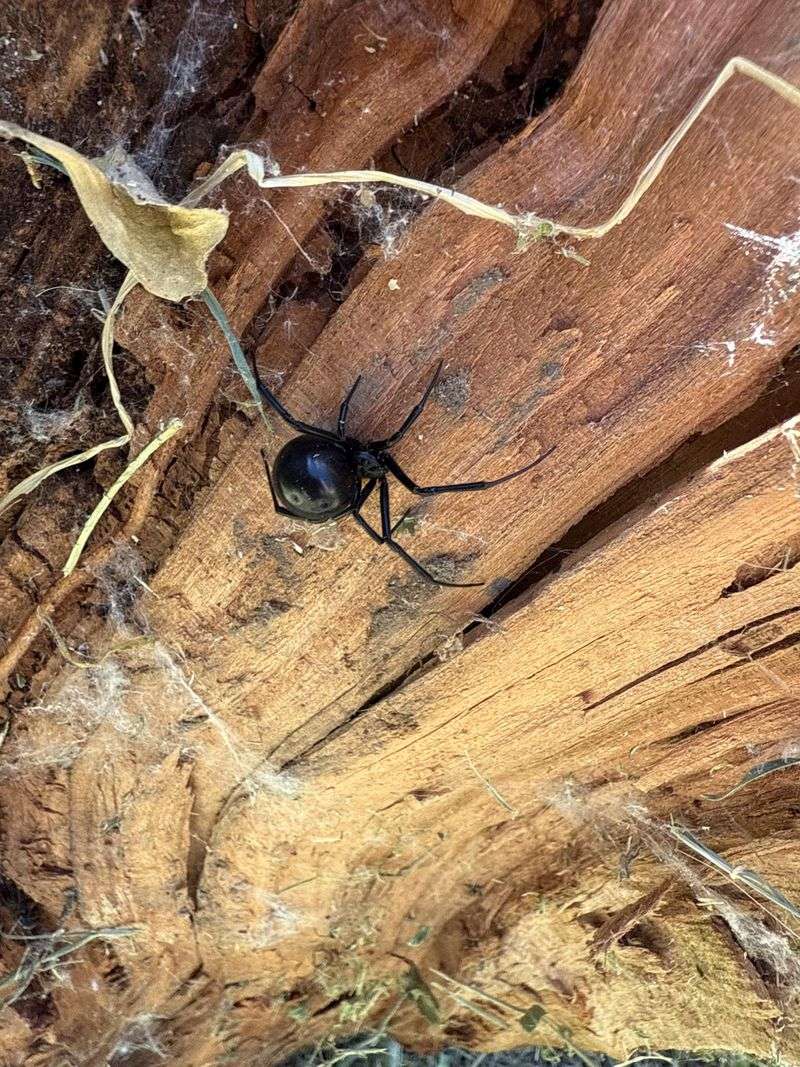
A lizard on the wall does not change the basic safety picture for black widows in a California yard. Western black widows are present across the state, and while they generally avoid open spaces and human contact, bites can and do happen when a spider is disturbed in its web or trapped against skin.
That risk exists regardless of whether a lizard is foraging nearby.
CDC guidance on venomous spiders for outdoor workers recommends wearing gloves when working in areas where black widows are likely to hide, including woodpiles, eaves, debris piles, equipment stored outdoors, and other dark, undisturbed spaces. Shaking out gloves, boots, and stored gear before putting them on is a straightforward habit that significantly reduces the chance of accidental contact.
These are the same areas where egg sacs and webs are most commonly found.
Black widow bites are medically significant. Symptoms can include muscle pain, cramping, sweating, and in some cases more serious systemic effects, particularly for children, older adults, and people with certain health conditions.
UC IPM’s widow spider resource advises seeking medical attention promptly if a bite is suspected, and recommends reducing black widow habitat by clearing clutter, sealing gaps in structures, and removing webs when found in high-contact areas.
None of that changes because an alligator lizard visits your yard. The lizard participates in a food web that includes black widows, but it does not patrol your property on a schedule or guarantee that spiders will be absent from specific locations.
Keeping gloves accessible, staying alert in concealed work areas, and maintaining realistic expectations about what any single predator can do in a residential yard are all habits that remain worth keeping.
Let the Wall-Sunner Stay Wild
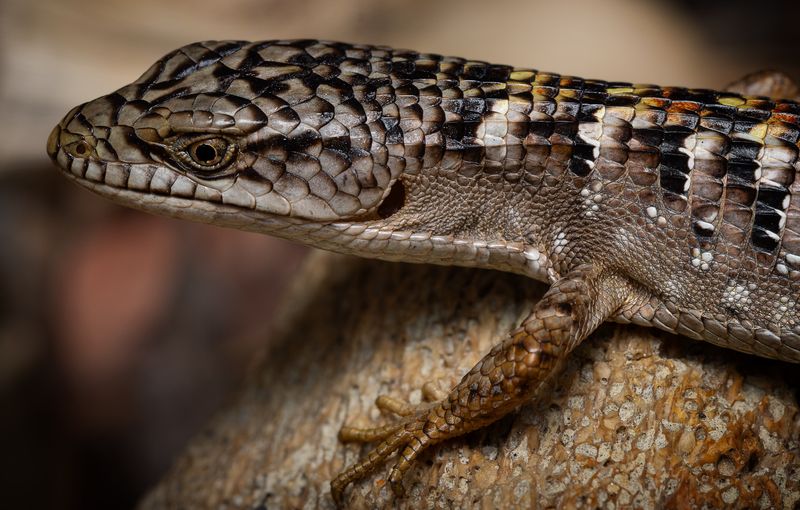
Putting the whole picture together leads to a simple response plan. Observe from a distance, check the physical traits and your regional range before drawing species-specific conclusions, and leave the lizard undisturbed to finish basking, resting, or moving through the yard on its own schedule.
That is genuinely the most useful thing a homeowner can do.
If the animal is a confirmed southern alligator lizard, UC IPM supports its presence as ecologically beneficial, and the peer-reviewed Toxins study establishes that it can eat western black widows and tolerate their venom under tested conditions. Those are real, documented facts about a native California reptile.
They do not add up to a pest-control guarantee, but they do describe an animal that earns its place in a wildlife-friendly yard without any management from the homeowner.
Keep broad-spectrum pesticides off the routine schedule, maintain a little sheltered ground cover where fire safety allows, and use standard glove-and-shake precautions when working in concealed areas where black widows may hide. The lizard on your wall is not a problem that needs solving.
It is a native predator that found something useful in your yard and decided to stay a while.