
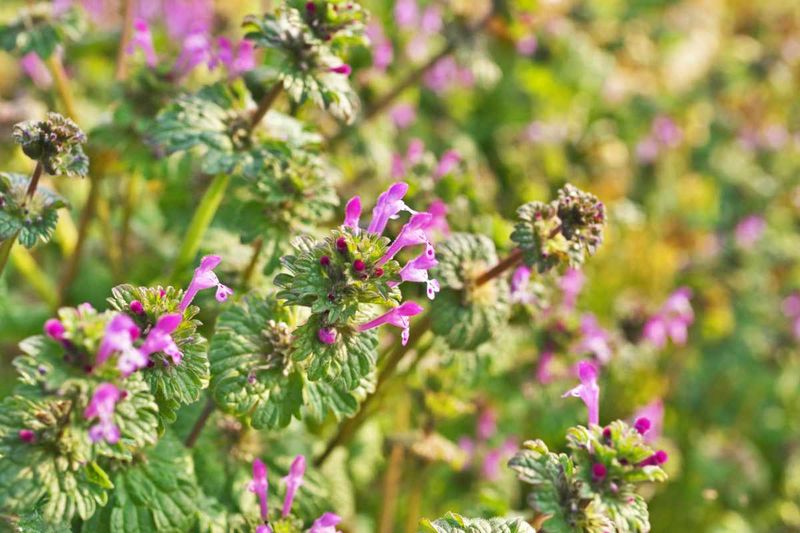
Every spring, Central Texas lawns fill up with small purple flowers, and the knee-jerk reaction is to yank them out or reach for a spray bottle. But some of those plants are actually doing something useful, while others are introduced weeds or even invasive spreaders that deserve a closer look.
The problem is that “purple weed” is not a plant name, and treating all of them the same way can mean pulling something worth keeping or protecting something that should go. Knowing what you have changes everything about how you handle it.
“Purple weed” is not an identification
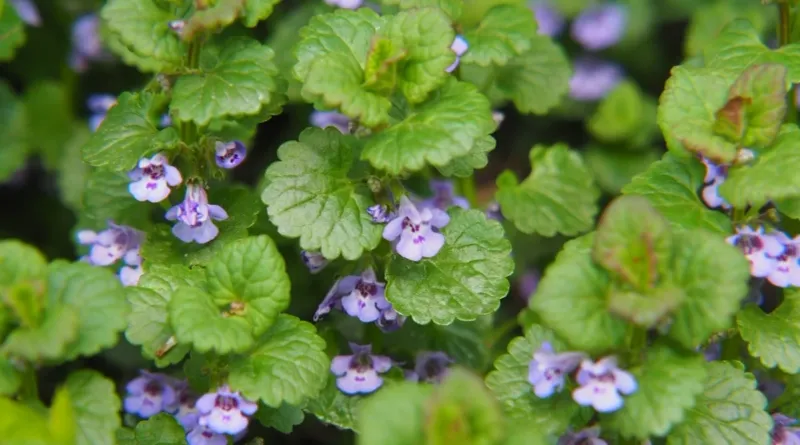
Seeing purple flowers scattered across your lawn in late winter or early spring does not tell you which plant you are looking at. Central Texas lawns can host several unrelated purple-flowering species at the same time, including henbit, purple deadnettle, native and introduced Ruellia species, slender aster, ground ivy, and others.
Each one has a different origin, a different relationship with pollinators, and a different management profile.
Appearance alone cannot settle the question. Flower color is one of the least reliable identification features because many unrelated plants converge on similar shades of purple or violet.
Leaf shape, stem cross-section, plant height, and the way leaves attach to the stem are far more useful clues, and those details only become clear when you crouch down and look closely.
Texas A&M AggieTurf’s turfgrass weed resource makes this point directly: correct species identification matters because control methods vary by weed. Recommending a management strategy for an unidentified purple plant is like prescribing medicine without a diagnosis.
The wrong call can mean removing a plant that was feeding bees, or leaving one that is quietly spreading through rhizomes and seed.
The article’s title premise, that a purple lawn plant is automatically a native pollinator plant worth keeping, does not hold up. Some purple volunteers are worth tolerating temporarily.
Some are native species that deserve genuine protection in the right setting. Others are introduced plants with no special ecological value in Texas, and at least one is considered invasive in neighboring states.
The only reliable first step is identification, and the sections that follow give you the field marks to make that call.
Henbit reveals itself by its stem and leaves
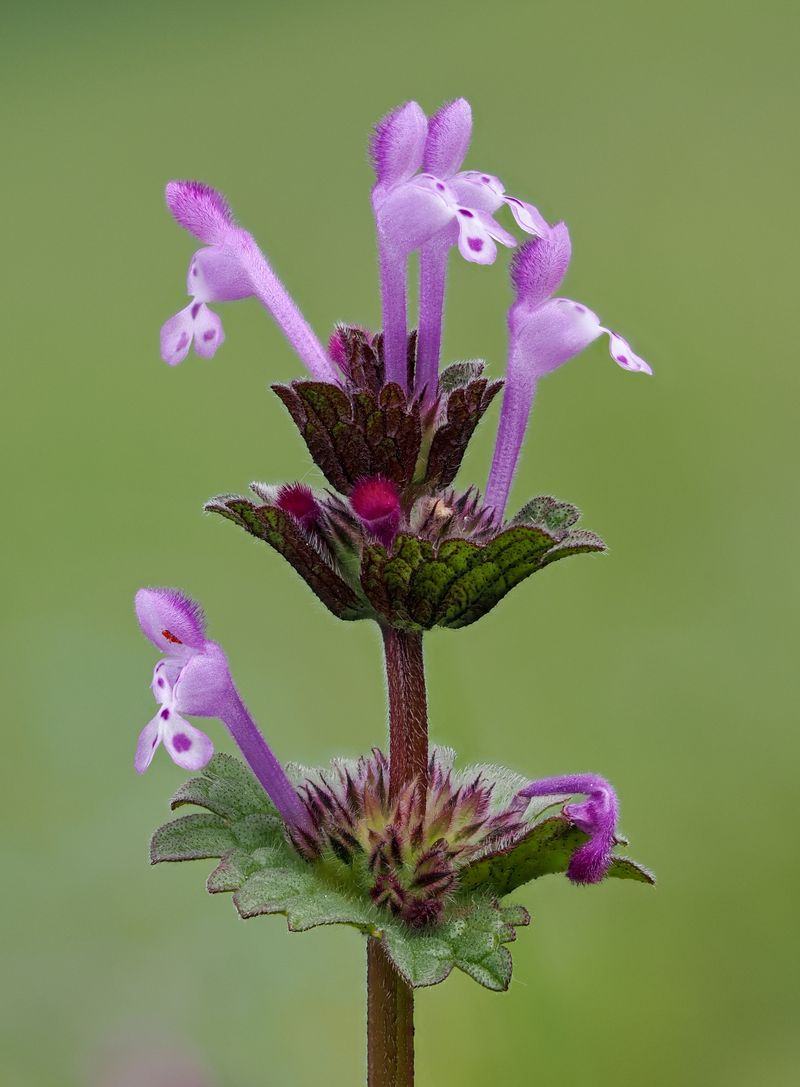
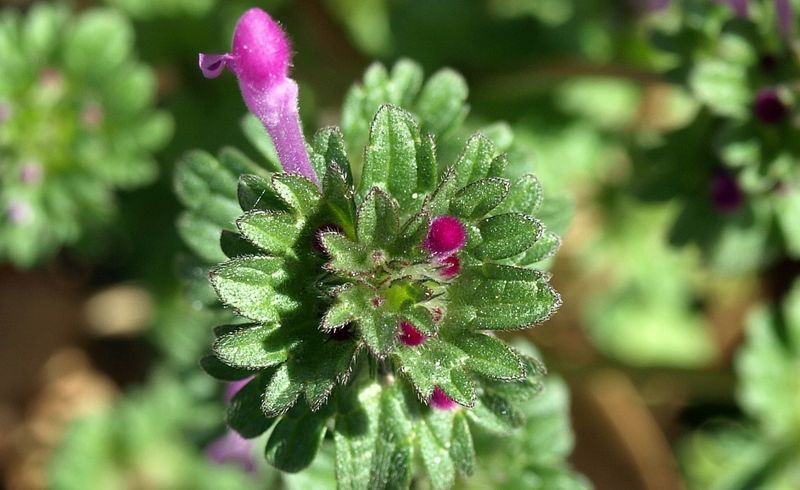
Henbit, known scientifically as Lamium amplexicaule, has a set of field marks that separate it from other purple lawn plants once you know what to look for. Start with the stem: it is distinctly square in cross-section, a trait shared by most members of the mint family.
Round-stemmed purple plants in your lawn are something else entirely.
The leaves are triangular to broadly ovate with rounded, scalloped teeth along the edges. Lower leaves grow on short petioles, but the upper leaves are the giveaway: they clasp the stem directly, with no petiole at all, so the stem appears to pass right through the leaf.
That clasping habit is one of henbit’s most reliable field marks and distinguishes it from purple deadnettle, a close relative whose upper leaves are stalked and often tinged reddish-purple rather than green.
The flowers are small, tubular, and pinkish to reddish-purple, arranged in dense whorls around the stem at each leaf node. Up close, the lower lip of the flower has darker purple spotting.
Texas A&M AggieTurf’s henbit profile describes this combination of square stem, toothed leaves, and clasping upper leaves as the plant’s defining characteristics in Texas lawn settings.
One thing henbit is not: a Texas native. NC State Extension’s plant record for greater henbit confirms that Lamium amplexicaule originated in Europe and North Africa and was introduced to North America.
It naturalizes readily in disturbed soils, thin turf, and garden beds, which is why it shows up so reliably every spring across Central Texas. Recognizing it correctly is the starting point for any sensible management decision, because a native wild petunia and henbit can both show purple flowers while belonging to entirely different plant families with entirely different stories.
Henbit offers a brief spring window
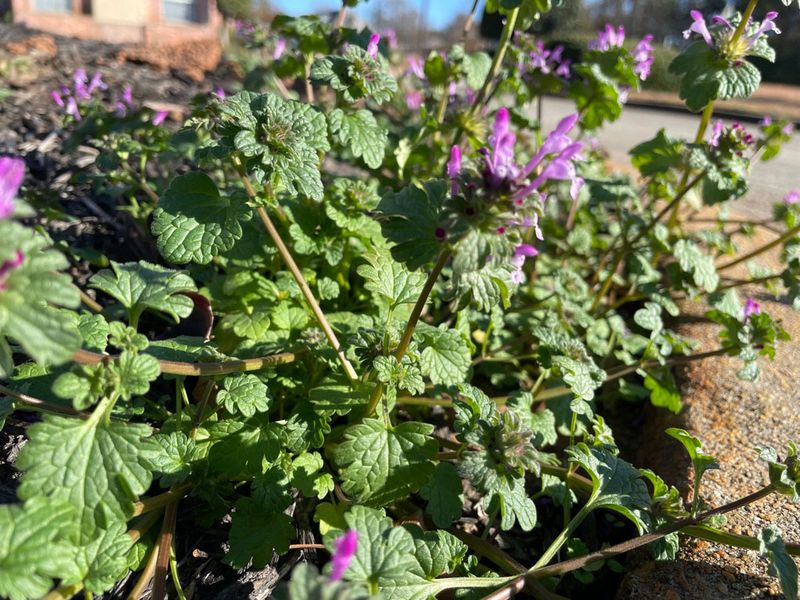
Henbit follows a cool-season schedule that most Central Texas homeowners notice only after the fact. Seeds typically germinate in late summer or early fall when soil temperatures drop.
The plant grows quietly through fall and into winter, staying low and green while bermudagrass goes dormant. Then, as days lengthen in late winter and early spring, henbit shoots up, flowers, sets seed, and dies as temperatures climb.
That brief flowering window, usually February through April depending on the year and location, is the only time henbit is visible enough to prompt a management decision. By the time bermudagrass greens up and fills in, henbit is already gone.
The Texas A&M AgriLife bermudagrass lawn management calendar places winter weed control in this seasonal context, though it is worth noting that this calendar addresses bermudagrass specifically. Homeowners with St. Augustine, zoysia, or other turf types will have different timing and different product considerations.
The seasonal biology has practical implications. If you want to reduce henbit in future years without chemicals, the most effective low-effort option is pulling plants before they set seed in spring.
Once seed drops, next year’s crop is already in the soil. Hand-pulling a small patch takes minutes and interrupts the cycle without any product risk to turf or pollinators.
Tolerating henbit through its flowering period in a low-traffic or informal area is a reasonable choice, too, especially since the plant disappears on its own when heat arrives. Texas A&M’s turfgrass weed guidance acknowledges that management decisions depend on the level of interference a weed causes, not just its presence.
A few henbit plants in a back corner that see no foot traffic and no formal lawn expectations are a different situation from a heavy stand competing with newly seeded turf or spreading into a flower bed.
Henbit can feed early-season visitors—but it is not native habitat
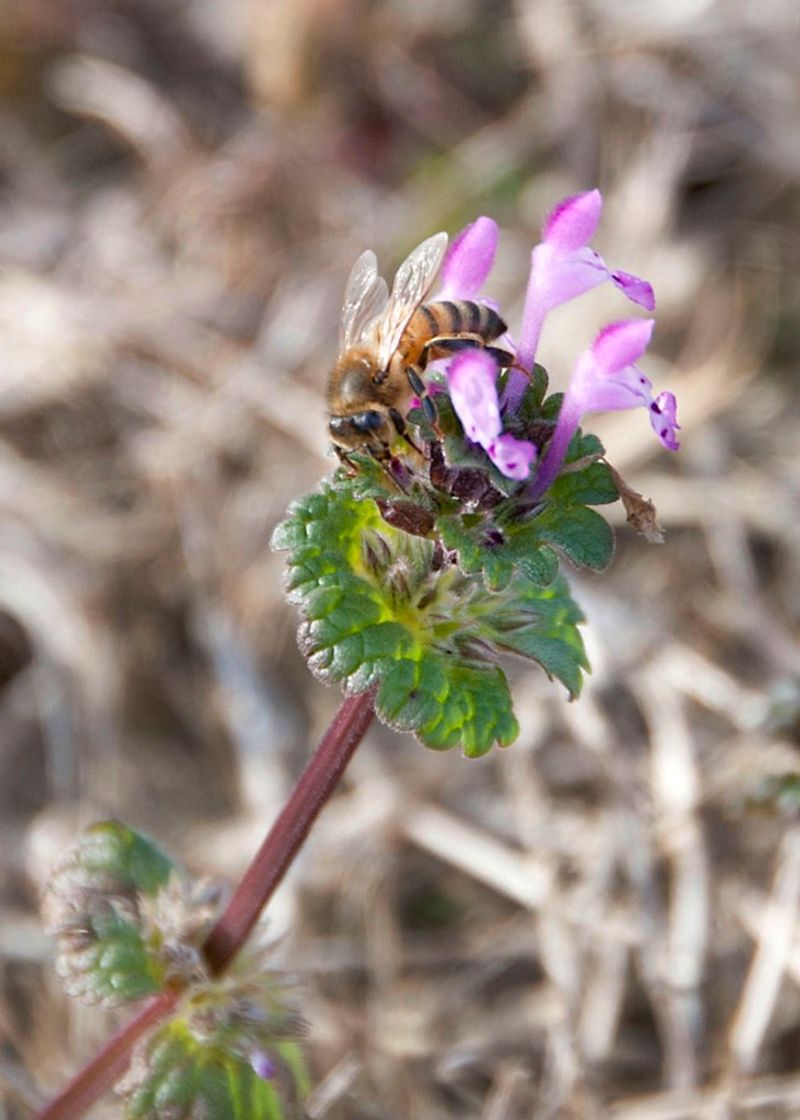
One reason some gardeners choose to leave henbit alone through its spring bloom is the early-season forage it provides. Honeybees in particular are drawn to the tubular purple flowers during a time of year when few other lawn plants are producing nectar and pollen.
NC State Extension’s henbit profile notes this early-season value, and a Central Texas bee-friendly plant list from Texas A&M AgriLife includes henbit among plants that can support bee activity in the region.
That is a real and useful fact. Honeybees need food in late winter and early spring, and a patch of blooming henbit in a dormant lawn fills a gap that most other plants cannot.
For a homeowner who manages bees or simply wants to support them during a lean season, tolerating henbit through its bloom is a practical choice with some evidence behind it.
The boundary around that evidence matters, though. The sources support describing henbit as a short-term floral resource, mainly for honeybees, during a narrow seasonal window.
They do not establish that henbit is a significant food source for native Texas bees as a group, that keeping it meaningfully improves pollinator populations, or that it provides the kind of habitat that native bees need for nesting and overwintering. Henbit is not native to Texas, and a plant that arrived from Europe and North Africa does not become essential native pollinator habitat just because honeybees visit its flowers in February.
Treating henbit as a temporary bonus during the early-spring gap is accurate and defensible. Treating it as a reason to abandon weed management or as a substitute for planting regionally appropriate native species is a different claim, and the evidence does not support it.
The two positions are easy to confuse, and the distinction is worth holding onto when making lawn decisions.
Native wild petunias belong to a different category
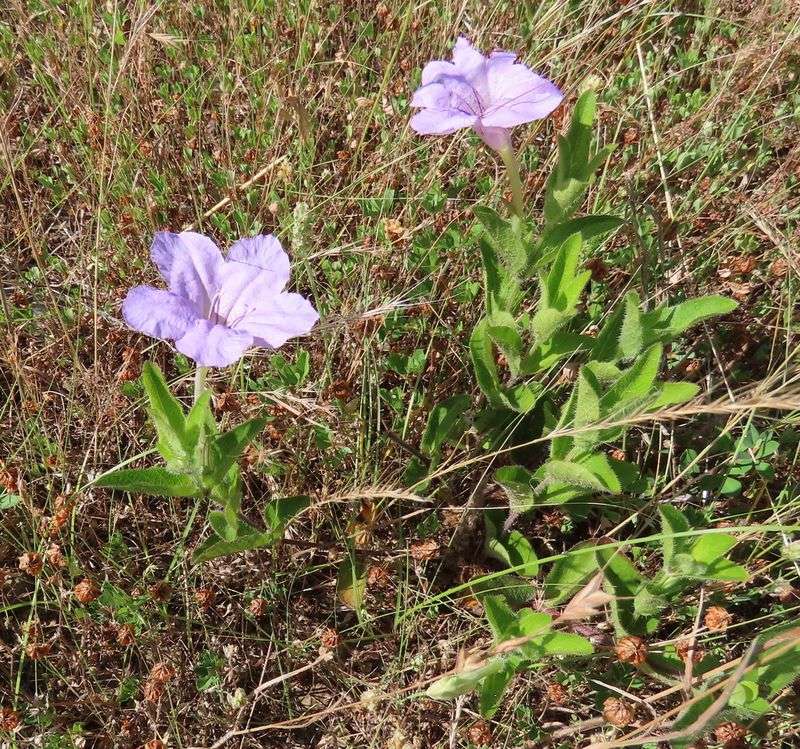
When people call a purple lawn plant a “wild petunia,” they are using a common name that covers several different Ruellia species with very different origins and management implications. Wild petunia is not a synonym for henbit, and it is not a single identifiable plant.
Getting specific about which Ruellia you are looking at is the only way to make a sound decision about keeping it.
Low wild petunia, Ruellia humilis, is one of the species with genuine Texas native credentials. Texas Parks and Wildlife’s vegetation survey for the Texas-Louisiana coastal prairie lists R. humilis as a forb found in native prairie communities, placing it firmly within Texas’s indigenous plant community.
The Native Plant Society of Texas profile for Ruellia humilis describes it as suitable for pollinator gardens, prairies, meadows, and rock gardens, with lavender-purple trumpet-shaped flowers that attract long-tongued bees and hummingbirds.
Ruellia humilis looks different from henbit in several useful ways. It belongs to the acanthus family, not the mint family, so its stem is round rather than square.
Its leaves are broader and more oval, with smooth to slightly hairy surfaces, and they attach in opposite pairs without clasping the stem. The flowers are larger and more openly trumpet-shaped than henbit’s small tubular blooms.
A plant that matches this description in an appropriate Texas setting, particularly a sunny, well-drained area with native-range soils, deserves protection rather than removal.
The key qualifier is “appropriate setting.” A Ruellia species that is native somewhere in Texas may not be native to every county or soil type in Central Texas. Before deciding to protect a volunteer, check a locally sourced native-plant reference or contact your county’s Texas A&M AgriLife Extension office.
Homeowners should protect an identified native species in a location that suits it, not assume that every purple volunteer with trumpet-shaped flowers belongs to the native category.
Mexican petunia changes the recommendation
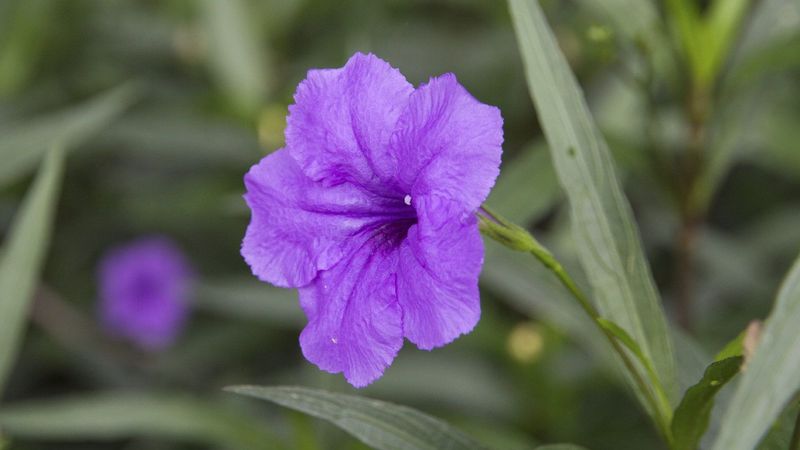
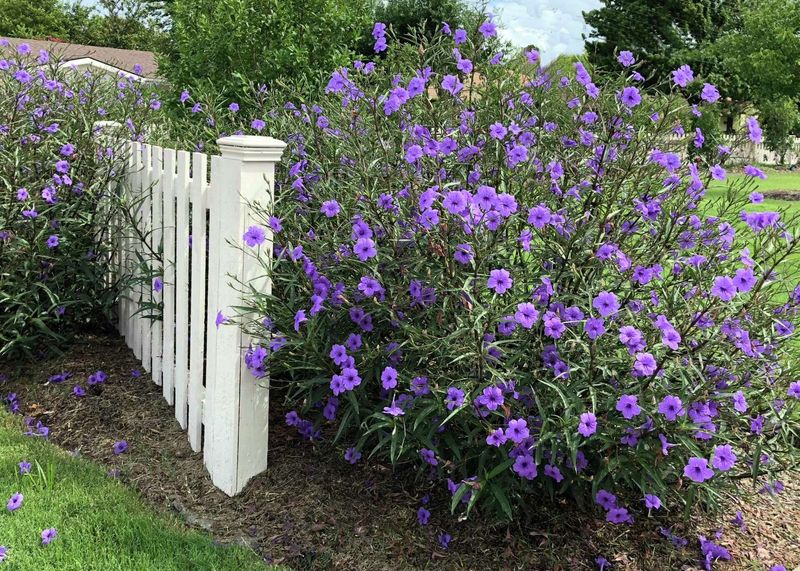
Mexican petunia, or Britton’s wild petunia (Ruellia simplex), is a plant that often gets lumped in with native wild petunias because it shares the common name and produces similar-looking purple flowers. The two groups are not the same, and the distinction has real management consequences.
Ruellia simplex is introduced to the United States. It has naturalized across parts of Texas, spreading through both rhizomes and seed.
Texas Invasives lists Britton’s wild petunia as an introduced plant in Texas and provides native Ruellia alternatives for homeowners who want the look without the spread. In Florida, the situation is more severe: UF/IFAS classifies the wild type of Ruellia simplex as invasive in Florida’s natural areas and does not recommend it for use near wetlands, waterways, or natural areas where it can displace native vegetation.
Sterile cultivars of Ruellia simplex receive different assessments from the wild type. Some evaluated cultivars produce little to no viable seed and spread more slowly, which has led to more favorable reviews in certain horticultural contexts.
However, cultivar assessments vary by source and region, and no cultivar should be assumed safe without checking a current, regionally specific evaluation. The safest approach is to verify the cultivar name and consult a Texas-based resource before planting any Ruellia simplex variety.
NC State Extension’s Ruellia simplex profile notes the plant’s spreading habit and its classification as invasive in some regions. For Central Texas homeowners who find a tall, narrow-leaved Ruellia spreading through a bed or lawn, the right response is to verify the species before deciding to protect or propagate it.
A purple flower does not make a plant native, and a plant called “wild petunia” is not automatically a Texas-native pollinator resource worth encouraging.
Match the lawn response to the plant and the place
Once you know what plant you have, the management decision becomes much more straightforward. Confirmed henbit in a low-traffic, informal area, such as a back corner, a naturalized strip, or a section of lawn that sees minimal use, can be tolerated through its spring bloom without much consequence.
The plant disappears when heat arrives, and the brief window of nectar and pollen it provides for early-season honeybees costs you nothing.
Where henbit interferes with turf establishment, competes with desired plants, spreads into a formal lawn area, or grows in a play space where visibility and safety matter, removal makes more sense. Utah State University Extension’s henbit management guide recommends hand-pulling small infestations before seed maturation as a practical, low-risk control method.
For larger infestations on bermudagrass, the Texas A&M AgriLife bermudagrass management calendar discusses fall pre-emergence and spring post-emergence options, but product choice depends entirely on your turf type, the current product label, and local timing. Homeowners with St. Augustine, zoysia, or other grasses should not apply bermudagrass-specific products without checking compatibility.
An identified native Ruellia species in a suitable location deserves a different response: protect it, work around it, and consider adding more plants like it. Texas Parks and Wildlife’s native pollinators and private lands program emphasizes that regionally adapted native plants in private yards play a meaningful role in pollinator conservation, and their native bee needs resource page explains how diverse, season-long flower availability supports native bee populations better than any single volunteer plant.
If a chemical option comes up, the non-negotiable rule is to read the current product label before applying anything. EPA pollinator protection guidance notes that some pesticide labels specifically prohibit applications while bees are foraging or while plants are in bloom.
Spraying a flowering henbit patch while pollinators are active is exactly the kind of outcome identification and timing are meant to prevent.
Keep the right plant, not every purple one
The clearest rule this article can leave you with is also the simplest: identify the plant before you decide. Henbit is a nonnative winter annual that offers a short burst of early-season nectar and pollen, mainly for honeybees, and then disappears on its own.
That limited benefit can justify temporary tolerance in the right spot, but it does not make henbit a native Texas pollinator plant or a reason to abandon weed management across the board.
Confirmed native Ruellia species, particularly Ruellia humilis in appropriate Central Texas settings, are genuinely worth protecting and propagating. Mexican petunia (Ruellia simplex), on the other hand, should not receive that same endorsement.
The wild type spreads and is considered invasive in Florida; its presence in a Texas yard warrants verification before any decision to keep or spread it further.
A Central Texas yard can absolutely support pollinators while staying functional and well-kept. The path there runs through regionally appropriate native plants chosen for the specific site, turf that suits the local climate and water situation, and seasonal management that accounts for what is actually growing in the lawn.
Purple flowers in February are worth a closer look, not a blanket reprieve. The homeowner who takes thirty seconds to crouch down and check the stem shape is already ahead of the headline.