

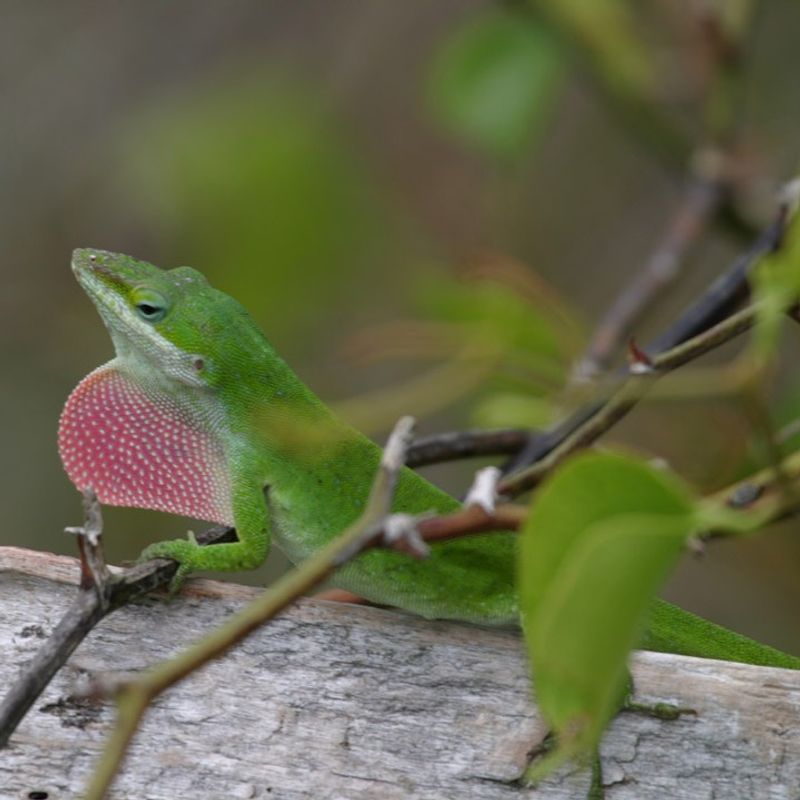
Yard fences, shrubs, and garden walls across North Carolina have been crawling with small green lizards this summer, and plenty of homeowners are wondering what that sudden activity means. Green anoles are native to the state, harmless to people, and a normal part of warm-season life in the Coastal Plain and Piedmont.
Whether you are spotting a dozen at a time on your back fence or watching one puff out its bright red throat flap, the picture is worth understanding before you do anything about it.
A summer “takeover” usually reflects favorable conditions
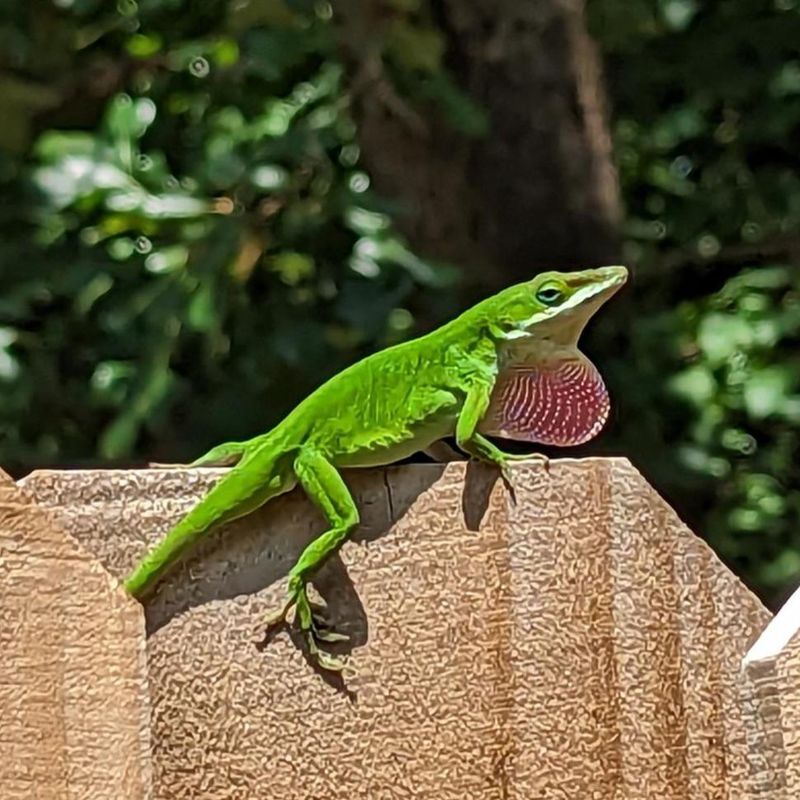
Spotting what feels like an army of small lizards across your fence, porch railing, and garden shrubs is a jarring moment, but the word “takeover” almost certainly describes an impression rather than a documented population explosion. North Carolina Wildlife Resources Commission guidance on the green anole confirms that these lizards are native to the state and common in urban and suburban settings, where they use humid gardens, shrubs, fences, trees, leaf litter, moist soil, and decaying wood throughout the warm season.
Green anoles, sometimes called Carolina anoles, are active and breeding from roughly March through September. Females can lay roughly one egg every two weeks during that window, which means a steady trickle of hatchlings becomes visible right around the peak of summer.
Those juveniles are small and easy to overlook early on, then suddenly seem to be everywhere once they spread into open perch spots.
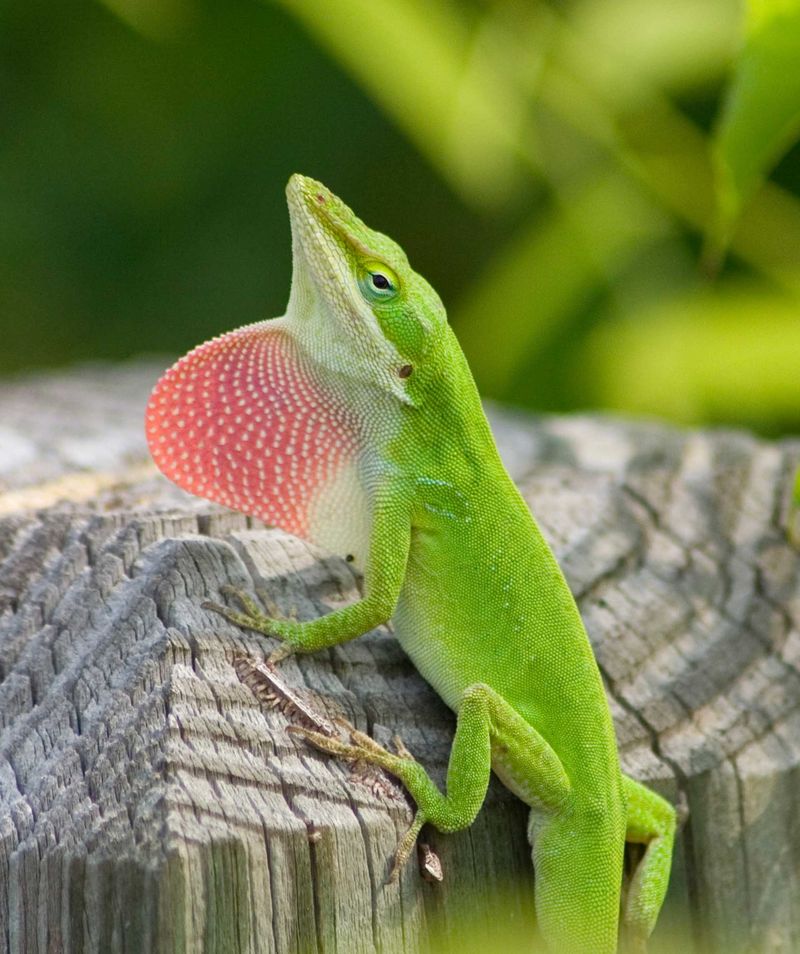
Territorial display is another reason the count looks high. Males bob and fan their bright red-orange dewlaps to claim space and signal rivals, which draws the eye in a way that a quiet lizard tucked into leaves never does.
Several animals performing that behavior at once across a yard can feel like a crowd even when the actual number is modest.
Weather also matters. After a stretch of warm, humid days following rain, anoles emerge and move around more actively.
Animals that were spread across a larger area may concentrate around one particularly attractive shrub, wall section, or shaded corner, making that spot look suddenly overrun. North Carolina Parks reptile records for Anolis carolinensis place the species as most common in the Coastal Plain and southern Piedmont, with sightings becoming less expected as you move into the mountains.
If you live in one of those eastern or southern counties, a summer full of green anoles is simply the season working as it should.
What makes a yard useful to green anoles?
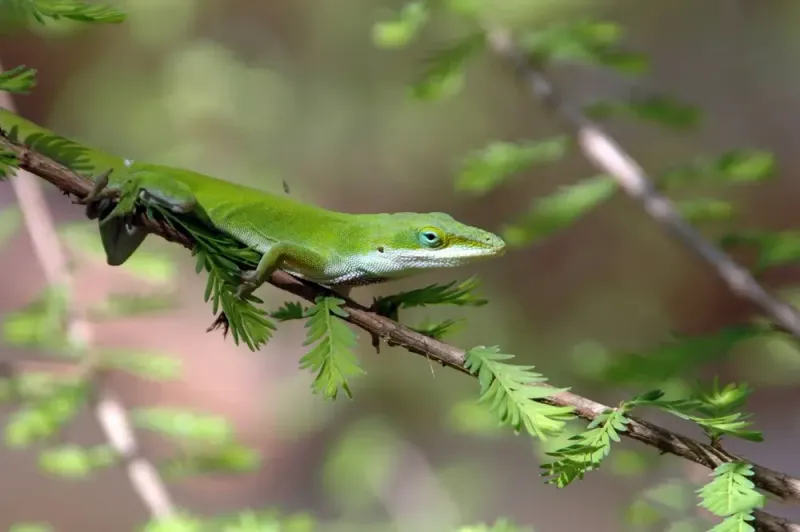
Anoles do not pick a yard at random. Several overlapping conditions have to be present at once, and most of them look like ordinary good gardening rather than anything exotic.
Warmth and moisture sit at the top of the list, since anoles are ectotherms that depend on their environment to regulate body temperature and need humid microhabitats to stay comfortable through a hot Carolina summer.
Vertical structure matters just as much. Green anoles are climbers that patrol shrubs, small trees, fences, walls, and garden trellises.
Animal Diversity Web’s profile of Anolis carolinensis describes the species as strongly arboreal, spending most of its active time above ground level where it can bask, watch for prey, and retreat quickly into dense cover. A yard with layered vegetation, including low ground cover, mid-height shrubs, and taller trees or climbing surfaces, gives anoles multiple zones to use across the day.
Ground-level features fill in the rest of the picture. Retained leaf litter in defined planting beds offers shelter from heat and predators, while moist soil and small patches of decaying wood support the invertebrates that anoles hunt.
USDA Forest Service research on anole habitat selection found that open, structured vegetation with reliable perch sites and thermal variety was more predictive of anole presence than any single plant species.
Prey access ties all of those features together. Anoles eat a broad range of small arthropods, including flies, crickets, moths, beetles, ants, and termites, so planted borders and flowering shrubs that attract insects naturally support foraging.
Recognizable spots in a typical NC yard that check multiple boxes at once include foundation plantings with mixed heights, fence lines backed by shrubs, raised bed edges with mulch, and shaded porch columns with nearby potted plants.
Retaining these features selectively is the practical takeaway. Keeping dense plantings and leaf litter in defined wildlife areas while maintaining tidy, visible zones around doors, play spaces, and patios gives anoles a home without letting the whole yard become unmanaged.
Supporting habitat for one species does not require sacrificing the rest of the outdoor space.
Why anole numbers cannot grade your yard
Counting lizards on the fence is not a reliable way to score your yard’s ecological health, and treating it that way leads to conclusions the evidence does not support. Battles et al. (2013), examining green anoles across different land-use types, found that relationships among land use, prey availability, and body condition in green anoles were complex rather than straightforward.
Seeing many anoles does not confirm that the yard is pesticide-free, unusually rich in insects, or ecologically superior to a neighbor’s property.
Green anoles are generalist predators that persist in disturbed and managed urban landscapes, not just pristine natural areas. They eat whatever small arthropods are available, which is a wide category that includes common yard insects found almost anywhere.
Their presence tells you the yard currently offers warmth, cover, and some prey, not that you have achieved a specific insect density or chemical-free status.
Summer visibility adds another layer of confusion. Males display territorially in ways that are hard to miss, hatchlings appear in pulses, and animals may cluster around one particularly favorable shrub or porch corner.
None of that clustering represents a census. No established homeowner threshold exists for how many anoles signal a healthy versus unhealthy yard, because the science has not produced one.
A few other tempting interpretations also fall flat. A yard full of anoles does not automatically mean it has a mosquito problem, since anoles eat many arthropods and there is no established link between visible anole numbers and mosquito abundance specifically.
Anoles also do not prove the yard is free of lawn chemicals, because they can live in managed landscapes with routine maintenance.
Artificial light occasionally comes up as a possible explanation for anole clustering near porches or lit walls at night. The relationship is real but complicated.
One study on artificial light and local predator behavior found context-dependent effects on predation rates, while experimental work specifically on anoles under artificial light documented potential behavioral and physiological costs rather than a simple prey windfall. Porch lights may attract some insects that anoles notice, but artificial light is not a straightforward reason for a yard to feel overrun.
Is that brown lizard actually a brown anole?
Before taking any action, it pays to make sure you are looking at what you think you are. Color is one of the most common sources of confusion here, because native green anoles are not always green.
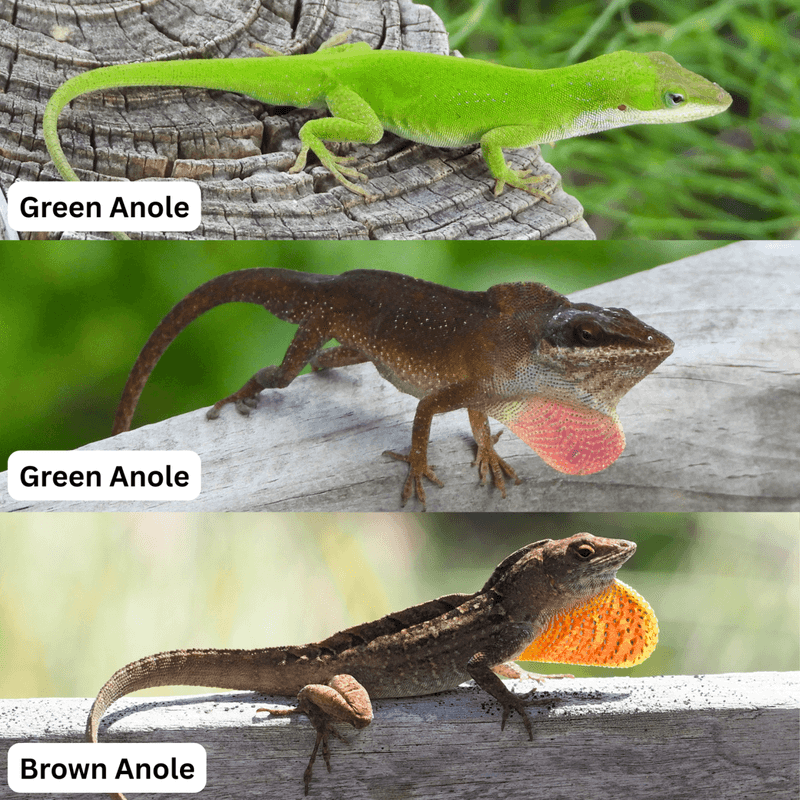
North Carolina Parks reptile identification records explain that green anoles cycle through green, brown, and gray depending on temperature, humidity, stress, and social context. A lizard that looks completely brown on a cool morning may be the same native species you saw bright green the afternoon before.
Brown anoles are a separate introduced species with a different look, and the differences go well beyond color. Native green anoles, even when brown, typically show a relatively plain or faintly mottled back without a strong, bold reticulated pattern.
Brown anoles usually display a more clearly patterned back with a distinct network of markings, and their overall body shape tends to be slightly stockier with a broader, flatter head. The dewlap is another clue: male green anoles fan a bright pink-to-red dewlap, while male brown anoles display an orange dewlap that is often edged in yellow or white.
Behavior and habitat position also help separate the two. National Park Service guidance on anoles notes that brown anoles tend to stay closer to the ground, while green anoles more often perch higher in vegetation.
That said, both species use overlapping spaces, so habitat position alone is not a definitive test.
The practical step when you are unsure is to photograph the animal from the side, capturing the back pattern, head shape, and dewlap if visible, then compare that image against an authoritative identification resource such as the NC Parks reptile checklist or a university extension guide. Do not handle the lizard until you have a confident identification.
If the animal turns out to be, or might be, a brown anole, North Carolina Wildlife Resources Commission rules on amphibian and reptile possession are worth reviewing before you collect, transport, or attempt to remove it. Brown anoles are more of a documented concern in Florida and parts of the deep South than in most NC homeowner yards, but the identification step still matters before any action.
Manage real pest problems without spraying the anoles away

Anoles showing up in numbers is not a reason to reach for a pesticide sprayer. Spraying to reduce insects as a way of discouraging lizards would harm the very habitat conditions that support native wildlife, expose pollinators and other non-target animals to unnecessary risk, and still leave the underlying pest question unanswered.
The right starting point is identifying whether you actually have a pest problem worth addressing.
EPA integrated pest management principles lay out a clear sequence: identify the actual pest, monitor its population level, set a threshold for when action is genuinely needed, try prevention or lower-risk controls first, and treat only when monitoring confirms that the threshold has been crossed. Broadcast, nonspecific pesticide application is a last resort under that framework, not a default response to noticing insects or lizards in the yard.
Reducing routine insecticide use in areas with flowering plants and wildlife habitat also protects pollinators. EPA guidance on pollinator protection recommends application practices that limit exposure to bees and other non-target organisms, which includes timing applications carefully and avoiding flowering plants during bloom.
Keeping insecticide use targeted and justified rather than routine benefits the broader yard community, not just anoles.
Mosquitoes deserve a specific note, because they come up frequently when people see lizards and wonder if the two are connected. NC Wildlife’s green anole profile describes the species as a generalist predator of small arthropods, not a targeted mosquito control tool.
Anoles may occasionally eat a mosquito, but they will not reduce a mosquito population to a level you would notice.
The concrete step that actually works for mosquitoes is source reduction. EPA smart pest control guidance recommends removing standing water from gutters, containers, plant saucers, toys, tarps, and any other receptacle that holds water for more than a few days.
That single habit eliminates breeding sites more reliably than any predator. For ticks, following current personal protection recommendations, including appropriate clothing and repellent use, remains the recommended approach regardless of what wildlife is present in the yard.
Choose a selective response for the rest of summer
Working out what to actually do is simpler than the biology might suggest. Start by observing the lizards long enough to photograph them clearly, then use a reliable identification resource such as the North Carolina Parks reptile checklist to confirm species before taking any further steps.
Correctly identified green anoles are harmless native wildlife with no venom and no threat to people, pets, or garden plants. The best response in most cases is simply to leave them alone.
For the yard itself, preserve useful shrubs and layered planting in defined wildlife areas while keeping doors, play spaces, patios, and frequently used lawn zones visible and tidy. That balance gives anoles workable habitat without letting the whole property become unmanaged.
Any verified pest problems should be handled through the identify-monitor-threshold approach rather than through broad spraying that could harm non-target animals.
If you spot a lizard that might be a brown anole rather than a native green anole, do not collect, transport, or attempt to remove it before consulting the North Carolina Wildlife Resources Commission’s rules on reptile possession. The commission can clarify what is permitted and what steps are appropriate.
Relocation of any lizard carries welfare risks for the animal, and legal questions about collection or possession are worth resolving before acting.
A yard full of green anoles this summer is telling you something specific and fairly narrow: right now, that space offers the warmth, cover, climbing structure, and prey that these lizards need. That is useful information about local conditions, not a comprehensive health score for the whole property.