
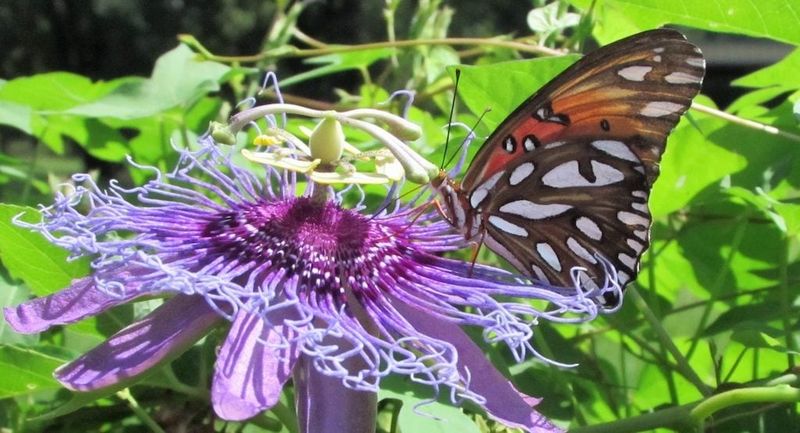
A single vine climbing your backyard fence can quietly become one of the most useful wildlife plants in your Central Texas yard. Purple passionflower, known botanically as Passiflora incarnata and commonly called maypop, gives Gulf fritillary butterflies a place to raise their young by providing leaves, stems, and tendrils that the caterpillars eat.
Getting the most out of this arrangement means choosing the right species, setting it up correctly, and knowing what to expect when the caterpillars arrive.
Choose a named species, not just a common name
Garden centers sell plants labeled simply as “passionflower,” and that label can cover a wide range of species that look and behave quite differently from one another. For a Central Texas fence planting aimed at Gulf fritillary habitat, the plant you want is Passiflora incarnata, commonly called purple passionflower or maypop.
Austin’s official plant guide lists it as a perennial vine that supports butterfly larvae, making it the documented choice for this region.
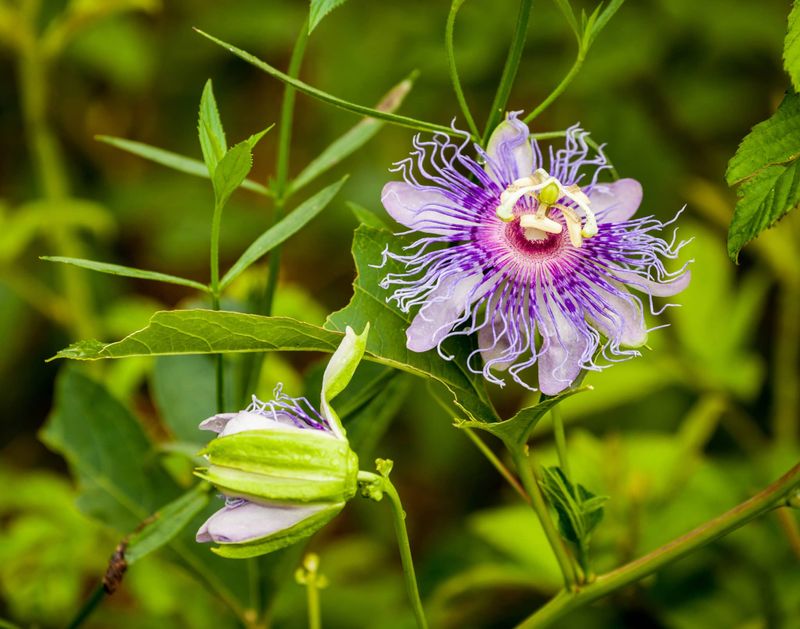
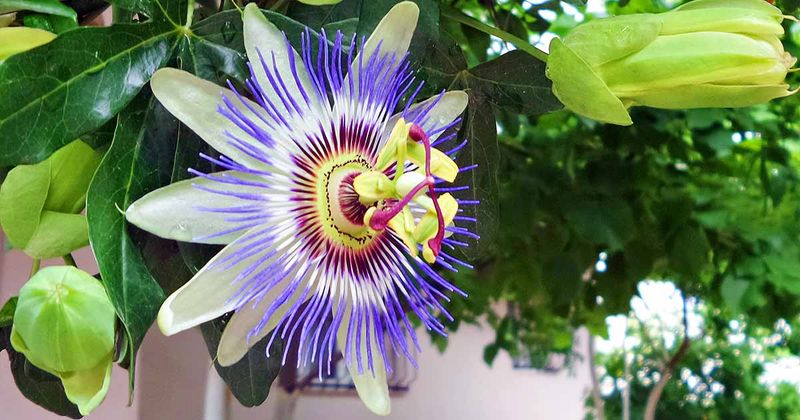
Purple passionflower is hard to miss once you know what to look for. Its blooms are large and showy, with lavender to pale purple petals surrounding an elaborate fringe of purple and white corona filaments.
The vine produces egg-shaped green fruit called maypops that ripen to yellow in late summer.
Two other Texas natives, yellow passionflower (Passiflora luteaPassiflora suberosaP. luteaP. suberosa) and corkystem passionflower (), also serve as documented larval host plants for Gulf fritillaries. However, carries much smaller, greenish-yellow flowers and a more compact growth habit, while differs again in leaf shape and stem texture.
Both are regionally native and ecologically valuable, but they are not the same plant as maypop, and they are harder to find at most Texas nurseries.
NC Extension’s plant database confirms that P. incarnataPassiflora is native to the central and eastern United States, including Texas. When you shop, read the tag all the way to the species name and avoid purchasing cultivars or nonnative species without researching their host-plant value first.
If your planting includes a photo or label, make sure it matches the plant actually in the pot.
Passionflower supplies a caterpillar host
Most people think of butterfly plants as nectar sources, but passionflower plays a fundamentally different role. Gulf fritillary females lay their eggs directly on or near the leaves, stems, and tendrils of passionflower vines, and the caterpillars that hatch spend their entire larval stage eating those same plant parts.
Without a passionflower host, the larvae cannot complete their development.
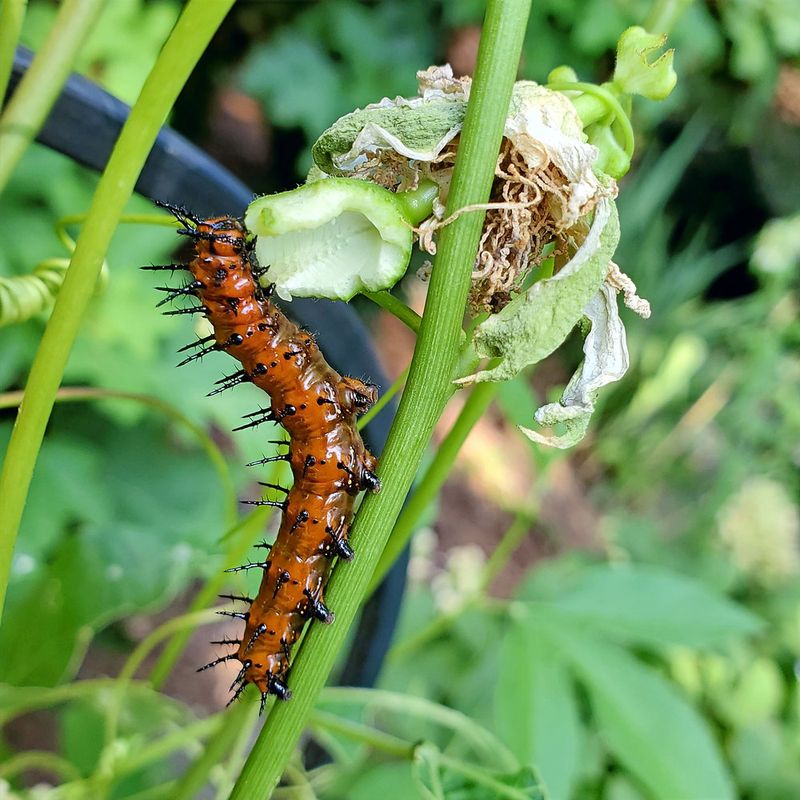
The caterpillars themselves are worth watching for. According to the Florida Wildflower Foundation, Gulf fritillary larvae are orange to reddish-brown with dark lengthwise stripes and rows of branched black spines running along their bodies.
They look dramatic and a little fierce, which surprises gardeners who expect something more delicate from a butterfly garden.
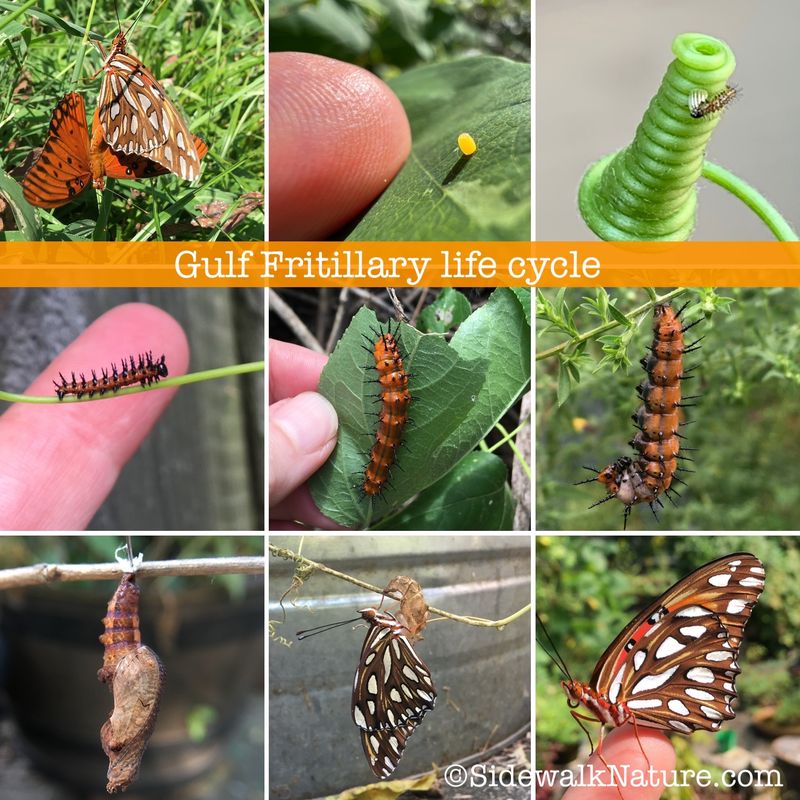
Eggs are laid singly, often on or near the vine rather than in clusters, so you may find just one or two at a time on a given stem or leaf surface. Once the caterpillar matures, it forms a chrysalis that closely resembles a crumpled dead leaf, complete with brown tones and irregular edges that make it easy to overlook on a fence post or woody stem.
Feeding damage is the clearest sign that the vine is doing its job. Chewed leaf margins, stripped tendrils, and partially eaten stems all indicate that caterpillars are present and active.
Treating that damage as a pest problem would mean treating the wildlife benefit as a problem, which defeats the purpose of planting the vine in the first place. A passionflower covered in caterpillar bites is a passionflower that is working exactly as intended.
Watch for a seasonal sequence, not a guarantee
Along a Central Texas fence, the arrival of Gulf fritillaries follows a loose seasonal pattern rather than a precise schedule. Gulf fritillaries produce multiple generations each year, and Texas sits well within the warm southern range where adults can be active from spring through late fall.
That means a healthy, well-placed passionflower vine has a reasonable chance of hosting caterpillars during the warmer months, particularly from late spring through summer and into early fall.
What that looks like in practice is a sequence rather than a constant spectacle. Early in the season, a female may land briefly on the vine, curl her abdomen toward a stem or leaf, and deposit a single small yellow egg.
Days later, a tiny larva emerges and begins feeding. Over the following weeks, the caterpillar grows visibly larger, the foliage becomes increasingly ragged, and eventually a brown chrysalis appears somewhere on the fence, a nearby post, or even a garden tool leaning against the structure.
Austin’s city plant guide notes seasonal interest from spring through summer for the vine itself, while NC Extension documents multiple annual generations for the butterfly in warm climates. Still, no planted vine guarantees uninterrupted activity.
Weather extremes, local butterfly population levels, plant vigor, nearby pesticide use, predation, and parasitism all shape what actually appears in a given yard in a given week.
The vine feeds caterpillars, not adult butterflies. Once adults emerge, they need nectar from flowering plants nearby, and if that resource is absent, they may move on quickly.
Watching the fence for the full sequence, eggs, larvae, chewed foliage, chrysalis, and occasional adult visits, is more realistic and more satisfying than expecting a constant flutter of orange wings all summer long.
Give the vine sun, support, and lateral room
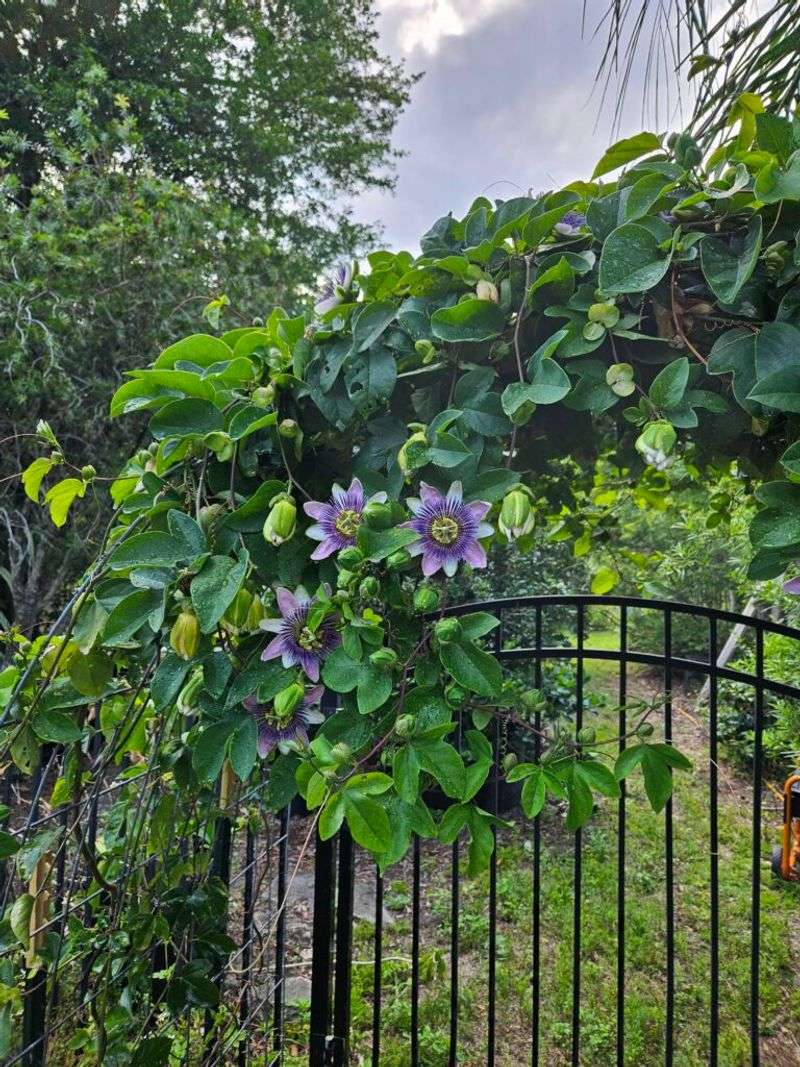
Purple passionflower is a tendril-climbing vine that grabs onto whatever structure it finds and pulls itself upward. A fence or trellis gives it exactly the kind of support it needs, and a sunny fence line in Central Texas suits it well.
USDA guidance for purple passionflower specifies direct sunlight for at least half the day, along with fertile, well-drained soil. The vine also tolerates heavier clay soils, which is useful across much of Central Texas where clay is common.
Before you plant, think about how much horizontal space you can offer. Austin’s plant guide documents a spread of approximately 6 to 15 feet and describes the vine’s growth as aggressive.
That means a single plant can eventually cover a substantial length of fence, and it will not politely stop at whatever boundary you have in mind.
Squeezing the vine into a narrow bed between a fence and a sidewalk, or pressing it up against a foundation wall, sets up a management problem rather than a habitat opportunity. A better approach is to choose a fence section with open ground on at least one side, so the plant can spread laterally without immediately running into something it cannot be allowed to cover.
If the fence borders a lawn, you can mow down any growth that crosses the line, but you will need to do it regularly once the vine is established.
NC Extension also confirms that P. incarnata can be trained onto a fence, trellis, arbor, or even a tree trunk, and notes that the plant may cover large areas under favorable conditions. Planting it where it has room to perform is the simplest way to keep it from becoming a problem while still letting it function as a habitat structure.
Pair the host vine with nectar flowers
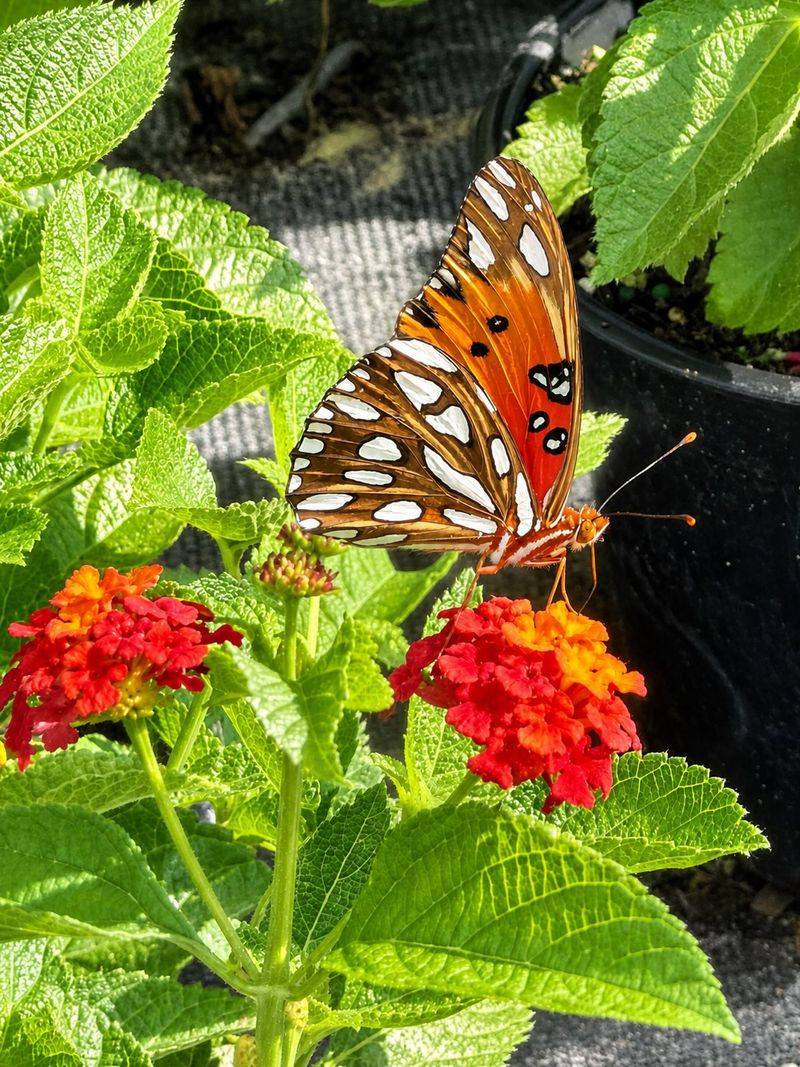
A passionflower vine handles the larval side of the Gulf fritillary’s life cycle, but adult butterflies need something else entirely. Once they emerge from their chrysalises, adults feed on nectar from flowering plants, and a fence covered in passionflower foliage alone does not supply that resource.
Without nearby nectar sources, newly emerged adults may simply leave the yard before you have a chance to watch them.
The Florida Wildflower Foundation documents several plants that Gulf fritillary adults use for nectar, including lantana, asters, black-eyed Susan, beggarticks, Stokes’ aster, and coreopsis. Several of these are well-suited to Central Texas conditions and widely available at local nurseries.
Lantana in particular is a reliable performer in Texas heat and tends to bloom through much of the warm season, giving adults a consistent food source when they are most active.
Penn State Extension’s butterfly gardening guidance recommends pairing host plants with nectar plants to create a more complete habitat arrangement. Placing nectar flowers within easy flight distance of the passionflower fence, rather than in a separate part of the yard, gives emerging adults an immediate reason to stay and feed nearby.
You do not need an elaborate garden to make this work. A few pots of lantana near the fence, a patch of black-eyed Susans, or a border of coreopsis can be enough to hold adults in the area long enough to observe.
The combination of host foliage and flowering nectar plants creates a more functional butterfly habitat than either element alone.
Let caterpillars chew the leaves
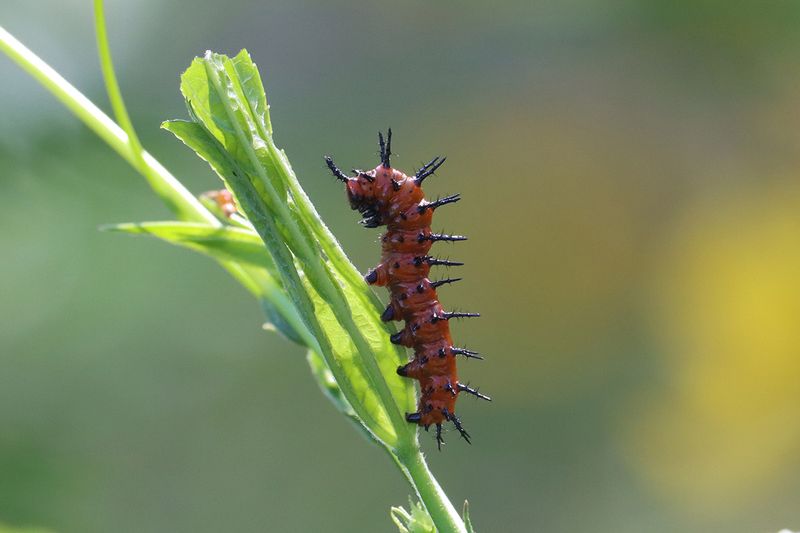
Searching the vine for eggs and caterpillars is one of the more rewarding parts of growing passionflower as a habitat plant. Check the undersides of leaves, along stems, around tendrils, and on actively growing portions of the vine where fresh tissue is available.
Gulf fritillary eggs are laid singly, so a careful look at several locations is more productive than scanning the vine from a distance.
When you find caterpillars, leave them alone. The foliage they eat is the point.
A passionflower that looks tattered and stripped through midsummer is a passionflower that is successfully hosting larvae, and the plant will typically recover or continue growing vigorously enough to sustain additional generations. Reaching for a spray bottle at the first sign of chewed leaves works directly against the habitat goal you planted the vine to achieve.
Penn State Extension advises minimal or no pesticide and herbicide use in butterfly gardens because these products can kill insects directly or eliminate the plants caterpillars depend on for food. That guidance applies to routine insecticides, broad-spectrum sprays, and herbicides used near the vine’s root zone.
Bt products, which are sometimes marketed as a safe biological option, are not safe for desirable butterfly larvae: they affect caterpillars indiscriminately and can kill Gulf fritillary larvae along with the target pest.
Managing a passionflower for habitat means shifting the standard from tidy foliage to functional foliage. A vine that looks well-chewed through the summer is doing exactly what you asked of it, and the chrysalises that follow are the reward for tolerating the mess.
Control spread and assess the planting site
Purple passionflower spreads in two directions at once. Above ground it climbs and extends laterally along the fence.
Below ground it sends out root suckers that can emerge several feet from the main plant, sometimes in unexpected places like lawn edges, adjacent beds, or cracks in paving. USDA specifically recommends regular sucker removal to keep the plant from spreading beyond its intended area.
Removing suckers is straightforward: pull or cut them as close to the soil as possible when they are young and the soil is workable. Letting suckers grow unchecked means the vine gradually colonizes more ground than you planned for.
Austin’s plant guide recommends pruning to direct and control the vine’s growth, which applies both to above-ground stems that stray beyond the fence and to the suckers emerging from the root system.
Water needs are real, especially during establishment. The vine is not drought-proof, and young plants benefit from regular moisture while their root systems develop.
Once established, NC Extension describes medium water needs for P. incarnata and notes that well-drained soil is preferred, though the plant tolerates heavier clay. Letting a newly planted vine dry out repeatedly before it is established can set it back significantly.
Two additional site considerations deserve attention before you plant. First, USDA advises checking with local authorities about the plant’s status in your specific area, since P. incarnata may behave invasively in some regional habitats even if it is not classified that way across all of Central Texas.
Second, NC Extension’s plant database assigns purple passionflower a high flammability rating. If your fence runs close to your home’s exterior, or if your property sits in a wildfire-prone or defensible-space zone, do a site-specific safety check before placing a high-flammability vine in that location.
Build an opportunity for Gulf fritillaries
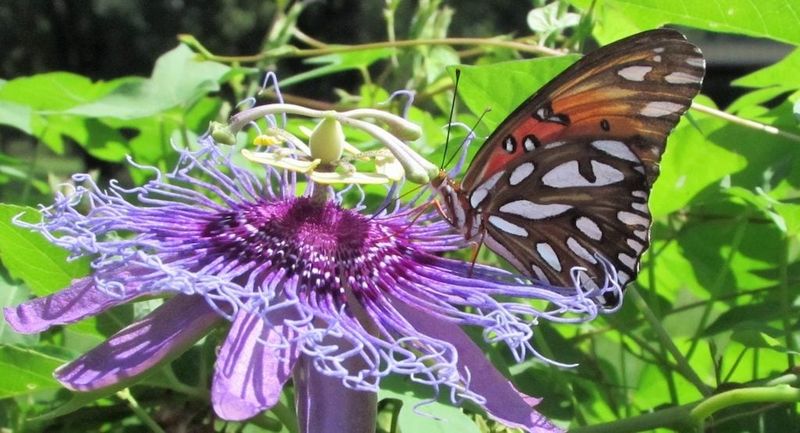
Getting a passionflower fence planting right comes down to a handful of connected decisions. Start with a correctly identified plant: look for Passiflora incarnata, purple passionflower or maypop, sold by species name rather than just a genus-level common name.
Put it where it gets at least a half-day of direct sun, in reasonably well-drained soil, with a fence or sturdy trellis to climb and enough lateral space to spread 6 to 15 feet without immediately becoming a problem.
Add nectar flowers nearby so that adult Gulf fritillaries have a reason to linger after they emerge. Documented adult nectar plants include lantana, asters, black-eyed Susan, and coreopsis, all of which are manageable in a Central Texas yard.
Plan to pull root suckers regularly, prune growth that leaves the fence line, and skip routine pesticide applications anywhere near the vine.
Tolerate chewed foliage. A ragged vine with visible caterpillars and the occasional brown chrysalis tucked against a fence post is the sign of a successful habitat planting, not a plant in trouble.
Austin’s plant resources confirm the vine’s value for butterfly larvae, and that value is only visible when larvae are actively feeding.
What you are building is an opportunity, not a guarantee. Some summers will bring more caterpillars than others, and local conditions will always shape the outcome more than any single planting decision.
A passionflower fence done well gives Gulf fritillaries a place to raise their young, and occasionally you get to watch the whole thing happen from your own backyard.