
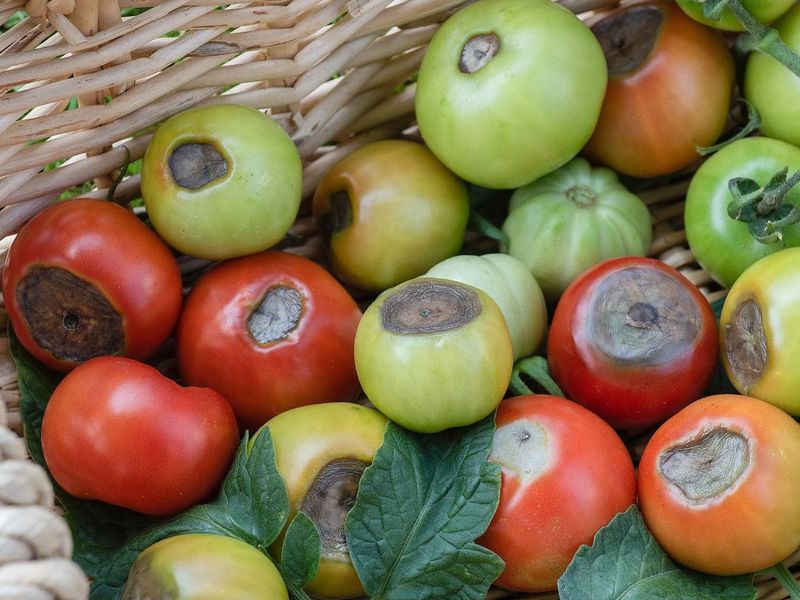
Pulling back a tomato leaf to find a dark, sunken patch on the bottom of your fruit is one of the most discouraging moments in a Southern summer garden. That symptom has a name, and it is more manageable than it looks.
Blossom-end rot is a physiological disorder, not a disease you can catch or spread, and understanding what drives it puts you back in control of your garden.
The blossom-end pattern points first to blossom-end rot
Every tomato has two ends. The stem end is where the fruit connects to the plant.
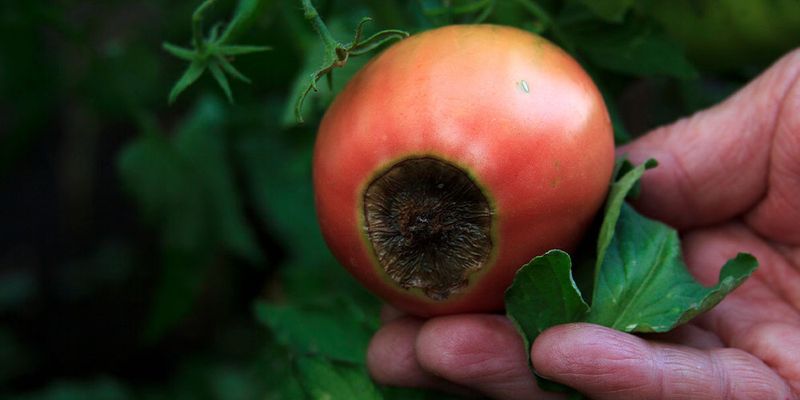
The blossom end is the opposite tip, where the flower once attached before the fruit began to form. When a dark, sunken lesion appears specifically at that blossom end, the most likely explanation is blossom-end rot, commonly abbreviated as BER.
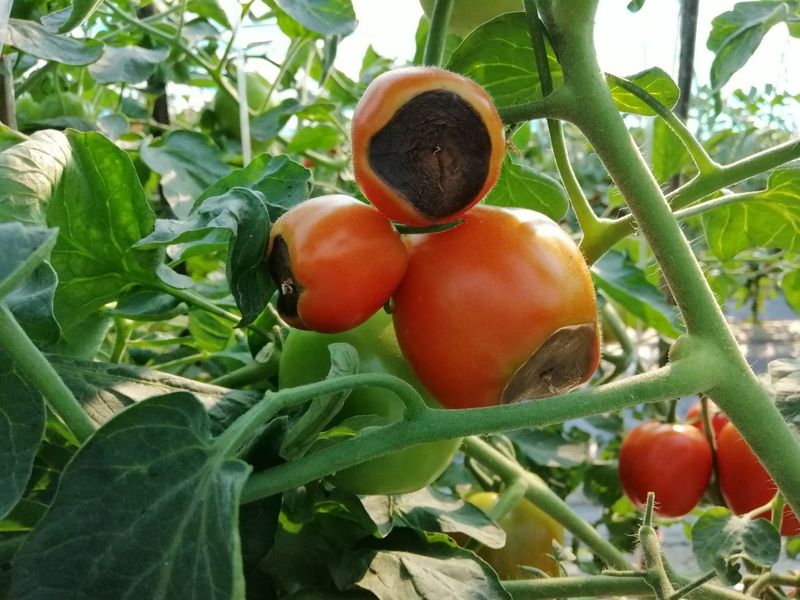
According to University of Georgia Extension, BER often starts as a small, pale or water-soaked area at the blossom end of the fruit. Over the following days, that spot enlarges, darkens to brown or black, sinks inward, and takes on a tough, leathery feel.
Secondary bacteria or fungi can later invade the damaged tissue, making it softer or wetter than the original lesion, which can complicate the visual diagnosis.
A lesion confined to the blossom end, uniformly dark and sunken, strongly suggests BER. A mark on the sidewall, the shoulder near the stem, or the stem end itself does not fit the classic pattern.
Keep the diagnosis probable rather than certain until you have confirmed the lesion’s location and appearance, because other problems can produce dark patches on tomatoes too.
Heat disrupts calcium delivery instead of simply removing calcium from the soil
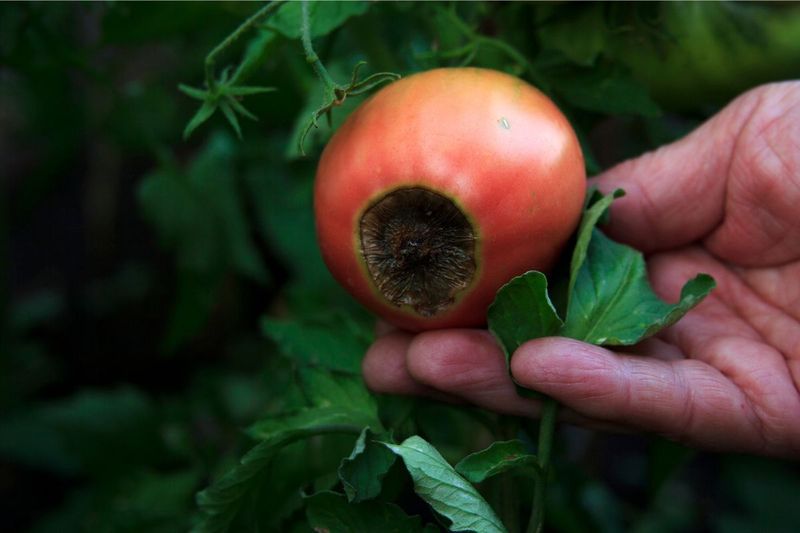
Calcium is the nutrient at the center of blossom-end rot, but the story is more nuanced than a simple shortage in the ground. Rapidly developing tomato fruit tissue needs a steady supply of calcium to build strong cell walls.
When that supply is interrupted, the cells at the blossom end collapse and die, producing the lesion you see.
The complication is that BER can appear even when the soil contains plenty of calcium. As noted by University of Minnesota Extension, the disorder reflects a localized calcium shortage in the fruit tissue rather than a whole-garden deficiency.
Calcium moves through the plant primarily in water, so anything that disrupts water flow from roots to fruit can cut off calcium delivery mid-season.
Hot, dry weather increases the plant’s water demand sharply, and if the soil dries unevenly or the roots are struggling, research on calcium transport in developing fruit confirms that delivery to rapidly expanding tissue can fall short even when conditions look adequate at the root zone. Waterlogged soil creates a similar problem from the other direction, damaging roots and reducing their ability to absorb water and nutrients.
Excess salinity, competing nutrients such as high potassium or magnesium, ammonium-heavy fertilizers, and periods of very fast fruit development can all contribute, with or without a heat wave.
Remove collapsed fruit, but aim your rescue at the next tomatoes
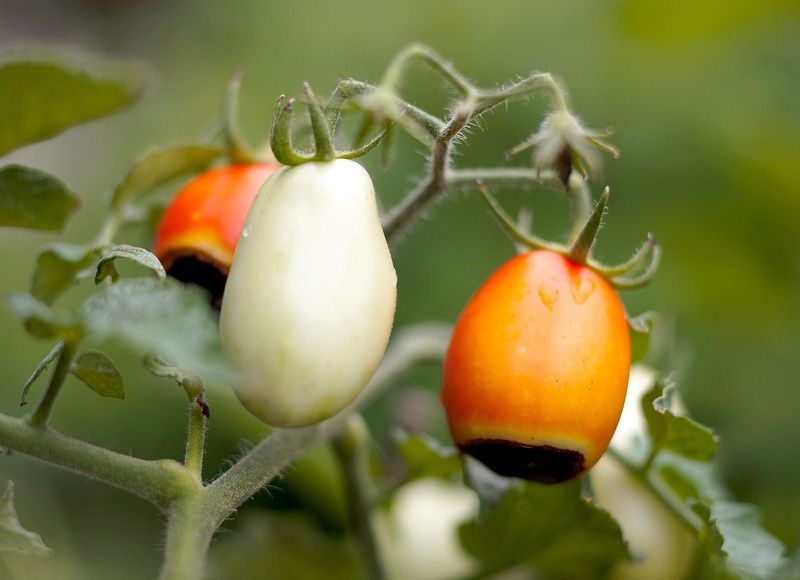
Once a tomato shows the collapsed, leathery tissue of blossom-end rot, that fruit cannot recover. No amendment, spray, or watering adjustment will reverse the cell damage already done.
The practical move is to remove those tomatoes from the vine.
University of Maryland Extension recommends removing affected fruit because it eliminates unusable tomatoes and allows the plant to put its energy toward developing fruit that still has a chance. Removing damaged tomatoes does not cure the plant or guarantee the next round will be problem-free, so think of it as clearing the deck rather than a treatment.
The encouraging part is what University of Georgia research and grower observations consistently show: later fruit on the same plant often develops normally after early fruit shows BER. Early-set tomatoes and large paste or plum varieties tend to be more susceptible, while subsequent fruit, especially fruit that sets after you stabilize moisture conditions, may come through without the disorder.
Your goal from this point forward is to create better conditions for the tomatoes still forming on the plant.
Steady moisture gives developing fruit its best chance
Water management is the single most effective tool you have once BER appears. The goal is consistent soil moisture at the root zone, not a rigid daily schedule.
Checking the soil before watering, by pressing a finger two to three inches deep, tells you far more than a calendar date.
When the soil needs water, use slow, deep irrigation rather than frequent light sprinkles. Shallow watering encourages shallow roots and leaves the root zone vulnerable to rapid drying between waterings.
UGA Extension guidance on tomato irrigation emphasizes that drip irrigation or careful hand watering directed at the soil surface improves moisture delivery and keeps foliage drier, which also reduces the risk of foliar disease. How often you water depends on your soil type, current weather, plant size, rainfall, and drainage, so no single number fits every garden.
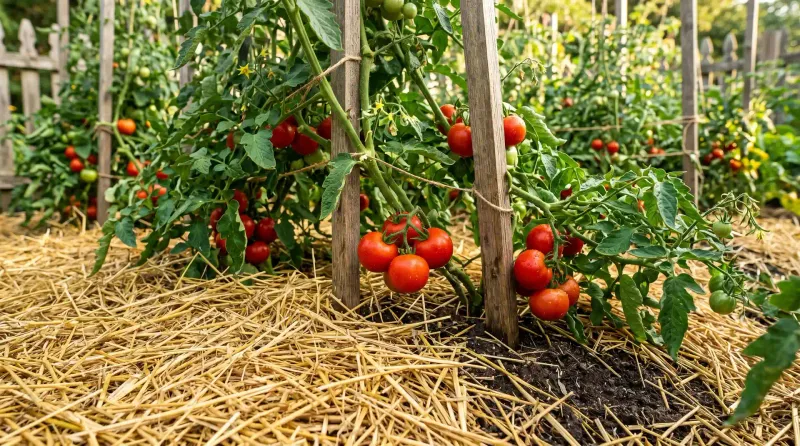
Mulch is one of the most practical tools for moderating those moisture swings. A two-to-three-inch layer of straw, wood chips, or similar material over the root zone slows evaporation and buffers the soil against the sharp wet-dry cycles that can disrupt calcium movement to fruit.
Keep mulch pulled slightly back from the main stem to avoid trapping moisture against it.
Container tomatoes deserve extra attention in Southern heat. UGA Lincoln County Extension points out that containers hold less soil volume and dry out considerably faster than in-ground beds, so they may need monitoring more than once a day during a heat wave.
The aim remains evenly moist soil with good drainage, not constant saturation.
Protect the roots and stop fertilizing in panic
Roots are how your tomato plant pulls both water and calcium from the soil. Any damage to the root system directly reduces the plant’s ability to deliver what developing fruit needs.
Deep hoeing, aggressive cultivation near the base of the plant, and rough handling during transplanting can all sever feeder roots without any visible sign above ground.
Keep cultivation shallow within about a foot of the main stem, and avoid disturbing the soil in that zone more than necessary during the growing season. Utah State University Extension identifies root damage as a recognized contributing factor in BER, because injured roots cannot move water and calcium as efficiently as healthy ones.
Resist the urge to respond to BER with a heavy fertilizer application. University of Maryland Extension cautions that excess nitrogen, particularly from ammonium-based fertilizers, can push the plant into rapid, lush foliage growth at the expense of fruit development and can interfere with calcium uptake or movement within the plant.
If you fertilized recently with a high-nitrogen product, hold off on the next application and let the plant stabilize. The intervention the plant needs right now is steady moisture and undisturbed roots, not more fertilizer.
Soil amendments require a test, not a guess
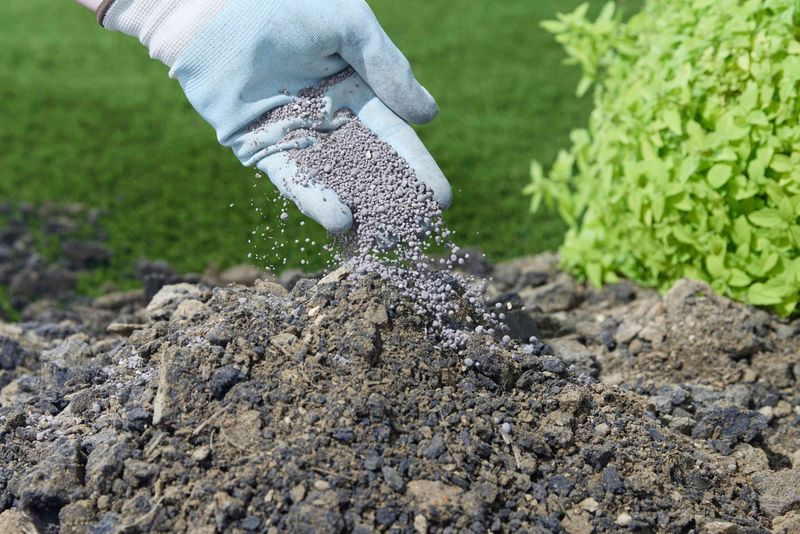
A common reaction to blossom-end rot is to reach for lime, gypsum, or a bag of crushed eggshells, reasoning that calcium is the problem and adding calcium is the fix. That logic skips a critical step: knowing whether the soil actually needs an amendment at all.
Soil testing is the right starting point. Many Southern soils already contain adequate calcium, and adding more without guidance can shift the pH or the balance of other nutrients in ways that create new problems.
University of Minnesota Extension explains that lime and gypsum are not interchangeable: lime raises soil pH, which is useful when the soil is too acidic, while gypsum supplies calcium without substantially altering pH, making it the appropriate choice when pH is already in the right range but calcium is genuinely low. Apply either product only according to the soil-test recommendation and the product label.
Eggshells decompose far too slowly to serve as a dependable immediate calcium source during an active growing season. Epsom salts are a popular home remedy but supply magnesium rather than calcium, and excess magnesium can actually compete with calcium uptake and worsen the imbalance.
Foliar calcium sprays are sometimes suggested, but University of Georgia Extension notes that absorption through leaves is poor and movement to the fruit is limited, making water management a far more reliable priority than any spray.
A different lesion calls for a different diagnosis
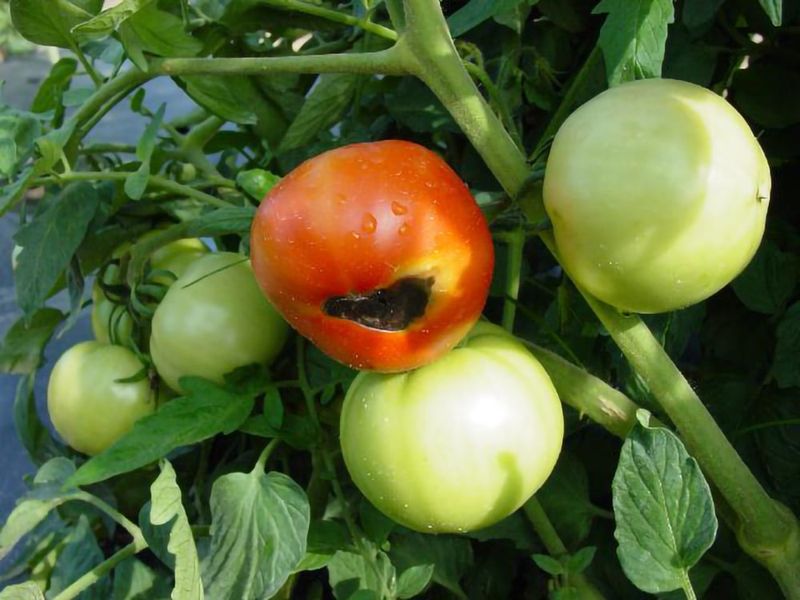
Not every dark patch on a tomato is blossom-end rot, and the location of the lesion is the most useful clue for telling them apart. BER is defined by where it starts: at the blossom end, the tip opposite the stem.
When the damage appears elsewhere, a different cause is far more likely.
Anthracnose is a fungal disease that produces sunken, circular lesions on the sidewall of ripening fruit, often with a salmon-colored center as spores develop. It is common in warm, wet conditions and spreads from soil splash.
University of Minnesota’s tomato diagnostic tool distinguishes anthracnose from BER by lesion placement and the presence of spore masses.
Sunscald appears as pale, bleached, or papery areas on the side of the fruit that was most exposed to direct sun, typically after foliage is lost or pruned away. A lesion beginning at the stem end, rather than the blossom end, does not match the classic BER pattern and warrants a closer look.
UGA Colquitt County Extension also notes that secondary bacteria and fungi can invade BER tissue and make it softer or wetter than expected, which can muddy the picture. Fuzzy growth, widespread decay across multiple fruit surfaces, or an atypical lesion location are signals to consult your local cooperative extension office for a more specific identification.
The damaged tomato is lost, but the plant may still produce good fruit
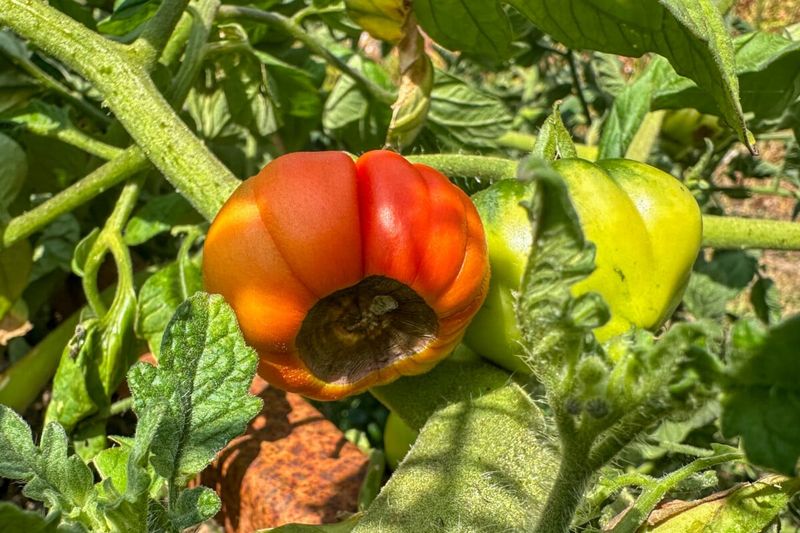
Confirming the diagnosis is the first step: check that the lesion sits at the blossom end, looks uniformly dark and sunken, and does not fit the sidewall or stem-end patterns of other disorders. Once you are confident, pull the affected fruit and shift your attention entirely to the tomatoes still forming on the vine.
From there, the plan is straightforward. Keep the root zone consistently moist with slow, deep watering guided by soil feel rather than a fixed schedule.
Maintain mulch over the root zone to moderate moisture swings. Avoid deep cultivation near the plant base, and hold off on nitrogen-heavy fertilizer until the plant stabilizes.
Reserve any soil amendment for after a soil test, following the test recommendation and product label as described by University of Georgia Extension.
University of Maryland Extension confirms that the affected tomato cannot be repaired, but improving growing conditions gives later fruit a genuinely better chance. The plant that frustrated you last week may still deliver a solid late-season harvest.