
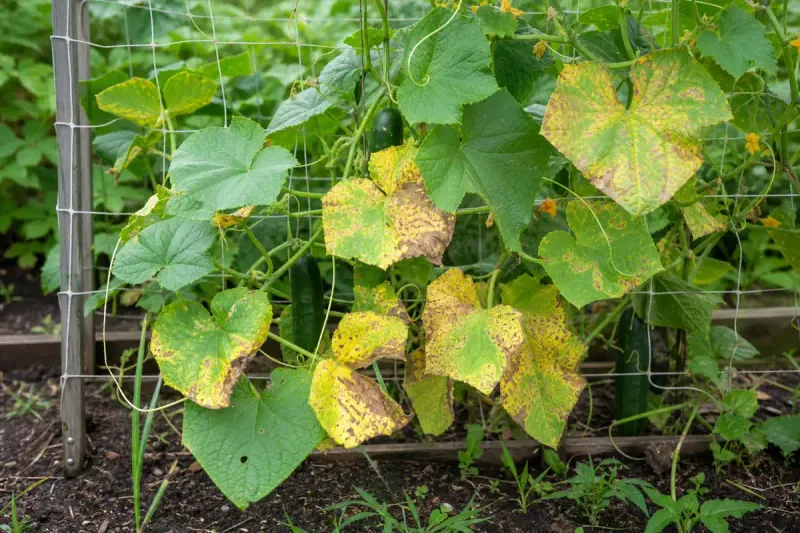
Spotting yellow halos and angular brown patches on your cucumber leaves can feel alarming, especially when your plants seemed fine just days before. The symptom pattern is worth taking seriously, but the cause is not always as obvious as it looks.
Several diseases and even non-disease injuries can produce very similar markings, and acting on the wrong diagnosis can waste time and money or even make things worse. Knowing how to read the clues on both sides of the leaf puts you in a much better position to respond.
Suspected Angular Leaf Spot Fits the Pattern—but Does Not Prove the Cause
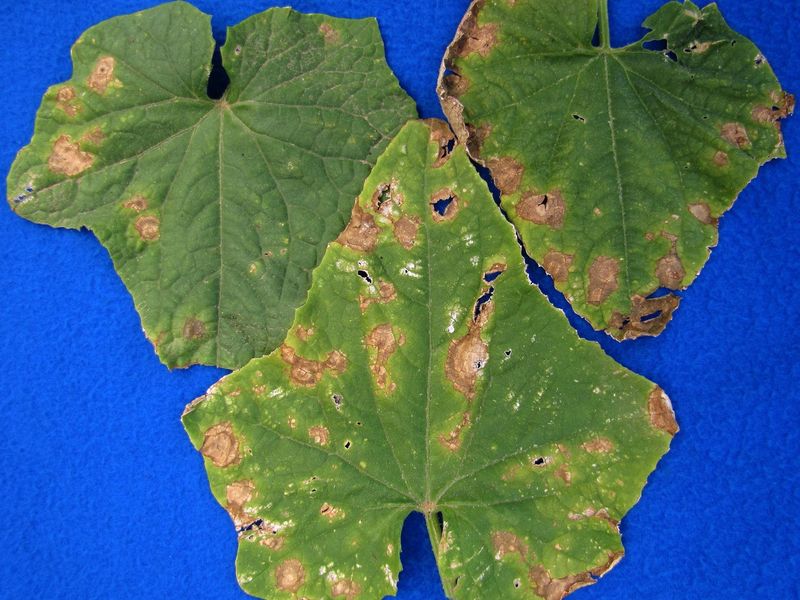
Angular brown spots that seem to follow the lines of leaf veins, ringed by yellow or pale halos, are one of the more recognizable leaf patterns in a cucumber patch. The spots often start as water-soaked, almost translucent patches before they develop brown or tan centers.
Over time they may dry out and crumble away, leaving ragged holes that look almost as if something chewed through the tissue.
That progression, water-soaked start, vein-bounded edges, yellow or brown center, and eventual drying or hole formation, is consistent with suspected angular leaf spot, a bacterial disease historically linked to the pathogen Pseudomonas syringae pv. lachrymans. One additional clue worth checking: University of Minnesota Extension guidance on angular leaf spot notes that wet foliage may show a sticky whitish bacterial exudate on the underside of affected leaves, which can dry into a thin white crust when conditions become drier.
Finding that residue is supportive evidence, but it still does not confirm the diagnosis on its own. University of Illinois Plant Clinic information on angular leaf spot and Virginia Cooperative Extension’s cucumber disease guide both make clear that other diseases and injuries can produce angular or brown lesions that look nearly identical.
Treat the pattern as a strong starting point for investigation, not a confirmed answer.
Inspect Both Leaf Surfaces for Downy Mildew and Other Look-Alikes
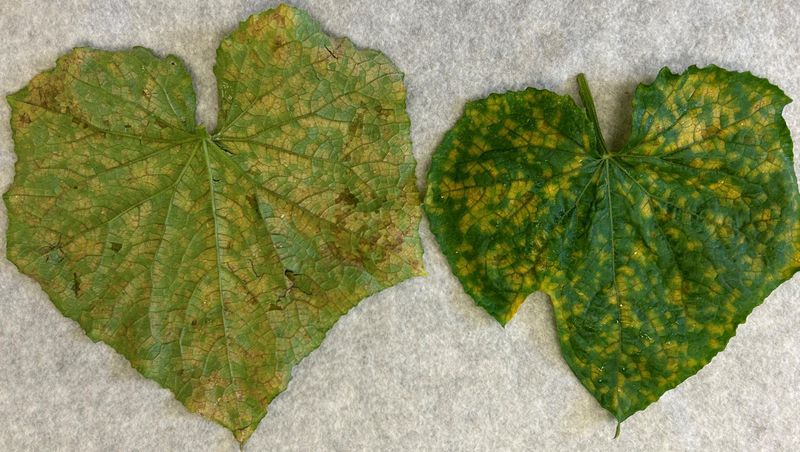
Before you settle on any single diagnosis, flip the leaf over and look carefully at the underside, ideally when the foliage is still wet from morning dew or recent rain. If you suspect angular leaf spot, you are looking for that whitish bacterial residue mentioned above.
What you do not want to find is a gray, purple, or dark fuzzy growth covering the tissue beneath the angular yellow or brown patches.
That fuzzy coating is the hallmark of cucurbit downy mildew, and it matters enormously for how you respond. NC State Extension’s cucurbit downy mildew guide explains that downy mildew also produces angular, vein-bounded lesions on the upper surface, making it one of the most common and most easily confused look-alikes for angular leaf spot.
The fuzzy sporulation is most visible in humid conditions or in the early morning before leaves dry.
Downy mildew is a fungal-like disease that requires different management than a bacterial infection, so misidentifying one as the other can lead to ineffective treatment. Cornell’s gallery of cucurbit downy mildew symptoms and imitators illustrates just how closely the two conditions can resemble each other.
Other conditions worth considering include anthracnose, gummy stem blight, scab, other bacterial leaf spots, and even insect feeding injury, all of which can produce angular or irregular brown lesions. As Cornell’s cucumber disease identification key and University of Maryland Extension’s common cucumber problems resource both note, these conditions can be difficult or impossible to distinguish by eye alone.
When you are not certain, your local cooperative extension office or a plant diagnostic lab can provide a more reliable answer.
Late-Summer Heat Does Not Establish the Diagnosis
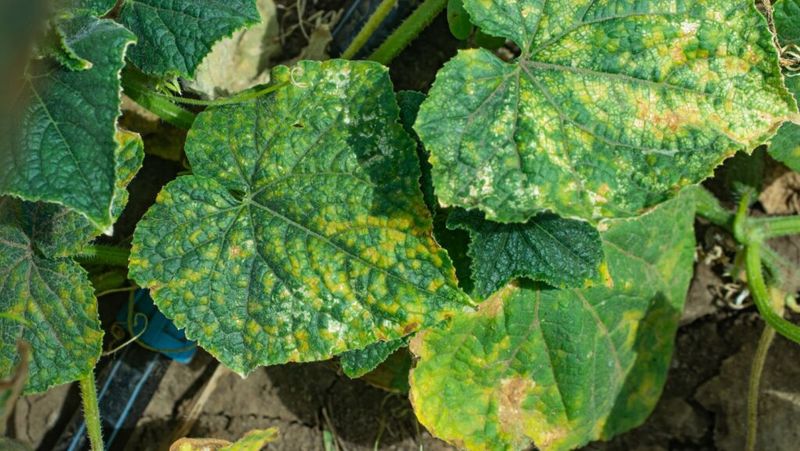
Seeing these spots appear in July or August might make heat feel like the obvious culprit, but that connection is not supported by the disease’s biology. Angular leaf spot is more closely tied to leaf wetness, rain, humidity, and the splashing or handling that moves bacteria from one leaf to the next.
Heat can certainly be present at the same time, but it is not the driver.
UF/IFAS guidance on bacterial leaf spot of cucurbits specifically reports that the disease tends to develop most severely under cool, wet conditions, with notable activity observed below roughly 72.5 degrees Fahrenheit. Iowa State University Extension’s angular leaf spot encyclopedia entry describes favorable ranges around 75 to 82 degrees, and Virginia Cooperative Extension similarly emphasizes wet weather and leaf wetness as the primary risk factors.
The range across sources shows that wet conditions matter more than a specific temperature.
Heat stress on its own tends to look quite different. WSU extension heat stress research and University of Nebraska-Lincoln extension guidance describe heat injury as wilting, curling, scorch, bleaching, sunscald, or shriveling rather than the neatly angular, vein-bounded lesions typical of bacterial disease.
That said, heat stress and disease can occur on the same plant at the same time, which makes sorting out the cause harder.
For gardeners in Florida and Texas, high humidity and summer rain events create conditions that genuinely favor bacterial spread. Texas A&M’s plant disease handbook notes that angular leaf spot can become serious during heavy rains when temperatures remain high.
The risk in those regions is real, but it comes from moisture, not heat alone.
Keep Foliage Dry and Reduce New Spread
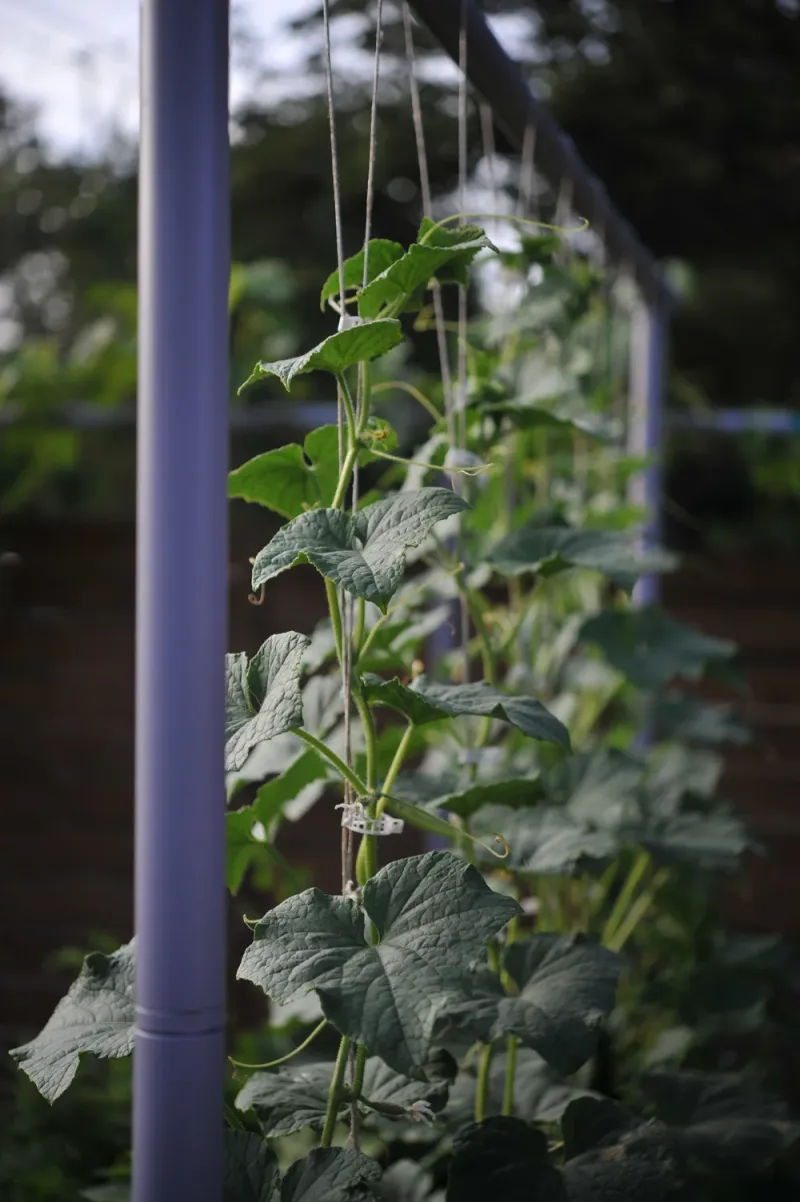
Once you have spotted the symptoms, the most useful thing you can do right away costs nothing and carries no risk of plant injury: stop adding water to the leaves. Overhead watering, whether from a sprinkler or a hand-held hose aimed at the foliage, creates exactly the wet leaf surface that allows bacteria to move and infect new tissue.
Switching to drip irrigation or watering directly at the soil line removes that risk with a single change.
Virginia Cooperative Extension and Washington State University’s HortSense fact sheet on angular leaf spot both advise against working among cucumber plants while foliage is wet. Bacteria travel readily through splashing water, wet hands, and tools that contact symptomatic growth.
After handling any affected leaves, wash your hands and wipe down tools before touching healthy plants.
Beyond irrigation, spacing matters. Plants crowded together trap humidity and stay wet longer after rain.
Trellising cucumbers so vines climb rather than sprawl improves airflow around the foliage and allows leaves to dry faster after rain or morning dew. UC IPM’s home and landscape angular leaf spot page and UF/IFAS both recommend improved spacing and airflow as part of managing this disease.
These steps reduce the chance of new infections spreading across the plant or to neighboring cucurbits, though they cannot reverse lesions that have already formed.
Remove Heavily Affected Material Without Promising a Cure
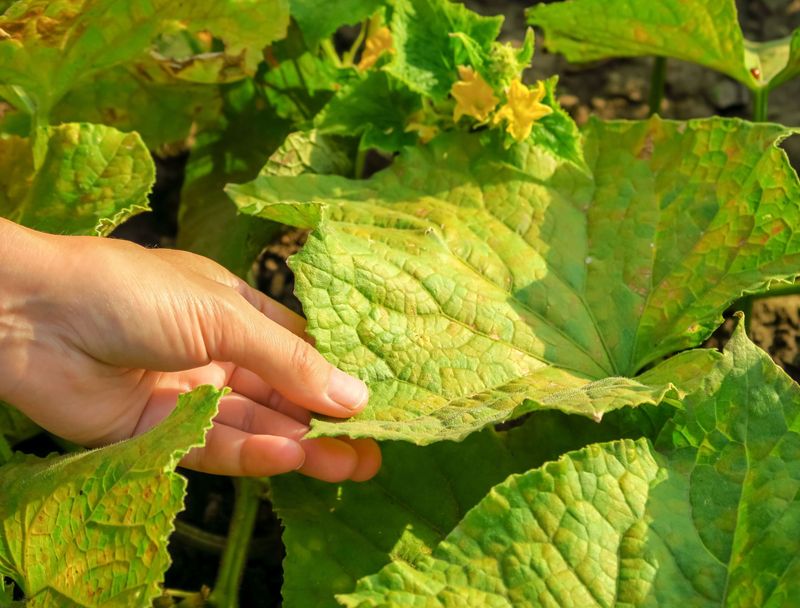
Removing leaves that are heavily covered in lesions is a reasonable step, and it can reduce the amount of bacterial material present on the plant. The key word, though, is reduce.
Sanitation is not a cure, and the distinction matters.
University of Minnesota Extension and Virginia Cooperative Extension both recommend removing heavily infected leaves as part of managing angular leaf spot, but neither source presents removal as a way to eliminate the infection. Bacteria can already be present inside plant tissue that looks healthy, and rain, debris, nearby cucurbits, and even seed can reintroduce the pathogen.
Removing spotted leaves reduces inoculum sources and may slow further spread, but it does not guarantee the plant recovers or that new lesions will not form.
When removing leaves, do it while foliage is dry to avoid spreading bacteria through wet handling. Try to minimize contact between the cut material and healthy growth as you work.
At the end of the season, clear all diseased vines and crop debris from the bed, since UC IPM’s agricultural angular leaf spot page notes that the pathogen can persist in infected plant debris. Follow local disposal guidance for diseased material, as composting infected tissue may not destroy the bacteria.
Whether to remove an entire plant depends on how widespread the infection is, how much healthy growth remains, how close harvest is, and what your local extension office recommends for disposal. There is no universal threshold for that decision, and it is worth getting local input before pulling a plant that may still produce.
Use Copper Only as a Label-Approved Early Protectant
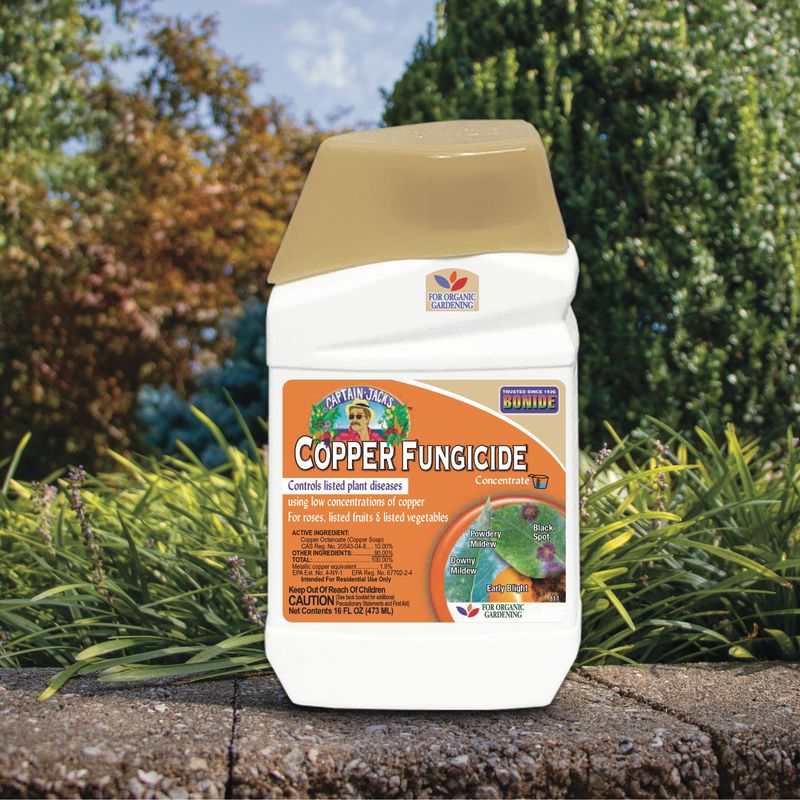
Copper-based products are sometimes used to help manage angular leaf spot, but they come with important limits that are easy to overlook when you are worried about losing a crop. Copper works as a protectant, meaning it is most useful before or in the very early stages of infection, not after disease is already widespread across the plant.
UF/IFAS specifically notes that copper efficacy may be limited when disease is already severe.
Before reaching for any copper product, verify that its current label lists cucumbers as a permitted crop and names the disease you are targeting. Labels vary by formulation, and a product registered for one crop or disease may not be approved for another.
Follow the label’s directions for rate, application interval, reentry period, and preharvest interval without exception. EPA pesticide label documentation illustrates how specific and varied these requirements can be across products.
Copper can injure cucumber foliage, and the risk goes up with repeated applications, high temperatures, or products not suited to the crop. Cornell’s guide to minimizing copper fungicide injury outlines how phytotoxicity develops and how to reduce that risk.
Texas A&M’s plant disease handbook similarly warns that repeated copper applications can cause yellowing or injury in cucurbits.
There is also a diagnostic reason to pause before spraying. Copper targets bacteria and has no useful effect on downy mildew, heat injury, mites, or other non-bacterial causes.
Mississippi State Extension’s cucurbit downy mildew publication and UC IPM’s agricultural angular leaf spot page both reinforce that treating without a confident diagnosis can leave the actual problem unaddressed while adding unnecessary chemical stress to the plant. University of Minnesota Extension also advises using copper only when the diagnosis and label both support it.
Build a Lower-Risk Plan for the Next Crop

Managing angular leaf spot in the current season is mostly about limiting spread. Protecting the next crop is where you have the most control.
Starting with disease-free or pathogen-free seed and transplants is one of the most effective steps available, because the pathogen can persist in infected seed and move into new plantings before the first leaf even unfurls. Virginia Cooperative Extension and Washington State University’s HortSense fact sheet both emphasize clean planting material as a foundational practice.
Resistant cucumber varieties are worth seeking out where they are available. Resistance reduces the likelihood of severe damage, but it does not make a plant immune.
UC IPM’s agricultural angular leaf spot page notes that resistant varieties are a useful tool within a broader management plan, not a replacement for sanitation and other practices.
Some extension programs recommend rotating away from cucurbits for at least two years in beds where angular leaf spot has occurred. University of Minnesota Extension includes this as a recommended practice.
Whether rotation is practical depends on your garden size and layout, and it works best as one part of a broader approach that also includes removing crop debris, sourcing clean seed, and managing irrigation and airflow. Rotation alone, without those companion steps, leaves meaningful gaps in protection.
Carrying the irrigation and trellising habits from this season into the next one also matters. Keeping foliage drier from the start of the season reduces the window during which bacteria can spread, regardless of weather conditions.
Choose Better Diagnosis Before a Blind Spray
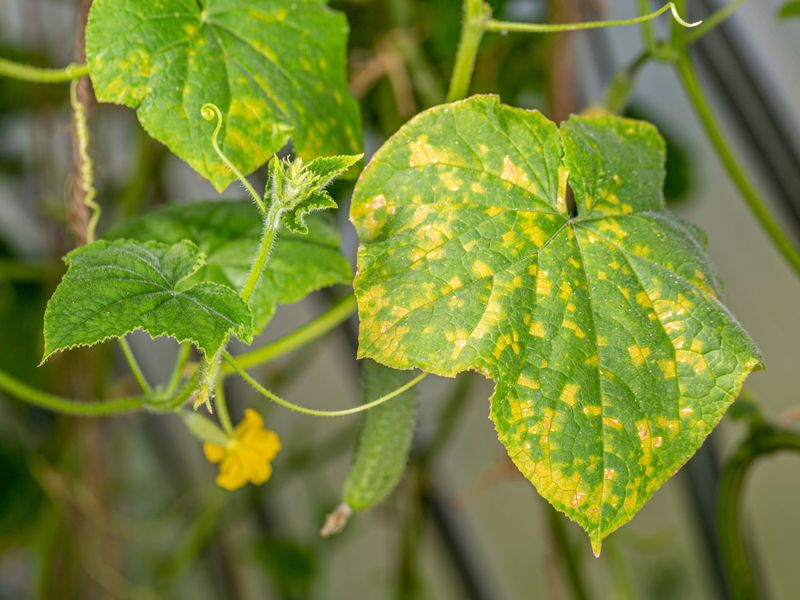
When angular yellow-haloed spots appear on your cucumber leaves, the most useful first move is a careful look at both leaf surfaces before you reach for any product. Check for whitish bacterial residue or a dried crust on the underside to support suspected angular leaf spot, and look for gray or fuzzy sporulation that points toward downy mildew instead.
That single inspection step can save you from treating the wrong problem.
From there, the practical sequence holds: stop overhead watering, clean tools and hands after handling symptomatic growth, remove heavily affected leaves when foliage is dry, and clear debris at season’s end. Consider a labeled early copper protectant only when both the evidence and the product label clearly support it, as UF/IFAS and University of Maryland Extension recommend.
Angular, yellow-haloed spots are a signal worth investigating, not a confirmed verdict. When symptoms stay ambiguous after your own inspection, your local cooperative extension office or a plant diagnostic lab, such as those listed through Cornell’s cucumber disease identification key, can give you a more reliable answer than any visible pattern alone.
A correct diagnosis is always the better starting point for rescue.