
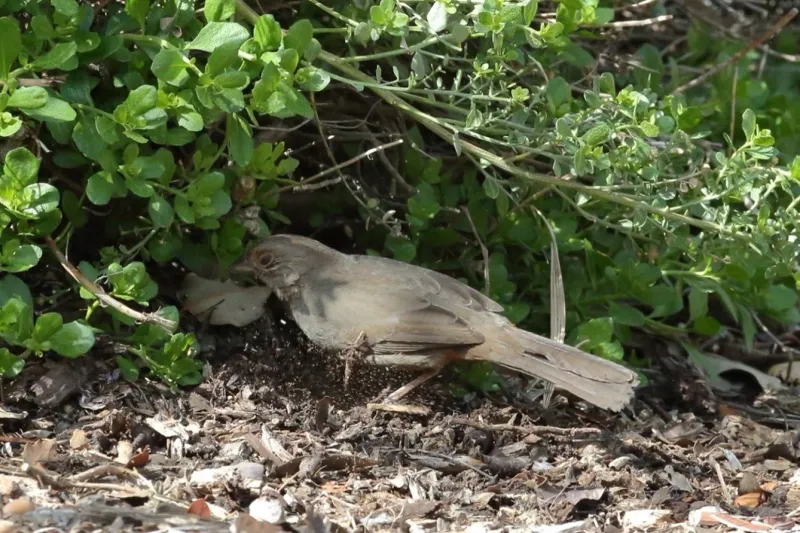
Most California homeowners walk right past one of their yard’s most active ground-level foragers without a second glance. The California Towhee is a plain, unassuming brown bird that spends its days scratching through leaf litter and loose soil, picking up seeds and insects as it goes.
Understanding what this bird is actually doing in your garden makes it easier to support it without giving up good weed management, fire-safe landscaping, or responsible pest control.
Meet the plain brown bird beneath the shrubs
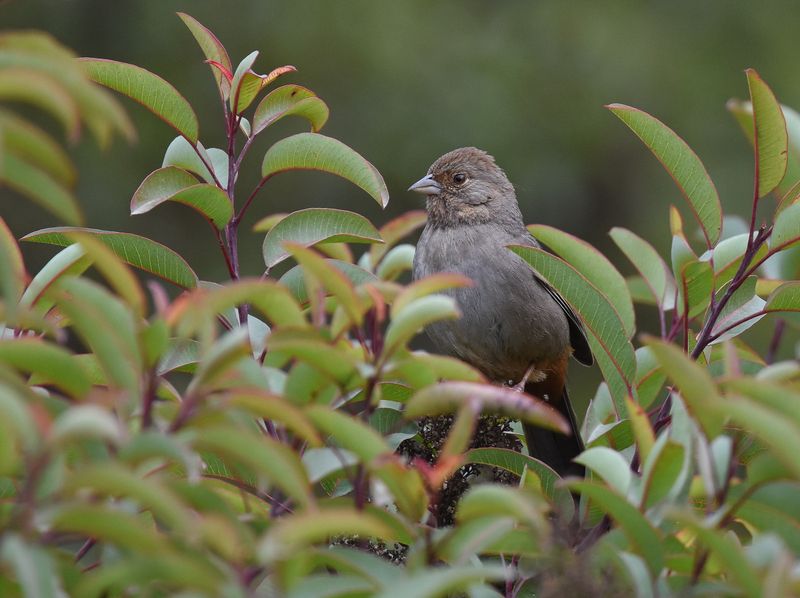
Spend a quiet morning near a dense shrub in almost any California garden, urban park, or patch of coastal scrub, and you may notice a plain brown bird hopping deliberately along the ground. That bird is almost certainly a California Towhee (Melozone crissalis), and it is far more common in California yards than most homeowners realize.
Its unremarkable appearance – uniformly warm brown above, slightly paler below, with a long tail and a faint rusty wash under the tail – means it rarely draws attention the way a bright blue jay or a vivid goldfinch would.
The easiest way to confirm what you are looking at is to listen. Audubon’s California Towhee field guide describes a sharp, metallic “chink” call that the bird uses frequently, often before you see the bird itself.
Watch for movement low in the vegetation, just beneath shrub canopies or along garden borders, and you will eventually spot the source. Once you do, look for the signature behavior: a short, energetic hop followed by both feet kicking backward simultaneously through leaf litter or loose soil.
That two-footed scratch is not random fidgeting. It is a foraging technique the bird uses to flip debris and expose food hiding underneath.
California Towhees use it in brushy chaparral, coastal scrub, riparian edges, and suburban gardens alike. Cornell Lab of Ornithology’s All About Birds guide confirms that this species is centered almost entirely in California and Baja California, with a smaller population in western Oregon.
Readers in Florida or Texas are more likely to encounter Eastern Towhees or Spotted Towhees, whose diets and habitat needs should not be assumed identical to those of the California Towhee. If you live in California and a brown bird is quietly working the ground under your shrubs every morning, there is a reasonable chance you already have a resident pair.
What the scratching is really looking for
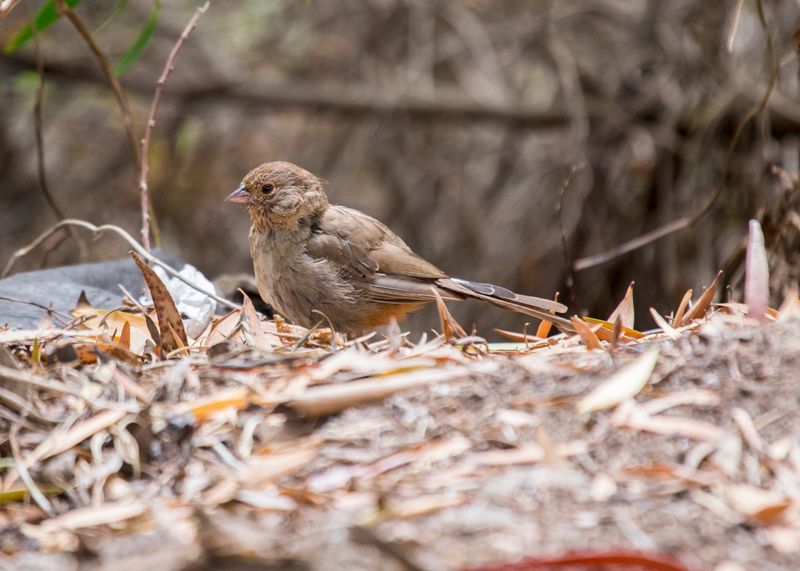
That energetic backward kick serves a single practical purpose: uncovering food that is hidden just below the surface of leaf litter, loose mulch, or bare soil. Audubon’s field guide to the California Towhee documents a broad menu that includes weed and grass seeds, waste grain, insects, berries, and small fruits.
The bird does not filter its scratch zone for items a homeowner would approve of – it is looking for anything edible that the debris layer is hiding.
Weed and grass seeds are genuinely part of that diet. Eating them reduces the number of viable seeds in a small patch of ground, but there is no evidence in the scientific literature that California Towhees provide meaningful or reliable weed suppression across a garden bed.
Scratching is not selective: the bird may consume seeds from plants you want to remove, but it may also disturb freshly seeded areas, expose bare soil to new weed establishment, move seeds to different spots, or consume seeds from desirable native plants nearby. Treating it as a weed-management tool would be a significant overstatement of what the behavior actually accomplishes.
Insects round out the foraging picture. Caterpillars, beetles, ants, and other small arthropods turn up under leaf litter and in loose soil, and the towhee takes what it finds.
Again, the scratch is not targeted at harmful species specifically. A beetle uncovered by a scratch might be a garden pest, a neutral detritivore, or a beneficial predator, and the bird makes no distinction.
The scratching itself can also be mildly disruptive in a well-maintained bed: loose mulch gets tossed aside, soil gets briefly exposed, and a freshly planted area may look rearranged after a towhee visit. Accepting that trade-off is part of sharing ground-level space with this bird.
Their diet changes as the seasons do
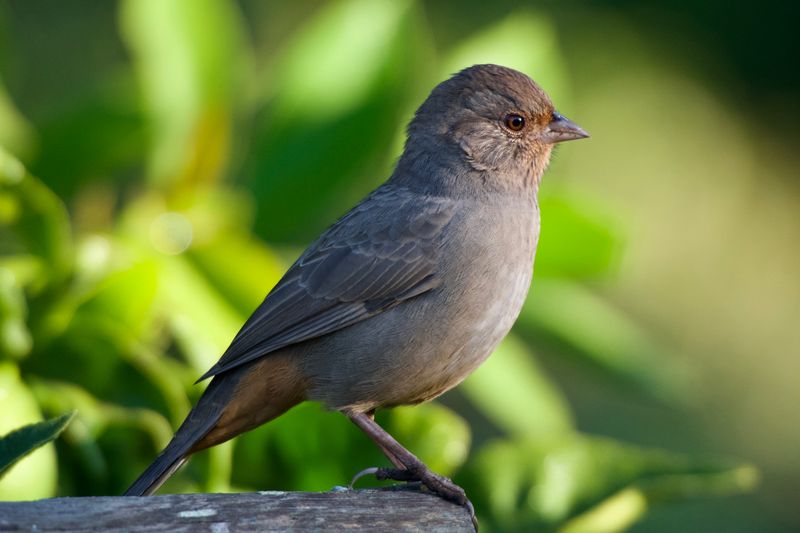
A California Towhee visiting your yard in January is doing something meaningfully different from one visiting in July, even if the scratching behavior looks the same from a distance. Seeds receive the heaviest emphasis during the winter months, when insects are less available and dried grass and weed seeds are abundant on and just below the soil surface.
That is the season when the bird’s foraging comes closest to the seed-eating portrait most people picture.
Summer shifts the balance considerably. Audubon’s California Towhee species account notes that insects become more prominent in the warm-season diet, and that adults feed nestlings mostly or entirely insects.
Protein from arthropods is essential for chick development, so a pair raising young in your yard depends on the insect life your garden supports as much as on any seed source. If your yard has dense shrubs, leaf litter, and minimal broad insecticide use, it is better positioned to supply that protein than a yard that is kept bare and heavily sprayed.
What does this seasonal shift mean for the “pest control” framing that often surrounds ground-foraging birds? Researchers studying birds as biological control agents have found that observing a bird eat a pest insect does not establish that the bird suppresses the pest population, reduces plant damage, or improves garden yields.
A 2020 review published in the Journal of Integrated Pest Management specifically cautions against inferring population-level pest control from diet studies alone. A California Towhee may consume caterpillars or beetle larvae that would otherwise damage plants, and that is genuinely useful – but it is not a replacement for monitoring, hand-removal, or other targeted pest management when a real infestation takes hold.
Keep weeding. Keep watching for pest outbreaks.
Let the towhee forage alongside those efforts, not instead of them.
Create practical habitat without overpromising results
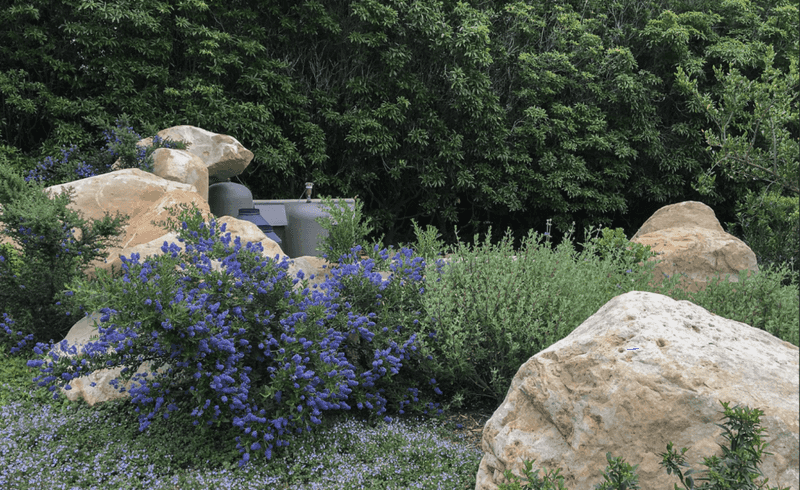
A practical, habitat-based way to support California Towhees is to provide layered native cover – a combination of taller shrubs, shorter shrubs, and low-growing plants that together give the bird places to forage, hide, and nest. The California Native Plant Society’s guide to native plant gardening for birds in Southern California recommends this kind of multi-layer planting because it mimics the brushy chaparral and coastal scrub structure the towhee naturally uses.
Tall shrubs provide canopy cover and nest sites; shorter shrubs and groundcovers create the low-level density the bird moves through while foraging.
For Southern California gardeners, the CNPS guide points to plants like toyon (Heteromeles arbutifoliaFrangula californicaSalvia), coffeeberry (), native sages ( spp.), and various native grasses as useful choices because they produce seeds, berries, or the insect life that supports ground-foraging birds. Gardeners in Northern California, the Central Valley, or inland foothill communities should consult their local CNPS chapter or regional native plant resources, since appropriate species vary considerably by climate zone.
What works along the Southern California coast may not be the right fit for a Sacramento valley yard or a foothill garden at higher elevation.
One important caution applies to every California homeowner, regardless of region. Adding dense shrub cover near a home in a fire-prone area is not a neutral landscaping decision.
California Department of Fish and Wildlife guidance on wildlife and fire acknowledges the tension between habitat value and fire risk, but your primary reference for what is allowed near structures must be your local fire authority, your county’s defensible-space requirements, and any applicable state or local vegetation-management rules. No single wildlife resource supplies a complete statewide fire code.
Check with your local authority before adding dense plantings within or near required clearance zones, and choose plant spacing and species that meet both wildlife and fire-safety goals.
Keep some leaf litter, but manage real weed problems
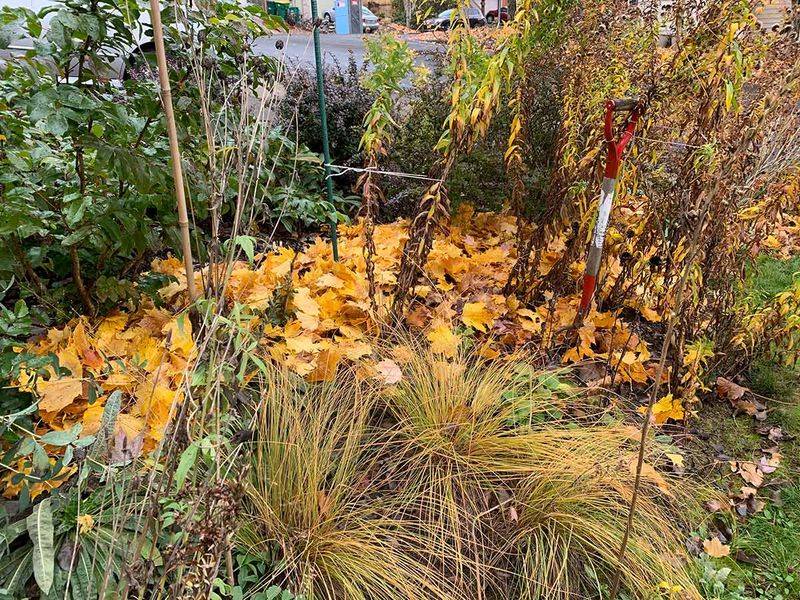
Leaf litter is one of the simplest and most direct things a homeowner can offer a ground-foraging bird. California Towhees scratch through it looking for seeds and insects, and a bed stripped bare by a leaf blower gives them nothing to work with.
The California Native Plant Society specifically identifies retained leaf litter as useful for towhees and other ground-feeding birds, noting that intensive cleanup removes foraging habitat along with the leaves.
Keeping some leaf litter does not mean abandoning bed maintenance. The line to hold is between natural ground cover that supports foraging and actively seeding weeds or confirmed pest reservoirs that are spreading through the bed.
A thin layer of decomposing oak leaves under a native shrub is foraging habitat. A mat of oxalis or annual bluegrass that is setting seed and spreading into adjacent areas is a weed problem that needs to be managed regardless of any bird’s presence.
Pull it, cut it before it sets seed, or cover it with a fresh layer of mulch – do not leave it unmanaged on the theory that a towhee might eat the seeds.
The California Department of Pesticide Regulation’s backyard garden IPM program recommends a step-by-step approach: identify the pest or weed accurately, use physical controls first (hand-pulling, hoeing, mulching), and escalate only when necessary. The DPR’s garden IPM fact sheet reinforces early identification as the most cost-effective intervention, since a small weed population is far easier to manage than an established one.
Applied to towhee-friendly maintenance, the practical routine looks like this: retain leaf litter in areas where it accumulates naturally under shrubs, hand-weed any plants that are actively seeding or spreading, and use targeted physical controls before reaching for any spray. The bird benefits from the litter you keep; your garden benefits from the weeds you remove.
Protect the insect food web before spraying
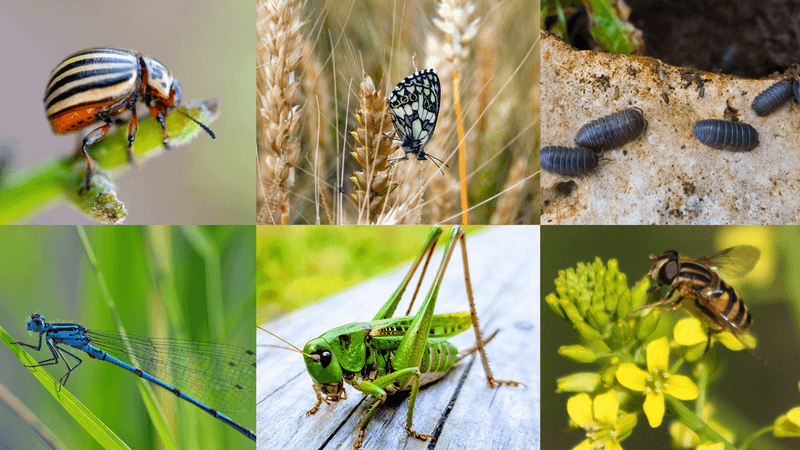
Broad-spectrum insecticides do not distinguish between the caterpillar you want gone and the ground beetle that was hunting it. When a spray eliminates a wide range of arthropods across a bed, it reduces the insect food supply that insect-eating birds, including California Towhees feeding nestlings in summer, depend on.
Audubon’s towhee species account confirms that adults feed young mostly or entirely insects, which makes the summer insect community in your yard directly relevant to whether a nesting pair can raise chicks successfully.
The connection between broad sprays and bird food webs is real, but it should be stated carefully. Minimizing unnecessary broad insecticide applications helps preserve the arthropod community on which insect-eating birds may rely.
That is a supported and practical reason to spray more selectively. What the evidence does not support is a claim that ordinary yard spraying measurably reduces towhee populations or reliably drives the birds away from a yard.
The effect is more diffuse: fewer insects in the soil and litter means less food for ground foragers, which may reduce the yard’s value as foraging habitat over time.
The California Department of Pesticide Regulation’s IPM guidance recommends identifying the specific pest before choosing any treatment, trying physical and cultural controls first, and selecting the least-disruptive product labeled for the identified problem when a chemical control is genuinely necessary. When a pesticide is required, California law now adds an additional consideration for certain products.
California’s neonicotinoid restrictions that took effect January 1, 2025, limit most non-agricultural outdoor uses of neonicotinoids on ornamental plants, turf, and non-production trees to licensed commercial applicators. Backyard fruit and vegetable gardens are treated differently under the law, so the restrictions do not apply uniformly across every use.
If you are unsure whether a product or application falls under the new rules, check directly with the California Department of Pesticide Regulation or a licensed pest control adviser before purchasing or applying.
Make the yard safer than a feeder is attractive
Putting out seed to attract California Towhees is optional, not essential. Cornell Lab’s All About Birds guide notes that the species may visit seed scattered on the ground or offered in low tray feeders, but a habitat-based approach – shrubs, native food plants, insects, and leaf litter – is more sustainable and less risky than routine supplemental feeding.
Feeding stations can attract rodents, concentrate birds in small areas, and create conditions where disease spreads more easily between individuals. If you do choose to scatter seed occasionally, keep the quantity modest and clean up spilled seed regularly to reduce rodent activity.
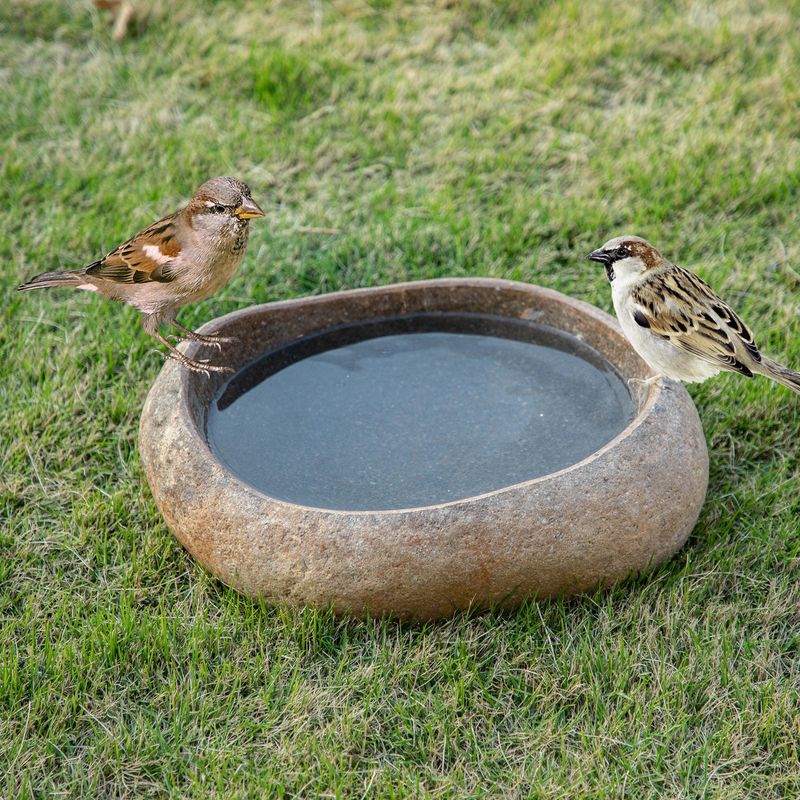
Birdbaths carry similar responsibilities. California Department of Fish and Wildlife’s Wildlife Health Lab notes that pathogens can persist on water, soil, and surfaces at shared wildlife water sources, making regular cleaning and water replacement important for any birdbath or feeding station you maintain.
Scrub the basin every few days, especially during warm weather, and empty standing water completely rather than just topping it off.
Two yard-safety measures offer more direct protection than any feeder setup. First, keep cats indoors or give them access only through an enclosed outdoor structure.
Cats are among the most significant sources of bird mortality in residential areas, and a towhee foraging on open ground is particularly exposed. Second, make large windows and glass doors visible to birds approaching from outside.
Audubon’s guidance on backyard bird hazards recommends exterior screens, closely spaced decals, or other bird-safe treatments applied to the outside surface of glass, where they interrupt the reflection that makes windows invisible to approaching birds. A yard with dense native cover, retained leaf litter, minimal broad spraying, safe windows, and indoor or enclosed cats gives a California Towhee far more than a feeder ever could – and does not require you to give up the garden you already maintain.