
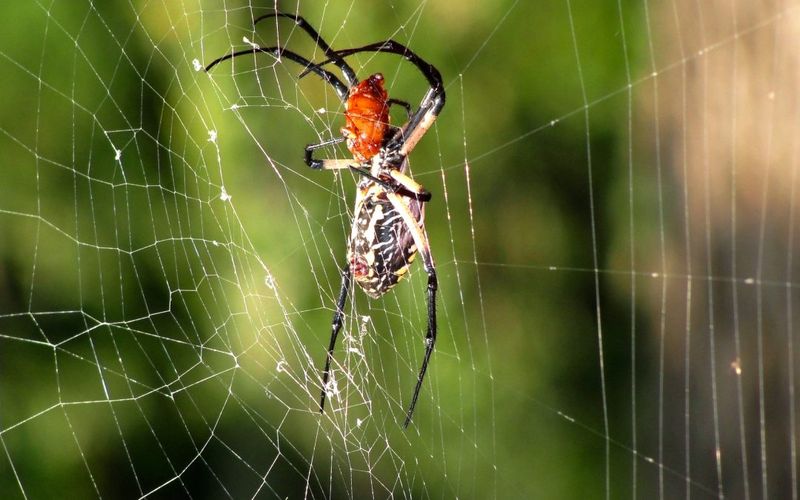
Most California gardeners have squashed a spider in their vegetable bed without thinking twice, not realizing they may have just removed one of their best free pest helpers. Garden spiders are not a single tiny species with a targeted menu; they are a varied group of generalist predators quietly working through whatever insects cross their path.
Understanding what they actually do, and where their limits are, can help you make smarter choices about when to reach for a spray bottle and when to put it back under the sink.
California gardens hold many helpful spider groups
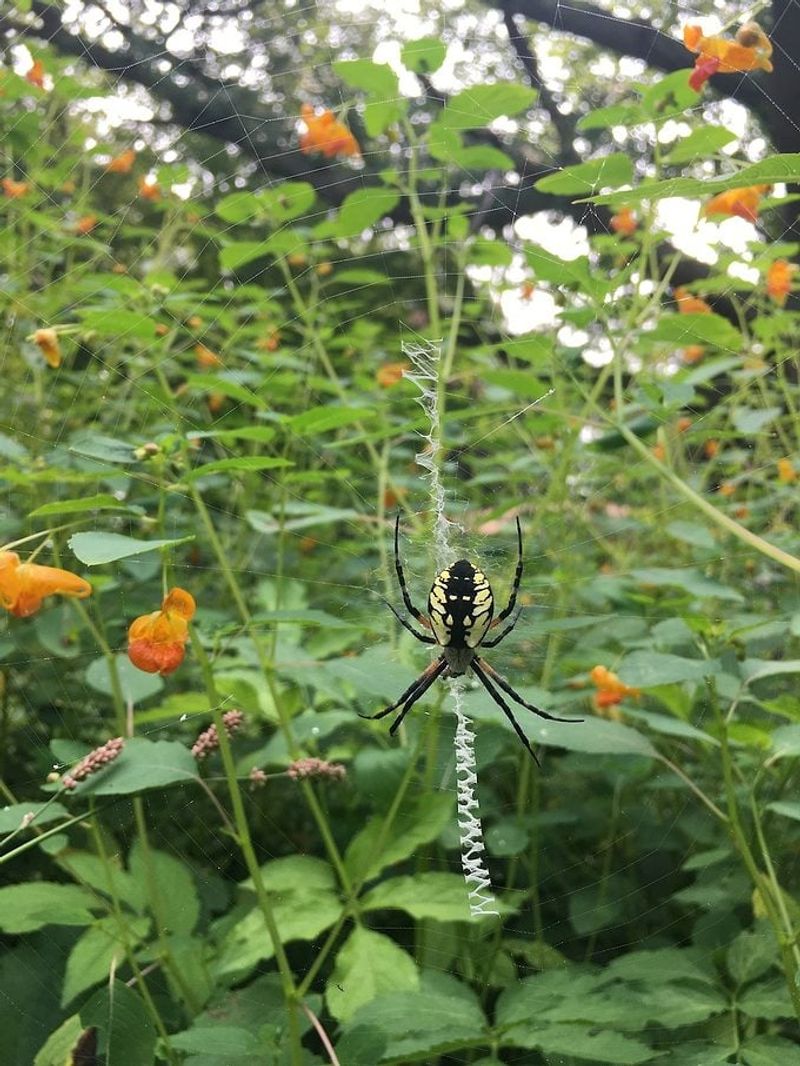
Walk through a California garden bed at dawn and you are almost certainly sharing the space with several different kinds of spiders. Orb weavers build the classic circular, wheel-shaped webs you notice strung between tomato cages or along fence lines.
Jumping spiders, compact and bright-eyed, stalk prey across leaf surfaces without building any web at all.
Wolf spiders hunt along the soil, moving through mulch and ground cover at night. Crab spiders flatten themselves against flower petals and leaves, waiting to ambush visiting insects without moving far.
Each group has a distinct hunting style, but all of them are generalist predators, meaning they eat whatever prey is available and the right size, not a curated list of garden pests.
One thing worth knowing: a spider’s web shape, color, or size alone is not enough to identify its species with confidence. California DPR’s spider best management practices note that appearance can vary widely even within a single spider group, and that accurate identification generally requires close examination of multiple physical features together.
Calling a spider “the tiny garden spider” without more detail does not point to one species.
The practical takeaway for homeowners is straightforward. Ordinary, harmless-looking spiders in low-contact garden areas, such as shrub borders, raised beds, fence lines, and porch planters, are worth leaving alone.
UC IPM’s guidance on natural enemies recommends conserving beneficial predators rather than removing them automatically. That does not mean inviting every spider into high-traffic spaces; use common sense about where spiders are likely to come into contact with people, especially children.
Spiders can catch aphids, but they do not run a targeted pest service
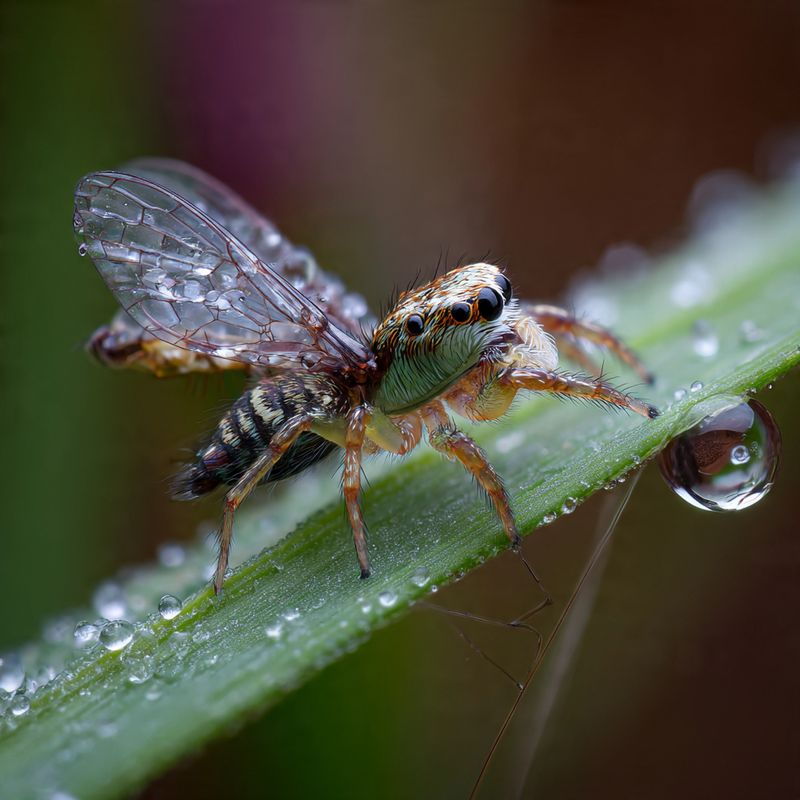
Spiders eat what they can catch, and that menu is wider than most gardeners expect. Depending on the species and the season, a single spider may consume aphids, fungus gnats, leafhoppers, small caterpillars, beetles, flies, and even other spiders.
The mix depends heavily on which insects are moving through the garden and whether they happen to land in or near the spider’s hunting zone.
There is real evidence that aphids show up regularly in spider diets. A field study of orb-weaving spiders in Texas cotton found that aphids made up between 34.6% and 90% of the prey recorded across five spider species, with smaller web-building species capturing the highest proportions.
That is a meaningful data point, but it comes from an agricultural setting in Texas, not from a California home garden trial. The numbers show that aphids can be a significant part of an orb weaver’s diet under the right conditions, not that any spider in your yard will clear an aphid colony on command.
Web placement and structure shape what gets caught. An orb weaver strung between two tomato plants will intercept whatever flies or drifts through that gap.
Research on tropical orb-weaving spiders confirms that prey composition varies by species, web architecture, and local insect abundance, meaning the same web in two different garden spots can yield very different results. A web is not a filter tuned to aphids; it is more like a passive trap that catches whatever happens to be moving.
Jumping spiders and wolf spiders add a different dimension. Because they hunt actively, they can pursue prey on leaf surfaces and in ground cover where webs would never reach.
Still, UC IPM describes spiders broadly as generalist natural enemies, not as aphid specialists, and that distinction matters when you are deciding whether a spider sighting is a reason to cancel your pest-management plan.
Whiteflies require a more cautious interpretation
Aphid predation by spiders has solid field evidence behind it. Whitefly control is a different story, and it is worth separating the two rather than treating them as equally supported claims.
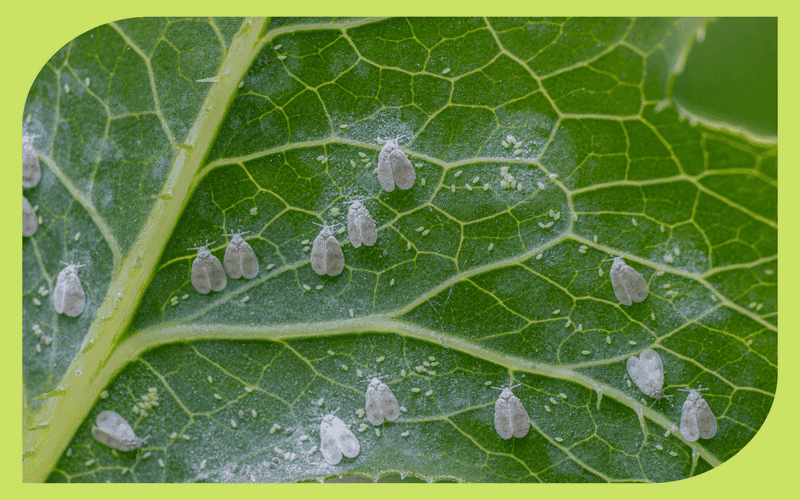
Spiders may occasionally capture adult whiteflies, which are small, flying insects that a web or an active hunter could intercept. The problem is that flying adults are only part of the whitefly picture.
UC IPM’s whitefly guidance explains that nymphs, the immobile scale-like juveniles feeding on leaf undersides, cause much of the plant damage. Nymphs do not fly into webs, and they are not easy prey for most hunting spiders.
A spider catching a few adults near the top of a squash plant does not address the nymph population packed onto the leaf undersides below.
UC IPM identifies several natural enemies with better-documented roles against whiteflies than spiders hold. Parasitoid wasps lay eggs inside whitefly nymphs and are often the most effective biological check on whitefly populations.
Lacewings, lady beetles, minute pirate bugs, and bigeyed bugs also appear consistently in authoritative whitefly guidance as significant predators. Spiders are listed among generalist natural enemies, but they are not highlighted as primary whitefly controllers.
For a homeowner watching whitefly numbers climb on a pepper or tomato plant, the practical response is to monitor both adults and nymphs on leaf undersides, note whether the population is growing or holding steady, and look for signs that parasitoid wasps or other natural enemies are already present. Yellow, dried-out, or blackened nymphs can indicate parasitism.
Acting on a spider sighting alone, either by protecting the spider or by assuming the spider is handling the problem, skips the inspection step that actually tells you what is happening on the plant.
Use spiders as one part of integrated pest management

Spiders are genuinely useful garden residents, but useful is not the same as sufficient. UC IPM’s biological control materials are direct on this point: spiders are helpful general predators present in most gardens, but they alone rarely control pests.
Accepting that limit does not mean spiders are worthless; it means they work best when supported by a broader management approach rather than being treated as a standalone solution.
Integrated pest management, or IPM, asks you to start with observation before taking action. When you spot aphids or whiteflies, the first step is to identify the pest accurately and inspect the plant for actual damage.
A few aphids on a healthy, established shrub may not require any response at all. UC IPM’s aphid guidance notes that established plants often tolerate light to moderate aphid populations, and that natural enemies, including parasitic wasps, lady beetles, lacewings, syrphid fly larvae, and spiders, may bring numbers down without any intervention from you.
The calculus shifts when populations are growing fast, when the plant is young or already stressed, or when the pest can transmit a plant disease. Whiteflies can vector plant pathogens in some situations, which means a “wait and see” approach has real limits in certain edible and ornamental gardens.
The guidance in this article applies primarily to outdoor home gardens with ordinary ornamental and edible plants. It does not automatically transfer to commercial production, severe infestations, indoor pest problems, or cases where a disease-transmitting pest population is actively expanding.
Monitoring is the bridge between observation and action. Check the same plants every few days, note whether pest numbers are rising or falling, and look for signs of natural enemy activity before deciding that intervention is necessary.
That habit, more than any single product or beneficial organism, is what UC IPM describes as the foundation of integrated pest management.
Start with water, monitoring, and ant management
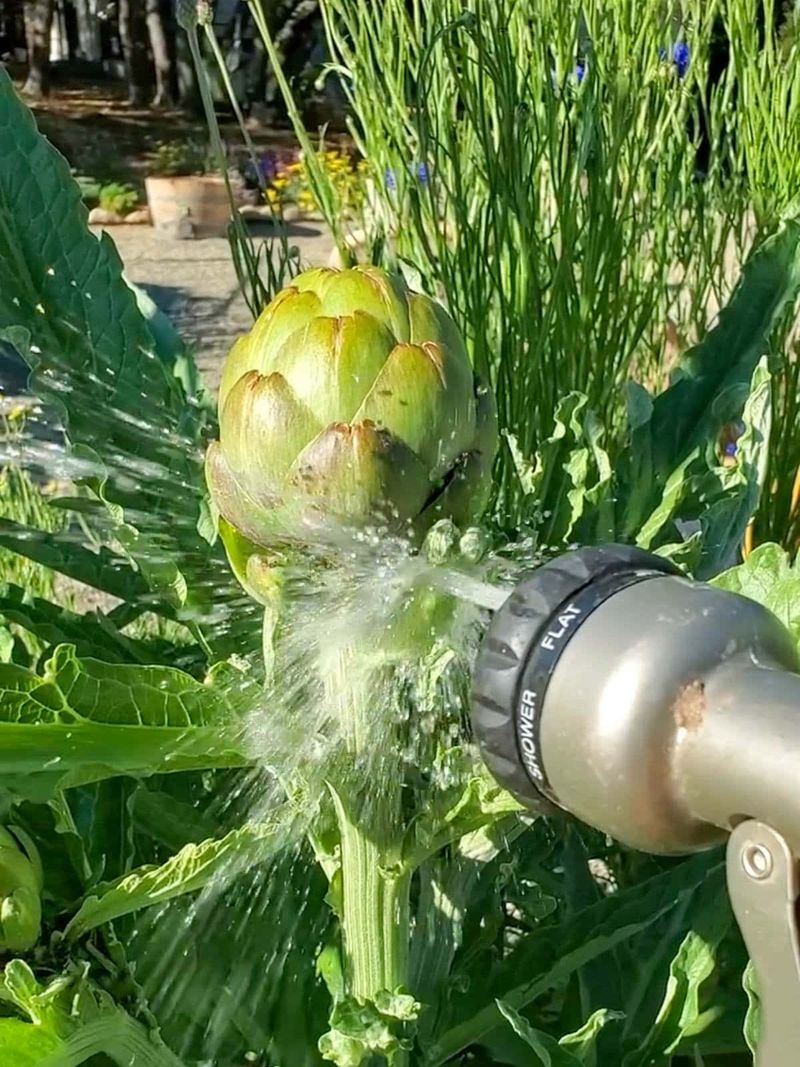
Before reaching for any product, there are low-disruption steps worth trying for a minor or developing infestation. Start by flipping leaves over and actually looking at what is there.
Aphids and whitefly nymphs cluster on the undersides of leaves, and a quick inspection tells you whether you are dealing with a handful of insects or a serious buildup.
A strong stream of plain water from a garden hose can dislodge aphids and adult whiteflies from sturdy plants. UC IPM’s aphid guidance recommends directing water at the undersides of leaves where the insects are feeding.
Many aphids that fall to the ground cannot climb back up efficiently, which makes water a surprisingly effective first response on plants that can handle the pressure. The key word is repeat: one spray-down rarely solves the problem, so follow up with inspections every few days to see whether numbers are dropping or rebounding.
Ants are a factor that many gardeners overlook entirely. Ants actively protect aphid and whitefly colonies in exchange for the sticky honeydew those insects produce.
They chase away or kill predators and parasitoids that would otherwise reduce pest numbers. UC IPM’s natural enemies guidance identifies ant management as part of supporting biological control, because keeping ants off infested plants gives spiders, lacewings, lady beetles, and parasitoid wasps a better chance to work.
Practical ant management on garden plants includes using a sticky barrier product on the trunk or stem of trees and woody shrubs, trimming branches that touch fences or structures ants can use as bridges, and keeping mulch pulled back from the base of plants where ant colonies establish. UC IPM’s whitefly resource reinforces that controlling ants is a meaningful part of whitefly management, not a side note.
Address the ant problem first and you may find that the beneficial insects you already have in the garden become noticeably more effective.
Choose treatment methods that limit collateral damage
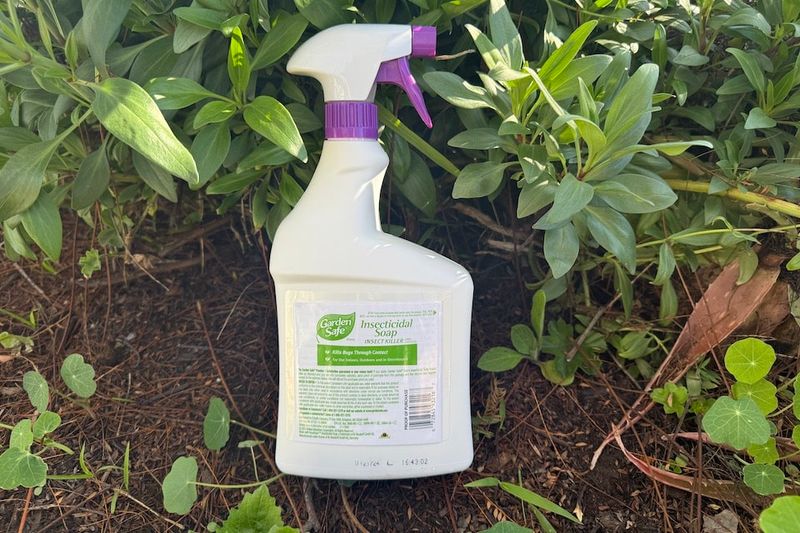
Not all pesticide treatments carry the same risk to garden wildlife, and treating every spray as equally harmful gets the science wrong. The active ingredient, formulation, timing, application method, and the organisms present all shape the actual outcome.
That said, some products are substantially more disruptive than others, and that distinction matters when you are trying to preserve the spiders and other beneficial organisms already working in your garden.
Broad-spectrum insecticides, including pyrethroids and some other conventional materials, can kill spiders, parasitoid wasps, lacewings, and other natural enemies on contact or through residual exposure. UC IPM’s whitefly guidance specifically warns that insecticide disruption of natural enemies can trigger whitefly outbreaks rather than control them, because the pest population recovers faster than the predator and parasitoid community does.
Reaching for a broad-spectrum product at the first sign of whiteflies can make the problem worse over the following weeks.
Insecticidal soaps and horticultural oils are sometimes presented as the safer alternative, and they are comparatively less disruptive to beneficial organisms that are not directly contacted. However, they are not harmless.
Both products work by direct contact, which means thorough coverage of infested leaf surfaces, especially undersides, is required for any effect. They may need to be applied more than once.
Neem-based products carry similar requirements and caveats.
Applying soaps or oils to plants that are already drought-stressed can cause additional injury to the plant itself. UC IPM advises using these products only when plants are adequately watered and, for whitefly management specifically, only when temperatures are below 90 degrees Fahrenheit.
At higher temperatures, the risk of leaf burn increases significantly. A UC IPM guide to choosing less-toxic pest-control products reinforces that the product label is always the controlling document, because formulations and concentration levels vary between brands.
Read the label for the specific product in your hand, not a general description of the ingredient category.
Tolerate ordinary garden spiders, but put safety first
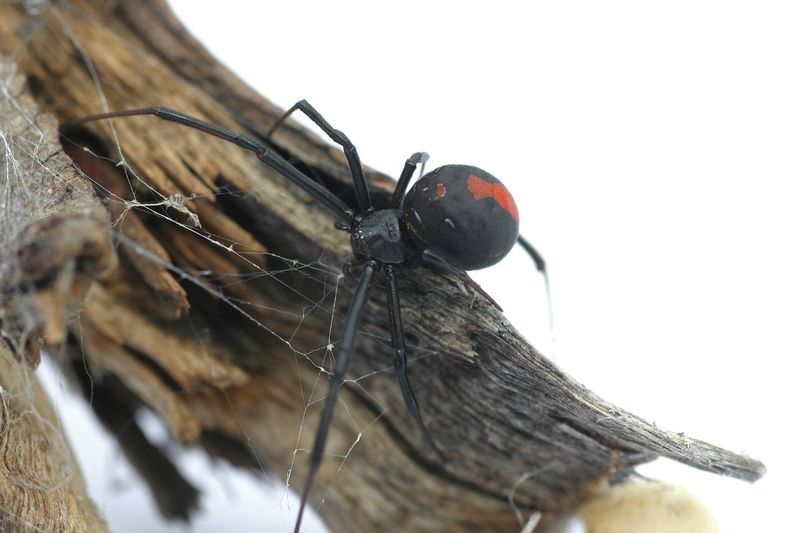
Leaving ordinary garden spiders alone in low-contact areas is a reasonable, evidence-supported habit for California homeowners. Beds, shrub borders, fence lines, and porch planters are good candidates for a live-and-let-live approach.
UC IPM recommends conserving natural enemies, and spiders are part of that community even if they are not a guaranteed fix for any specific pest.
Safety is a real consideration, though, and it should not be glossed over. California DPR identifies the western black widow as the state’s most medically significant common spider.
Female black widows favor dark, undisturbed spaces, including wood piles, under patio furniture, inside garden sheds, and along foundation walls. They are not aggressive, but a bite can cause serious symptoms and requires medical attention.
Do not handle unfamiliar spiders, and teach children the same rule. Identification should come before any hands-on contact with a spider you cannot recognize confidently.
The usable rule for most California home gardens is this: preserve the ordinary spiders you find in planting beds and on shrubs, monitor your aphid and whitefly populations on a regular schedule, and act proportionately when plant damage crosses a threshold that warrants treatment. Spiders are one supporting thread in a larger web of natural controls, and a garden that makes room for them, along with parasitoid wasps, lacewings, and lady beetles, is harder for pest populations to overwhelm than one scrubbed clean of every crawling thing.