
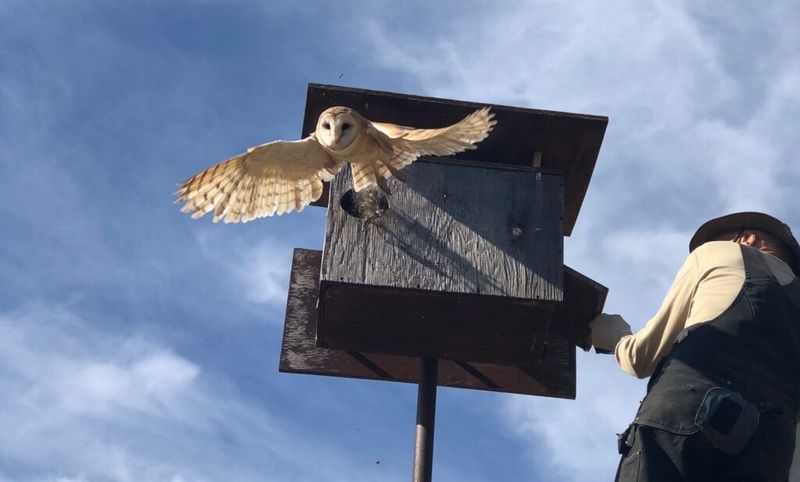
Barn owls are one of California’s most effective nocturnal hunters, quietly patrolling open fields and vineyard edges in search of small mammals. A properly designed nest box can give a local pair a place to raise young, and California research suggests that may support some reduction in rodent activity under the right conditions.
But the results depend heavily on habitat, species, and site, and no box guarantees that your rats or gophers will disappear. Here is what the evidence actually shows, and how to give a nest box its best realistic chance.
A nest box may help some rodent problems—but it cannot promise eradication
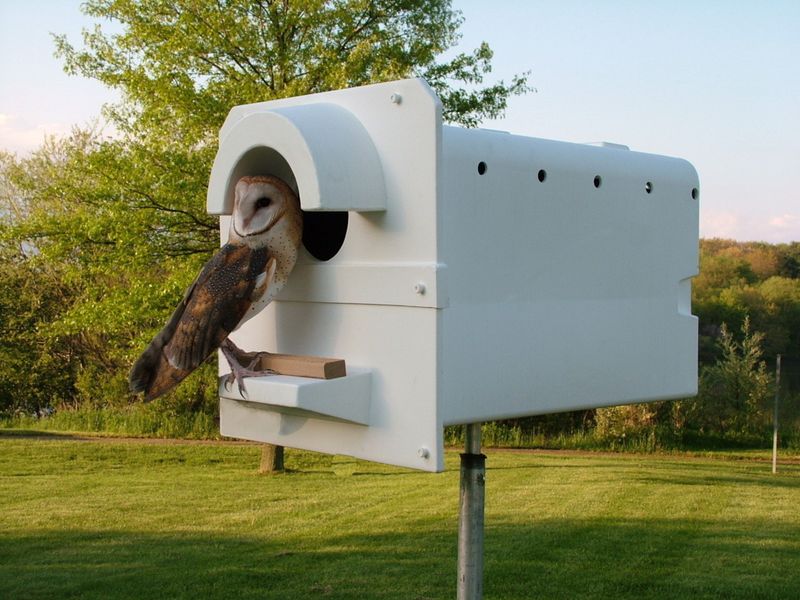
Barn owls are genuine predators of small mammals. Cornell Lab’s barn owl life history confirms they routinely take rats, mice, voles, and pocket gophers, along with occasional shrews and rabbits.
What they eat, though, is not the same as what disappears from your yard, and that distinction matters a great deal before you invest in a nest box.
The strongest California evidence comes from wine-grape vineyards in Napa Valley. A Napa vineyard study by Hansen and Johnson found that pocket-gopher activity declined during periods of peak owl hunting pressure near occupied boxes, while mouse declines were not significantly attributable to the boxes.
Vole results were inconclusive. A follow-up study found that effects on rodent activity and perceived predation risk varied with surrounding vegetation cover, meaning the same box in two different settings could produce meaningfully different outcomes.
Those findings come from open agricultural landscapes, not from small enclosed suburban backyards. A box placed in a dense residential lot with limited hunting range, few natural corridors, and bright artificial lighting is a very different situation from a vineyard edge bordered by grassland and riparian habitat.
Translating vineyard results directly to a home garden overstates what the research supports.
One more distinction is worth holding onto: prey delivered to chicks is not the same as rodents removed from your property. A ScienceDirect study on prey delivery in vineyard barn owls found each chick received roughly 191 prey items before fledging, which sounds impressive but tells you about chick nutrition, not about whether the rodent population on a specific parcel stayed below damaging levels.
Predators rarely eliminate every individual, and remaining animals can repopulate quickly.
Barn owls also are not silent partners once a nest is active. NestWatch notes that hungry nestlings can produce substantial noise at night, so “quietly” is not an accurate description of an occupied box near a bedroom or patio.
A realistic picture of what a nest box can do starts with accepting those limits.
Check whether your property offers usable owl habitat
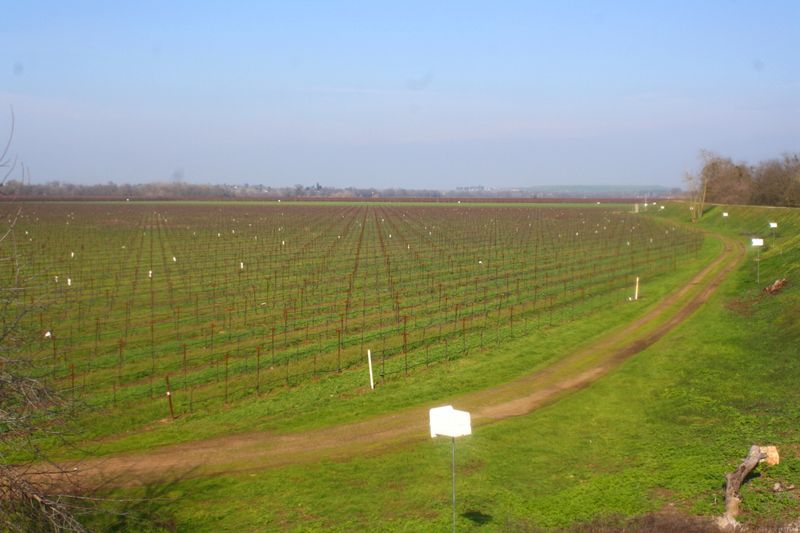
Before buying lumber or ordering a pre-built box, spend some time looking honestly at what your property offers a hunting owl. California research found that barn owls strongly preferred nest boxes associated with nearby grassland, mixed forest, and riparian habitat.
A multi-scale nest-box selection study in Napa Valley vineyards found that wooden boxes in open landscapes were meaningfully more likely to be occupied than boxes surrounded by dense development. That pattern reflects what owls need to hunt effectively, not just where they will sleep.
Translate that research into a practical checklist for your site. Useful properties tend to have open ground for low-altitude hunting flights, nearby natural habitat that supports a prey base, minimal light pollution, and distance from busy roads and loud machinery.
UC Cooperative Extension guidance on barn owl nest box installation recommends placing boxes in open areas with natural habitat nearby, away from sources of disturbance that could interrupt hunting or nesting.
Rural-edge properties, foothill lots bordering open space, and larger parcels near vineyards or rangelands are better candidates than small lots hemmed in by fences, structures, and pavement on every side. UC IPM’s vole management guidance notes that barn owl box networks may be more appropriate in larger areas of open habitat such as parks or grasslands, outside or on the outskirts of cities, which is a significant qualification for any homeowner expecting yard-scale results.
Colonization is also rarely immediate. UC Cooperative Extension material indicates that a box may go unoccupied for two to three years depending on location and local owl population density.
Seeing an empty box for one season does not mean the site is unsuitable. Patience and realistic expectations are part of the commitment.
Build or buy a box suited to barn owl nesting
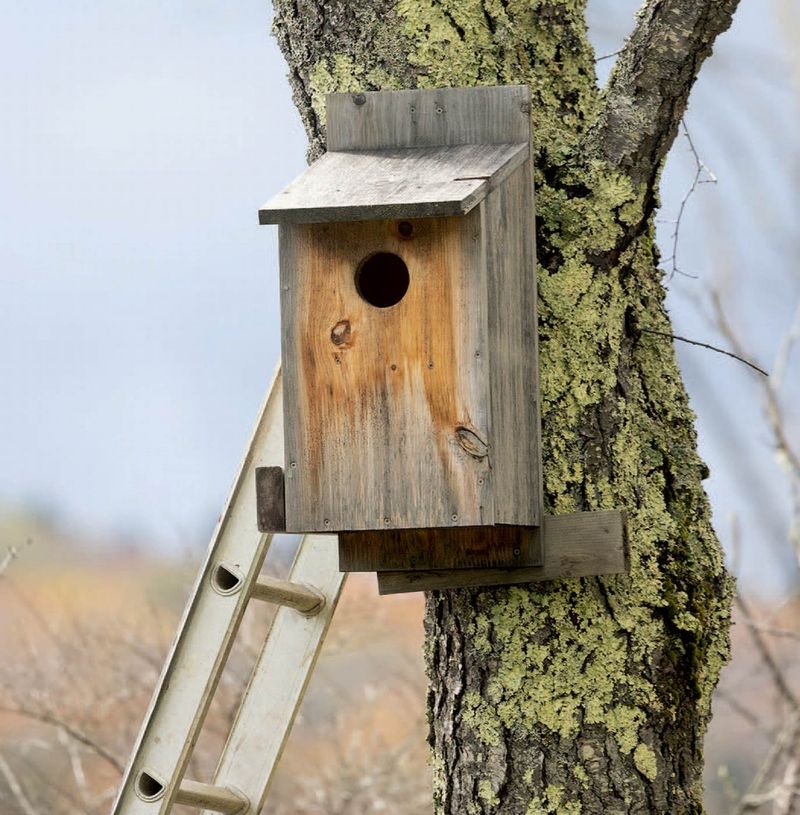
Barn owls will not nest in just any cavity. The box needs to match the bird’s size, behavior, and nesting habits, and cutting corners on construction can leave a box that sits empty or, worse, one that traps heat or lets predators in.
Start with untreated, durable wood such as exterior-grade plywood or rough-sawn cedar. Treated lumber and interior plywood can off-gas chemicals that harm eggs and chicks.
Cornell Lab’s NestWatch barn owl specifications cite an entrance opening of approximately 4.5 inches and a placement range of roughly 8 to 25 feet above the ground. Those figures represent a widely used design baseline, but local conditions and extension recommendations may call for adjustments, so check with your county UC Cooperative Extension office if you are unsure which dimensions suit your area.
The entrance should have no external perch, which would give predators a foothold and is unnecessary for a species that lands directly at the opening.
Ventilation and drainage are non-negotiable. A box that heats up on a warm California afternoon or pools water after rain can kill eggs or chicks.
Drill small vent holes near the top and drainage holes in the floor. The interior floor should be rough or lined with wood shavings to give eggs and owlets traction.
UC ANR’s barn owl nest box plans provide tested dimensions and construction details that have been field-checked in California conditions.
Siting the box away from bedrooms, patios, bright security lights, busy roads, and loud equipment is part of good construction planning, not an afterthought. California Department of Pesticide Regulation guidance on owl boxes for biological pest management echoes those placement criteria.
Sound construction and appropriate siting create an opportunity for nesting. They do not guarantee that owls will arrive or that any rodent population will decline.
Mount the box to block climbing and jumping predators
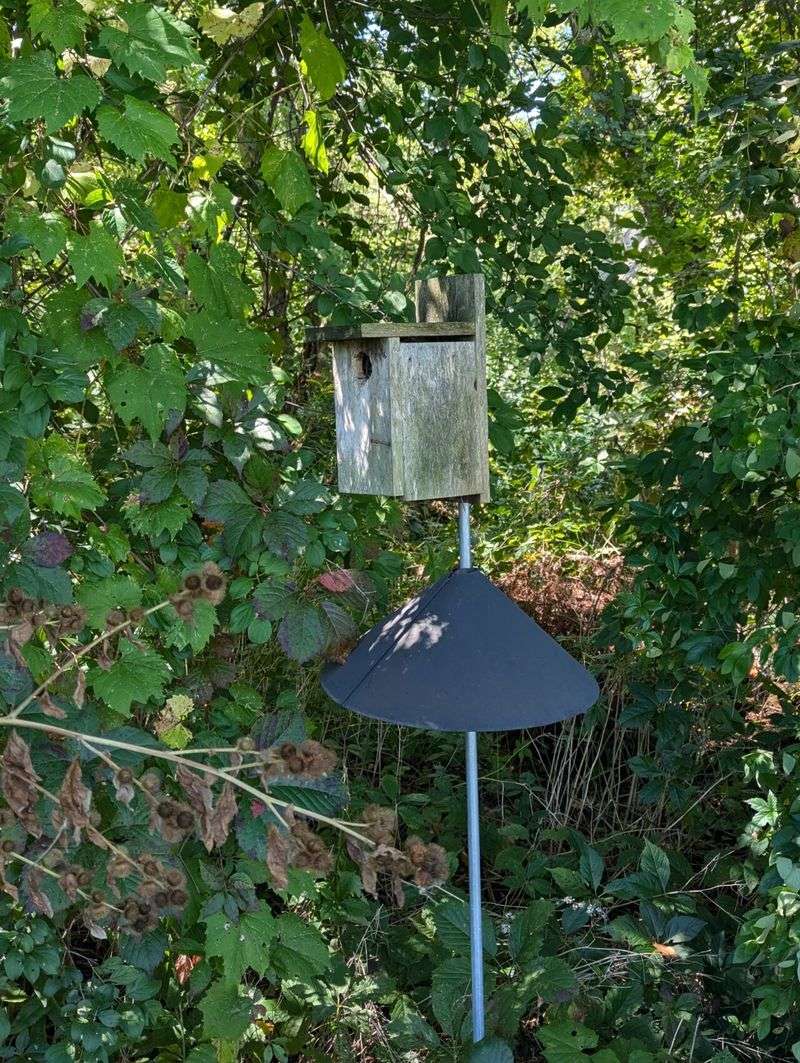
A well-built box mounted on a climbable surface is an invitation to predators. Raccoons, rat snakes, opossums, and domestic cats can scale rough wooden posts and tree trunks with little effort, and a box that owls cannot safely use is worse than no box at all.
The solution recommended by wildlife-nesting authorities is a smooth metal pole paired with a cone-shaped or cylindrical predator baffle positioned below the box.
NestWatch’s pole installation guidance explains that a metal pole makes climbing far more difficult than wood, and a properly fitted baffle closes off the remaining gap. The baffle needs to be large enough that a raccoon cannot reach around it, and it should be positioned high enough that a jumping animal cannot bypass it from the ground.
Nearby branches, fence tops, rooflines, and utility lines are just as dangerous as the pole itself. Keep all of those potential launch points well clear of the box entrance.
Height matters for both safety and function. California DPR guidance on owl boxes generally recommends placement at roughly 9 to 12 feet or higher, balancing accessibility for monitoring with enough elevation to discourage ground-based predators and give owls an unobstructed flight path to the entrance.
The front of the box should face open space rather than a wall or dense vegetation so incoming owls can approach without maneuvering through obstacles.
Placement also affects your household. Nestlings can be loud at night, so a box mounted directly beside a bedroom window or over a frequently used patio may create more disruption than expected.
NestWatch’s predator management resource reinforces that a functioning nest site requires safe access, suitable habitat, prey availability, and minimal disturbance from both predators and people. A quick box swap is not the same thing.
Improve the surrounding habitat without baiting wildlife
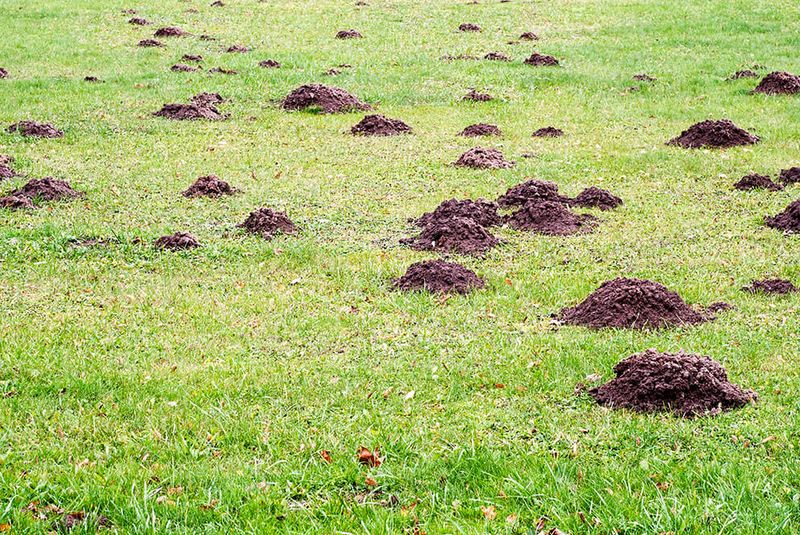
A nest box gives owls a place to raise young, but it does not give them a reason to stay if the surrounding habitat is degraded or if rodent food sources are so abundant that the pest population keeps rebounding faster than any predator can track. Sanitation and habitat management are the unglamorous side of rodent control, and they matter whether or not you ever put up a box.
Start by eliminating easy food sources. Secure garbage cans with tight-fitting lids, bring in pet food before dark, store birdseed in sealed metal containers, manage compost so it does not become an open buffet, and pick up fallen fruit promptly.
Reducing dense ground cover and debris piles near your home’s foundation removes the shelter rodents use to move undetected. UC IPM’s vole management page walks through habitat modification as a core management step, noting that predators generally cannot hold rodent populations below damaging levels on their own when food and cover remain plentiful.
Before choosing any control approach, identify which animal you actually have. Rats, house mice, voles, and pocket gophers cause different types of damage, respond to different controls, and are not all equally affected by nest-box programs.
A California study evaluating barn owls as gopher control found limited evidence of effective gopher suppression in some vineyard and orchard settings and recommended integrating barn owl programs with other management methods rather than relying on them alone. The research does not establish equivalent nest-box control across all four species.
Adding live rodents, poisoned bait, or other attractants to lure owls is unsafe and unsupported by any credible source. Cornell Lab’s barn owl life history confirms that owls are attracted by suitable nesting habitat and a natural prey base, not by supplemental feeding.
Baiting risks habituating wildlife, exposing owls and pets to toxins, and creating sanitation problems that make the underlying rodent issue worse.
Keep rodenticides away from owls and their prey
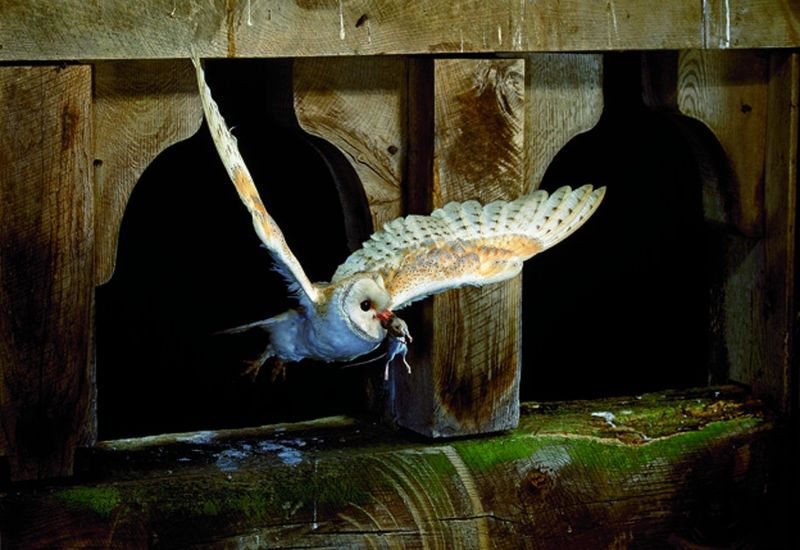
Rodenticide use near an occupied or intended owl box is one of the clearest ways to undermine the whole point of putting up the structure. The risk is not just direct contact.
An owl can absorb a lethal or sublethal dose of anticoagulant rodenticide by eating a rat or mouse that consumed bait somewhere else on the property, or even on a neighboring parcel. That pathway is called secondary poisoning, and it is well documented in California raptors.
California Department of Fish and Wildlife’s Wildlife Health Lab avian investigations have documented fatal anticoagulant poisoning in predatory birds, including barn owls, through exactly this route. The assumption that using poison farther from the box makes it safe for owls does not hold when those owls are actively hunting across a wide area and consuming whatever they catch.
Cornell Lab’s barn owl profile flags rodenticide exposure as a significant threat to the species.
The research also does not support the claim that nest boxes outperform traps or other control methods in residential settings. One older California study found limited evidence of effective gopher control from barn owl programs and recommended further research and integration with other methods.
Traps, exclusion, and habitat modification remain the most reliable tools for homeowners dealing with rats or gophers in a confined yard, and they carry no secondary-poisoning risk.
A responsible integrated approach starts with accurate pest identification, then moves to sanitation and habitat changes, then to physical controls such as snap traps or exclusion hardware, with rodenticides considered only as a last resort and only in formulations and placements that minimize wildlife exposure. UC IPM’s vole management guidance models that kind of layered, wildlife-aware approach and provides species-specific control options.
A nest box fits into that framework as one supporting tool, not as a replacement for the rest of it.
Maintain the box only during a confirmed non-nesting period
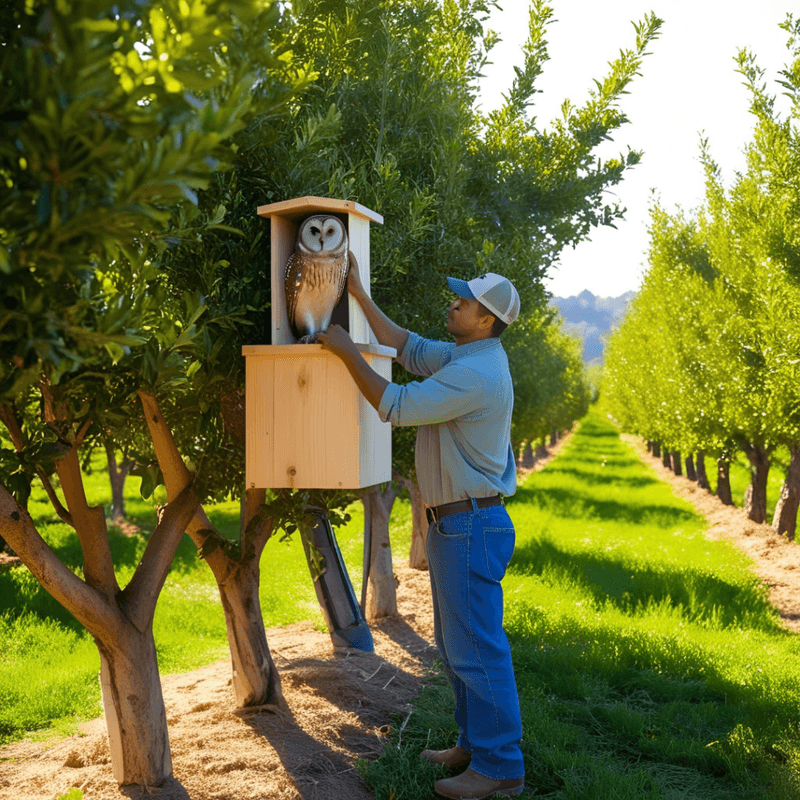
Once a box is up, the temptation to check on it regularly is understandable, but frequent inspections during the nesting season can cause owls to abandon eggs or young. The right approach is to schedule any cleaning, repair, or close inspection for a confirmed non-nesting window, which in California typically falls in late summer through fall after the breeding season has ended.
UC ANR’s guidance on barn owl box maintenance specifically recommends fall cleaning when owls are absent, and that timing should be treated as a firm rule rather than a suggestion.
Do not inspect chicks, handle owlets, remove eggs, or seal an occupied structure at any time of year. 16 U.S.C. Section 703, the Migratory Bird Treaty Act, prohibits taking, possessing, or destroying protected migratory birds, their nests, or their eggs without federal authorization.
Barn owls are covered by that law. Violating it carries real legal consequences, so if you are uncertain whether a box is currently occupied, contact your local California Department of Fish and Wildlife regional office or UC Cooperative Extension before doing anything.
Cleaning itself requires protective gear. Owl pellets, droppings, and nesting debris can harbor fungal spores, and dry sweeping or blowing out the box without protection is how people get exposed.
CDC/NIOSH guidance on personal protective equipment for Histoplasmosis prevention recommends wearing gloves and respiratory protection, and CDC’s Histoplasmosis prevention page advises wetting dusty material before handling it to reduce airborne particles. Avoid dry sweeping entirely.
For large accumulations of droppings, professional cleanup is the safer choice because disturbing heavily contaminated material can expose you to Histoplasma capsulatum, the fungus linked to histoplasmosis lung infection.
NestWatch’s barn owl nesting guidance also recommends adding a thin layer of wood shavings after cleaning to replace natural nesting material that owls would otherwise bring in. Keeping records of when the box was occupied, how many young fledged, and what prey remains you found gives you useful data over time and helps you decide whether the site is working or whether adjustments are needed.
Use the box as one part of a realistic pest-management plan
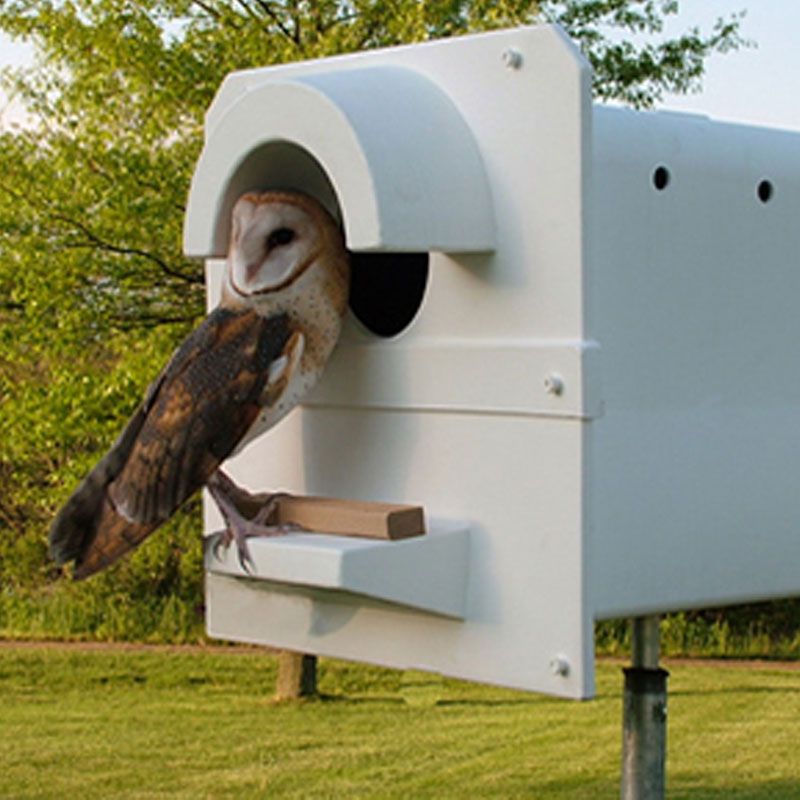
A barn owl nest box makes the most practical sense where several conditions line up: open hunting habitat nearby, a natural prey base, a safe mounting location away from heavy predator pressure, and a property owner willing to wait two to three years for possible occupancy. UC IPM’s integrated pest management approach frames barn owl boxes as one layer of a broader strategy, not a standalone solution, and that framing reflects what the California research actually supports.
The clearest possible benefit documented in California involves pocket-gopher activity in suitable open landscapes, particularly vineyards, under specific conditions. The Hansen and Johnson Napa vineyard study and the Moore, Van Vuren, and Ingels gopher-control evaluation both point to context-dependent effects rather than reliable yard-scale elimination.
Rat control in residential settings has not been established by the cited studies. California DPR’s biological pest management resource provides a grounded starting point for property owners who want to explore owl boxes within a compliant, wildlife-safe program.
Readers outside California should consult local wildlife agencies or university extension services before acting, because habitat suitability, prey species, nesting seasons, and applicable regulations all differ by region. The responsible first step anywhere is to identify the pest accurately and assess whether the site can realistically support owl nesting.
A well-sited, well-built box in suitable habitat is a genuine contribution to local wildlife and may reduce some rodent pressure over time. That is a worthwhile outcome, even if it is a quieter one than most pest-control promises.